
At the 2026 Biennale Matter of Art in Prague, Belarusian artist Rufina Bazlova installed a textile structure nearly seven meters high made from 681 embroidered portraits. Each portrait showed a political prisoner held by the Lukashenko regime. More than 800 people from 41 countries had stitched them using red thread on white linen, working from the traditional Belarusian folk embroidery vocabulary. The project, called #FramedInBelarus, is as politically urgent as anything shown in paint or video that year. The medium is needle and thread. The argument that embroidery is somehow less serious than other art forms does not survive contact with that installation.
Embroidery has been classified as a domestic skill for most of its history in Europe, and that classification was always more about gender politics than about any quality difference between embroidery and the arts that received institutional validation. The people who made Opus Anglicanum in medieval London, the finest needlework Europe had ever produced, worked in professional workshops with demanding technical standards. They were mostly unnamed. That omission says something about whose labor got recorded and whose did not.
This guide traces embroidery from its earliest surviving evidence through the medieval period, the feminist recovery of the 1970s, the major contemporary artists who have built significant careers around stitch, and the current moment in which embroidery is doing some of the most politically engaged work of any medium.
What Embroidery Actually Demands
Before the history, the technique deserves a clearer description than it usually gets. Embroidery is the stitching of thread onto an existing fabric ground to create surface imagery or decoration. The thread can be silk, wool, cotton, metallic, or synthetic. The stitches vary enormously: satin stitch covers an area with smooth parallel threads; long-and-short stitch creates tonal gradation by varying thread length; split stitch creates fine lines; French knots produce small raised dots; couching lays heavy thread on the surface and secures it with smaller stitches. Each stitch produces a different visual and textural effect, and the skilled embroiderer chooses and combines them with the same deliberateness that a painter chooses brushwork.
The fine silk embroideries of the Chinese Ming and Qing imperial courts, with threads of approximately 0.1 millimeters in diameter worked on silk grounds, required years of training to achieve the tonal gradations that made them indistinguishable at a distance from painting. The gold and silver couching of Opus Anglicanum required the management of metallic threads stiff enough to damage a standard needle, worked at such density that the finished surface caught light like a mosaic. These are not simple crafts. They are technically demanding practices that reward sustained study.
According to research by the Victoria and Albert Museum, the finest examples of Opus Anglicanum contain more than 50,000 stitches per square inch, worked in silk threads sometimes finer than a human hair. That level of labor and precision is not decoration. It is craftsmanship at a level that most other art forms do not approach.
The Bayeux Tapestry and Opus Anglicanum
The Bayeux Tapestry (c.1066-1077) is the most famous embroidery in existence and the most consistently misnamed: it is embroidered wool on linen, not a woven tapestry. At approximately 68 meters long and 50 centimeters tall, it depicts the events leading to the Norman Conquest of England in a continuous visual narrative that includes battle scenes, feasts, astronomical events, and the border fauna that frame the main action. It currently hangs in the Bayeux Museum in Normandy, a UNESCO Memory of the World inscription, and is one of the most important documents of 11th-century visual culture in any medium.
A section of the Bayeux Tapestry (c.1066-1077), showing mounted knights. Despite its name, this is embroidered wool on linen rather than woven tapestry. At approximately 68 metres in length, it is the longest narrative embroidery in the world. Image: Public domain, via Wikimedia Commons
Opus Anglicanum, produced from the late 11th through the early 14th centuries in professional London workshops, was the prestige art object of medieval Europe. Popes purchased it. Kings gave it as diplomatic gifts. It appears in papal inventories alongside goldsmiths' work and panel paintings. The technique combined raised goldwork, with metallic threads couched over padding to create three-dimensional relief, with fine silk split-stitch shading on faces and hands so precise that individual strands of hair were rendered stitch by stitch. The Pienza Cope, the Clare Chasuble, and the Butler-Bowdon Cope, all now in major museum collections, give some sense of the scale of this tradition's achievement.
Bess of Hardwick (1527-1608), one of the wealthiest women in Elizabethan England, embroidered extensively with her household, including the imprisoned Mary, Queen of Scots. A substantial body of work associated with her survives at Hardwick Hall in Derbyshire, now in the care of the National Trust. Those panels show embroidery functioning as both social practice and personal expression: large-scale narrative and emblematic work that required months of collaborative effort and resulted in objects of real formal power.
The Feminist Recovery of the 1970s
Judy Chicago's "The Dinner Party" (1974-79) positioned needlework within fine art in a way that was impossible to ignore. The large-scale triangular table setting with thirty-nine place settings honoring women in history incorporated elaborate embroidered runner cloths beneath each place setting, worked by a team of volunteers whose labor Chicago documented in the same way she documented her own ceramic work. The project was not arguing that embroidery was as good as painting. It was arguing that the distinction between the two was a product of whose labor got valued, not what the labor produced.
The Feminist Art program at CalArts, the Womanhouse project, and related initiatives of the same period approached domestic skills as sites of political meaning. Quilting, weaving, and embroidery were not presented as lesser alternatives to the fine arts but as media with specific histories, aesthetic possibilities, and cultural significance, whose classification as "craft" was a product of gender bias rather than any inherent quality difference. This argument is now widely accepted in art historical circles, though the market and institutional hierarchies have been slower to reflect it.
Tracey Emin and Ghada Amer
Tracey Emin (born 1963) began making large appliquéd blankets in the early 1990s, stitching personal text onto fabric in forms that directly referenced the sampler tradition, the domestic needlework form in which young women practiced stitches while producing improving moral texts. Emin's versions contain raw, confessional, sexually explicit, and emotionally vulnerable text. The tension between the domestic form, with its associations of patience and propriety, and the content, which refuses both, is the engine of the work. Emin is now a Royal Academician and one of Britain's most prominent artists. Her embroidered and appliquéd works are in major museum collections internationally.
Ghada Amer (born 1963 in Egypt, based in New York) uses embroidery thread on canvas to create works that read at a distance as abstract paintings: dense, looping color fields applied over acrylic grounds. Close up, the threads resolve into outlines of women from pornographic magazines, figures whose postures and gestures become legible only at close range. The formal strategy is specific: Amer exploits the domestic associations of needlework to smuggle transgressive content past the viewer's initial defenses. The work is simultaneously a painting, an embroidery, and a critique of how women's images and women's labor are both consumed without acknowledgment.
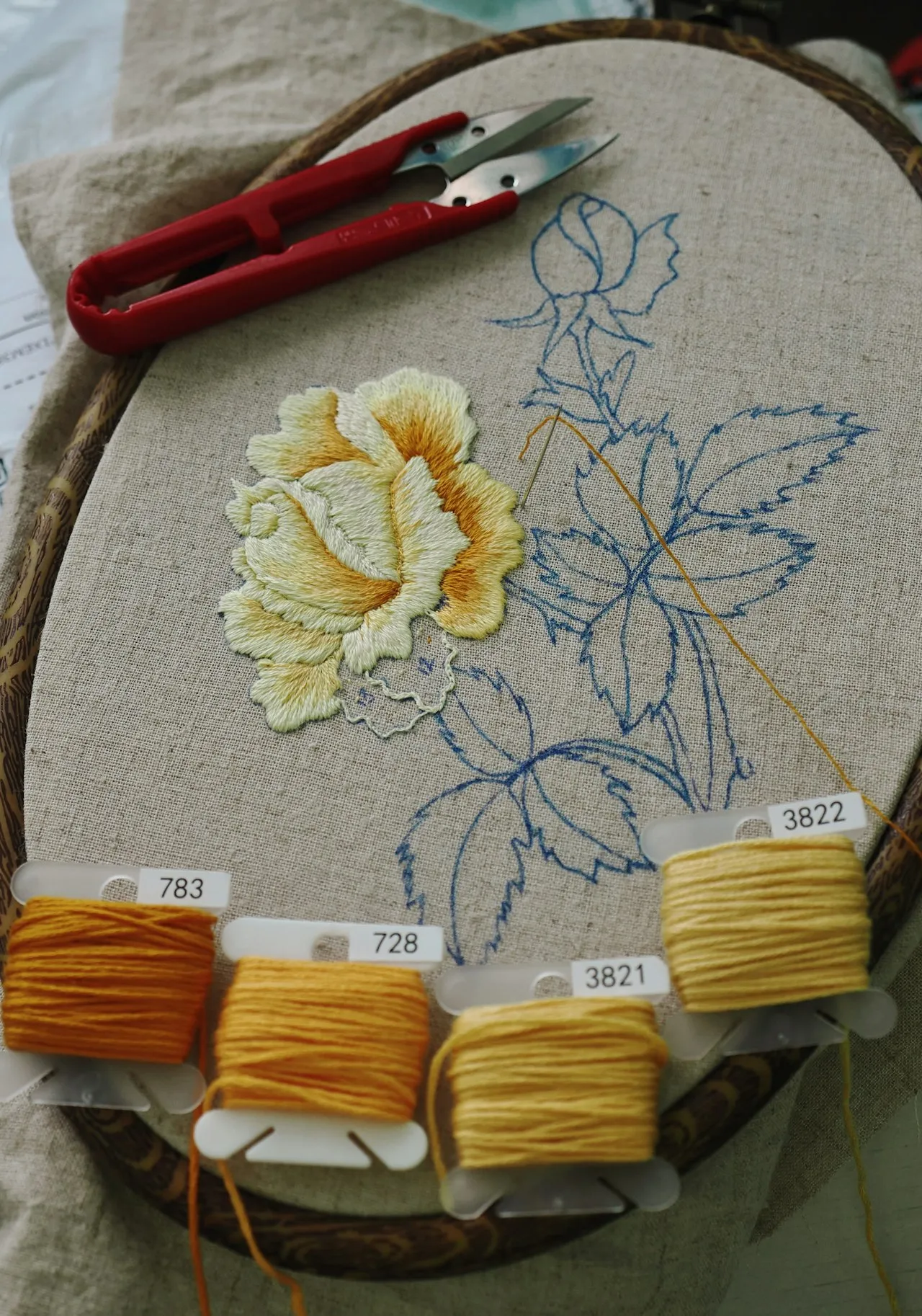
Hand embroidery showing roses worked in satin and long-and-short stitch. These fundamental techniques, developed in Chinese court embroidery and transmitted globally through trade and instruction, are the foundation of both domestic needlework and fine art embroidery. Photo: Unsplash
Embroidery as Political Language in 2026
What is happening with embroidery right now is genuinely interesting. The medium has become one of the most active sites for politically engaged art in the current moment, partly because its labor-intensive slowness operates as a form of resistance to the speed of digital image culture, and partly because its associations with collective practice make it suitable for projects that require participation across communities.
Rufina Bazlova's #FramedInBelarus, described above, is the most striking current example: a project in which the slow, meditative act of stitching a single portrait becomes an act of political witness, scaled through global participation into something that is both archive and protest. The 681 embroidered portraits installed at the 2026 Biennale Matter of Art in Prague represent more than 4,300 political prisoners recognized by human rights organizations in Belarus. The stitch count functions as testimony.
In London in March 2026, the exhibition "The Awakening of Embroidery" at the Royal Geographical Society brought together a decade of collaboration between contemporary artist Wu Jian'an and Suzhou embroidery masters Yao Huifen and Yao Huiqin. The exhibition, the first UK show dedicated to Chinese Suzhou embroidery in a contemporary art context, explored what happens when embroidery is treated as "an autonomous artistic language" rather than a technique for representing pre-existing images. The 58 works on view included pieces where embroidery grows without a predetermined image, the stitch itself determining the form, which is formally equivalent to what abstract painters have been claiming for paint since the 1940s.
Polish-Ukrainian artist Natasza Niedziółka, who exhibited at Sean Kelly Gallery in New York in 2024, uses hand-stitched thread on linen and silk to create works that reference Agnes Martin's grids while incorporating text from protest songs across history, from a 1914 Ukrainian folk song to a 2020 solidarity anthem. Each word is embroidered with reclaimed Italian silk. The result is a practice that connects the formal concerns of late modernist painting with the political urgency of the present moment, using a medium that no gallery would have taken seriously before the 1970s.
Getting Started with Embroidery
Embroidery is one of the most accessible entry points into making art. A basic starter kit, including a hoop, needles, stranded cotton thread, and even-weave fabric, costs very little and allows you to learn the fundamental stitches (running stitch, backstitch, satin stitch, French knot, chain stitch) that underlie most practice. Free instruction is widely available through YouTube, library books, and embroidery society websites.
For more structured learning, the Royal School of Needlework at Hampton Court Palace offers courses at every level from beginner to conservation-standard repair, and their online courses since 2020 have made professional-grade instruction globally accessible. The Embroiderers' Guild in the UK and the Embroidery Guild of America connect practitioners with communities, classes, and exhibitions. If you want to see the highest-level historical embroidery in person, the Victoria and Albert Museum in London holds the most significant collection of Opus Anglicanum in the world.
For the broader context of textile art, the textile art guide covers weaving and fiber art. For how craft entered the gallery system more broadly, the ceramics guide traces a parallel journey. And for the political art context in which contemporary embroidery is doing some of its most significant work, the guide to art and politics covers how political context shapes what art gets made and what gets remembered.


