
Why does your eye go straight to the pearl earring in Vermeer's famous portrait, even though the girl's face takes up far more space? Why does "The Last Supper" feel so perfectly balanced, even though thirteen figures are crammed into a single room? Why does Degas's off-center ballet dancers feel dynamic rather than awkward? The answer to all three questions is the same. Composition.
Composition is how an artist arranges visual elements within the frame of a painting, photograph, or any other two-dimensional work. It is the invisible architecture that determines where your eye goes first, how it moves through the image, and what emotional response the work triggers. A painting with brilliant color and masterful brushwork can still feel "off" if the composition does not work. Conversely, a simple sketch with strong composition can be more compelling than a technically perfect painting with a weak one.
This guide breaks down the key principles of composition that artists have used for centuries. Understanding these principles will help you appreciate paintings more deeply and sharpen your eye for photography, graphic design, film, and any other visual medium.
What Is Composition and Why Does It Matter?
At its most basic, composition answers the question: where do I put things? Every time an artist picks up a brush, they face decisions about placement. Should the figure be centered or off to one side? Should the horizon line be high or low? Should the space feel crowded or empty? These choices are not arbitrary. They directly control how the viewer experiences the work.
Good composition does three things simultaneously. It guides the viewer's eye, creating a visual path through the painting so the viewer sees the most important elements first and then explores the rest in a logical order. It creates visual balance, distributing visual weight across the canvas so the painting feels stable (or deliberately unstable, if that is the artist's intent). And it supports the emotional content. A symmetrical composition feels formal and stable. An asymmetrical one feels dynamic and energetic. The composition reinforces the painting's meaning.
Artists do not always plan composition consciously. Many develop an intuitive sense of arrangement through years of practice. But the underlying principles are consistent across centuries and cultures. Leonardo da Vinci, Hokusai, Vermeer, and Mondrian all worked with the same fundamental toolkit, even though their paintings look nothing alike.
The Focal Point: Where the Eye Lands First
Every strong composition has a focal point. The area that grabs the viewer's attention first. This is the visual anchor of the painting, the element that everything else supports. Artists create focal points through several techniques.
Contrast
The area of highest contrast, where the lightest light meets the darkest dark, naturally attracts the eye. Rembrandt was the undisputed master of this technique. In "The Night Watch" (1642), Captain Frans Banning Cocq and Lieutenant Willem van Ruytenburch are illuminated by a shaft of golden light while the surrounding militia members recede into shadow. Your eye cannot help but land on those two bright figures first.
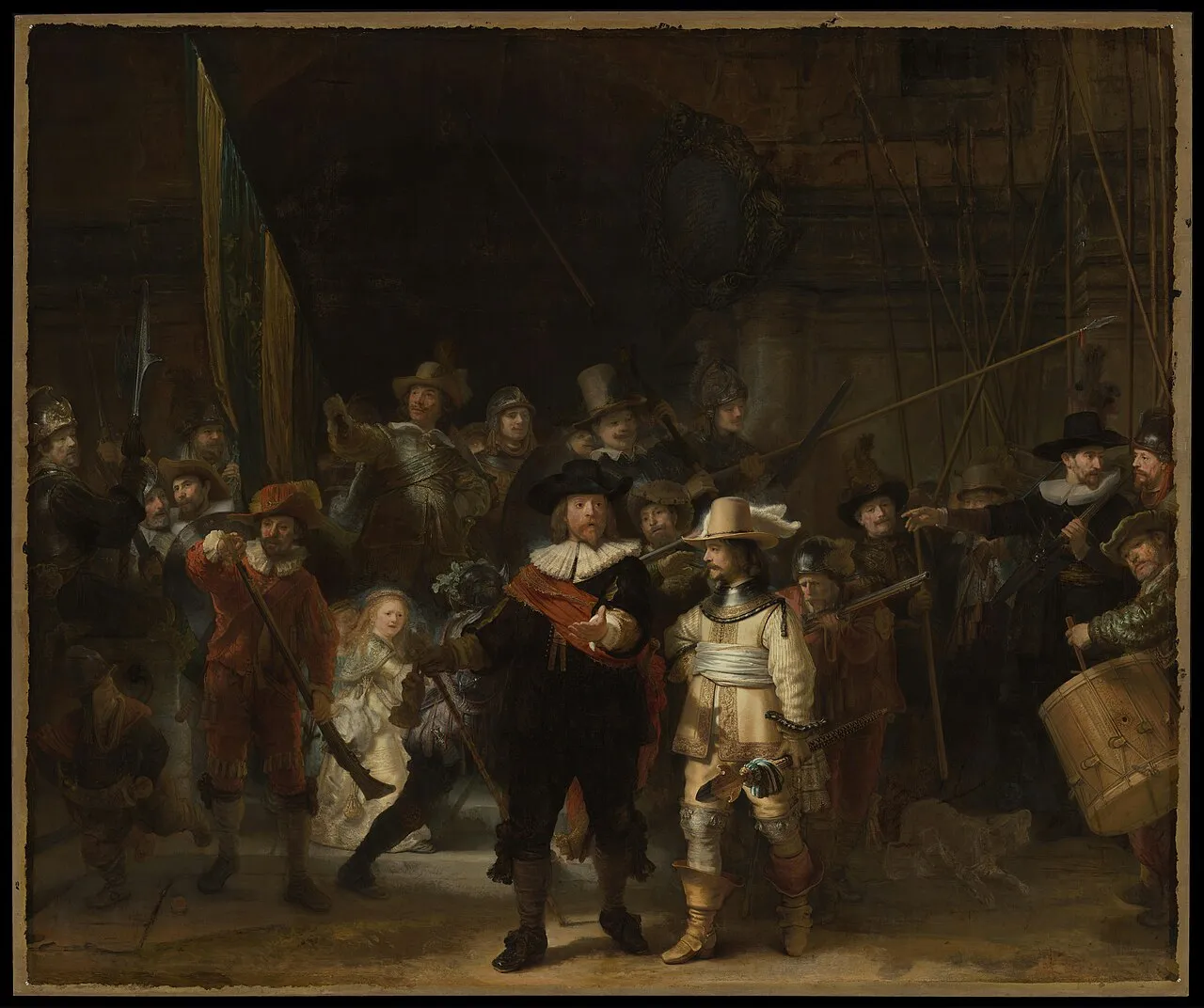
Rembrandt van Rijn, "The Night Watch" (1642), oil on canvas, 363 x 437 cm. Rijksmuseum, Amsterdam. Rembrandt uses dramatic light contrast to create an unmistakable focal point. Image: Public domain, via Wikimedia Commons
Color
A spot of saturated color against a muted background acts like a visual magnet. In Vermeer's "Girl with a Pearl Earring" (c. 1665), the luminous pearl and the bright blue turban pop against the dark, nearly black background. The warm-cool color contrast between the girl's skin and the blue turban further strengthens the focal point.
Convergence
When multiple lines or shapes point toward the same area, they create a focal point through convergence. Leonardo da Vinci's "The Last Supper" (1495 to 1498) is the textbook example. The ceiling beams, the edges of the tapestries, and even the arrangement of the apostles' hands all converge on Christ's head at the center of the composition. Every line in the painting leads your eye to the same place.
What Eye-Tracking Research Tells Us About Composition
The principles artists developed through intuition and practice have been confirmed and refined by scientific research. Eye-tracking studies, which use infrared cameras to record exactly where a viewer looks and for how long, have provided empirical data on how composition controls attention.
A 2024 study published in Frontiers in Psychology used eye-tracking to compare how viewers scanned paintings with different compositional structures. The researchers found that paintings with clear focal points produced consistent viewing patterns across different observers. Most viewers looked at the focal point first, then followed leading lines outward. Paintings without clear focal points produced scattered, inconsistent gaze patterns, and viewers reported finding them less engaging. The study confirmed what artists have known for centuries: without a focal point, the eye has nowhere to land, and the painting feels incoherent.
A 2025 study in Psychology of Aesthetics, Creativity, and the Arts examined the role of the rule of thirds in aesthetic preference. Researchers presented participants with photographs and paintings in their original compositions and in versions where the main subject had been digitally moved to the center. The off-center compositions were consistently rated as more dynamic and aesthetically pleasing, but only when the surrounding negative space was balanced. Moving a subject off-center without balancing the negative space produced compositions that felt awkward rather than dynamic. The study suggests that the rule of thirds works not simply because off-center placement is inherently better but because it forces the artist to engage with negative space as a compositional element.
Research on the golden ratio remains more contested. A 2024 review in Empirical Studies of the Arts surveyed decades of studies on golden-ratio preference and found that the evidence for a universal human preference for the 1:1.618 proportion is weak. Some studies show a preference; others show none. The review concluded that the golden ratio's effectiveness in art may have more to do with its relationship to balanced proportions generally than with any specific mathematical ratio. Artists who use it are making a sound compositional choice, but not because the ratio has unique perceptual power.
The Rule of Thirds: Off-Center Power
The rule of thirds is perhaps the most widely known compositional guideline. Imagine dividing the canvas into a 3x3 grid with two horizontal and two vertical lines. The rule suggests that placing key elements along these lines, and especially at the four points where they intersect, creates a more dynamic and visually pleasing composition than centering everything.
This principle has roots in the Golden Ratio (approximately 1:1.618), a mathematical proportion that appears throughout nature and has been used in art and architecture since antiquity. The rule of thirds is a simplified approximation of the Golden Ratio that is easier to apply in practice.
You can see the rule of thirds at work in countless masterpieces. In Vermeer's "The Milkmaid" (c. 1658), the woman's figure is positioned along the left third of the canvas, with the stream of milk falling near a lower intersection point. The right two-thirds of the painting is mostly empty wall and table, but this "empty" space is essential. It gives the composition room to breathe and makes the figure feel more natural than if she were centered.
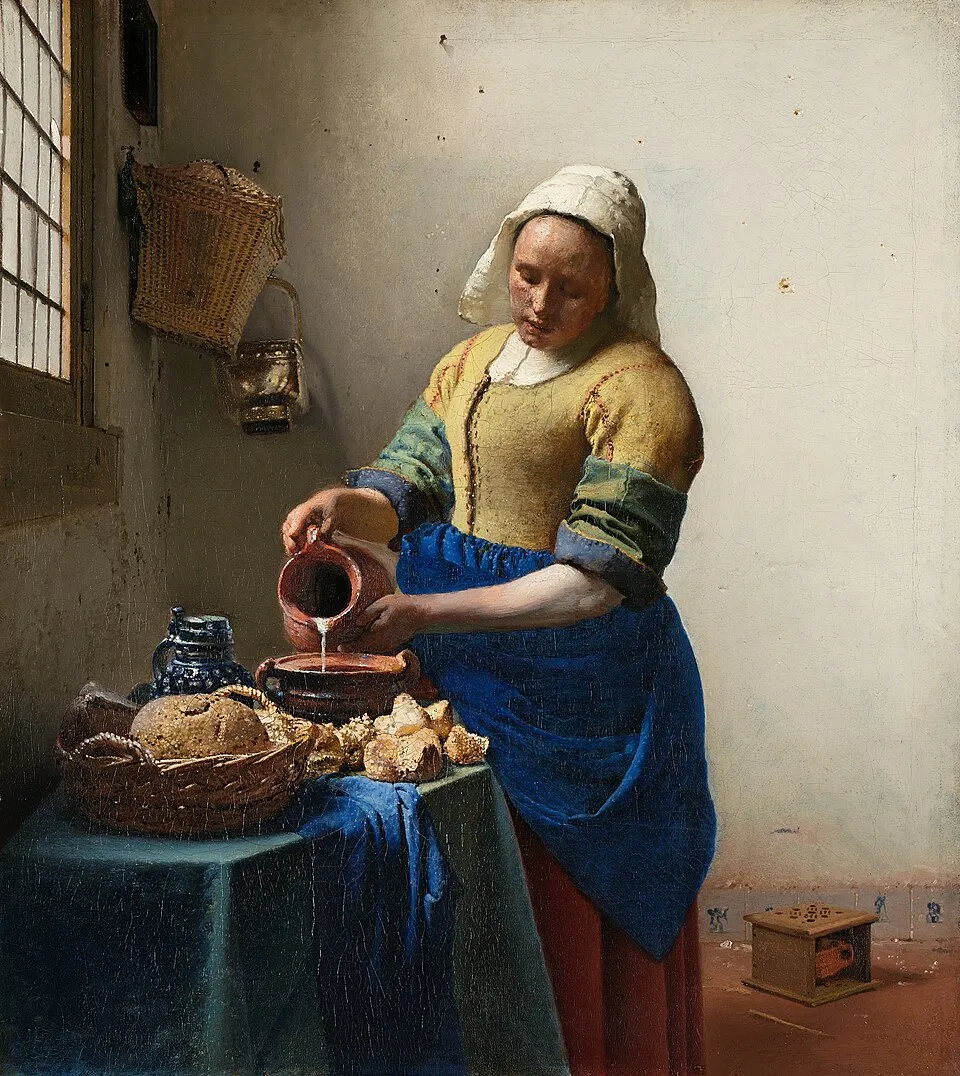
Johannes Vermeer, "The Milkmaid" (c. 1658), oil on canvas, 45.5 x 41 cm. Rijksmuseum, Amsterdam. The figure is placed along the left third, with the stream of milk near a key intersection point. Image: Public domain, via Wikimedia Commons
When to Break the Rule
The rule of thirds is a guideline, not a law. Centered compositions can be extremely powerful when used deliberately. Byzantine icons, Warhol's screen prints, and many of Frida Kahlo's self-portraits place the subject dead center, creating a sense of confrontation, formality, or iconic presence. The key is intentionality. Centering a subject should be a conscious choice, not a default.
Balance: Symmetrical vs. Asymmetrical
Visual balance refers to how visual weight is distributed across the composition. There are two main types.
Symmetrical Balance
Symmetrical balance means the left and right halves of the composition mirror each other (or nearly so). This creates a sense of formality, stability, order, and sometimes grandeur. Religious art frequently uses symmetrical composition to convey divine order. Think of Raphael's "The School of Athens" (1509 to 1511), where the architectural space is perfectly symmetrical and the two central figures (Plato and Aristotle) are framed by a grand archway at the exact center.
Asymmetrical Balance
Asymmetrical balance distributes visual weight unevenly but still achieves equilibrium. A large, dark shape on one side might be balanced by several smaller, brighter shapes on the other. Asymmetrical compositions feel more dynamic, natural, and contemporary than symmetrical ones.
Edgar Degas was a master of asymmetrical composition. His ballet paintings frequently place dancers at the extreme edges of the canvas, with large areas of empty floor space dominating the center. In "The Ballet Class" (1871 to 1874), the ballet master stands near the right edge while dancers cluster at the left, with a vast expanse of wooden floor between them. This unconventional arrangement was influenced by Japanese woodblock prints and early photography, both of which favored off-center compositions and cropped figures.
Leading Lines and Visual Pathways
Leading lines are lines within the composition, real or implied, that guide the viewer's eye through the painting. They can be literal (a road, a river, a fence) or implied (the direction a figure is looking, the alignment of several objects).
Canaletto's Venice paintings are textbook examples of leading lines. In "The Grand Canal and the Church of the Salute" (c. 1730), the canal itself acts as a massive leading line, drawing the eye from the foreground boats deep into the picture space toward the domed church in the background. The rows of buildings on either side reinforce this directional pull.
Leading lines do not have to be straight. In Hokusai's "The Great Wave off Kanagawa" (c. 1831), the curving wave creates a powerful diagonal line that sweeps from the lower left to the upper right, framing Mount Fuji in the negative space beneath the crest. The composition is dynamic precisely because the leading line is a curve rather than a straight path.
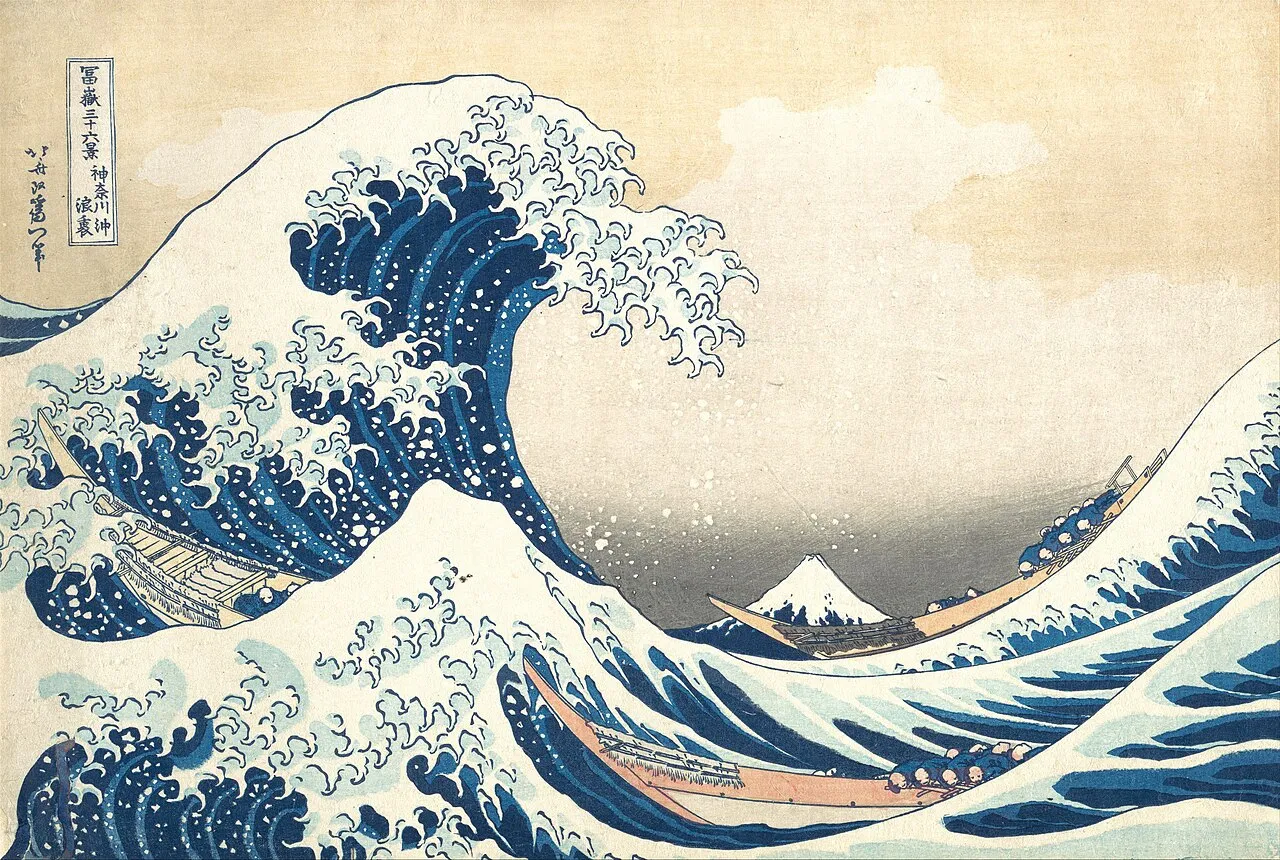
Katsushika Hokusai, "The Great Wave off Kanagawa" (c. 1831), woodblock print, 25.7 x 37.9 cm. One of the most famous compositions in art history, using the curve of the wave as a powerful leading line. Image: Public domain, via Wikimedia Commons
Negative Space: The Power of Emptiness
Negative space is the area around and between the subjects of a painting. Beginning artists often focus entirely on the positive space (the objects themselves) and neglect the shapes created by the empty areas. But skilled artists know that negative space is just as important as positive space. Sometimes more so.
Andrew Wyeth's "Christina's World" (1948) is a masterclass in negative space. The figure of Christina crawls across a vast, empty field that occupies roughly three-quarters of the canvas. The farmhouse and barn sit small and distant at the top of the hill. All that empty grass creates a palpable sense of distance, isolation, and longing. Without the negative space, the painting would lose its emotional power entirely.
In East Asian painting, negative space has been valued for centuries. Chinese and Japanese scroll paintings often leave large areas of bare silk or paper, using emptiness to suggest mist, distance, or spiritual openness. The concept of ma in Japanese aesthetics refers to the meaningful pause or gap. The space between things that gives them definition. For a deeper exploration of this topic, see our post on how artists use positive and negative space.
Diagonal Composition and Dynamic Energy
Horizontal lines suggest calm and stability. Vertical lines suggest strength and formality. But diagonal lines create energy, movement, and tension. Artists use diagonal composition when they want a painting to feel dynamic rather than static.
Eugene Delacroix's "Liberty Leading the People" (1830) is built on a powerful diagonal that rises from the fallen bodies in the lower right to the figure of Liberty holding the tricolor flag in the upper left. This upward diagonal creates a sense of forward momentum and triumph. The composition itself embodies the revolutionary energy of the subject.
Caravaggio frequently used diagonal compositions to create dramatic tension. In "The Conversion of Saint Paul" (1601), the fallen saint lies diagonally across the canvas with his arms outstretched, while the horse looms above him. The strong diagonal creates a sense of sudden, violent disruption. Perfect for depicting a moment of divine intervention.
How to Analyze Composition in Any Painting
Here is a practical checklist you can use the next time you stand in front of a painting:
Find the focal point. Where does your eye land first? What technique did the artist use to draw you there (contrast, color, convergence)?
Trace the visual path. After the focal point, where does your eye go next? Can you identify leading lines or directional cues?
Check the balance. Is the composition symmetrical or asymmetrical? Does it feel stable or dynamic?
Look at the negative space. What role do the empty areas play? Do they create breathing room, isolation, or tension?
Identify the dominant lines. Are they horizontal (calm), vertical (strong), or diagonal (dynamic)?
Consider the framing. How close or far is the viewpoint? Are figures cropped at the edges or fully contained within the frame?
With practice, this analysis becomes second nature. You will start noticing compositional choices not just in paintings but in photographs, films, advertisements, and even the way furniture is arranged in a well-designed room.
Final Thoughts
Composition is the silent language of visual art. While color and brushwork grab your attention, composition is what holds it. It guides your eye, creates emotional resonance, and gives the painting its underlying structure. The greatest artists in history understood that a painting is not just a collection of beautiful details but an organized whole, where every element supports every other element.
Next time you visit a gallery, try squinting at a painting until the details blur and only the big shapes remain. That simplified view reveals the composition in its purest form, and often explains why a painting works (or does not). For more on the building blocks of visual art, explore our guide to the essential art toolkit, or learn about color theory for art appreciation. For how composition relates to the broader question of what makes art moving, see our post on the neuroscience of aesthetic experience.


