
Look at Monet's "Impression, Sunrise" (1872) and your eye goes directly to the orange sun. It is a small mark, maybe a centimeter across in the original 48 x 63 cm canvas, floating in a sea of blue-gray water and mist. The sun is not the largest element. It is not the most technically complicated. It dominates the painting because orange and blue are complementary colors, and when they sit next to each other at different saturations, the eye treats the warm color as radiating forward. Monet understood exactly what he was doing. The small mark is not small at all.
This is color theory in practice, and it is more useful for looking at painting than almost any other knowledge you can bring to a museum. Color is the primary tool painters have for directing attention, creating the illusion of depth, suggesting mood, and organizing a composition. Artists have studied and used these effects deliberately for centuries. You do not need to be a painter to understand them. You just need to know what to look for.
This guide covers the color wheel, warm and cool contrast, complementary relationships, the role of value and saturation, and how to actively read color in any painting from any period. By the end, you will have a practical framework you can use the next time you stand in front of work you have never seen before.
The Color Wheel and What It Actually Tells You
The color wheel is a circular diagram that maps the relationships between colors. The version most useful for understanding painting is the RYB (Red-Yellow-Blue) wheel, based on subtractive pigment mixing: combining paint colors absorbs light rather than adding it, and the wheel maps which combinations produce which results.
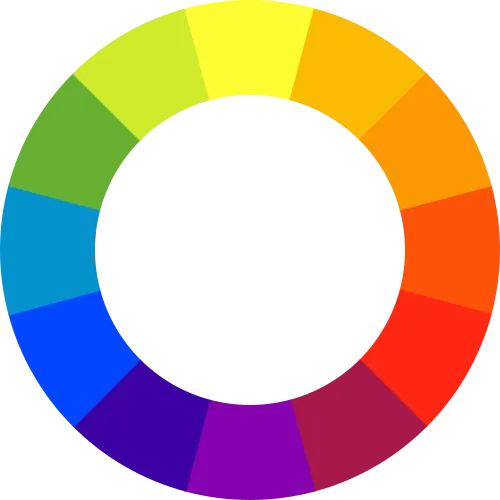
The traditional RYB color wheel used in painting and art education. Complementary pairs sit directly opposite each other across the wheel. Image: Public domain, via Wikimedia Commons
The wheel organizes colors into three layers. Primary colors (red, yellow, blue) cannot be mixed from other pigments. Secondary colors (orange, green, violet) are each made from two primaries. Tertiary colors (red-orange, yellow-orange, yellow-green, blue-green, blue-violet, red-violet) come from mixing a primary with an adjacent secondary. The wheel's real value is not in these categories. It is in the spatial relationships it reveals: colors opposite each other contrast most strongly, colors adjacent to each other harmonize, and the diagonal line from warm to cool runs straight through the wheel's center.
Warm Colors and Cool Colors: The Most Useful Distinction
The warm-cool divide is the single most practically useful concept in color theory for looking at painting, because it explains how artists create the illusion of depth, model three-dimensional form, and control the emotional temperature of an image without changing anything else.
Warm colors (reds, oranges, yellows) appear to advance visually, coming forward toward the viewer. Cool colors (blues, greens, violets) appear to recede. This is a property of how the human visual system processes different wavelengths: warmer wavelengths are slightly longer and the eye focuses them marginally closer than cooler, shorter wavelengths. The perceptual effect is real and consistent enough that artists have used it as a spatial tool since the Renaissance.
Leonardo da Vinci was among the first to describe atmospheric perspective systematically: distant mountains appear bluer and hazier than nearby objects because the atmosphere scatters blue light between the viewer and the far distance. In the background of the "Mona Lisa" (c. 1503-1519), you can trace this effect clearly. The landscape shifts from warm brownish earth tones in the foreground to cool violet-blue at the horizon. The painting appears to extend kilometers behind the figure because warm and cool temperature shift at the right rate.
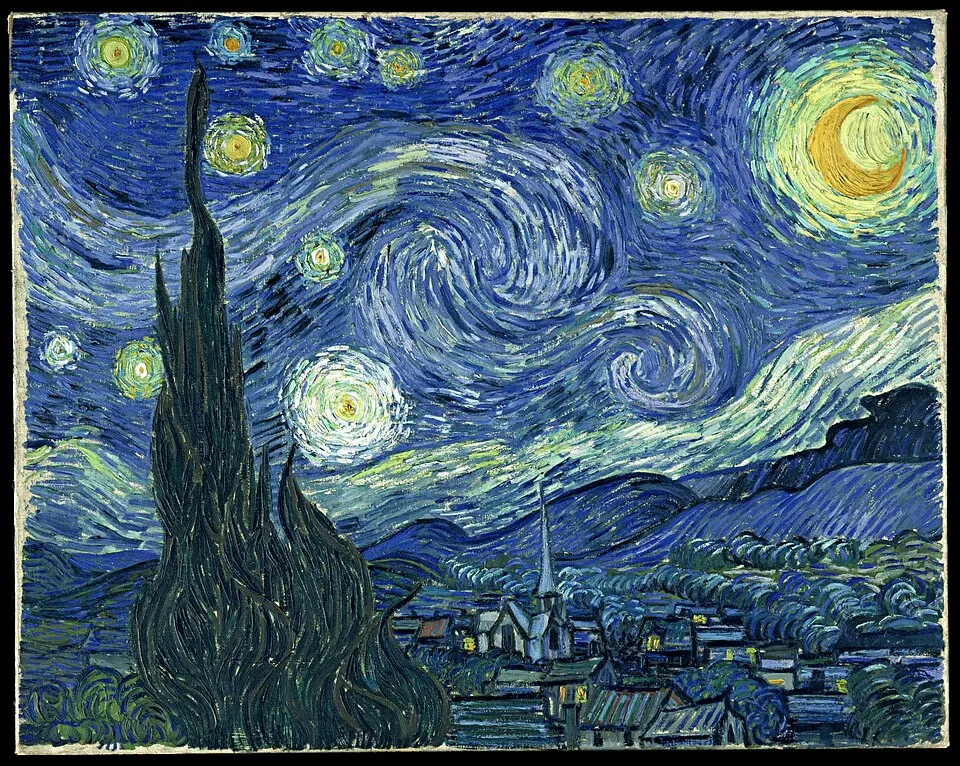
Vincent van Gogh, "Starry Night Over the Rhône" (1888), oil on canvas, 72.5 x 92 cm. Musée d'Orsay, Paris. Warm yellow stars and gas lamps against the cool blue night water: the contrast pulls the light sources forward and pushes the sky back, creating spatial depth through temperature alone. Image: Public domain, via Wikimedia Commons
Warm and Cool in Portraits
Portrait painters use temperature to model the human face without relying purely on light and dark. The forehead and cheekbones catch the most light and are painted in warmer tones. The eye sockets, under the chin, and the sides of the nose are in shadow and receive cooler colors. Vermeer understood this better than almost anyone. In "Girl with a Pearl Earring" (c. 1665), the subtle shift from the warm lit side of the face to the cooler shadow side is what makes the skin look like skin rather than paint. It is not visible at a glance, but your eye reads it as three-dimensional form before you consciously register the technical method.
Monet's Haystacks series (1890-1891) is worth looking at for this reason. The same haystacks appear warm gold in summer noon light and cool violet in winter shadow. Nothing has changed except the color temperature, and it is enough to completely transform the emotional quality of each painting.
Complementary Colors: Why Contrast Works
Colors directly opposite each other on the color wheel are complementary. The three primary pairs in painting are red and green, blue and orange, yellow and violet. When placed side by side, each makes the other appear more saturated. This is not convention. It is a documented property of human visual perception: the opponent-process theory of color vision, confirmed by neurological research, explains that the visual system processes color in opponent channels (red versus green, blue versus yellow), and adjacent complementary stimuli activate those channels simultaneously, exaggerating the difference between them.
The French chemist Michel Eugène Chevreul documented this phenomenon in his 1839 book "De la loi du contraste simultané des couleurs" (The Law of Simultaneous Color Contrast). His work was read directly by the Impressionists and Post-Impressionists and fundamentally shaped how they used color. The full text is available through the Bibliothèque nationale de France's digital archive.
Van Gogh and Vermeer: Two Approaches to the Same Principle
Van Gogh was explicit about his use of complementary contrast. In a letter to his brother Theo about "The Night Café" (1888), he wrote: "I have tried to express the terrible passions of humanity by means of red and green." The painting is extremely uncomfortable to spend time in. The red and green clash at high, near-equal saturation, and the room feels wrong in a way that is hard to articulate before you understand what he did technically.
Vermeer did the opposite with the same pair of colors. In "Girl with a Pearl Earring" (c. 1665), the blue-green turban sits against the warm skin tones in a complementary relationship, but both colors are carefully desaturated and the contrast is modulated. The result is luminous rather than jarring. Same principle, completely different emotional outcome, all driven by changes in saturation and value. This is why color theory is more useful than color rules: the principles explain the mechanism, but applying them requires judgment about context.
Analogous Colors: Harmony Over Contrast
Analogous colors sit next to each other on the wheel and share underlying hues, which is why combinations like blue, blue-green, and green, or red, red-orange, and orange feel harmonious rather than tense. They are not competing for attention in the way complementaries are.
Monet's late Water Lily paintings use analogous relationships extensively. Many of them work almost entirely within a blue-green-violet range, with only small touches of warm pink or yellow for relief. The effect is immersive calm. Your eye is not pulled between competing poles. It floats across the surface the same way it would float across a real pond on a still day.
Mark Rothko's color field paintings work from the same principle. "No. 61 (Rust and Blue)" (1953) places warm rust and burnt orange against each other in soft-edged rectangles. The colors breathe together rather than competing. The meditative quality Rothko's paintings are known for comes directly from this analogous structure. He chose colors carefully and then made them big enough to fill your peripheral vision, so the harmonic relationship is all you perceive.
Value and Saturation: The Two Things People Forget
Color has three properties: hue (what color), value (how light or dark), and saturation (how intense). Most people pay attention to hue and not much else, which is why so many paintings and design projects look wrong even when the chosen colors seem right in theory.
Value is more important than hue for creating readable compositions. If you photograph any well-designed painting in black and white, it should still work: the light and dark patterns should guide your eye through the image even without color. Rembrandt's chiaroscuro technique uses dramatic value contrast (deep shadow against bright highlight) to create both three-dimensional form and a directed focal point. In "The Night Watch" (1642), the central figures are bathed in golden light while the crowd around them recedes into shadow. The eye goes to the light. The color matters, but the value structure is what organizes the painting.
Saturation is the tool for creating emphasis. A single spot of fully saturated color in an otherwise muted painting will draw the eye immediately. The Fauves understood this. Matisse's "Woman with a Hat" (1905), shown at the 1905 Salon d'Automne, painted his wife's face in stripes of vivid green, violet, and orange at near-maximum saturation. The painting was not trying to describe how she looked. It was using maximum saturation as emotional directness, following where Van Gogh and Gauguin had pointed.
How to Read Color in a Painting
Here is a practical five-step framework for the next time you stand in front of something unfamiliar:
Find the dominant color: what hue covers the most area? This sets the baseline mood of the whole image.
Find the accent: what color breaks from the dominant? This is almost always where the artist wants your attention first.
Check the temperature: is the painting overall warm or cool, and does that temperature shift across the canvas to create depth or direct the eye?
Read the value range: high contrast between light and dark creates drama; close-value paintings create calm or ambiguity.
Look at the shadows: are they black-brown (academic convention) or colored (Impressionist observation)? Colored shadows in violet, blue, or green are a reliable sign the artist understood how light actually falls.
Try this with a Vermeer, then a Monet, then a Rothko. The framework is the same across all three, and noticing what each artist prioritizes tells you something about their whole approach to painting.
What Color Teaches You About a Painter
Color choices are not decoration. They are decisions that reveal what a painter cared about and what they understood. Van Gogh's yellows in "The Bedroom" (1888) radiate anxiety despite the domestic subject because he used warm yellows at high saturation against violet walls, exactly the combination Chevreul would predict would vibrate most intensely. Picasso's Blue Period (1901-1904) is not sad because the subject matter is sad. It is sad because monochromatic cool blue suppresses all the visual tension that warm-cool contrast would create, producing a flatness that reads as grief or exhaustion.
Once you start reading color this way, paintings that seemed opaque become transparent. The emotional quality you feel is not vague or mysterious. It is the predictable result of specific technical choices. For the practical side of how these color relationships work when you are actually mixing paint, the guide to color mixing basics covers the mechanics in detail. For a broader look at the visual elements that organize any painting, explore the essential art toolkit, and for how to start applying this kind of active looking in any museum, see how to look at art as a beginner. Which painting have you looked at differently after learning something about color? Share it in the comments.


