
William Morris (1834-1896) wrote: "Have nothing in your houses that you do not know to be useful or believe to be beautiful." He wrote this in 1880, at the peak of the Industrial Revolution, when factory-produced goods were flooding British homes with cheap, ornate, poorly made furniture, wallpaper, and textiles. Morris believed that the objects people lived with shaped their inner lives, and that surrounding them with ugly, soulless products was a form of degradation. The movement he helped found, the Arts and Crafts Movement, was a rebellion against the industrialization of beauty.
The movement's argument was simple: things should be made by hand, by skilled craftspeople, in conditions that allow them to take pride in their work. The factory system, which reduced workers to operators of machines and reduced objects to commodities, was morally and aesthetically bankrupt. This was not a nostalgic retreat to the Middle Ages, though Morris was deeply influenced by medieval art and guild structures. It was a political argument about the relationship between labor, beauty, and human dignity.
This guide covers the origins in Ruskin's criticism, Morris's career as designer and printer, the movement's spread to America and Europe, and the contradictions that the William Morris Gallery's 2025 exhibition "Morris Mania" (April 5 to September 21, 2025) laid bare with unusual honesty.
John Ruskin and the Moral Argument Against Industrial Production
John Ruskin (1819-1900) was the intellectual ancestor of the Arts and Crafts Movement. He was an art critic, not a maker, but his writing gave the movement its theoretical foundation. In "The Stones of Venice" (1851-53), Ruskin devoted a chapter called "The Nature of Gothic" to an argument about labor that Morris later called "one of the only things I ever learned from a book." Ruskin argued that Gothic architecture was beautiful because it was made by craftspeople who were free to make creative decisions, even imperfect ones. Industrial production, by contrast, divided labor into tiny repetitive tasks that allowed no creative input from the worker. The result was objects that were technically precise but spiritually dead, and workers who were treated as extensions of machines.
Ruskin's argument was moral, not just aesthetic. He believed that a society that treats its workers as machines produces art that reflects that treatment. The ornate, mass-produced wallpaper and furniture of Victorian Britain were not just ugly. They were evidence of a system that had broken the connection between the maker and the made. This idea became the core of the Arts and Crafts Movement's philosophy.
William Morris and the Firm
Morris met Edward Burne-Jones at Oxford in 1853, when both were undergraduates. They planned to become clergymen. Instead, after reading Ruskin and discovering the Pre-Raphaelite Brotherhood, they decided to become artists. Morris founded Morris, Marshall, Faulkner & Co. in 1861 with Burne-Jones, Dante Gabriel Rossetti, Ford Madox Brown, and Philip Webb. The firm produced furniture, stained glass, textiles, and wallpaper designed by artists and made by hand.
Morris's wallpaper designs are his most widely recognized work. "Trellis" (1862), his first wallpaper pattern, shows a garden trellis with roses and birds. "Willow Bough" (1887) and "Strawberry Thief" (1883) are among his most reproduced designs. The patterns are dense, symmetrical, and drawn from direct observation of plants. Morris studied plants in his garden at Kelmscott Manor and drew them repeatedly before carving the woodblocks used for printing. Each color in a Morris wallpaper required a separate woodblock, precisely aligned, printed by hand. A complex pattern could require six or more blocks.
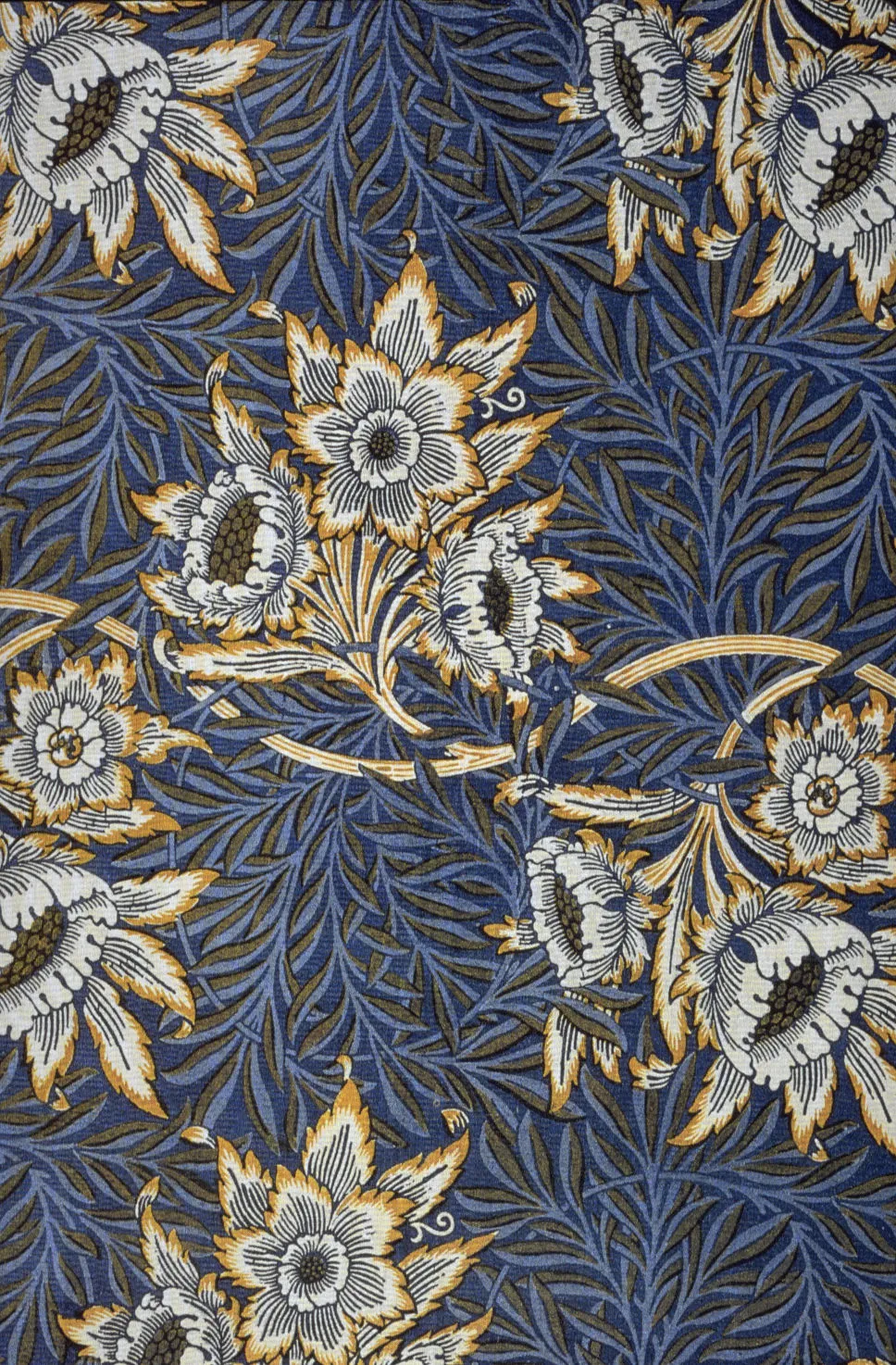
William Morris, "Tulip and Willow" (1873). Wallpaper design. Wikimedia Commons.
The contradiction at the heart of Morris's enterprise was obvious from the start. Handmade wallpaper printed with six woodblocks is expensive. Morris's designs were affordable only to the wealthy, the same industrialists and bourgeoisie whose factory system he condemned. He was a socialist who sold luxury goods. He knew this and wrote about it with frustration. "If I were to live ten years," he wrote in 1885, "I think I should see the time when people would not be so foolish as to pay me 30s a yard for their wallpaper." He was wrong. People still pay premium prices for Morris patterns, and the question of whether beauty should be expensive remains unresolved.
The Kelmscott Press and the Book as Total Work of Art
In 1891, Morris founded the Kelmscott Press in Hammersmith, London. He was 57 years old and had become dissatisfied with the quality of machine-printed books. The press produced 53 titles between 1891 and 1898, with Morris designing the typefaces, borders, initial letters, and page layouts himself.
The Kelmscott Chaucer, published in 1896, was the culmination. Morris spent four years on it. He designed a typeface called "Chaucer" for this book. Edward Burne-Jones contributed 87 woodcut illustrations, spending every Sunday working on them. William Hooper engraved the illustrations on wood. The book has 556 pages, 14 large ornamental borders, 18 smaller borders, and 26 large initial words. Morris conceived each double-page spread as a single design, with the text, borders, and illustrations working together as a unified visual experience.

Opening page of the Kelmscott Chaucer (1896). Designed by William Morris, illustrated by Edward Burne-Jones. Wikimedia Commons.
425 copies were printed on paper and 13 on vellum. They sold for 20 pounds each, the equivalent of several months' wages for a skilled worker. Burne-Jones called the book "a pocket cathedral, so full of design." W.B. Yeats called it "the most beautiful of all printed books." Morris died on October 3, 1896, four months after the first copies were delivered. The Kelmscott Press closed in 1898, two years after his death.
The criticism of the Kelmscott Press was the same as the criticism of Morris's wallpaper: a socialist was producing books that only the rich could buy. Morris's response was that the press was a demonstration of what was possible, not a business model. He believed that if people could see what a well-made book looked like, they would demand better from the industrial system. This was the same argument he made about furniture and textiles: show people what beauty looks like, and they will stop accepting ugliness as inevitable. Whether this argument is convincing depends on whether you believe aesthetic example can drive social change. The Library of Congress holds a copy of the Kelmscott Chaucer and provides detailed documentation of its production.
The Movement Spreads: America and Europe
The Arts and Crafts Movement was not exclusively British. It spread to the United States in the 1890s, where it took on a different character. American Arts and Crafts practitioners were less interested in medieval revival and more interested in simplicity, honest materials, and the integration of art with daily life. Gustav Stickley produced furniture in upstate New York that was plain, sturdy, and made of oak with visible joinery. The Roycroft Community in East Aurora, New York, produced books and furniture along Morris's lines. Elbert Hubbard, who founded Roycroft after visiting the Kelmscott Press in 1894, was a showman as much as a craftsman, but his operation employed hundreds of people and produced affordable versions of the kind of work Morris championed.
In Europe, the movement fed into Art Nouveau, which shared the Arts and Crafts interest in natural forms and handcraft but added a more sinuous, organic line. The Vienna Secession, founded in 1897, took the Gesamtkunstwerk idea from Arts and Crafts and applied it to a broader range of disciplines. The Bauhaus, founded in 1919, inherited the Arts and Crafts conviction that art and craft should be unified, but reversed Morris's position on industrial production. The Bauhaus embraced the machine as a tool for producing well-designed objects at scale, which is exactly what Morris rejected.
Morris Mania: The Unresolved Legacy
The William Morris Gallery in Walthamstow, London, is housed in a mansion where Morris lived as a teenager. In 2025, its 75th anniversary year, the gallery mounted "Morris Mania," an exhibition that examined Morris's legacy with unusual candor. The show ran from April 5 to September 21, 2025, and was curated by gallery director Hadrian Garrard.
The exhibition included a rose-patterned seat from a 1980s British nuclear submarine, Willow pattern Nike trainers, Loewe fashion inspired by Morris designs, and a Hello Kitty yukata featuring Morris-style birds and foliage. It also included AI-generated Morris knockoffs sold on Temu, the Chinese online marketplace that has been questioned by UK lawmakers over alleged forced labor in its supply chains. The juxtaposition was pointed: Morris, the socialist who believed in fair labor conditions, has become a brand whose patterns are reproduced by algorithms and sold by a company accused of exploiting workers.
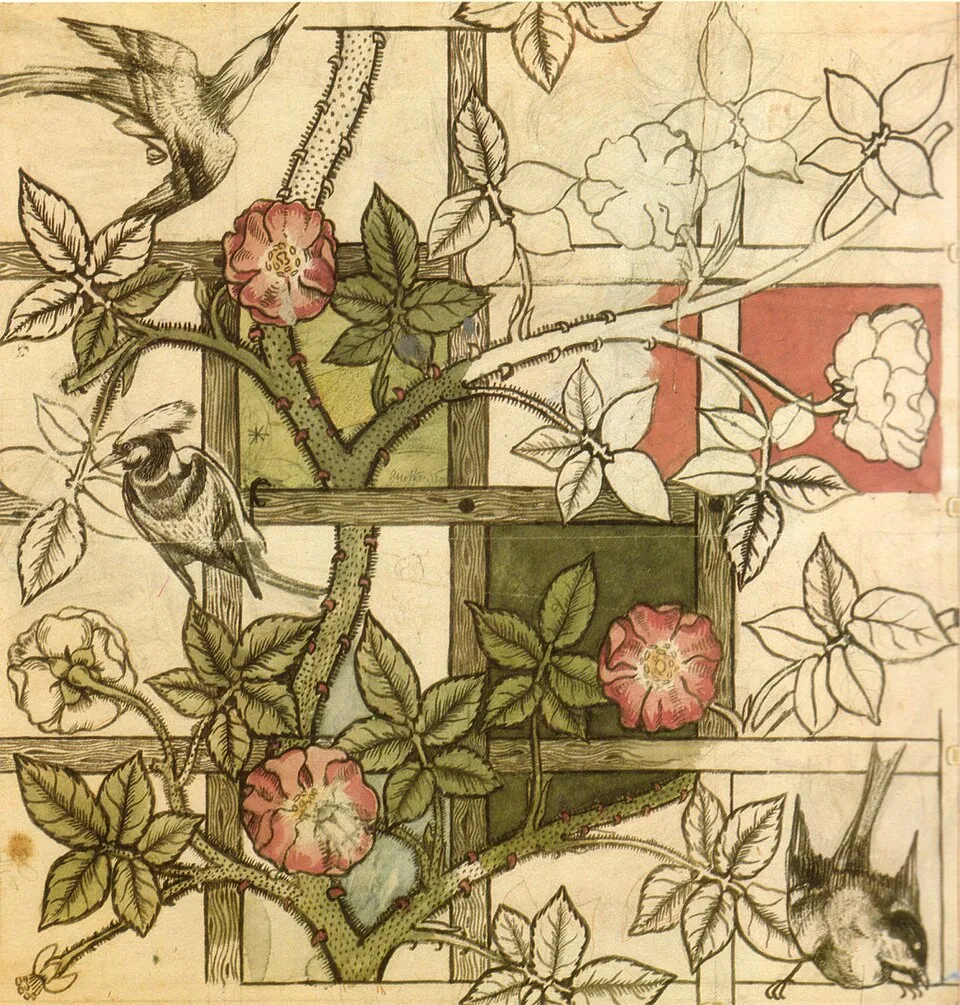
William Morris, design for "Trellis" wallpaper (1862). Wikimedia Commons.
Garrard told The Art Newspaper: "Morris was asking these big questions at a time when the world was changing very fast through the industrial revolution. We're looking at some of the same problems now." The exhibition included a newly commissioned documentary film, "Wallpaper" (2025) by Natalie Cubides-Brady, that traced Morris designs through film and television history. Scenes from "My Fair Lady," "Sunday Bloody Sunday," and "Django Unchained" all feature Morris wallpaper, revealing how the patterns have become shorthand for taste, comfort, and a particular kind of Englishness.
The contradiction Morris could not solve in his lifetime, that beautiful handmade objects are expensive and therefore available only to the wealthy, has been "solved" by mass production in a way that would have horrified him. Morris patterns are now available on phone cases, shower curtains, and dentist waiting room walls. They are affordable and everywhere. They are also divorced from the conditions of their making, produced by machines or by workers in conditions Morris would have condemned. The "democratization" of Morris has been achieved by stripping his work of everything he believed in except the visual pattern.
What the Arts and Crafts Movement Got Right and Wrong
The movement was right that industrial production in the 19th century produced ugly objects in degrading conditions. It was right that the connection between maker and object matters aesthetically and morally. It was right that design is not a secondary concern but a fundamental part of how people experience daily life.
It was wrong about the solution. Morris believed that handcraft was the only way to produce beautiful objects and dignified labor. The Bauhaus proved that machines could produce well-designed objects if the design was good. Scandinavian furniture, mid-century modern design, and the entire tradition of industrial design that descends from the Bauhaus demonstrate that mass production and beauty are not mutually exclusive. Morris's refusal to engage with industrial production as a potential tool, rather than an enemy, limited the movement's practical impact.
The movement was also wrong about medieval craft. Morris idealized the medieval guild system, but medieval craft was often performed in conditions of poverty, coercion, and rigid hierarchy that were not much better than factory labor. The idea that the medieval craftsman was a free creative agent while the factory worker was a slave is a Romantic simplification that does not survive contact with the historical record.
Final Thoughts
The Arts and Crafts Movement was a political argument made through objects. William Morris believed that beauty was a right, not a privilege, and that the system that denied people beauty was the same system that denied them dignity in labor. He was right about the diagnosis and wrong about the cure. The objects he made, the wallpapers, the books, the furniture, are genuinely beautiful. The conditions under which he made them, in small workshops by skilled craftspeople, were genuinely better than factory labor. But the objects were expensive, the conditions were available only to a few, and the mass production that Morris condemned eventually made versions of his designs available to millions of people in forms he would not have recognized or approved.
If you want to go deeper, the William Morris Gallery in Walthamstow is the best single resource. The Victoria and Albert Museum's Arts and Crafts introduction provides excellent broader context. You can also explore our posts on the Pre-Raphaelites, Art Nouveau, and the Bauhaus for the movements that connect to Arts and Crafts. Our art movements timeline and art history cheat sheet provide additional context for where this movement fits in the larger story. For more on Morris's influence on design education, see our post on the Bauhaus movement.


