Yale Center for British Art Open Access: 70,000 Images of British Art, Including 3,000 Turners
The Yale Center for British Art reopened on March 29, 2025 after a two-year closure for a major building conservation project. All 224 original skylights in Louis Kahn's final building were replaced. The halogen lighting system was swapped for LEDs, cutting energy use by 60%. The fourth-floor galleries were completely reinstalled as In a New Light: Five Centuries of British Art. Two blockbuster exhibitions launched alongside it: a Turner retrospective marking his 250th birthday and the first Tracey Emin solo show in a North American museum.
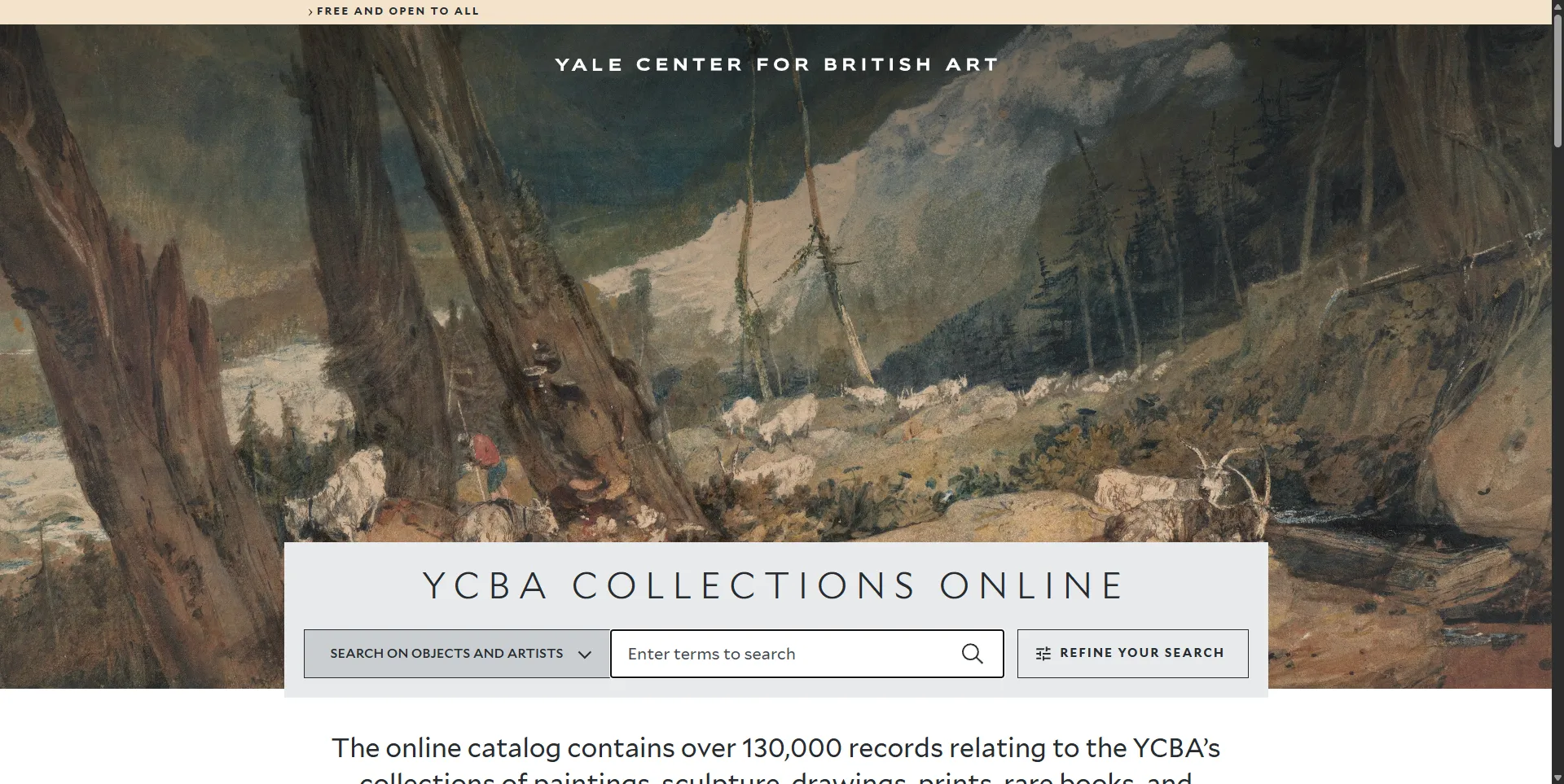
If you cannot get to New Haven, the good news is that nearly 70,000 images from the collection are available online under Yale's Open Access Policy. No application, no authorization, no fees. Download them, use them commercially, modify them. The museum was a founding member of the IIIF Consortium, which means the images are served through the International Image Interoperability Framework and can be compared, manipulated, and annotated across collections.
What Makes This Collection Different
The YCBA holds the largest and most comprehensive collection of British art outside the United Kingdom. It was assembled by Paul Mellon, one of the great American collectors of the 20th century, and donated to Yale along with the Kahn-designed building that opened in 1977. The collection covers five centuries of British art, from the Elizabethan period to the present day, with over 100,000 works including paintings, sculptures, prints, drawings, watercolours, and rare books.
What sets the YCBA apart from other museum open access programs is its focus. The Met Open Access covers every culture and period. The Walters Art Museum specializes in medieval manuscripts. The YCBA goes deep on a single national tradition, and that depth is what makes it valuable.
Turner: The Crown Jewel
The YCBA holds nearly 3,000 works by and after J.M.W. Turner, including 14 oil paintings and hundreds of drawings, prints, and watercolours. This is the largest collection of Turner's work outside the United Kingdom.
The Turner retrospective that opened with the reopening traces his entire 60-year career, from early meticulously rendered topographical landscapes to the near-abstract atmospheric works of his later years. Highlights include "Dort, or Dordrecht: The Dort Packet-Boat from Rotterdam Becalmed" (1818) and "Staffa, Fingal's Cave" (exhibited 1832). His last known intact sketchbook, used on the coast of Kent around Margate in 1845, is on display.
For painters, the high-resolution images of Turner's work available through the online collection allow detailed study of his techniques: his use of transparent watercolour washes, his scraping and lifting methods, his application of bodycolour for highlights. The watercolours in particular benefit from high-resolution digitization because Turner's technical innovations in watercolour are best understood at the level of individual brush marks.
Constable, Gainsborough, and the Landscape Tradition
John Constable is represented by oil sketches and finished paintings that document his approach to painting from direct observation. The high-resolution images show his broken brushwork and his attention to the specific qualities of English light. For landscape painters studying the transition from academic finish to plein-air immediacy, these images are primary source material.
Thomas Gainsborough appears in both the portrait and landscape holdings. His loose, feathery brushwork is visible in the high-resolution downloads, and comparing his landscapes to Constable's reveals two very different approaches to the same English countryside.
The watercolour tradition is a standout. The collection holds major works by Paul Sandby, Thomas Girtin, John Sell Cotman, and other leading figures. British watercolour painting is one of the most distinctive traditions in Western art, and the YCBA's collection covers its full development. For watercolourists, the ability to study these works in high resolution is invaluable: you can see washes, drybrush, scratching, and other techniques that are nearly impossible to discern in printed reproductions.
Portraiture and Works on Paper
British portraiture includes major works by Sir Joshua Reynolds, Gainsborough, George Romney, and Sir Thomas Lawrence. The collection traces the grand manner tradition from its 18th-century peak through its later development. A recent acquisition on display in the reopened galleries is a circa 1675 portrait of an unknown woman by Mary Beale, a successful 17th-century painter whose work has been receiving renewed attention.
William Blake is represented by illuminated books and separate prints. The high-resolution images allow study of his printmaking techniques and his integration of text and image.
Samuel Palmer is represented by works from his Shoreham period, when he produced some of the most visually intense landscape works in British art. The combination of close observation and visionary intensity in these works is best appreciated in the detailed images available through the online collection.
The IIIF Advantage
The YCBA was one of the first museums in the world to commit to IIIF-compliant images. This matters if you are doing serious research or building digital tools. IIIF lets you compare images from different institutions side by side, zoom into specific regions, and annotate images with scholarly notes. If you are comparing a Turner watercolour at the YCBA with a Turner oil at the Tate, IIIF makes this possible within a single viewer.
The museum also provides collection data in machine-readable formats via OAI-PMH, using the CIDOC Conceptual Reference Model for semantic integration with other datasets. There is no public API in the traditional sense, but the OAI-PMH endpoint allows bulk harvesting of collection metadata.
How the YCBA Compares
Against the Met Open Access, the YCBA is smaller: 70,000 images versus 490,000. But the Met has a handful of British works. The YCBA has the deepest British art collection outside the UK, period.
Against the Rijksmuseum Open Data, the YCBA lacks the Rijksmuseum's polished Rijksstudio interface and 100-megapixel downloads. But the Rijksmuseum covers Dutch art, not British.
Against the National Gallery of Art in Washington, the YCBA is more specialized but deeper in its niche. The NGA covers Western European art broadly; the YCBA goes deep on Britain.
Insider Tips
Use the IIIF viewer for detailed study. The online collection's IIIF support lets you zoom deeper than standard image viewers. If you are studying brushwork or surface texture, use the IIIF viewer rather than downloading a standard JPEG.
Filter by "Free to Use" in the collection search. The collection search has a rights filter. Set it to "Free to Use" to see only the open access images. This filters out works still under copyright.
Check the exhibition history filter. The reopened galleries are organized as "In a New Light: Five Centuries of British Art." You can filter the collection search by this exhibition to see exactly what is on display on the fourth floor.
Visit the Study Room. If you are in New Haven, the Study Room provides access to works on paper, rare books, and archives that are not on display. It is free but requires an appointment. The Reference Library has over 40,000 titles and 120 current periodicals on British art.
Plan around the Turner show. The Turner retrospective runs on the third floor and draws the biggest crowds. Visit on a weekday morning for the quietest experience. The Emin exhibition on the second floor is less crowded but equally worth seeing.
The building itself is worth the trip. Kahn's last building is a study in natural light. The reopened galleries with their new polycarbonate skylight domes and LED lighting are significantly brighter and more energy-efficient than before. Even if you are there for the digital collection, seeing the works in person in this space adds context you cannot get online.
Who Is This For?
The YCBA Open Access is for painters and watercolourists who want to study the British landscape and portrait traditions in high resolution. It is for illustrators working on historical British subjects who need accurate reference for costume, landscape, and material culture. It is for researchers and educators who need legally clear, high-quality images of British art for teaching and publication.
It is not for you if you need a broad, encyclopedic collection. The YCBA covers British art only. For breadth, the Met or Smithsonian are better starting points.
Getting Started
Visit collections.britishart.yale.edu and filter by "Free to Use" to browse the open access collection. For information about visiting the reopened museum, see britishart.yale.edu. The museum is at 1080 Chapel Street in New Haven, Connecticut. Admission is free. All open access images are CC0: download them, use them, modify them, sell them. No attribution required.