Walters Art Museum Open Access: Medieval Manuscripts and Ancient Gold, Free Under CC0
Most museum open access programs give you paintings. The Walters Art Museum gives you something harder to find: nearly 900 illuminated manuscripts, Byzantine icons, Islamic miniature paintings, and one of the finest collections of ancient jewellery in North America. All under CC0. No attribution required. No fees. No paperwork.
The Walters was one of the first museums in the United States to adopt Creative Commons Zero for its digital collection, and its open access policy remains one of the most straightforward in the museum world. The collection at art.thewalters.org contains over 10,000 downloadable records spanning 7,000 years of art history, from 5000 BCE to the 21st century. It is not the biggest open access collection. The Met Open Access has 490,000 images. The Smithsonian Open Access has millions. But neither of those institutions has what the Walters has: a manuscript collection that rivals the Vatican's, photographed in enough detail to see individual strokes of gold leaf.
Why the Walters Matters for Artists
The museum sits at 600 N. Charles Street in Baltimore's Mount Vernon neighborhood, a historic district packed with 19th-century mansions, the Peabody Conservatory, and the first major monument to George Washington in the United States. Admission is free. The Walters Cafe on Level 1A serves decent coffee and sandwiches, and on Thursday nights when the museum stays open until 9 p.m., you can grab a glass of wine before walking through the medieval galleries.
The collection was assembled by William T. Walters and his son Henry between the 1850s and 1931, when Henry bequeathed everything to the City of Baltimore. The Walters family bought broadly and obsessively: Egyptian amulets, Greek vases, Roman cameos, medieval ivories, Renaissance paintings, Islamic manuscripts, Ethiopian icons, Armenian gospel books. The result is a collection of about 36,000 objects that feels less like a curated museum and more like the private cabinet of two obsessive collectors who happened to have extraordinary taste and unlimited funds.
The Manuscript Collection: The Real Prize
The illuminated manuscript holdings are the reason most researchers find the Walters. The collection includes nearly 900 manuscripts from Europe, Byzantium, Armenia, Ethiopia, South Asia, and the Islamic world, spanning the 5th through the 15th centuries. More than half have been digitized to date, and the work is ongoing.
Books of Hours form the largest category. The Walters holds examples from France, Flanders, and Italy ranging from modest workshop productions to lavishly illuminated commissions. The high-resolution scans let you zoom in close enough to see how individual illuminators applied gold leaf and built up pigment layers. If you paint or illustrate medieval subjects, this level of detail is hard to find anywhere else for free.
Byzantine manuscripts cover the 9th through 15th centuries and represent a tradition that differs sharply from Western European illumination. The iconographic conventions, the use of tempera on vellum, and the specific color palettes of Byzantine work are documented here in enough depth to support serious technical study.
Islamic manuscripts from Persia, Turkey, and other centers of Islamic manuscript production provide access to geometric patterns, floral compositions, and calligraphic traditions that are difficult to study in person outside of a handful of specialized collections.
The Walters also maintains a separate site called The Digital Walters for high-resolution archival images of entire manuscripts, along with detailed catalog descriptions. For a more interactive experience, the Ex Libris site offers page-turning views of digitized manuscripts. If you are studying a specific manuscript, check both the main collection site and The Digital Walters, because they sometimes host different versions of the same material.
Ancient Art and Decorative Objects
The ancient art collection covers Egypt, Greece, Rome, and the Near East. The standout is not the monumental sculpture but the small-scale luxury objects: ancient goldsmithing, gem carving, engraved stones, amulets, and shabtis. The Greek and Roman gem collection is one of the finest in the United States, with engraved stones documenting the full range of ancient gem-cutting traditions.
For jewelry designers and metalsmiths, the ancient jewelry holdings are worth browsing systematically. The high-resolution images show enough detail to study construction techniques, solder joints, and granulation work that would normally require a magnifying loupe and physical access to the object.
The medieval and Renaissance collection includes ivory carvings, enamel work, and small-scale devotional paintings from Italian, Flemish, and German workshops. The ivory carvings in particular are photographed well enough to study the chisel marks and surface finishing.
The API and Search Interface
The Walters provides a free API that gives developers access to the full collection database, including metadata and image URLs. The API is well-documented and supports queries by period, medium, culture, and other parameters. If you are building a tool that needs art historical data or want to batch-download images for a specific research project, the API is the fastest route.
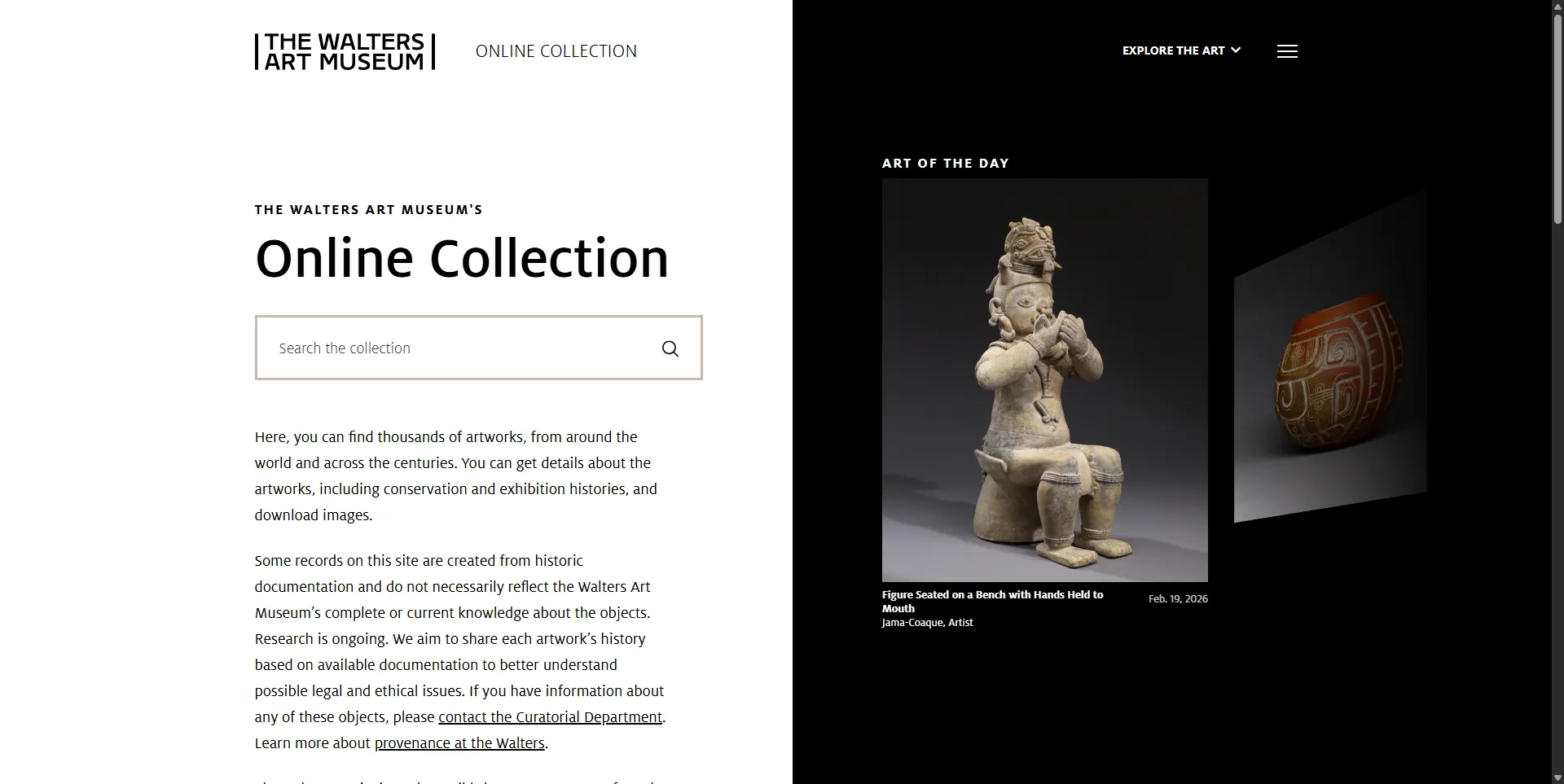
The main search interface at art.thewalters.org allows filtering by period, medium, culture, and other criteria. Each work's page includes provenance, exhibition history, conservation notes, and dimensions alongside the download link. The download process is simple: one click gives you the highest resolution available.
One limitation: the search interface is functional but not polished. Compared to the Rijksmuseum's Rijksstudio or the Cleveland Museum's ArtLens, the Walters' interface feels dated. You will not find visual similarity search or curated thematic collections here. If you know what you are looking for, the search works fine. If you want to browse and discover, the category system on The Digital Walters is more useful.
How the Walters Compares
Against the Met Open Access, the Walters is tiny: 10,000 images versus 490,000. But the Met does not have 900 illuminated manuscripts. If your work involves medieval or Byzantine material, the Walters fills gaps that the Met cannot.
Against the Harvard Art Museums, the Walters has a deeper manuscript collection and a more permissive licensing approach. Harvard uses a mix of CC0 and CC BY, while the Walters applies CC0 across the board for public domain works.
Against Wikimedia Commons, the Walters offers guaranteed provenance, consistent metadata, and reliable image quality. Wikimedia Commons has more files but variable quality and inconsistent attribution data.
Insider Tips
Start with The Digital Walters for manuscripts. The main collection site and The Digital Walters overlap but are not identical. The Digital Walters hosts complete manuscript scans with full catalog data, while the main site sometimes has individual page images. For manuscript research, The Digital Walters is the better starting point.
Use the API for batch work. If you need metadata for dozens of objects, the API is faster than manual browsing. The API returns JSON with image URLs, so you can script downloads for specific categories.
Check provenance notes. The Walters has been transparent about ongoing provenance research, and some object pages include detailed notes about acquisition history and potential restitution claims. This matters if you are using images in scholarly or editorial contexts.
Visit on a Thursday. The museum stays open until 9 p.m. on Thursdays, and the cafe serves wine and beer. The medieval galleries on the upper floors are usually quiet in the evening, which gives you time with the manuscripts and ivories without the weekend crowd.
Take the Charm City Circulator. The free Purple line bus stops near the museum at stop 307. Street parking in Mount Vernon is limited, and the paid lot at 600 Cathedral Street fills up on weekends.
Who Is This For?
The Walters Open Access is for illustrators and painters who work with medieval, Byzantine, or Islamic visual traditions and need high-resolution reference material they cannot find elsewhere. It is for jewelry designers and metalsmiths who want to study ancient construction techniques. It is for educators who need legally clear, high-quality images of manuscript illumination for teaching.
It is not for you if you need a broad, encyclopedic collection covering every period and culture. For that, the Met or Smithsonian are better starting points. The Walters is a specialist resource, and its value comes from depth in specific areas rather than breadth across all of art history.
Getting Started
Visit art.thewalters.org to search the open access collection, or head to The Digital Walters for complete manuscript scans. Developers can access the API documentation to query the collection programmatically. All images are CC0: download them, use them, modify them, sell them. No attribution required, though the museum appreciates a credit when feasible.