
She looks back over her shoulder, her lips slightly parted, her gaze meeting yours with an expression that falls somewhere between question and invitation. The pearl at her ear catches the light. The dark background gives her nowhere to belong and everywhere to belong at once. Johannes Vermeer painted this figure around 1665, and in the roughly 360 years since, she has become one of the most instantly recognizable faces in Western art, called the "Mona Lisa of the North" so often that the comparison has almost lost its meaning. But she is stranger and more interesting than that comparison suggests.
Almost nothing about this painting is certain. We do not know who she is. We do not know if the earring is pearl or glass. We do not know precisely when it was painted or exactly what it is a painting of. What we do know is what we see: a figure of extraordinary psychological presence rendered in Vermeer's incomparable light, a work that has generated centuries of looking and a burst of 21st-century cultural production that shows no sign of slowing down.
The Painting
"Girl with a Pearl Earring" (c.1665) is oil on canvas, 44.5 x 39 cm, now in the Mauritshuis museum in The Hague. It is small. In person, visitors expecting the scale of a major canvas are often surprised by its intimacy. The painting was acquired by the Mauritshuis in 1902 for just two guilders and thirty cents at an estate sale; its true significance was not recognized until the 20th century.
The figure wears a blue and yellow turban, a garment that places her nowhere specific, no identifiable period or national dress, in a literary and pictorial tradition of imaginary exotic costume. She wears a plain collar. The pearl earring hangs from the left ear, catching the ambient light with a single bright highlight. The background is dark, almost black, giving the figure a floating quality. There are no furnishings, no windows, no other objects, nothing to place her in space or time except the light that models her face.
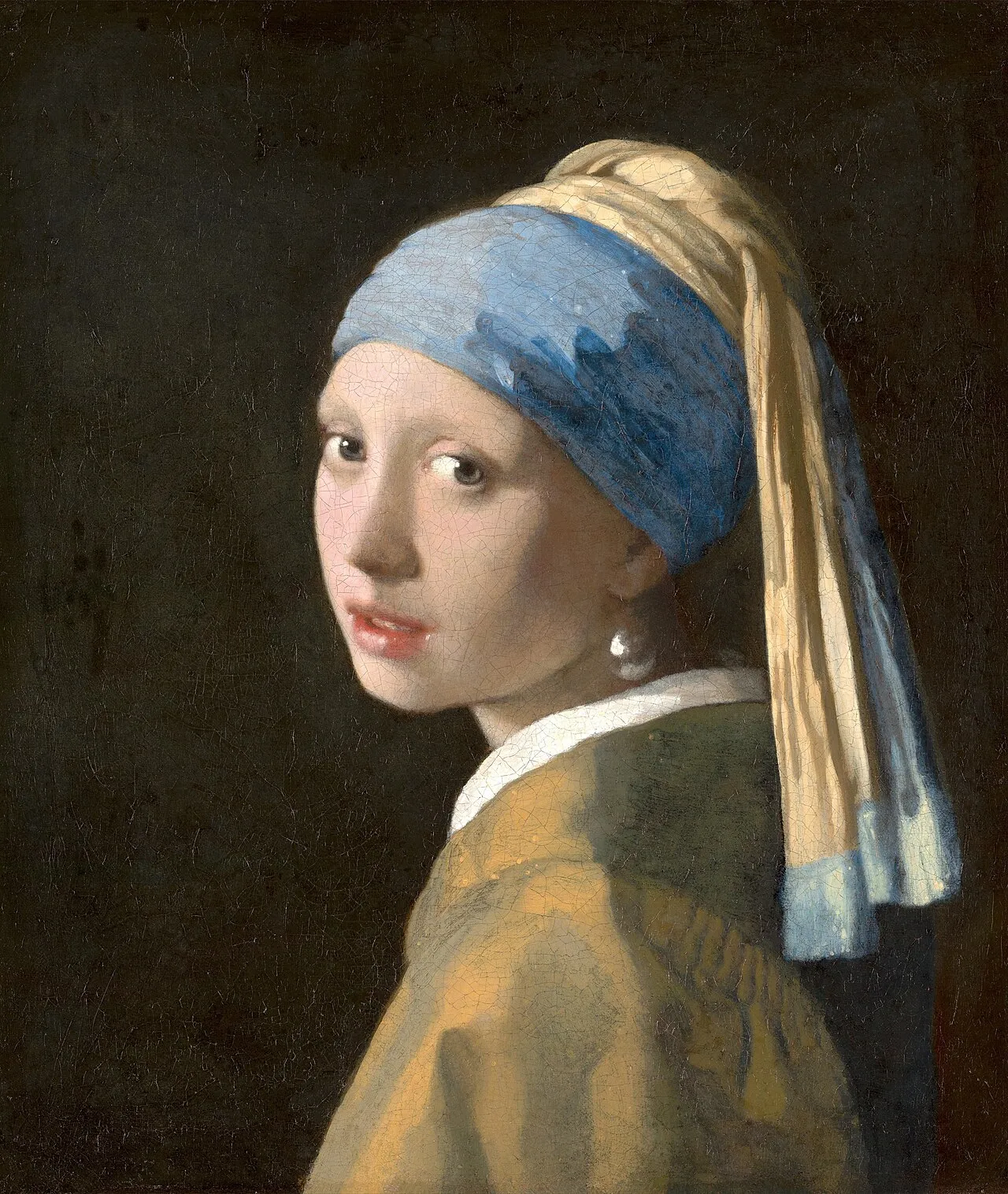
Johannes Vermeer, "Girl with a Pearl Earring" (c.1665), oil on canvas, 44.5 x 39 cm. Mauritshuis, The Hague. The painting has been called the "Mona Lisa of the North" for its atmospheric mystery and the enigmatic expression of its unknown subject. Image: Public domain, via Wikimedia Commons
What Kind of Painting Is It?
The painting is technically a tronie, a Dutch term for a type of painting that depicts a type or character rather than a specific portrait of an identifiable person. Tronies showed imaginary figures in exotic costume, displaying the painter's skill at rendering different textures, facial expressions, and light effects. They were not commissioned portraits. They were studio exercises and commercial products, made to be sold to collectors who valued them as demonstrations of painterly skill rather than as records of specific individuals.
This classification matters because it explains why we do not know who the sitter was. She was probably not a specific commission, which means the usual paper trail, contracts, family records, inventories, does not exist. She was also not necessarily a real person at all: the turban she wears is not authentic Turkish dress of the period, and the entire image may be a composite, assembled from studio models and Vermeer's imagination rather than directly observed from a single sitting person.
The full exploration of how Vermeer used light, models, and possibly the camera obscura to construct his images is covered in the artist spotlight Johannes Vermeer: Light Through Windows and Domestic Mystery. The "Girl" stands apart from most of his domestic interior scenes precisely because it lacks a domestic setting, placing all the visual interest on the figure and the light falling on her face.
The Pearl: Real or Glass?
In 2014, a team of Dutch researchers including art historian and Vermeer specialist Abbie Vandivere examined the painting under various forms of imaging technology, including macro X-ray fluorescence scanning, reflectance imaging spectroscopy, and 3D microscopy. Their findings, published in 2020, revealed important details about Vermeer's technique: the dark background was originally a green curtain that faded over time; the painting shows no underdrawing, suggesting Vermeer worked directly on the primed canvas; the figure's hair and costume were built up in complex layers.
They also examined the earring. The conclusion: it is probably not a pearl. Real pearls have a characteristic texture in close examination that is not present in the painted earring. Art historian Marjorie Wieseman had previously argued that the earring is actually glass, a less expensive material that was widely used in jewelry of the period and that would have been more accessible to a studio prop. The painting that has become synonymous with a pearl earring may not actually depict one. This is very Vermeer: reality and illusion intertwined.
The Provenance and Rediscovery
The painting passed through several collections after Vermeer's death in 1675, appearing in a 1696 Amsterdam sale among 21 Vermeer works sold from the estate of a collector. It was acquired in 1881 by Arnoldus Andries des Tombe for two guilders and thirty cents, an almost laughably small sum for what is now estimated to be one of the most valuable paintings on earth. Des Tombe bequeathed it to the Mauritshuis in 1902.
The Mauritshuis's 1996 Vermeer retrospective, which traveled to Washington's National Gallery, was a turning point in the painting's cultural profile. The exhibition catalog and the critical reception brought Vermeer to mainstream attention in a way that had not happened before. The timing coincided with Tracy Chevalier's novel.
The Novel and Film
Tracy Chevalier's "Girl with a Pearl Earring" was published in 1999 and became an immediate bestseller, translated into 47 languages and selling millions of copies worldwide. Its premise was irresistible: a fictional account of how the painting might have been made, told from the perspective of Griet, a servant girl in Vermeer's household who becomes the painter's model and possibly something more. Chevalier freely acknowledged that the novel was entirely invented, but its psychological acuity and period detail made it feel plausible enough that many readers came to think of it as biography.
The 2003 film adaptation, directed by Peter Webber with Scarlett Johansson as Griet and Colin Firth as Vermeer, cinematographed by Eduardo Serra, became one of the most visually sophisticated costume dramas of the decade. Serra's photography directly referenced Vermeer's lighting at every turn, using natural window light and a palette of blues, yellows, and earth tones that virtually every reviewer noted as "Vermeeresque." The film added to the painting's cultural mythology while acknowledging, by its very existence as fiction, that the actual historical subject remains unknown.
The Painting Today
The "Girl" traveled to Japan in 2012 for an exhibition that drew over 700,000 visitors, the largest attendance for any art exhibition in Japanese history to that point. She returned to the Mauritshuis, which closed for renovation from 2012 to 2014. In 2023, climate activists from Just Stop Oil glued their hands to the display case in a protest that drew global media coverage, the painting itself undamaged behind its glass protection.
The painting's cultural saturation, on tote bags, coffee mugs, calendars, and art history syllabi, has not diminished its power as an object. Part of what makes it so resilient to reproduction and commerce is that the original's quality of light and intimacy cannot be replicated at scale: you cannot make a poster that captures what happens when you stand close to the actual canvas and meet that returning gaze. This resistance to reproduction is what the seven-step framework for reading paintings on this site tries to address: the experience of the original requires direct looking that no image can substitute.
For the broader context of Dutch Golden Age painting, which produced this work and the tradition that makes it comprehensible, see Rembrandt: Light, Shadow, and the Dutch Golden Age. Who do you think she is? Share your theory in the comments.


