
In 1925, Alain Locke published "The New Negro," a book that told Black Americans they were no longer a "problem" but a "people" with a culture worth taking seriously. The visual art that followed was not illustration for Locke's thesis. It was the thesis made visible. Painters, sculptors, and printmakers took his arguments about African heritage and modern identity and turned them into images that still shape how we understand American art.
The Great Migration brought millions of Black Americans from the rural South to northern cities between 1916 and 1970. Harlem became the cultural capital of this displacement. The Renaissance was not a single movement with a manifesto. It was a cluster of artists, writers, musicians, and intellectuals working in the same neighborhoods, reading the same journals, and arguing about the same question: what should Black art look like? The answers they produced between roughly 1920 and 1940 changed American visual culture permanently.
This guide covers the key artists, the debates that shaped them, and why the Harlem Renaissance matters beyond its historical moment. From Aaron Douglas's mural cycles to Augusta Savage's lost sculptures to Jacob Lawrence's Migration Series, the Harlem Renaissance was the first time Black American artists collectively insisted on defining themselves rather than being defined by others.
What Was the Harlem Renaissance?
The Great Migration and the Making of Harlem
Roughly 1.6 million Black Americans moved north between 1916 and 1940, driven by the mechanization of southern agriculture, the boll weevil's destruction of the cotton crop, and the Jim Crow system that made daily life a sequence of humiliations and dangers. They went to Chicago, Detroit, Philadelphia, and New York. In Harlem, a neighborhood that had been a white middle-class area until the early 1900s, real estate speculation and overbuilding created vacancies that Black renters filled. By 1920, Harlem had the largest concentration of Black people in any neighborhood in the country.
The NAACP, founded in 1909, provided institutional infrastructure. Its magazine, The Crisis, edited by W.E.B. Du Bois from 1910 to 1934, published political analysis, poetry, and visual art. The National Urban League's magazine Opportunity, edited by Charles S. Johnson, served a similar function. These publications were not just vehicles for writing. They were where Black visual artists first found an audience, through cover illustrations, reproductions, and exhibition reviews.
Alain Locke and "The New Negro"
Locke's 1925 anthology "The New Negro: An Interpretation" collected essays, poetry, and fiction by writers including Langston Hughes, Zora Neale Hurston, and Countee Cullen. Its argument about visual art was specific: Black artists should draw on African heritage rather than imitate European academic models. Locke pointed to African sculpture, masks, and geometric forms as sources for a modern Black visual language. He believed art should be autonomous expression, not political propaganda.
Du Bois disagreed. He argued that all art is propaganda and that Black artists had a responsibility to produce work that advanced racial uplift. His famous 1926 speech, "Criteria of Negro Art," stated: "I do not care a damn for any art that is not used for propaganda." The debate between Du Bois and Locke was never resolved, but Locke's position was more productive for artists. It gave them permission to experiment formally without worrying that every painting had to serve a political program. Aaron Douglas's murals could be modernist and African-inspired without being literal illustrations of political arguments. Without Locke's framework, the visual range of the Harlem Renaissance would have been far narrower.
The Metropolitan Museum of Art's 2024 exhibition "The Harlem Renaissance and Transatlantic Modernism" (February 25 to July 28, 2024) was the first major museum survey of the movement in nearly four decades. Curated by Denise Murrell, it brought together 160 works and positioned the Harlem Renaissance not as a footnote to European modernism but as central to it. The show included works by Matisse, Munch, and Picasso alongside Black American artists to demonstrate the transatlantic exchange of ideas about race, identity, and representation.
Aaron Douglas and the Visual Language of the New Negro
Aaron Douglas arrived in Harlem in 1925, the same year Locke published "The New Negro." He had studied art at the University of Nebraska and taught high school in Kansas City, but Harlem was where his visual language came together. He began producing cover illustrations for The Crisis and Opportunity that fused Egyptian silhouette forms, West African mask geometry, and Art Deco concentric circles into something that looked like none of those sources alone.
Douglas's most important work is the four-panel mural series "Aspects of Negro Life," painted in 1934 for the 135th Street branch of the New York Public Library, now the Schomburg Center for Research in Black Culture. The panels were commissioned through the Public Works of Art Project, the first major federal arts program. Each panel traces a stage of African American history: "The Negro in an African Setting" depicts pre-colonial African life with dancers and drummers; "From Slavery to Reconstruction" shows the transition from enslavement through Emancipation; "An Idyll of the Deep South" portrays rural southern life under Jim Crow; and "Song of the Towers" depicts the Great Migration northward, with a saxophone player standing on a cogwheel surrounded by industrial forms and a rising city silhouette.
Douglas's technique is consistent across all four panels. He used concentric circles radiating from key figures, silhouetted bodies in profile, and a color palette of muted greens, blues, lavenders, and earth tones. The figures are flat, not modeled with chiaroscuro. The effect is decorative and narrative at the same time. You can read the panels as a historical sequence, but you can also look at any single panel and get lost in the pattern of circles and silhouettes. Douglas called his style "Egypto-African," and it became the visual signature of the Harlem Renaissance.
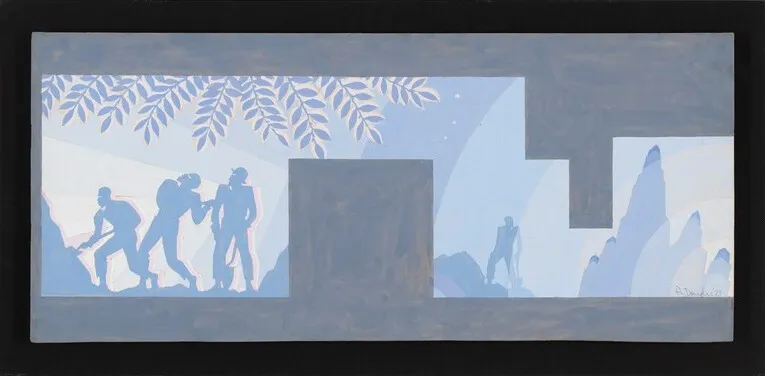
Aaron Douglas, mural study for Cravath Hall, Fisk University. Wikimedia Commons.
Douglas's influence on later Black artists is direct and visible. Jacob Lawrence's flat color and silhouette figures owe a debt to Douglas. The Art Institute of Chicago holds study drawings for the "Aspects of Negro Life" panels that show how carefully Douglas planned his compositions before touching a canvas.
Archibald Motley and the Complexity of Black Nightlife
Archibald Motley Jr. (1891-1981) worked in Chicago, not Harlem, but he was part of the same cultural moment. He studied at the School of the Art Institute of Chicago and painted the Bronzeville neighborhood on Chicago's South Side, where Black migrants from the South created a parallel city of businesses, churches, and nightlife.
Motley's paintings of nightlife are his most distinctive contribution. "Blues" (1929) shows a crowded nightclub with figures dancing, drinking, and socializing in warm, saturated color. "Black Belt" (1934) depicts a street scene in Bronzeville with storefronts and pedestrians. "Nightlife" (1943), his most reproduced painting, shows a bar with couples dancing under amber and purple light. The figures in Motley's nightlife paintings have varying skin tones, a detail that has generated significant discussion. Some scholars read this as colorism, with lighter-skinned figures given more prominent positions. Others read it as an honest depiction of the actual range of skin tones within Black communities, which is more accurate to lived experience than the monolithic representations that white artists typically produced.
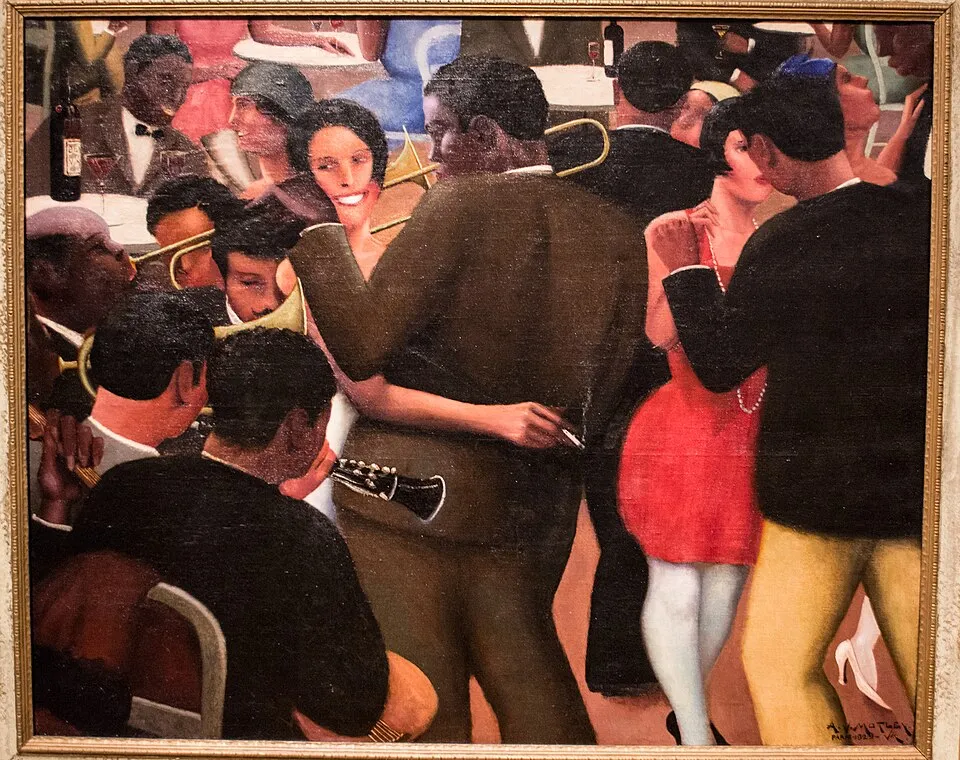
Archibald Motley, "Blues" (1929). Oil on canvas. Whitney Museum of American Art. Wikimedia Commons.
Motley also painted portraits of mixed-race women, including "The Octoroon Girl" (1925) and "Mending Socks" (1928). These paintings raise the question of who Black art is for. Motley was interested in the social performance of race, in how mixed-race identity complicated the binary categories that American society imposed. The Smithsonian American Art Museum holds several of Motley's works and provides detailed documentation of his career.
Augusta Savage and Sculpture as Community Building
Augusta Savage (1892-1962) was the most important sculptor of the Harlem Renaissance, and her career illustrates both the achievements and the losses of the period. Born in Green Cove Springs, Florida, she moved to New York City with less than five dollars in her pocket. She completed a four-year degree at Cooper Union in three years and became a recognized talent, only to have a scholarship to study in Paris revoked because of her race. She raised her own funds and went anyway, exhibiting at the Salon d'Automne and the Grand Palais in Paris.
Savage's most famous work is "Lift Every Voice and Sing," also known as "The Harp," created for the 1939 New York World's Fair. The sculpture was 16 feet tall, made of plaster treated to resemble basalt. Twelve singers in choir robes formed the strings of a harp, with a large arm and hand serving as the base. A young man knelt at the front holding sheet music. The work was inspired by James Weldon Johnson's poem and hymn "Lift Every Voice and Sing," often called the Black national anthem. The fair's organizing committee renamed it "The Harp" without Savage's consent. It was one of only two works by African American artists at the fair, and Savage was the only Black woman to receive a commission.
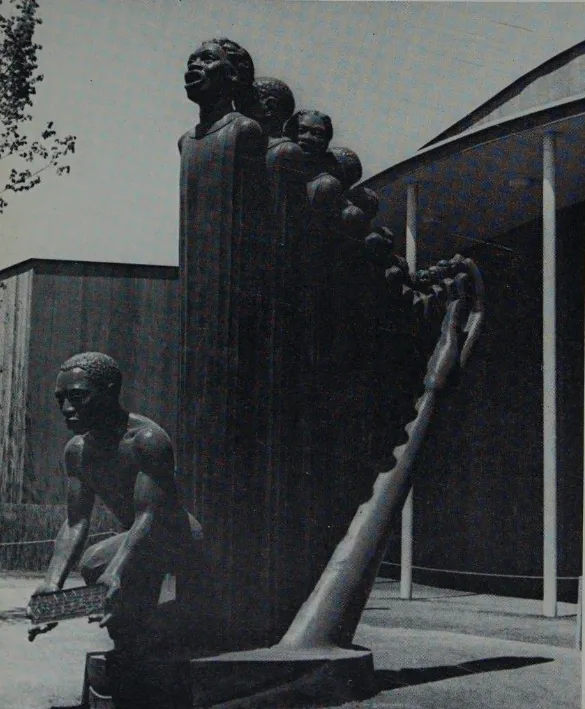
Augusta Savage, "Lift Every Voice and Sing" (The Harp) (1939). Plaster. Destroyed after the 1939 New York World's Fair. Wikimedia Commons.
The Harp was destroyed after the fair ended in 1940. There was no funding to cast it in bronze or even to store the plaster. This is not an isolated loss. Most of Savage's sculptural output is lost or under-documented because she worked in plaster and terracotta rather than bronze, and because institutional support for Black women sculptors was effectively nonexistent. What survives are photographs, small souvenir maquettes sold at the fair, and the memory of her students.
Savage's role as a teacher may be more important than her surviving sculptures. She ran the Savage Studio of Arts and Crafts in Harlem, which trained a generation of artists including Jacob Lawrence and Norman Lewis. She was also instrumental in securing WPA Federal Art Project support for Black artists. The WPA employed thousands of artists between 1935 and 1943, and for Black artists it was one of the few sources of institutional funding available. Savage's advocacy within that system opened doors that would otherwise have stayed shut.
Jacob Lawrence and the Next Generation
Jacob Lawrence (1917-2000) is the bridge between the Harlem Renaissance and postwar American art. He studied with Savage at her studio and absorbed Douglas's visual language, but he stripped away the Egyptian and African references in favor of direct narrative. His "Migration Series" (1940-41) is the outstanding achievement of this generation: 60 small panels painted in tempera on hardboard, each captioned with a single sentence, telling the story of the Great Migration from the rural South to northern cities.
Lawrence painted all 60 panels simultaneously. He laid them out on the floor of his studio and worked on them as a group, applying the same colors to multiple panels at once to maintain consistency. He was 23 years old. The series was exhibited at Edith Halpert's Downtown Gallery in 1941, making Lawrence the first Black artist represented by a major New York gallery. The series is now divided between the Museum of Modern Art (which holds the even-numbered panels) and the Phillips Collection in Washington, D.C. (which holds the odd-numbered ones), a split that occurred when both institutions wanted to purchase it and a compromise was reached.
Lawrence's technique is worth examining closely. He used tempera, a fast-drying medium made with egg yolk, on hardboard. The colors are flat, unmodulated, applied in shapes that read as both pattern and form. The captions are typed on separate labels and mounted below each panel. The combination of image and text creates a rhythm: you look at the painting, read the caption, look again. The series functions as a pictorial novel, and the narrative accumulates panel by panel. Lawrence's approach to art and politics was less direct than Du Bois would have wanted, but more grounded in lived experience than Locke's theory predicted.
Why the Harlem Renaissance Still Matters
The Met's 2024 exhibition positioned the Harlem Renaissance not as a regional or racial sideshow but as central to modernism itself. The show's argument, laid out in curator Denise Murrell's accompanying publication, is that the flow of ideas between Black artists in Harlem, Paris, London, and the Caribbean contributed to international conversations about art, race, and identity in ways that standard art history has failed to acknowledge. The Met's own history made this point sharper: in 1969, the museum mounted "Harlem on My Mind," a social history exhibition that included not a single painting or sculpture by a Black artist. The 2024 show was, among other things, a correction of that failure.
The connection to later movements is direct. The Black Arts Movement of the 1960s and 70s, led by figures including Amiri Baraka and Faith Ringgold, drew explicitly on the Harlem Renaissance's insistence on self-definition. Kerry James Marshall's paintings of Black life in Chicago extend the project that Motley started. Kehinde Wiley's portraits reclaim the European portrait tradition for Black subjects, a project that would have been unimaginable without the Harlem Renaissance's initial assertion that Black people deserved to be seen on their own terms. The ongoing debate about whether "Black art" as a category is liberating or limiting started with Locke and Du Bois and has not been resolved.
Final Thoughts
The Harlem Renaissance was the first time Black American artists collectively insisted on defining themselves rather than being defined by others. Aaron Douglas created a visual language that synthesized African forms with modernist geometry. Archibald Motley painted the complexity of Black urban life with an honesty that still generates debate. Augusta Savage built institutions and trained students even as her own sculptures were destroyed for lack of storage funds. Jacob Lawrence turned the Great Migration into a pictorial narrative that remains one of the great achievements of American art.
If you want to go deeper, read Alain Locke's "The New Negro" and visit the Schomburg Center for Research in Black Culture if you are in New York. The Schomburg still holds Douglas's "Aspects of Negro Life" murals in the very room they were painted for. You can also explore our complete guide to art movements and our post on African art traditions for more context. For the connection to later artists, see our pieces on Basquiat and cultural commentary and Social Realism. Our art history cheat sheet provides broader context for where this movement fits in the larger story of art.


