
Aaron Douglas, widely acknowledged as one of the most accomplished and influential visual artists of the Harlem Renaissance, was born in Topeka, Kansas, on May 26, 1899. He arrived in Harlem in 1925, shortly after the publication of the March 1925 issue of Survey Graphic titled "Harlem: Mecca for the New Negro," edited by Alain Locke. When interviewed late in his career, Douglas declared that the Harlem issue of Survey Graphic was the single most important factor in his decision to move to New York. Jacob Lawrence (1917-2000) was born in Atlantic City, New Jersey, and moved to Harlem in 1930, at the age of 13. Before he was twenty years old, Lawrence had developed a powerful, concise style that expressed all of the vibrancy of Harlem. Lawrence made his breakthrough in 1941 with his iconic series of paintings entitled "The Great Migration," a series consisting of 60 panels. In September 2025, Kunsthal KAdE in Amersfoort, the Netherlands, opened "Jacob Lawrence: African American Modernist," the first retrospective exhibition ever in Europe of the African-American artist Jacob Lawrence (1917-2000). The exhibition features seventy paintings, twenty-five drawings, and seventy-five prints. As Artforum noted, "Perhaps this is why it's sadly ironic that the most comprehensive retrospective of Lawrence's work in decades will not be seen in the US, given that a timely reconsideration of his art would be so useful to the American public right now." Black Modernism is not a subset of American modernism. It is a parallel tradition, developed by African American artists who were simultaneously engaging with European modernism, African art, and the lived experience of Black America. Douglas and Lawrence are its two greatest figures.
The Harlem Renaissance (roughly 1918-1937) was one of the most significant cultural movements in American history. It produced not only literature (Langston Hughes, Zora Neale Hurston, Countee Cullen) and music (Duke Ellington, Billie Holiday) but also visual art: Aaron Douglas, Meta Warrick Fuller, Augusta Savage, and later, Jacob Lawrence, who came of age in Harlem in the 1930s as the Renaissance was waning but its institutions and networks remained. This guide covers Black Modernism through Aaron Douglas and the Harlem Renaissance (Survey Graphic 1925, Alain Locke, The New Negro, God's Trombones 1927, Aspects of Negro Life 1934), Jacob Lawrence and the Migration Series (60 panels, 1940-41, MoMA and Phillips Collection, the 2025 European retrospective at Kunsthal KAdE), the Harlem visual tradition (Augusta Savage, Charles Alston, the Harlem Community Art Center), the relationship between Black Modernism and European modernism, and why this tradition matters.
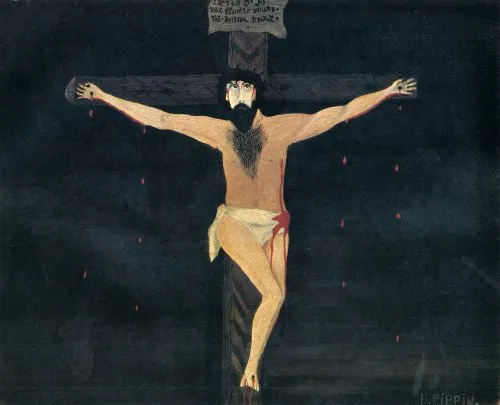
Aaron Douglas, illustration from "God's Trombones" (1927). "In his illustrations for this publication, and later in paintings and murals, Douglas drew upon his study of African art and his understanding of the intersection of cubism and art deco to create a style that soon became the visual signature of the Harlem Renaissance" (National Gallery of Art). Image via Wikimedia Commons.
Aaron Douglas: The Visual Signature of the Harlem Renaissance
Douglas arrived in Harlem shortly after the publication of what was immediately recognized as a landmark publication: the March 1925 issue of Survey Graphic titled, "Harlem: Mecca for the New Negro." When interviewed late in his career, Douglas declared that the Harlem issue of Survey Graphic was the single most important factor in his decision to move to New York. Welcomed by the leaders of the New Negro initiative, Douglas enjoyed the support of both Johnson, who arranged for him to study with German émigré artist Fritz Winold Reiss, and Du Bois, who gave him a job in the mailroom of The Crisis. In 1927 Du Bois invited Douglas to join the staff of The Crisis as their art critic.
The style was new and it was his. Douglas combined angular cubist rhythms, seductive art deco style, and traditional African and African American imagery to develop his own unique visual vocabulary, which was part of a rich interchange between the visual arts, music, dance, literature, and politics. This style comprised boldly flattened silhouettes that occupied complexly fractured spaces and were overlaid with transparent layers of geometric atmosphere. "Blackness," both in terms of his palette and as a conscious evocation of race, was at its core. That same year James Weldon Johnson, poet and New Negro activist, asked the young artist to illustrate his forthcoming collection of poems, God's Trombones: Seven Negro Sermons in Verse. Critically praised, God's Trombones was Johnson's masterwork and a breakthrough publication for Douglas.
Aspects of Negro Life (1934) is the mural masterpiece. It is a four-panel mural cycle for the 135th Street Branch of the New York Public Library, now the Schomburg Center for Research in Black Culture. The murals depict the journey from Africa through slavery to emancipation and modern Black life. "Aaron Douglas: African American Modernist is the first nationally touring retrospective that brings together more than eighty rarely seen works by the artist Aaron Douglas (1899-1979), one of the most influential visual artists of the Harlem Renaissance" (Smithsonian American Art Museum). The exhibition toured from 2007-2008 (Spencer Museum of Art, University of Kansas; Frist Center, Nashville; Smithsonian American Art Museum, Washington; Schomburg Center, New York). For the wider movement context, see our complete guide to art movements.
Jacob Lawrence: The Migration Series and Beyond
Lawrence was born in 1917 in Atlantic City, New Jersey. He was trained and his talent was nurtured there, supported by influential teachers and mentors like Charles Alston, Augusta Savage, Henry Bannarn, and Charles Seifert. He moved to Harlem in 1930, at age 13. Lawrence made his breakthrough in 1941 with his iconic series of paintings entitled "The Great Migration," a series consisting of 60 panels. The sixty panels are shared between MoMA in New York and The Phillips Collection in Washington, D.C., a split that happened in 1942. Each has thirty panels. The series depicts the Great Migration of African Americans from the rural South to the urban North between World War I and World War II. The very first panel of Lawrence's "Migration" series shows New York as only one of several destinations for Black migrants, alongside Chicago and Saint Louis.
Lawrence's work is characterized by bold, flat colors, simplified forms, and narrative sequencing. He worked in series: the Migration Series, the Harriet Tubman series, the Toussaint L'Ouverture series, the Builders series. He used the format of multiple panels to tell stories that single paintings could not. The 2025 European retrospective at Kunsthal KAdE shows the first retrospective exhibition ever in Europe of the African-American artist Jacob Lawrence (1917-2000). The exhibition spans his six-decade career from the 1930s, featuring 70 paintings, 25 drawings, and 75 prints, along with photographs and archival materials. It includes works from his celebrated series on the Great Migration, Builders, World War II, and historical figures like Harriet Tubman and Toussaint L'Ouverture.
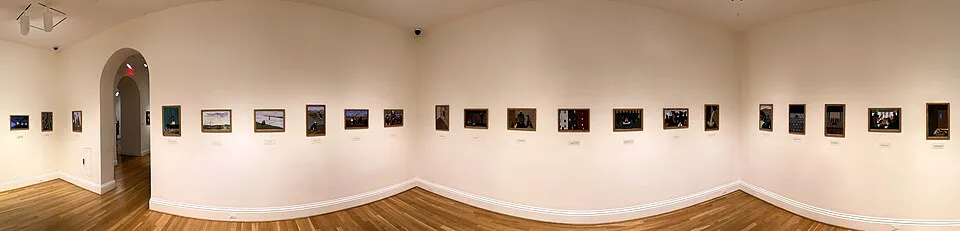
Jacob Lawrence, "The Migration Series" (1940-41). "Lawrence made his breakthrough in 1941 with his iconic series of paintings entitled 'The Great Migration', a series consisting of 60 panels, half of which are on display at the Phillips Collection, the other half at MoMA in New York" (DC Moore Gallery). "The sixty panels are shared between MoMA in New York and The Phillips Collection in Washington, D.C., a split that happened in 1942. Each has thirty panels" (Wikipedia). Image via Wikimedia Commons.
The transatlantic context matters here. Denise M. Murrell's 2024 exhibition "The Harlem Renaissance and Transatlantic Modernism" at the Metropolitan Museum of Art in New York made clear, particularly in the "transatlantic" reference in its title, that the term "Harlem Renaissance" is somewhat limiting, given that the flowering of Black intellectual and cultural production in that period occurred on a broader stage and in a much wider range of locales. For more on the works that anchor this history, see our guide to famous paintings explained.
The Harlem Visual Tradition: Savage, Alston, and the Community Art Center
Augusta Savage (1892-1962) was a sculptor and educator who was one of the most influential teachers and mentors of Lawrence. She founded the Savage Studio of Arts and Crafts (1932) and was a driving force behind the Harlem Community Art Center (1937), a Federal Art Project institution that provided free art instruction to the Harlem community. Her "Lift Every Voice and Sing" (also known as "The Harp") was created for the 1939 New York World's Fair, a monumental sculpture of a harp formed by standing figures, destroyed after the fair closed. The destruction is its own history lesson.
Charles Alston (1907-1977) was a painter and sculptor who taught Lawrence at the Harlem Art Workshop. He was the first African American instructor at the Art Students League (1950) and later taught at the City University of New York. The Harlem Community Art Center (1937-1942) was a Federal Art Project institution that provided free art instruction to the Harlem community. It was the institutional backbone of the Harlem visual tradition, the place where Lawrence, Norman Lewis, and others learned to paint. The Center closed in 1942, but its alumni shaped American art for decades.
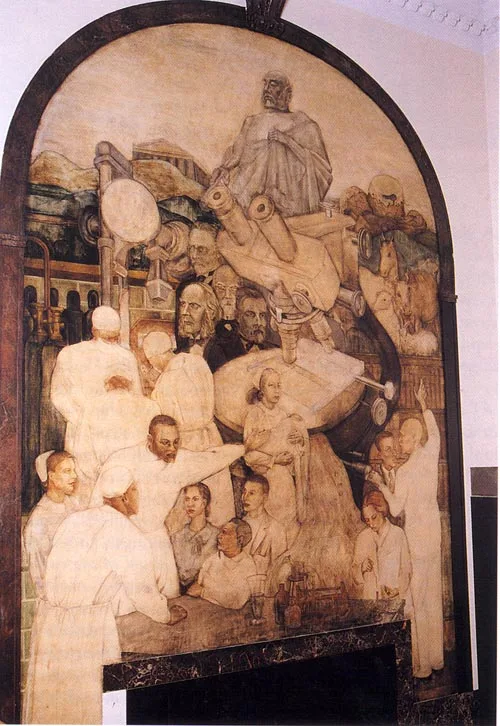
Charles Alston, "Modern Medicine" (1936). Oil on canvas, Harlem Hospital. Alston (1907-1977) was a painter and sculptor who taught Lawrence at the Harlem Art Workshop and was the first African American instructor at the Art Students League (1950). The mural was commissioned by the Federal Art Project, the same New Deal program that funded the Harlem Community Art Center. Image via Wikimedia Commons.
The Harlem visual tradition was not just about individual artists. It was about institutions: the Harlem Community Art Center, The Crisis magazine, the 135th Street Library. These provided the infrastructure for Black artistic production. Without these institutions, Douglas and Lawrence would not have had the networks, the training, and the audience that made their work possible. For the social framework behind this, see our piece on art and society.
Black Modernism and European Modernism
Douglas and Lawrence were not isolated from European modernism. Douglas studied with Fritz Winold Reiss, a German émigré artist, and absorbed the lessons of cubism and art deco. Encouraged by Locke, Reiss, Du Bois, and others to study African art as a rich source of cultural identity, Douglas also absorbed the lessons of European modernism as he forged his own visual language. Lawrence engaged with the color and form of Matisse, the sequencing of film, and the narrative traditions of Mexican muralism.
The difference is structural. Black Modernism was not an imitation of European modernism. It was a parallel development, using the tools of modernism (abstraction, fragmentation, bold color) to tell stories that European modernism did not tell: the Middle Passage, slavery, emancipation, the Great Migration, the Harlem Renaissance. Douglas combined angular cubist rhythms, seductive art deco style, and traditional African and African American imagery to develop his own unique visual vocabulary.
The African art connection carries the point further. Just as Picasso and the Cubists borrowed from African masks, Douglas borrowed from African art, but from a position of cultural inheritance, not exotic appropriation. Encouraged by Locke, Reiss, Du Bois, and others to study African art as a rich source of cultural identity. The difference matters: for Picasso, African art was a resource to be mined. For Douglas, it was a heritage to be reclaimed. For a structured way to study these distinctions, see our guide on how to teach yourself art history.
Why This Tradition Matters
Black Modernism has been systematically excluded from the canon of American modernism. "Aaron Douglas: African American Modernist reaffirmed his position in the annals of what remains the largely white epic of American modernism" (American Studies Journal). The phrase "remains the largely white epic" is key. The exclusion is ongoing.
The correction is underway. The 2025 European retrospective of Lawrence at Kunsthal KAdE, the 2024 Met exhibition "The Harlem Renaissance and Transatlantic Modernism," and the 2007-2008 Douglas retrospective are part of a broader correction, bringing Black Modernism into the art historical canon, not as an addendum but as a constitutive element of American modernism. The present makes the case. "A timely reconsideration of his art would be so useful to the American public right now" (Artforum). Lawrence's Migration Series depicts a history that is still living. The Great Migration shaped American cities, American politics, and American culture in ways that are still unfolding. The series is not just art history. It is American history. If you are new to this material, start with our guide on art for beginners, and for how to read the work itself, see our guide on how to look at art.
Final Thoughts
Aaron Douglas (1899-1979) was "the preeminent visual artist of the Harlem Renaissance" (Smithsonian). He arrived in Harlem in 1925, after reading the "Harlem: Mecca for the New Negro" issue of Survey Graphic. "Douglas combined angular cubist rhythms, seductive art deco style, and traditional African and African American imagery to develop his own unique visual vocabulary" (Smithsonian). God's Trombones (1927) was "a breakthrough publication." Aspects of Negro Life (1934) is his mural masterpiece. The 2007-2008 retrospective "reaffirmed his position in the annals of what remains the largely white epic of American modernism" (American Studies Journal). Jacob Lawrence (1917-2000) "made his breakthrough in 1941 with his iconic series of paintings entitled 'The Great Migration', a series consisting of 60 panels" (DC Moore). "The sixty panels are shared between MoMA in New York and The Phillips Collection in Washington, D.C., a split that happened in 1942" (Wikipedia). In September 2025, Kunsthal KAdE in Amersfoort opened "Jacob Lawrence: African American Modernist," "the first retrospective exhibition ever in Europe," featuring "seventy paintings, twenty-five drawings, and seventy-five prints" (Brooklyn Rail). "The most comprehensive retrospective of Lawrence's work in decades will not be seen in the US" (Artforum). The 2024 Met exhibition "The Harlem Renaissance and Transatlantic Modernism" showed that "the term 'Harlem Renaissance' is somewhat limiting, given that the flowering of Black intellectual and cultural production in that period occurred on a broader stage and in a much wider range of locales" (Artforum). Augusta Savage (1892-1962) founded the Harlem Community Art Center (1937). Charles Alston (1907-1977) taught Lawrence. The Harlem visual tradition was built on institutions, The Crisis, the 135th Street Library, the Community Art Center, that provided the infrastructure for Black artistic production. Black Modernism was not a subset of American modernism. It was a parallel tradition, using the tools of modernism to tell stories that European modernism did not tell.
Go to the Schomburg Center for Research in Black Culture in Harlem. It holds Douglas's "Aspects of Negro Life" murals and the archives of the Harlem Renaissance. Go to MoMA and The Phillips Collection. They each hold 30 panels of the Migration Series. If you are in the Netherlands before January 4, 2026, go to Kunsthal KAdE in Amersfoort for the Lawrence retrospective, "seventy paintings, twenty-five drawings, and seventy-five prints." Then read Alain Locke's "The New Negro" (1925), the anthology that gave the Harlem Renaissance its intellectual framework. Look at the Migration Series. Look at the 60 panels. Look at the story they tell, the movement of six million African Americans from the rural South to the urban North. It is not just art history. It is American history. And it is still unfolding. For reference, read the National Gallery of Art's Aaron Douglas page, the Smithsonian's Aaron Douglas: African American Modernist, and the Brooklyn Rail review of Jacob Lawrence: African American Modernist. For where this tradition sits today, see our guide to contemporary art trends.


