
When Pablo Picasso visited the Trocadéro museum in Paris in 1907, he encountered African and Oceanic sculpture in the ethnographic collection and later described the experience as a revelation. The fractured planes and multiple simultaneous perspectives in the masks and figures he saw there fed directly into what became Cubism. "Les Demoiselles d'Avignon" shows the debt clearly, particularly in the two right-hand figures whose faces reference Fang reliquary heads and masks from the region that is now Gabon. Picasso downplayed this influence publicly for most of his life.
The irony runs deep. African art transformed modern Western art, yet the Africans who made it received no credit, no payment, and often no acknowledgment. The objects had frequently arrived in Europe as the result of colonial raids and theft. They were displayed in natural history and ethnography museums as artifacts of "primitive" culture rather than as works by sophisticated artists with names, training, and traditions. The label "primitive art," applied to African, Oceanic, and pre-Columbian work throughout much of the twentieth century, is one of the most consequential misclassifications in art history, and its effects have not fully been undone.
This guide covers the major traditions of African art, the historical forces that shaped how it was received and misunderstood in the West, what is currently happening with the repatriation of objects like the Benin Bronzes, and the contemporary African art scene that is producing some of the most compelling work anywhere in the world right now.
Africa Is Not a Style
The single biggest error in most Western discussions of "African art" is treating a continent of 54 countries, thousands of distinct cultures, and more than 2,000 languages as if it were a single unified tradition. Africa is the second-largest continent on earth, and its artistic traditions are correspondingly vast.
The ancient Egyptian civilization along the Nile produced one of the most distinctive and long-lived visual traditions in human history. The civilizations of West Africa produced bronze castings of extraordinary technical sophistication. The rock paintings of Southern Africa span tens of thousands of years of continuous practice. The wood carving traditions of Central Africa, the textile traditions of East Africa, the beadwork traditions of the Maasai, the illuminated manuscripts of Ethiopia: each is a distinct tradition with its own history, its own visual logic, and its own practitioners who understood themselves as artists within a specific cultural context, not as contributors to a generalized "African art."
What follows focuses on several of the most historically significant and widely studied traditions, with the acknowledgment that this is necessarily a partial account of something far larger.
The Benin Bronzes: Art as Political Record, and What Is Happening Now
In 1897, a British punitive expedition attacked and sacked Benin City, capital of the Kingdom of Benin in what is now Edo State, southern Nigeria. Among the objects looted were several thousand bronze, brass, and ivory works that had been commissioned by successive Obas (kings) of Benin over several centuries. These objects, known collectively as the Benin Bronzes, are among the finest metalwork ever produced anywhere in the world before the industrial era.
The brass plaques, portrait heads, and royal regalia demonstrated a mastery of lost-wax casting, the cire perdue technique, that astonished European audiences. The portrait heads in particular, with their serene, idealized faces and elaborate collar decorations, revealed a tradition of court portraiture as technically accomplished as anything in Renaissance Europe. Most dated to between the 13th and 19th centuries, meaning the Kingdom of Benin had been producing work of this quality for five centuries before the British arrived. The objects documented the history, ceremonies, and political structures of the Benin court. As the Oba of Benin, Ewuare II, has stated: they are "records of governance, spirituality and artistry of the Edo people taken by force."
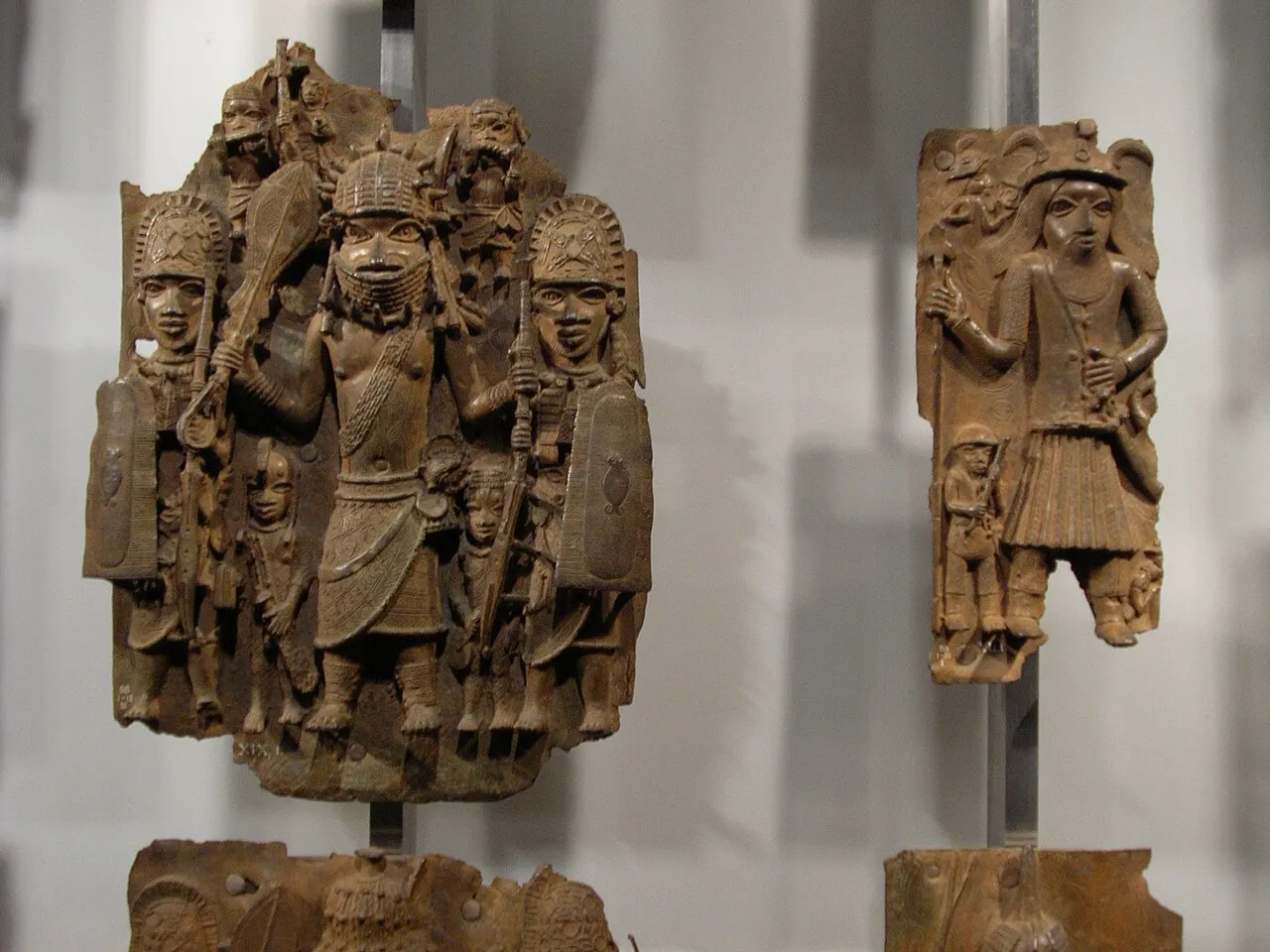
Benin Bronzes on display, showing brass plaques and portrait heads from the Kingdom of Benin, Nigeria (13th to 19th century). The sophistication of the lost-wax casting technique astonished European audiences in 1897 and continues to be recognized as among the finest metalwork ever produced. Image: Public domain, via Wikimedia Commons
The Benin Bronzes are distributed across more than 160 museums and private collections worldwide, with the largest holdings at the British Museum in London and German institutions. The repatriation debate has moved significantly in 2025 and 2026. The Netherlands returned 119 Benin Bronzes to Nigeria in 2025, the largest single physical restitution to date. In February 2026, the University of Cambridge transferred legal ownership of 116 Benin Bronzes to Nigeria's National Commission for Museums and Monuments. In June 2026, three Swiss museums returned 18 Benin Bronzes to Nigeria in a ceremony in Lagos, following an agreement signed in March 2026 committing to the eventual transfer of 28 objects total. The Oba of Benin received the objects at the royal palace in Benin City. Germany agreed in 2022 to transfer ownership of its Benin objects and physical returns have been phased since then. The British Museum, constrained by legislation preventing deaccessioning from its collection, has not returned any bronzes despite repeated formal requests from the Nigerian government. The Oba of Benin has called on Germany to honour its 2022 agreement and has appealed to all institutions still holding looted objects to complete returns.
African Masks: What They Are and What They Are Not
African masks are probably the African art form most familiar to Western audiences, and also the most frequently misunderstood. The English word "mask" implies something worn over the face to conceal identity. Many of these objects are not worn over the face at all. They are held, mounted on elaborate full-body costumes, or used in ways that have no direct Western equivalent.
More fundamentally, they are not primarily visual art objects. They are functional objects used in specific social, spiritual, and ceremonial contexts. A mask made for a masquerade ceremony in a Yoruba community in Nigeria, a mask used in a Poro society initiation ritual in Sierra Leone, a Kuba royal dance mask from the Democratic Republic of Congo: each exists within a specific cultural framework that determines its form, materials, use, and meaning. In many traditions, the mask does not conceal identity. It transforms the wearer, making them temporarily embody an ancestral or spiritual power. Removed from that context and placed in a glass case in a Western museum, the object retains its visual qualities but loses most of what makes it the thing it was made to be.
This does not mean African masks cannot be appreciated aesthetically. Many are works of extraordinary visual intelligence, solving difficult sculptural problems with economy and force. The Dan face masks of Liberia and Côte d'Ivoire are celebrated for their serene, almost abstract beauty. The Fang reliquary figures of Gabon achieve a dynamic tension between mass and line that directly influenced Cubism. The Kuba geometric patterns on ceremonial objects demonstrate design sophistication that would look at home in any twentieth-century abstract tradition. But aesthetic appreciation alone is a thin engagement with work whose full meaning requires understanding the social and spiritual systems that produced it.
Ancient Traditions Worth Knowing
African sculptural traditions go back much further than most Western audiences realize. The Nok terracottas of central Nigeria, dated to approximately 1000 BCE to 300 CE, are among the oldest known figurative sculptures in sub-Saharan Africa. They show human and animal figures with distinctive features: triangular or oval eyes, elaborate hairstyles, and tubular forms. The tradition appears fully developed in its earliest known examples, suggesting an even older antecedent not yet found.
The terracottas and bronzes of the Ife civilization (roughly 1000 to 1400 CE) in what is now southwestern Nigeria represent one of the great achievements in portrait sculpture from any culture or period. The Ife heads, in both terracotta and brass, are strikingly naturalistic, with fine parallel striations on the faces that likely represent ritual scarification. When the first Ife heads came to European attention in the early twentieth century, scholars initially refused to believe they were African, attributing them variously to ancient Greeks, Egyptians, or even the mythical continent of Atlantis. The idea that sub-Saharan Africans could have produced such technically sophisticated naturalistic portraiture independently was incompatible with prevailing assumptions. Those assumptions were wrong, and the scholarly consensus has long since corrected them, though the correction has been slow to reach general public understanding.
The Contemporary African Art Scene
The contemporary African art scene is one of the most active in the world, with major hubs in Lagos, Johannesburg, Nairobi, Cairo, Dakar, and Accra. Each city has active commercial gallery scenes, artist-run spaces, and growing museum infrastructure. Artists working today engage directly with postcolonial identity, the legacies of the slave trade and colonialism, urbanization, globalization, and the tension between traditional culture and modernity.
El Anatsui (born 1944, Ghana) creates large-scale hanging installations from repurposed materials, most famously from liquor bottle caps and aluminum seals that are flattened, woven, and stitched together into tapestries that can cover entire building facades. The works reference Ghanaian kente cloth weaving, the history of the alcohol trade and colonialism in West Africa, and the formal possibilities of flexible metal at monumental scale. They have been exhibited at the Venice Biennale and major institutions worldwide, and each installation is assembled differently for each venue, making every showing a unique configuration of the same material.
Njideka Akunyili Crosby (born 1983, Nigeria) creates densely layered paintings that place Nigerian domestic interiors and family photographs alongside Western art historical references, exploring the experience of living between two cultural contexts simultaneously. Her work is held in major collections including MoMA and the Los Angeles County Museum of Art. It sold for over $3 million at auction in 2017, which was at that time a significant market signal about the changing valuation of work by African artists.
Zanele Muholi (born 1972, South Africa), who uses the honorific title "visual activist," creates photographic and sculptural work documenting the lives of LGBTQ+ people in South Africa with directness and formal rigor. They received the Hasselblad Award in 2020, one of photography's highest distinctions.
How to Approach African Art More Honestly
The history of how African art has been received in the West is inseparable from the history of colonialism, racism, and cultural extraction. Objects were removed without consent, stripped of context, renamed according to Western classification systems, and displayed in ways that reinforced narratives of African inferiority. "Primitive art" as a category was invented not to describe a level of technical skill (the Benin Bronzes are technically superior to much Western Renaissance metalwork) but to justify a political and ideological hierarchy.
Understanding African art well means understanding this history and its ongoing consequences for how objects are owned, displayed, and interpreted. It also means approaching African art with the same interest in specific cultural context that you would bring to European art: asking not just "what does it look like?" but who made it, for what purpose, within what tradition, and what do the people of that tradition say about it today.
This does not mean abandoning aesthetic engagement. El Anatsui's cascading metal tapestries are formally extraordinary on purely visual terms. Ife bronze heads are technically breathtaking by any standard. But aesthetic appreciation alone is a thin engagement with work whose full meaning requires contextual knowledge, and that contextual knowledge is available to anyone willing to look for it.
For more on how political and social forces shape what gets shown in museums and what gets excluded, the guide to how museums decide what to display covers these questions in depth. If you want to explore more non-Western art traditions, the guides to Pre-Columbian art and Islamic geometric art examine other traditions whose complexity has been underappreciated in Western art history. What aspect of African art do you want to learn more about? Share your thoughts below.


