
On February 3, 1908, the Macbeth Gallery on Fifth Avenue opened a show called "The Eight." It featured 63 works by eight painters: Robert Henri, John Sloan, William Glackens, George Luks, Everett Shinn, Arthur B. Davies, Maurice Prendergast, and Ernest Lawson. The show was a direct challenge to the National Academy of Design, which had rejected work by Henri's circle for being too rough, too urban, and too unconcerned with beauty in the academic sense. Within a month, the exhibition had drawn more visitors than any show in the gallery's history. The press coined the term "Ashcan School" two years later, and it stuck.
The Ashcan School was not a formal group with a manifesto. It was a loose circle of painters who shared a conviction that American art had to stop imitating French Impressionism and start looking at the city around it. They painted immigrants, saloons, construction sites, street fights, and children playing in gutters. They were newspaper illustrators who had learned to draw fast and from life, and they brought that speed and directness to painting. The result was the first distinctly American art movement of the 20th century.
This guide covers the origins, the key artists, the 1908 exhibition that launched them, and the recent scholarship that has complicated the received story. The Art Students League's 2025-2026 exhibition "150 Years: Reexamining Realism" (September 11, 2025 to February 2, 2026) is the most recent institutional examination of this movement, featuring works on paper by George Bellows, Theresa Bernstein, Robert Henri, Everett Shinn, and John Sloan from the League's collection.
Robert Henri and the Philadelphia Origins
Robert Henri (1865-1929) was the center of the group. He studied at the Pennsylvania Academy of the Fine Arts under Thomas Anshutz, who had himself studied with Thomas Eakins. Eakins was the movement's spiritual ancestor. He had defied Victorian decorum by painting surgical procedures, male nudes, and working-class people with the same seriousness that academic painters reserved for mythological subjects. Henri absorbed this approach and passed it on.
In Philadelphia in the 1890s, Henri became the mentor to four newspaper illustrators: William Glackens, George Luks, Everett Shinn, and John Sloan. They worked for the Philadelphia Press and other papers, drawing everything from crime scenes to sporting events. Newspaper illustration in the 1890s was a form of visual journalism that required speed, accuracy, and the ability to capture a scene from memory. These skills, developed under deadline pressure, became the foundation of the Ashcan style. Between 1896 and 1904, all four moved to New York, where Henri had settled in 1900.
Henri's teaching was direct. He told his students to paint what they saw, not what they were told to paint. He rejected the academic hierarchy that placed historical and mythological subjects above contemporary life. His own paintings from this period, including "Snow in New York" (1902), show the city in broad, calligraphic brushstrokes with a dark palette inherited from chiaroscuro traditions of Velazquez, Hals, and Goya. Henri taught at the Art Students League, where his students included George Bellows and Edward Hopper.
The 1908 Exhibition of The Eight
The Macbeth Gallery show was organized because the National Academy of Design had consistently rejected work by Henri's circle. The National Academy's annual exhibitions were the main venue for American artists to show and sell their work, and its jury favored academic painting in the European tradition. Henri and his associates saw this as a structural problem, not a matter of taste. They mounted their own show with the help of Macbeth Gallery owner William Macbeth, who was willing to take a risk on work that other dealers considered unsalable.
The show included five of the painters who would become known as the Ashcan School (Henri, Sloan, Glackens, Luks, Shinn) plus three others who did not share their urban realist approach. Arthur B. Davies painted dreamlike mythological scenes. Maurice Prendergast painted decorative, post-Impressionist crowd scenes. Ernest Lawson painted landscapes in a style close to Impressionism. The inclusion of these three was strategic: Henri wanted to show that the exhibition was about artistic independence, not about a single style. The press and public focused on the urban realists, and the term "Ashcan School" emerged from a drawing by Bellows captioned "Disappointments of the Ash Can," which appeared in the Philadelphia Record in April 1915. Cartoonist Art Young used the term in a disparaging review in the New York Sun in April 1916, and curators Holger Cahill and Alfred H. Barr Jr. gave it institutional currency in a 1934 exhibition at the Museum of Modern Art.
George Bellows and the Boxing Paintings
George Bellows (1882-1925) was the most talented painter in the group and the one who achieved the most during his lifetime. He came to New York in 1904 to study with Henri at the Art Students League, having dropped out of Ohio State University. He was 22. Within four years he was elected an associate member of the National Academy, the youngest person ever to receive that honor.
Bellows's boxing paintings are his most famous works and the ones that best represent the Ashcan approach. "Both Members of This Club" (1909) shows two fighters in a private club, one Black and one white, locked in a brutal exchange. The painting's original title was a racial slur, and its revised title refers to the fact that both fighters had to be club members to fight legally under New York's boxing ban. The painting is physically imposing: 114 by 160 centimeters, with blood visible on the fighters' bodies and the crowd pressed close around the ring. The brushwork is loose and energetic, capturing the speed of the action.
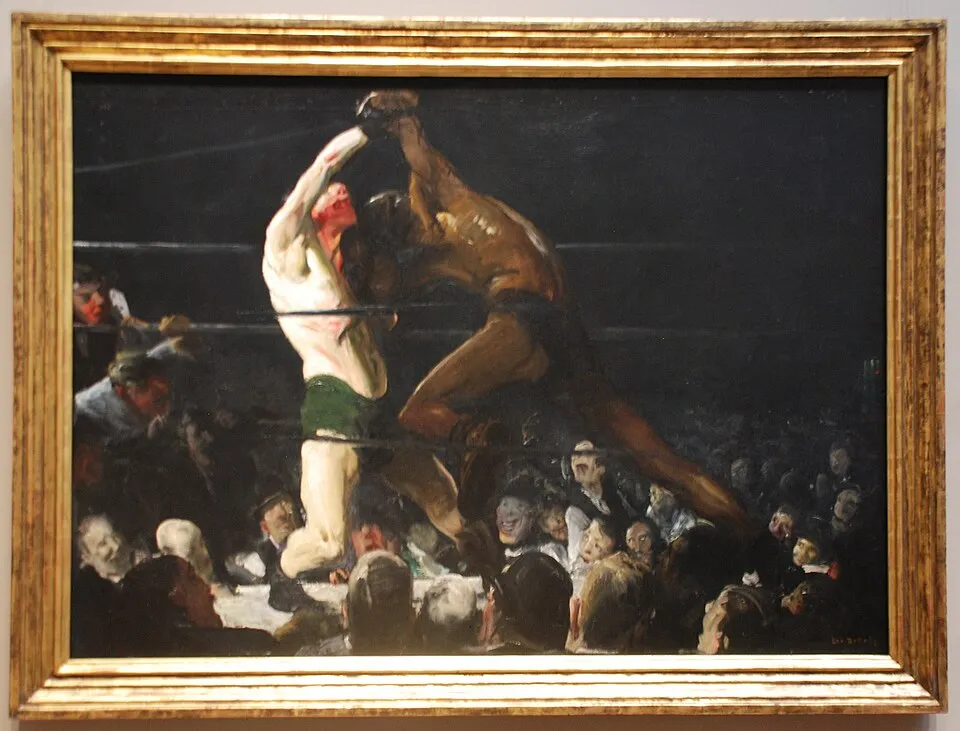
George Bellows, "Both Members of This Club" (1909). Oil on canvas. National Gallery of Art, Washington, D.C. Wikimedia Commons.
"Stag at Sharkey's" (1909) is the other major boxing painting. It shows a fight at Tom Sharkey's saloon on Broadway, where private "stag" bouts were held for male audiences. The fighters' bodies are twisted in dynamic, unstable poses, and the crowd behind them is a dark mass of faces. Bellows painted these from memory and from quick sketches made at the fights. He could not have painted them in the studio from posed models because the energy would have been wrong. The boxing paintings work because they capture something that academic painting could not: the physical sensation of bodies in violent motion.
Recent scholarship has complicated the reading of "Both Members of This Club." A 2024 essay in the journal Panorama, part of a suite of essays examining Blackness and the Ashcan School, argues that the painting has been consistently misread as progressive. The National Gallery of Art promoted it on social media in September 2024 as "a daring social commentary for its time that challenged prevailing notions about white supremacy." The Panorama authors point out that this reading distorts the historical timeline and ignores the systemic anti-Blackness embedded in the painting and its reception. The revised title, "Both Members of This Club," was itself a commercial decision, not a political statement. This kind of critical reexamination is reshaping how the Ashcan School is understood.
John Sloan and the Street as Subject
John Sloan (1871-1951) was the most politically engaged member of the group. He was a socialist who painted New York's streets, rooftops, and bars with sympathy for the working-class people who inhabited them. "McSorley's Bar" (1912) shows the interior of the famous East Village saloon, with men drinking and reading newspapers in warm, dark tones. "The Haymarket" (1907) depicts a dance hall on Sixth Avenue that was a well-known site of interracial socializing, though Sloan's painting does not show this aspect directly.
Sloan's work has been the subject of recent critical attention. A 2022 panel at the College Art Association annual conference, later published as a suite of essays in Panorama, examined how Ashcan artists depicted, or more often failed to depict, Black New Yorkers. Between 1900 and 1920, Manhattan's Black population grew from 60,666 to 142,467. The neighborhoods that Sloan and his colleagues painted, including the Tenderloin and the area around the Lincoln Arcade studios, were known to contemporaries as racially mixed areas. Yet Black figures appear rarely in Ashcan paintings. Art historian Martin A. Berger has noted that these artists "must have worked quite hard to intentionally exclude subjects of color from their canvases." The absence is not neutral. It is a choice, and recent scholarship is beginning to hold the Ashcan School accountable for it.
George Luks and the Lower East Side
George Luks (1866-1933) was the most flamboyant personality in the group. He had worked as a newspaper illustrator in Philadelphia and New York, and he painted with the same aggressive directness he brought to everything. "Hester Street" (1905) shows a Jewish immigrant market scene on the Lower East Side, with women in shawls and men in caps bargaining over goods. The painting is sympathetic without being sentimental. Luks painted the people as individuals, not as types, though his depictions of ethnic minorities have also been criticized for relying on stereotypes.
Luks's "The Spielers" (1905) shows two girls dancing on a street, their faces blurred with motion. The painting captures something that photography at the time could not: the experience of seeing children play in the street, moving too fast for a posed image. Luks learned to capture motion from his years as a newspaper illustrator, where he had to draw sporting events and street scenes from memory after the fact.
What the Ashcan School Got Wrong
The Ashcan painters were not social reformers. They identified with the working class but lived middle-class lives. They painted poverty but did not organize against it. The Met's essay on the Ashcan School notes that "they avoided civil unrest, class tensions, and the grit of the streets," and that "their works are never as direct or disturbing as those of their European counterparts or of the reformist images of American photographers such as Jacob Riis."
This is a fair criticism. Compare Bellows's "Forty-two Kids" (1907), which shows boys swimming in the East River, with Jacob Riis's photographs of tenement interiors from the 1880s. Riis documented overcrowding, disease, and exploitation. Bellows painted children having fun. Both are accurate to aspects of lower-class life on the Lower East Side, but Riis's work has a moral urgency that Bellows's lacks. The Ashcan painters saw the city as a source of visual excitement. Riis saw it as a site of systemic injustice. The difference matters.

George Bellows, "Forty-two Kids" (1907). Oil on canvas. Corcoran Collection, National Gallery of Art. Wikimedia Commons.
The Ashcan School's treatment of race is the other major problem. Alexis Boylan's 2017 book "Ashcan Art, Whiteness, and the Unspectacular Man" argued that these artists' depictions of urban life reinforced white male supremacy. The Panorama essays published in 2024 extended this critique, showing how the Ashcan painters' selective vision of the city excluded Black New Yorkers even from neighborhoods where they were visibly present. This does not make the paintings worthless. It makes them historically specific documents produced by people with blind spots, and recent scholarship is doing the necessary work of identifying those blind spots.
The Legacy and Recent Reassessment
The Ashcan School's direct legacy runs through Edward Hopper, who studied with Henri and absorbed his commitment to American subjects. It runs through Social Realism, which took the Ashcan interest in urban life and added the political urgency that the Ashcan painters lacked. And it runs through American Regionalism, which applied the same commitment to contemporary subjects to rural rather than urban life.
The market for Ashcan work has been strong in recent years. A 2026 market analysis noted that Bellows commands the most serious prices and institutional attention, with his boxing paintings drawing collectors with broader modernist appetites who respond to the physical authority of the work. Jerome Myers, who worked in a more intimate register depicting pushcart markets and street festivals on the Lower East Side, has attracted renewed scholarly interest because of his sustained attention to Jewish immigrant life. The Whitney Museum of American Art has been active in situating Ashcan works within their social and political contexts rather than treating them as charming period documents.
Final Thoughts
The Ashcan School was the first American art movement that looked at cities without apologizing for it. Robert Henri told his students to paint what they saw, and what they saw was New York: immigrants, boxers, street kids, saloons, and construction sites. The best of this work, especially Bellows's boxing paintings and Sloan's street scenes, has a physical energy that still communicates across more than a century. The limitations are real. The Ashcan painters avoided the worst of the poverty they depicted, excluded Black New Yorkers from their vision of the city, and confused sympathy with understanding. Recent scholarship from the Panorama journal and the Art Students League's 2025-2026 exhibition is doing the necessary work of holding both the achievement and the limitations in view at the same time.
If you want to go deeper, visit the Met Museum's essay on the Ashcan School and the National Gallery's page on "Both Members of This Club". You can also explore our posts on composition in art and our art movements timeline for broader context. For the connection to later American art, see our pieces on Hopper and American solitude and art history in 10 minutes.


