
"Nighthawks" (1942) is one of the most immediately recognizable paintings in American art. Four people in a late-night diner, a sharp corner of glass and steel lit from within against an empty dark street, figures who seem to be together and yet fundamentally alone. The painting has been reproduced so many times, parodied so often, and referenced so widely in film, advertising, and popular culture that you might think it has been emptied of its original power. Stand in front of the original at the Art Institute of Chicago and discover that it has not. The silence and the alienation hit you immediately, and they hit you hard. Hopper himself said of it: "Unconsciously, probably, I was painting the loneliness of a large city."
Edward Hopper painted American loneliness the way Rembrandt painted Dutch light: as a subject in itself, not just a setting or a mood, but the actual content of the work. His diners, gas stations, empty hotel rooms, sunlit storefronts, and solitary figures by windows are not pessimistic images of a failed society. They are precise observations of what it actually feels like to be a modern person in a modern place: surrounded by the infrastructure of civilization, technically in proximity to others, and yet somehow deeply isolated. That combination of technical precision and psychological truth is what makes Hopper one of the essential American painters.
This profile examines Hopper's life in New York, his development from commercial illustrator to serious artist, his technique, and why his work continues to generate more cultural resonance than almost any other American painter of the 20th century.
Early Life and the Long Road to Recognition
Edward Hopper was born on July 22, 1882, in Nyack, New York, a small Hudson River town about thirty miles north of New York City. His parents were middle-class Baptists who supported his interest in art. He studied illustration and then fine art in New York from 1900 to 1906 at the New York School of Art under Robert Henri, a leading figure of American Realism who taught his students to paint contemporary life with directness and without sentimentality.
Hopper made three trips to Europe between 1906 and 1910, spending most of his time in Paris. He saw and absorbed Impressionism, Post-Impressionism, and the work of Manet and Degas, but he was not swept up in the modernist experimentalism that was transforming European painting at the time. He was not interested in Cubism or abstraction. He remained committed to representational painting, to the direct depiction of observed reality, and to the particular quality of American light, which he found more interesting than anything in Europe. The year before he painted "Nighthawks," Van Gogh's "Cafe Terrace at Night" was exhibited in New York, which Hopper saw and admired. The nighttime setting and the contrast between artificial interior light and dark street in his 1942 painting carry echoes of Van Gogh's approach.
After returning to the United States, he spent nearly two decades earning his living as a commercial illustrator and etcher, which he found deeply frustrating. He sold almost nothing at his first solo painting exhibition in 1920. His work sold slowly, recognition came late, and he was forty-one before he could make a serious claim to being a painter rather than an illustrator. The breakthrough came in 1924, when a show of his watercolors sold out and allowed him to reduce his commercial work. His first major oils sold at the 1925 show.
The Technique of Loneliness
Hopper's paintings look technically straightforward but are in fact meticulously constructed. He made extensive preparatory drawings before touching a canvas, studying the geometry of his subjects with the care of an architect. His wife Josephine Nivison, who married him in 1924 and was herself a significant painter, recorded in her diary the weeks and months of preparation that preceded each major painting. Hopper was a slow and deliberate worker who could spend a full year developing a single canvas.
The key to his visual language is the treatment of light. Hopper was obsessed with the way light falls in America: the particular quality of afternoon sun in New England, the harsh artificial brightness of a city at night, the long horizontal light of morning through a window. He used light not just to illuminate his subjects but to create compositional structure and emotional atmosphere simultaneously. In "Morning Sun" (1952), a woman sits on a bed facing a window, bathed in strong morning light. The simplicity of the image is deceptive: every element of the composition, the angle of light, the bareness of the room, the woman's absorbed gaze, combines to produce a feeling of profound solitude that is neither depressing nor sentimental.
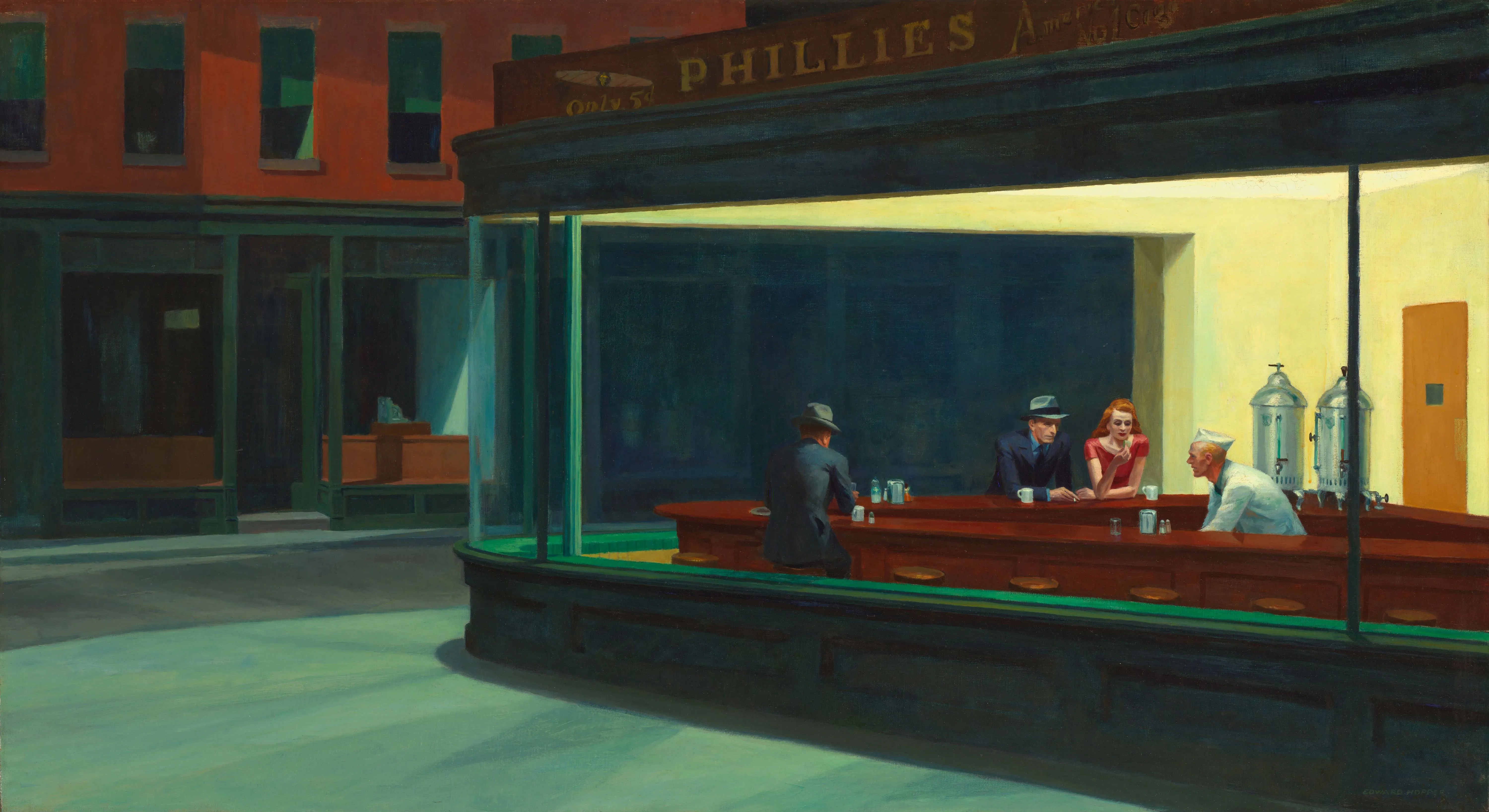
Edward Hopper, "Nighthawks" (1942), oil on canvas, 84.1 x 152.4 cm. Art Institute of Chicago. Painted in the weeks following Pearl Harbor, the painting captures an atmosphere of urban isolation that resonated deeply with wartime America. Image: Public domain, via Wikimedia Commons
Hopper's compositional choices are also worth studying closely. He frequently used architectural elements, walls, windows, doorways, and partitions, to divide his canvases into areas of contrasting light and dark. These divisions create a sense of psychological separation: figures are framed, isolated, contained within sections of the picture plane. The viewer often feels positioned outside looking in, watching people who are unaware of being observed. This voyeuristic quality is part of what gives Hopper's paintings their uneasy intimacy, the sense that you are witnessing something private without permission.
The American Landscape: Gas Stations, Motels, and Empty Roads
Hopper and his wife spent their summers in Cape Cod, Massachusetts, where Hopper painted the architecture, the light, and the landscape of New England with the same quiet precision he brought to his urban work. But some of his most powerful images are of the American landscape in transition: the moment when the older, agricultural America gave way to the automobile culture of highways and roadside businesses.
"Gas" (1940) shows a lone gas station attendant working at dusk on an empty road, the forest darkening at the edge of the painting. The station is lit and organized, a fragment of human civilization, but it is surrounded by gathering darkness. The road disappears into the trees with no indication of where it leads or when anyone else will come. It is not a dramatic image. It is a quiet one. And that quietness carries a specific American melancholy that is entirely Hopper's own.
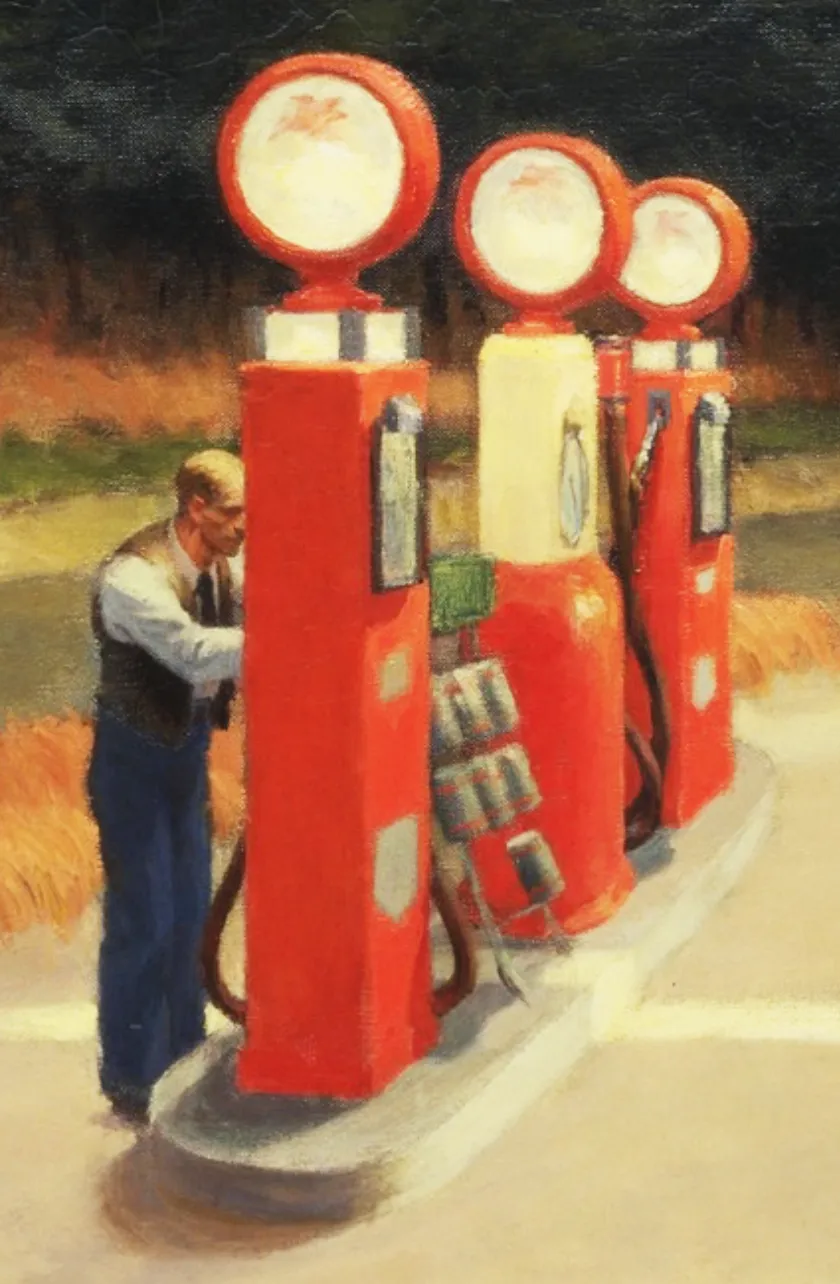
Edward Hopper, "Gas" (1940), oil on canvas, 66.7 x 102.2 cm. Museum of Modern Art, New York. The painting distills the atmosphere of the American roadside: human presence in a landscape that feels indifferent to it. Image: Public domain, via Wikimedia Commons
"Automat" (1927), "Room in New York" (1932), "New York Movie" (1939), "Hotel by a Railroad" (1952): across forty years of major work, Hopper returned again and again to the same essential subject: a person alone, or people near each other but essentially alone, in a physical environment that is both recognizable and somehow slightly strange. The observation is consistent and it is never cruel. Hopper did not mock or condescend to his figures. He simply looked at them with the accuracy of someone who understood the feeling from the inside.
Josephine Hopper and the Shared Life
Hopper's wife Josephine was an essential part of his working life, though she has been overshadowed by his fame in most accounts. She modeled for virtually every female figure in his paintings, kept detailed diaries of his working process that have become the primary source for scholars studying his methods, and maintained a catalogue raisonne of his work that documented every painting he produced after their marriage. She was also a painter herself, showing regularly in New York and earning good reviews, though she and Hopper agreed that his career would take priority. The arrangement was not always comfortable: Josephine left detailed accounts in her diary of arguments about professional recognition and the difficulty of maintaining her own artistic identity alongside his.
The Whitney Museum of American Art, which holds the largest collection of Hopper's work in the world, received his entire estate after Josephine's death in 1968, ten months after Hopper died in his studio on May 15, 1967, at age 84. The Whitney's online catalogue provides detailed documentation of hundreds of paintings, drawings, and watercolors, and the Whitney's Hopper collection pages are an excellent starting point for anyone who wants to engage with his work systematically. In July 2025, the Whitney also hosted "Step Into Hopper," an immersive public event in the Meatpacking District that recreated three of Hopper's iconic works as life-size sets, drawing thousands of visitors and demonstrating that his visual language continues to resonate far beyond the museum walls.
Final Thoughts
Edward Hopper painted the same feeling, in different guises, for fifty years: the feeling of being present but not quite connected, of inhabiting spaces that are neither hostile nor welcoming, of existing in a world that is fully rendered but somehow not fully inhabited. He had no stylistic heirs in the way that Picasso or Matisse had heirs. His approach was too personal, too specific, too resistant to being made into a formula. But his emotional territory is everywhere: in the cinematography of film noir, in the visual language of advertising that wants to suggest a certain solitude of modern life, in the photographs of Diane Arbus and Stephen Shore, in countless films that use empty American spaces to suggest psychological states. Director Ridley Scott kept a reproduction of "Nighthawks" in front of his production team throughout the making of Blade Runner (1982) as a reference for the look and mood he was after.
The recognition he sought for so long, and received so late, has proven extremely durable. More than half a century after his death, "Nighthawks" is still being reproduced, still being parodied, still being put in the background of movies set in mid-century America to establish an atmosphere. He found something true about what it means to be alive in the modern world and painted it with exceptional skill. That combination does not age.
To explore how Hopper used light and shadow in ways that parallel other masters, read our guide to How Art Communicates Emotion Without Words. For more on the compositional techniques that structure his paintings so effectively, see Understanding Composition in Art. Which Hopper painting has stayed with you longest? Tell us in the comments.


