
Here is something most people do not know about "Nighthawks": there is no door. The famous glass-walled diner wraps around its corner without any visible entrance or exit. The four figures inside are lit up and fully visible, but you cannot get to them. You stand on the dark street looking in, permanently outside. Once you notice this, the painting becomes a different, more unsettling experience than it appeared before.
Edward Hopper completed "Nighthawks" in January 1942, six weeks after the attack on Pearl Harbor. The United States had just entered World War II. New York's streets were subject to partial blackout regulations, the windows of tall buildings taped over or curtained to prevent them from silhouetting ships offshore. The city at night was darker than usual, and the usual urban loneliness had acquired a wartime edge. Hopper finished the painting in his studio on Washington Square and sold it to the Art Institute of Chicago for $3,000 in May 1942. It has not left Chicago since.
In this guide, you will learn what the painting actually shows, how Hopper constructed it, who the figures are, and why it has been reproduced and referenced more than almost any other American painting in history.
What You Are Looking At
"Nighthawks" (1942) is oil on canvas, 84.1 x 152.4 cm. The format is wide and horizontal, more like a cinema screen than a conventional canvas, and the composition treats the diner as a cross-section: you see it from straight ahead at street level, looking through the curved glass walls at the figures inside. The diner occupies the right two-thirds of the picture. The left third is the darkened street and the shuttered storefronts opposite, their interiors visible only as blackness through the windows.
Inside the diner are four figures. A counterman in white stands behind the bar, bent slightly over a task not visible to us. A man and a woman sit at the counter near the center: the man wears a dark hat and suit; the woman is red-haired, in a red dress, and holds something small in her hand. A third man sits alone at the far right of the counter with his back to the viewer. None of the four is looking at any of the others. No one is talking. They are in the same room and entirely elsewhere.
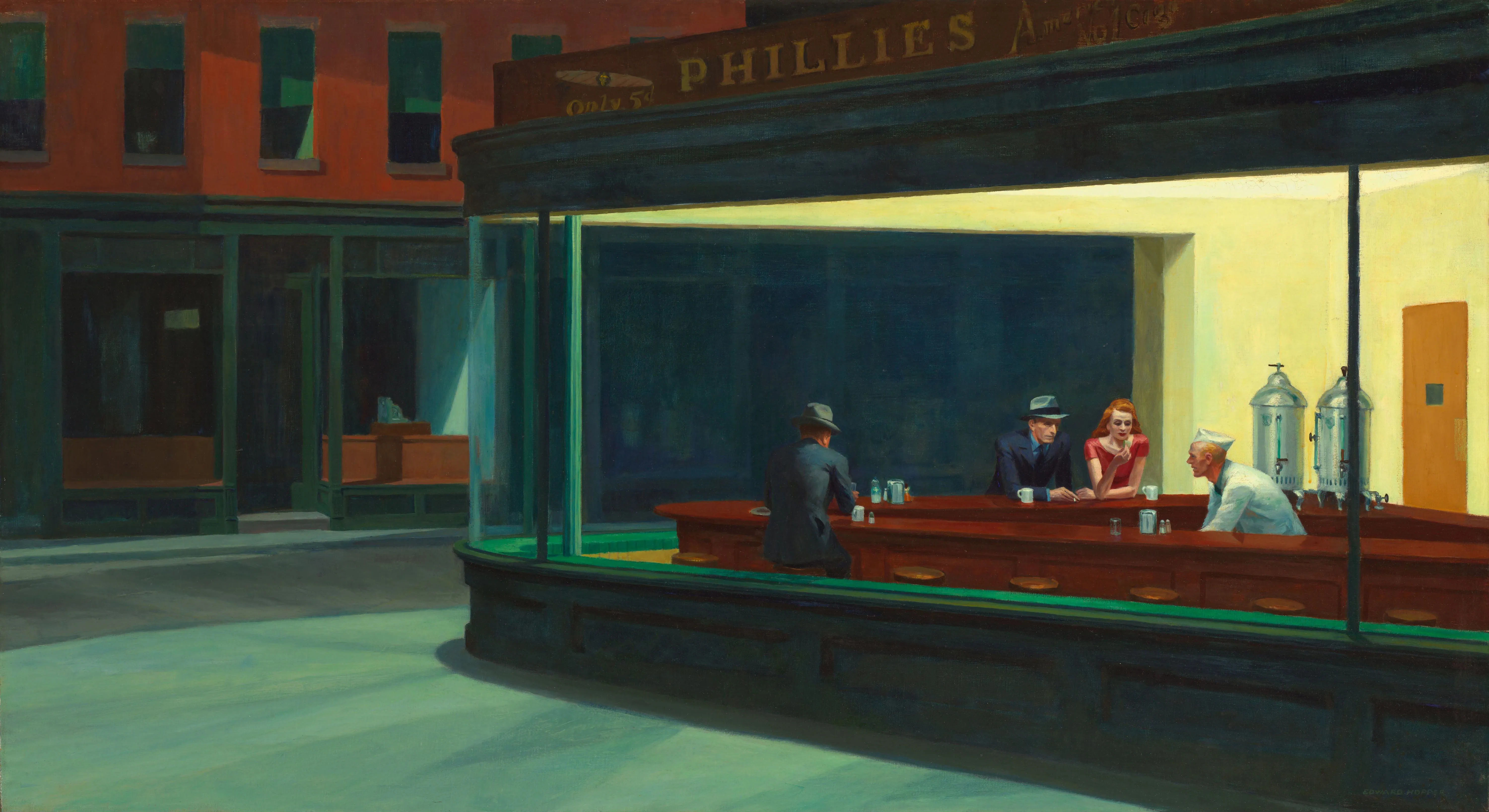
Edward Hopper, "Nighthawks" (1942), oil on canvas, 84.1 x 152.4 cm. Art Institute of Chicago. Painted six weeks after Pearl Harbor. The Art Institute of Chicago's collection page includes high-resolution detail views. Image: Public domain, via Wikimedia Commons
The Missing Door
The glass-walled diner has no visible entrance. The curved front wraps continuously from one edge of the painting to the other without interruption. This is not a realistic oversight. Hopper deliberately removed the door from a real building he had observed. The diner he based the painting on was at the corner of Greenwich Avenue and Seventh Avenue in Greenwich Village, a neighborhood he knew well. He simplified and compressed the architecture to produce a specific effect: a space that looks accessible but is not. You observe from outside. You cannot enter.
This outside perspective is characteristic of Hopper's work. Painting after painting places the viewer as a watcher looking into a lit interior from a dark exterior. A woman reading alone by a window. A man in a hotel lobby at night. An office building at dusk, one floor still lit, a figure inside. The viewer is implicated in the scene, watching, but never included. The absence of the door in "Nighthawks" makes this exclusion unusually explicit.
The Light
The diner interior is the only light source in the painting. Everything else is dark. The quality of that light is important: it is harsh, greenish-white fluorescent light from the period, the kind of commercial lighting that bleaches surfaces and makes skin look slightly wrong. The green cast of the diner walls, the yellow-green countertop, the way the red of the woman's dress reads against that background: these are not warm, welcoming colors. They are correct to the specific visual experience of being outside at night, looking through glass into a harshly lit interior.
Hopper filled dozens of notebooks across his career with observations about how light falls on buildings at different times of day and in different conditions. His wife Jo recalled that the two of them walked the streets of Manhattan for hours looking at buildings, with Hopper stopping to study how light hit a particular facade or edge. The light in "Nighthawks" is the result of that accumulated observation. It is not generic night light. It is specific, 1940s, fluorescent, urban, cold American night light.
The Figures: Jo and Edward
The red-haired woman in the painting is Jo Hopper, Edward's wife. She modeled for virtually every female figure he painted in his mature work. Jo Hopper was a painter in her own right, trained at the New York School of Art under Robert Henri, and a serious figure in New York's art world before their marriage in 1924. She kept meticulous notebooks recording the details of Hopper's paintings throughout their marriage, and those notebooks are now among the most reliable documentary sources for his work.
Hopper modeled the solitary man at the far end of the counter on himself. Jo's notebooks confirm this. The couple at the center, who might be together or might not be, are less clearly identified. Jo recorded that there was "some unnamed trouble" between them but did not elaborate, and Hopper characteristically refused to provide backstory. He did not want his figures explained. He wanted them observed.
Jo's role as universal female model raises genuine questions. The women in Hopper's paintings are often isolated, exposed, or psychologically vulnerable, and the relationship between the Hoppers was reportedly difficult, marked by fierce arguments over artistic and domestic matters. Reading the female figures in his work as always being Jo specifically, but also as standing in for a broader condition, is one of the most productive tensions in how we interpret these paintings. The full artist spotlight, Edward Hopper: Loneliness, Light, and American Solitude, covers his life and practice in more depth.
Why the Painting Has Not Stopped Mattering
The cultural afterlife of "Nighthawks" is extraordinary. Gottfried Helnwein's 1984 painting "Boulevard of Broken Dreams" replaced the original figures with Elvis Presley, James Dean, Humphrey Bogart, and Marilyn Monroe, and generated the most celebrated of hundreds of parody and homage versions. The painting has appeared in dozens of films and television shows as visual shorthand for urban isolation. Dozens of songs reference it by name. It is reproduced on more merchandise than almost any other American painting, a status it shares with only the Mona Lisa and Vermeer's "Girl with a Pearl Earring" in terms of sheer cultural saturation.
Why this particular painting? The specific 1942 context of wartime New York has passed, but the condition it depicts has not. The experience of being physically present among other people while remaining entirely alone is not a historical anomaly. It is a permanent feature of urban life, and in 2026 it is more widely recognized and more openly discussed than it was in 1942. Hopper painted it without sentimentality and without moral judgment. The painting does not say this is sad. It says this is how it looks. That refusal to editorialize is part of why the image keeps working.
Final Thoughts
Hopper said the painting was inspired by the loneliness of a large city, and left it at that. He rarely explained his work and was suspicious of critics who over-interpreted it. But "Nighthawks" has survived eighty years of interpretation precisely because the conditions it describes remain true. The city at night, the glass that separates without protecting, the people who share a room without sharing an experience: none of that has aged. What has aged is the specific architecture and the specific light, and even those feel like features rather than flaws, anchoring the painting in a real time and place rather than floating it in abstraction. For more on how Hopper built his visual language across his career, see the full artist spotlight. Does "Nighthawks" make you feel lonely or comforted? Share your response in the comments below.


