
Grant Wood's sister Nan Wood Graham spent decades correcting people who got the painting wrong. She was the woman in "American Gothic," and she lived until 1990, long enough to watch the image become a cultural fixture used for every possible satirical purpose. The parodies depicted the two figures as a grim married couple, symbols of rural Midwestern rigidity and American puritanism. Nan's correction: she and Byron McKeeby, the dentist who posed as the man, were playing father and daughter. Not husband and wife. "People seem to think we're very stern and grim," she said in interviews, sounding genuinely exasperated after sixty years of the same misreading.
The misreading matters because it shapes what people see when they look at the painting. Grant Wood did not paint a critique of the Midwest. He was a Midwesterner from Cedar Rapids who spent his career painting Iowa with real affection. The painting's actual meaning is subtler, more ambivalent, and considerably more interesting than its cultural afterlife suggests. This guide goes through what Wood intended, what he actually produced, why Iowa residents initially hated the painting when it was shown in 1930, and how a work painted in six weeks became the most reproduced image in American art history.
The House, the Figures, and the Misunderstanding Built In
In the summer of 1930, Grant Wood was driving through Eldon, Iowa when he noticed a small white clapboard house with a distinctive Carpenter Gothic window in its upper gable: a pointed arch window more typical of church architecture, transplanted to a modest farmhouse frame. He sketched it on a scrap of paper and returned later to photograph it. The house still stands in Eldon and receives tens of thousands of visitors a year, many of them arriving to pose with pitchfork props in front of it for photographs.
Wood asked his sister Nan and his dentist Byron McKeeby to pose as the figures he would paint in front of the house. He originally conceived them as a farmer and his wife, but Nan refused to be depicted as the older man's spouse. In the finished painting, she is understood to be his daughter. This distinction is not incidental. The painting depicts a father and daughter, not a married couple, which changes the psychological relationship between them entirely. The woman's gaze, directed slightly away from the viewer at something off to the right, and the man's direct stare into the picture plane take on different meanings depending on whether you read their relationship as marital or familial. Most parodies have perpetuated the wrong reading for ninety-six years.
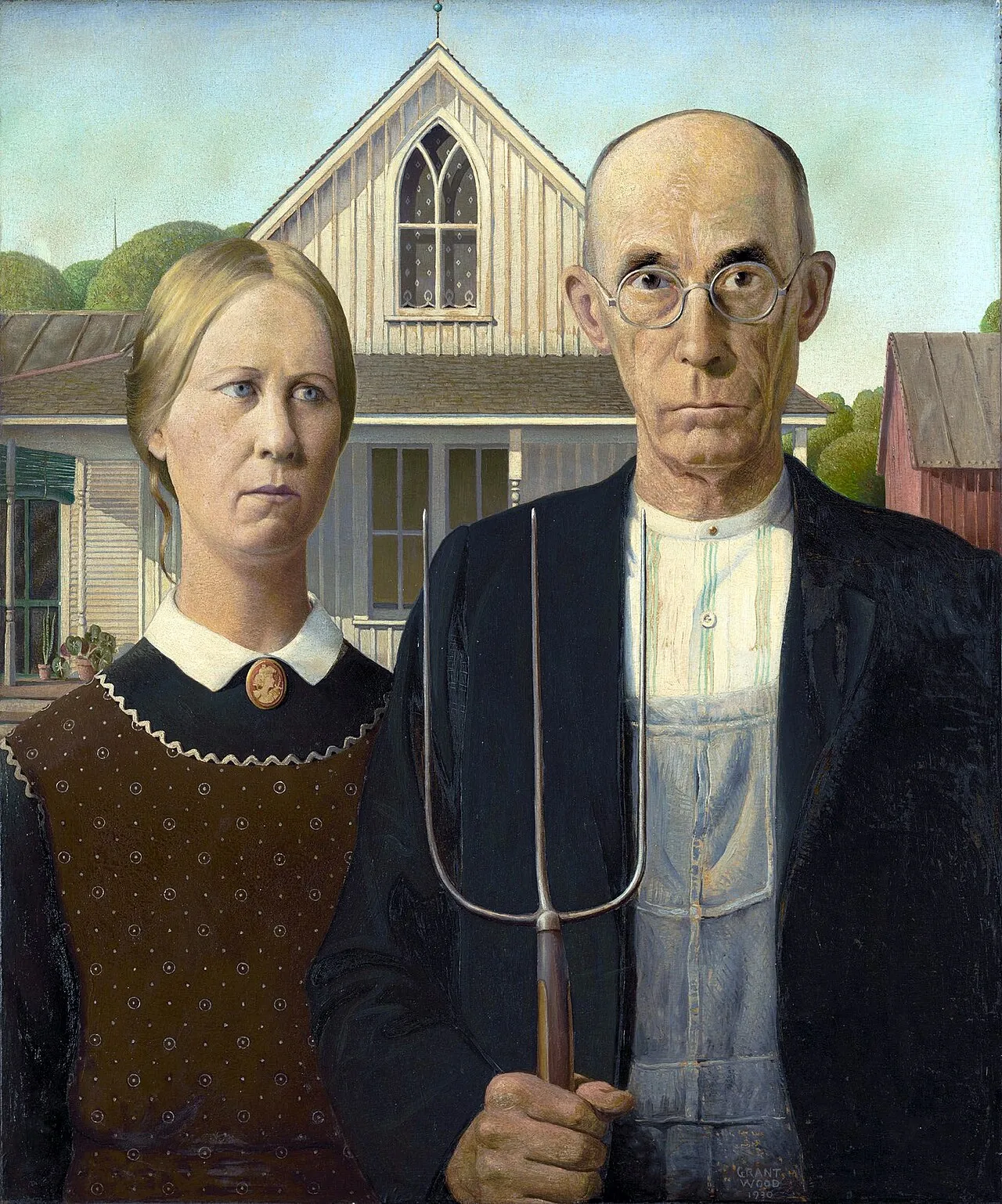
Grant Wood, "American Gothic" (1930), oil on beaverboard, 78 x 65.3 cm. Art Institute of Chicago. The painting's two figures are Wood's sister Nan Wood Graham and his dentist Dr. Byron McKeeby, posing as a farmer and his daughter rather than a husband and wife. Image: Public domain, via Wikimedia Commons
What Wood Intended and Why Iowa Was Furious
Wood entered "American Gothic" in the Art Institute of Chicago's 43rd Annual Exhibition of American Paintings and Sculpture in 1930. It won a $300 prize and was purchased by the museum, which has held it ever since. The critical response was immediate and divided. Eastern critics read it as satire: a mocking portrait of Midwestern rural narrowness and religious severity. Midwestern audiences, particularly in Iowa, were furious. Local newspapers described the painting as an insult. The Iowa State University president's wife called it a "depressing study in degeneracy."
Wood insisted that both reactions missed the point. He described the painting as his "tribute to the Midwest," an image of the people he associated with the region's durability and practical strength rather than a mockery of their limitations. He pointed to the Flemish and Northern Renaissance influences on his style as evidence of the seriousness of his intentions. He had studied in Europe multiple times and was deeply influenced by Hans Memling, Jan van Eyck, and the German Neue Sachlichkeit movement of the 1920s. The technique of painting small, precise details with a fine brush, which he applied to the stitching on McKeeby's overalls, the rickrack trim on Nan's collar, and the wood grain on the porch behind them, comes directly from this tradition. These are not caricatures. They are carefully observed, dignified faces painted with the attention that Flemish portraiture gave to specific physiognomies in the fifteenth century.
The Pitchfork
The pitchfork is the most discussed single element in the painting. It is a three-tined steel fork, a type used for pitching hay, and Wood painted its tines with an exactness that mirrors the tines of the Gothic window above and the stitching on the man's overalls. The parallel verticality of tines, window tracery, and stitching creates a formal unity that is one of the painting's most sophisticated compositional choices.
What the pitchfork means is disputed. Is it simply a farming tool that establishes the man's occupation? Is it a symbol of defiance, the American farmer's hard-won independence from the land? Is it a slightly sinister element that gives the man an air of potential threat? All three readings have been proposed. Wood never explained it beyond the practical necessity of giving the farmer something to hold.
Regionalism and Its Internal Contradictions
Wood was one of three figures identified as leaders of American Regionalism, alongside Thomas Hart Benton and John Steuart Curry. The movement of the 1930s rejected European modernism in favor of American subject matter: the landscape, life, and people of the Midwest and South. It was explicitly anti-abstract and anti-European, a declaration of artistic independence from the Parisian avant-garde that had dominated American art since the Armory Show of 1913.
The irony is that Regionalism, which positioned itself against the European avant-garde, used formal devices derived from that avant-garde to achieve its effects. Wood's flattened forms, the decorative precision of his rendering, and his interest in pattern as a compositional element owe as much to his study of German Neue Sachlichkeit painting and Flemish masters in Europe as to his Iowa roots. He was an anti-modern painter who had studied in Paris and Munich. The ideological position and the formal practice were in genuine tension, which may be part of why the painting feels so unresolved despite its visual clarity.
What the Parodies Reveal
The painting has not left the Art Institute of Chicago for more than brief loans since 1930. It is among the most visited works in the museum's collection. The parodies began almost immediately after it was shown and have never stopped. During the Great Depression, the image was reworked in both anti-rural and pro-rural directions depending on the cartoonist's politics. During World War II, the two figures became Axis leaders in propaganda cartoons. In the twenty-first century, the image has been reworked to include virtually every celebrity couple, political pairing, and fictional duo imaginable. The painting's visual economy, two recognizable figures in a simple composition before an identifiable background, makes it one of the most adaptable templates in popular culture.
The sheer volume of parody reveals what the painting has actually become: a container for American anxieties about rural life, national identity, and the relationship between the agricultural past and the modern present. Whether you read the figures as grim or dignified, as authentic or absurd, depends on your relationship to those anxieties rather than on what Wood painted. None of this was his stated intention. All of it is a plausible response to what he produced. The painting succeeded in doing what good art does: it became more than its maker intended.
The Art Institute of Chicago's page on the painting includes a zoomable high-resolution image that shows the level of detail Wood put into the surfaces. The guide to Famous Paintings Explained covers additional context, and the step-by-step framework for reading paintings offers practical tools for looking at it more carefully. What do you think the pitchfork means? Share your interpretation in the comments.


