
In 1599, Caravaggio walked into the Contarelli Chapel in the Church of San Luigi dei Francesi in Rome and painted something that broke European art in half. "The Calling of Saint Matthew" shows a group of men sitting around a table in what looks like a tavern. A shaft of light cuts across them from an unseen source above and to the right. It hits Matthew with the force of a divine spotlight. The darkness around the figures is total, pressing in from every edge of the canvas. The light does not illuminate the scene. It strikes it, and the difference between illumination and assault is what makes this painting religious art rather than a genre scene.
Caravaggio did not invent chiaroscuro. The Italian word comes from "chiaro" (light, clear) and "oscuro" (dark, obscure). Together they describe the use of strong contrasts between light and shadow to create the illusion of three-dimensional form on a flat surface. Leonardo da Vinci had been developing this technique systematically a century earlier. But Caravaggio intensified it to a degree that changed how light could function in painting, and his influence runs through Rubens, Velazquez, Vermeer, and Rembrandt to every painter who has used directed artificial light since.
What makes chiaroscuro worth understanding is that it is not just a technique. It is a decision about what kind of experience the viewer will have. The painter who uses deep shadow and directed light is choosing drama over calm, confrontation over invitation. Once you can see how this works, you start noticing it everywhere, from Renaissance altarpieces to contemporary film lighting. This guide will show you how chiaroscuro models form, how Caravaggio turned it into tenebrism, how Rembrandt made shadow warm, and how to read it when you stand in front of a painting.
The Technical Foundation: How Chiaroscuro Models Form
Before chiaroscuro, European painting typically described three-dimensional form through outline and local colour. An arm was described as arm-shaped and painted skin-coloured. The system worked, but it produced a certain flatness, an essentially graphic quality in which objects existed as coloured shapes rather than forms existing in space. Chiaroscuro replaced outline with tonal modelling as the primary means of describing three-dimensional form, and the result was a revolution in pictorial illusionism.
The principle is simple. Light striking a curved or irregular surface creates a gradient of values from the highest illumination at the point most perpendicular to the light source, through mid-tones, to deep shadow at the point farthest from the light. The exact nature of this gradient depends on the quality of the light (hard or diffuse), the texture of the surface (matte or reflective), and the relationship of the surface to its light source. By observing and accurately describing these gradients, painters could create convincing illusions of roundness, weight, and spatial position without the need for outline at all.
Leonardo's term for his refined use of this principle was "sfumato" (from "fumo," smoke), referring to the soft, smoky transitions between tonal areas with no sharp edges. In his late works, including the "Mona Lisa" (c. 1503 to 1519) and "Saint John the Baptist" (c. 1513 to 1516), sfumato creates figures that emerge from darkness rather than existing against a background. Their forms are defined by gradual tonal transitions rather than any distinct boundary. The technique produces the quality of breathing, interior life that makes Leonardo's figures feel more psychologically present than the more crisply outlined figures of his contemporaries.
A 2024 study published in the journal Arts traced the origins of affective chiaroscuro, the use of light and shadow to move viewers emotionally rather than just describe form, back to Leonardo's "Virgin of the Rocks" (1483 to 1486) in Milan. The research argues that under the influence of Franciscan theology, Leonardo began using chiaroscuro not just to articulate three-dimensional space but to focalize the viewer's experience and draw them toward a sense of divine presence. This shifts the origin of emotional chiaroscuro decades earlier than previously thought, placing it in late 15th-century Milan rather than post-Council of Trent Rome. You can read the full study at MDPI Arts.
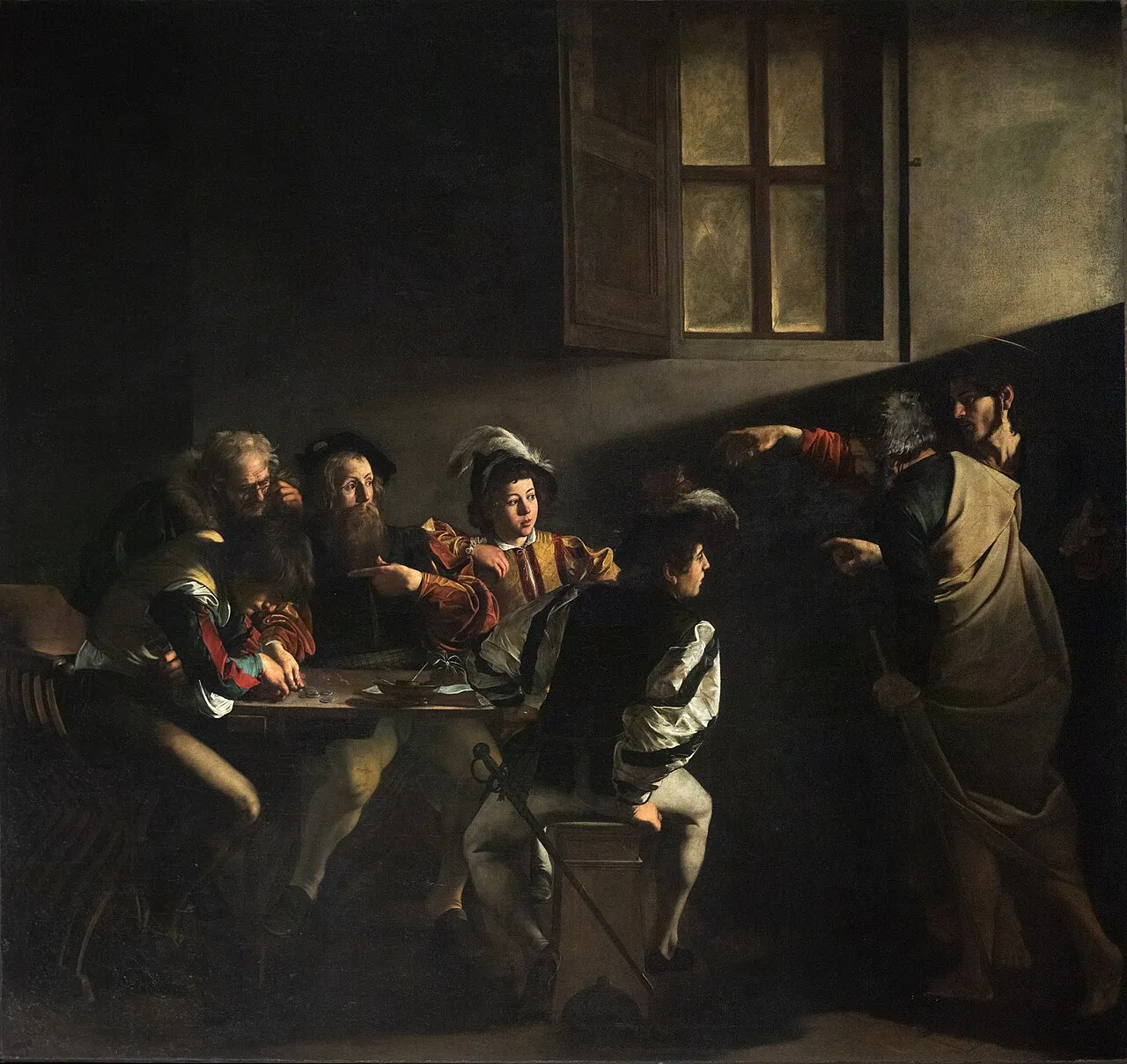
Caravaggio, "The Calling of Saint Matthew" (1599 to 1600), oil on canvas, 322 x 340 cm. Contarelli Chapel, San Luigi dei Francesi, Rome. The shaft of light entering from the upper right produces tenebrism at its most dramatic: figures emerge from near-total darkness, the light serving as compositional anchor, narrative agent, and emotional intensifier simultaneously. Image: Public domain, via Wikimedia Commons
Tenebrism: When Chiaroscuro Becomes Extreme
Caravaggio's particular intensification of chiaroscuro, using darkness so deep that figures seem to emerge from black voids rather than from shadowed environments, is specifically called tenebrism (from "tenebroso," deeply shadowed). The key distinction between standard chiaroscuro and tenebrism is the darkness of the shadow areas. In chiaroscuro, shadows describe form and space. In tenebrism, shadows become near-absolute darkness that collapses space into a confrontation between light and void.
This has profound compositional consequences. In tenebrism, the only information available to the viewer is what the light chooses to illuminate. Backgrounds, spatial depth cues, secondary figures, and contextual details all disappear into the dark unless specifically lit. Caravaggio uses this to focus attention with the intensity of a theatre spotlight. Every illuminated element has been selected for attention by the painter's control of the light, and the viewer cannot escape this guidance. The eye has nowhere to go except where the light falls.
In March 2026, researcher Pepe Ballesteros presented a computational study at the Prado Museum titled "Unnatural Naturalism: A Computational Study of Caravaggio's Light." Using algorithmic analysis, Ballesteros extracted lighting characteristics from Caravaggio's paintings that escape human perception. The findings suggest that Caravaggio's supposedly "natural" light was in fact highly artificial, engineered in his studio with a level of optical sophistication that redefines what we mean by naturalism. The project positions naturalism as a gray area between reality and artifice, which is exactly what you feel standing in front of a Caravaggio. The light looks real but no real light has ever behaved that way. More details are available from DVS Studies.
The Spanish painter Jusepe de Ribera (1591 to 1652) and the French artist Georges de La Tour (1593 to 1652) extended Caravaggio's tenebrism into their own distinctive practices. La Tour's series of candlelit night scenes, including "The Penitent Magdalene" (c. 1640), uses a single candle as light source to create an intimacy that Caravaggio's theatrical directional light never aimed for. The candle's warm, encircling glow softens where Caravaggio's light strikes. The meditative stillness that results is entirely different in emotional character while employing the same fundamental technique.
Rembrandt and the Warmth of Shadow
Rembrandt van Rijn (1606 to 1669) took the Caravaggesque tenebrism transmitted through Dutch painters who had studied in Rome and transformed it into something altogether more personal and humanistic. Where Caravaggio uses light to dramatise, Rembrandt uses it to reveal. Not the theatricality of a divine call or a martyrdom, but the specific quality of light as it falls on an aged face, or illuminates a figure in private prayer, or differentiates the velvet of a sleeve from the skin of the hand it covers.
Rembrandt's chiaroscuro is distinguished by the quality of his shadow areas. Where Caravaggio's darks tend toward absolute black, Rembrandt's shadows are warm, rich, and layered with transparent glazes of brown, umber, and amber that contain residual information about form without illuminating it clearly. Figures emerge from and return to a warm darkness that feels inhabited rather than empty. This quality of shadow, which requires multiple transparent paint layers built up over extended working periods, is one of the defining achievements of oil painting technique and the primary reason Rembrandt's originals consistently lose so much to reproduction.
A 2025 study published in npj Heritage Science as part of "Operation Night Watch" used macroscopic X-ray fluorescence and reflectance imaging spectroscopy to map Rembrandt's pigment palette in "The Night Watch" (1642). The research revealed that Rembrandt applied his pigments in a consistent, systematic way, combining lead white, lead-tin yellow, ochres, vermilion, and arsenic sulfide pigments in groups to achieve pictorial unity through chiaroscuro. He even used arsenic-based pigments to capture the warm reflections of gold threads on Lieutenant Van Ruytenburch's costume. This is not an artist improvising. This is an engineer building light from chemistry. The full study is available at Nature npj Heritage Science.
A separate 2025 study from the same journal identified yellow lake pigments in Rembrandt's "Aristotle with a Bust of Homer" (1653) for the first time, using high-performance liquid chromatography. Rembrandt mixed these translucent yellow lakes with opaque pigments to create the deep, rich shadows that give his paintings their characteristic warmth. The identification of a Rhamnus species as the source of the yellow lake marks the first time this pigment has been definitively identified in a 17th-century Dutch painting, despite being widely discussed in historical literature. You can read the findings at Nature npj Heritage Science.
Reading Chiaroscuro as a Viewer
When you encounter a painting that uses strong chiaroscuro or tenebrism, a few questions immediately reward attention. First, where is the light source? Is it visible within the painting (a candle, a window) or implied from outside the picture (as in most Caravaggio)? The location of the implied light source determines everything about the distribution of illuminated and shadowed areas, and identifying it is the first step to understanding the painting's compositional logic.
Second, what has the painter chosen to illuminate? The selection of lit versus unlit elements is never neutral. It encodes the painter's interpretation of the subject's hierarchy: what matters, what can be left in shadow, what must be brought into full clarity. In Caravaggio's "Calling of Saint Matthew," the money on the table is brightly lit because the narrative is about a tax collector abandoning material wealth. The face of Christ himself is among the least clearly described elements in the painting.
Third, what quality do the shadows have? Are they empty and absolute, as in tenebrism, or do they contain information and warmth, as in Rembrandt? Are the transitions between light and shadow sharp, suggesting a hard directional artificial light source, or gradual, suggesting diffuse natural light? These qualities determine the emotional register of the work. Hard shadows create drama and urgency. Soft transitions create contemplation and intimacy.
Chiaroscuro connects directly to the practice of portraiture discussed in our guide to how to read a portrait, since tonal modelling of the face was the primary technical means by which Rembrandt and his contemporaries achieved psychological depth in their sitters. For the broader context of the period in which both Caravaggio and Rembrandt worked, our overview of Baroque art places these techniques within the period's larger visual and religious programme. You might also find our guide to how to read a painting useful for the broader toolkit of visual analysis.
Final Thoughts
Chiaroscuro is among the most direct demonstrations in art history of technique serving expression. The choice to use directed light, deep shadow, and the contrast between them is not a stylistic preference unconnected to meaning. It is a decision about what kind of experience the viewer will have: dramatic or contemplative, theatrically guided or intimately invited. The great masters of chiaroscuro understood this and used their technical control of light not to show off their skill but to produce the specific emotional and psychological effects their subjects required.
The next time you encounter a Caravaggio, a Rembrandt, or a La Tour in a gallery, stand with the painting for longer than you think necessary and let the light do its work. The technique is in the service of an experience that cannot be absorbed quickly. Give it time. And if you want to understand how light and shadow function within the broader visual vocabulary of painting, our guide to the essential art toolkit covers the full range of visual elements that painters use to construct meaning.


