
In 1876, Gustave Moreau exhibited a painting at the Paris Salon showing Salome pointing at the severed head of John the Baptist, floating in a halo of light. Nobody in the painting reacts to the head. It might be real. It might be a hallucination. It might be both. The critics did not know what to make of it, but a young writer named Joris-Karl Huysmans was transfixed. He later devoted several pages of his novel "A rebours" (1884) to describing the painting, calling it "the symbolic masterpiece of decadent art."
Symbolism emerged in the 1880s as a reaction against Realism, Impressionism, and the scientific materialism of the late 19th century. Where Realists painted what they saw and Impressionists painted how light affected what they saw, Symbolists painted what could not be seen at all: dreams, myths, nightmares, death, desire, and the unconscious. The movement was officially launched in 1886 when Jean Moreas published a manifesto in Le Figaro, but Moreau had been painting Symbolist works for over a decade before that.
This guide covers the origins, Moreau and Redon, Bocklin's Isle of the Dead, Belgian Symbolism (Khnopff, Spilliaert), Gauguin and the Nabis, the Salon de la Rose+Croix, and why Symbolism is the direct ancestor of Surrealism.
The Origins: A Reaction Against Reason
The literary roots of Symbolism run back to Charles Baudelaire's "Les Fleurs du Mal" (1857), which was prosecuted for obscenity. Baudelaire established the aesthetic of finding beauty in darkness, decay, and the forbidden. The poems insisted that the most interesting territory for art was not the observable world but the interior one, and that position shaped everything that followed.
Jean Moreas's manifesto appeared in Le Figaro on September 18, 1886. It declared Symbolism the enemy of "didaction, declamation, false sensibility, and objective description." The manifesto was vague about what Symbolism actually was, beyond being against what Realism and Naturalism were. As Artland's overview of Symbolism notes, the movement was never a school with a shared style. It was a loose network of artists across Europe who agreed that art should look inward rather than outward.
The intellectual context matters. Freud's early work on hysteria and the unconscious was underway in Vienna throughout the 1890s. The Symbolists were exploring the same territory visually before Freud published his theories. "The Interpretation of Dreams" appeared in 1899, but Moreau was painting dream imagery in the 1860s. The Symbolists did not need Freud to tell them that the unconscious was interesting. They had already been painting it for decades.
Gustave Moreau and the Birth of Symbolist Painting
Gustave Moreau (1826 to 1898) was the precursor. He was painting Symbolist subjects 20 years before the manifesto gave the movement a name. "The Apparition" (1876) is the painting that transfixed Huysmans and defined the Symbolist approach: a biblical subject treated as dream, with deliberately ambiguous space and lighting. The painting is 55.9 by 46.7 centimeters and is now at the Fogg Museum at Harvard University.
Moreau's technique was obsessive. He used layers of glaze to create jewel-like surfaces, and he painted over 150 drawings and 19 paintings of the Salome subject alone. The repetition was not a failure of imagination. It was the point. Moreau was circling an image, returning to it again and again, trying to get closer to something that could not be captured in a single painting. His surfaces are dense with detail, almost claustrophobic, and the effect is of a mind that cannot stop looking at its own obsessions.
Moreau became a professor at the Ecole des Beaux-Arts in 1892, where his students included Henri Matisse and Georges Rouault. He told them: "I have never looked for a subject. I have always found it in the dream." That instruction, to paint from the interior rather than from observation, would shape modern art for the next century.
Odilon Redon and the Journey from Darkness to Light
Odilon Redon (1840 to 1916) is the greatest Symbolist painter, and the reason is that he alone managed the transition from dark to color without losing the strangeness. His early work, the "noirs," consists of charcoal drawings and lithographs from the 1870s through the 1890s. They depict spiders, eyes, floating heads, and strange creatures emerging from darkness. The noirs are unsettling because the creatures seem to be forming out of the blackness itself, as if the darkness is generating them.
"The Cyclops" (c. 1898 to 1900) marks the transition. The giant eye of Polyphemus emerges from a mountainous landscape, but the colors are pastel pinks and greens rather than black. The subject is from mythology, but the treatment is dreamlike. Redon wrote: "My drawings inspire and are not to be defined. They do not determine anything. They place us, as does music, in the ambiguous world of the unknown."
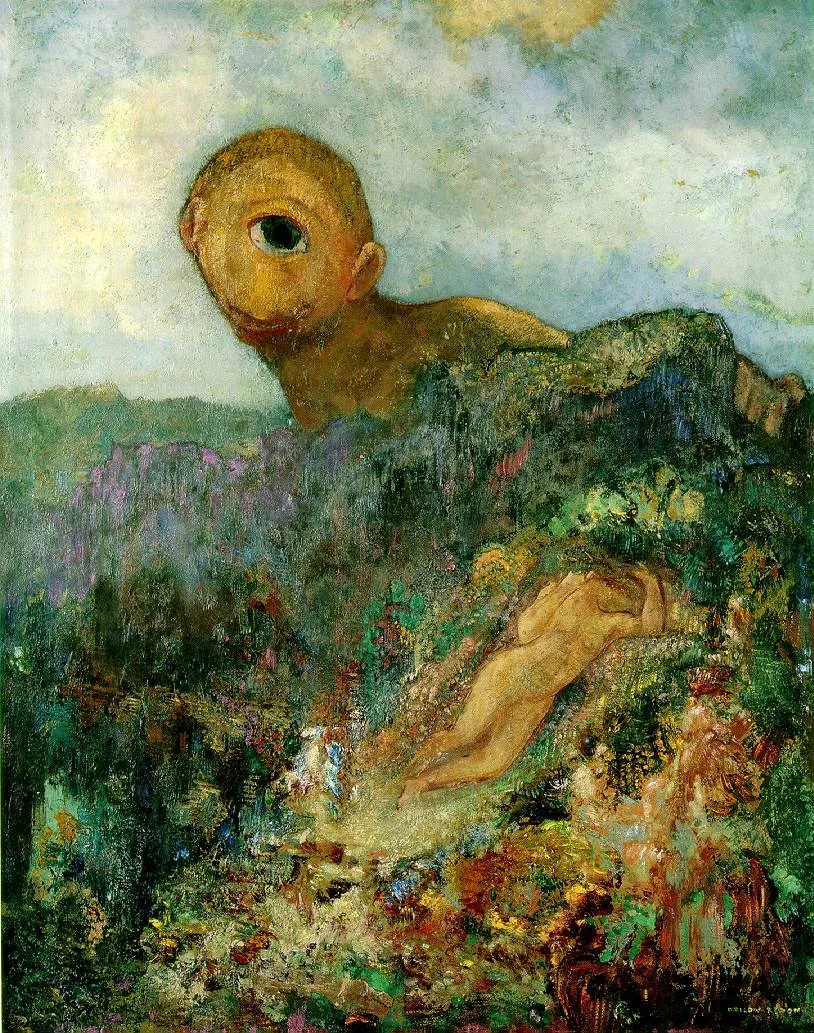
Odilon Redon, "The Cyclops" (c. 1898-1900). Oil on canvas. Kroller-Muller Museum, Otterlo. Image: Public domain, via Wikimedia Commons
The Art Institute of Chicago's exhibition "Strange Realities: The Symbolist Imagination" (October 4, 2025, through January 5, 2026) drew on the museum's collection of over 85 works on paper, including the largest American collection of Redon and Paul Gauguin. As the Art Institute's press release noted, the exhibition went beyond the usual French suspects to include lesser-known figures like the Swedish painter Gustaf Fjaestad, the Austrian Emilie Mediz-Pelikan, the Belgian Leon Spilliaert, and the French Gustav Adolf Mossa. The show's curator, Jay A. Clarke, kept the question of what Symbolism was deliberately open, letting the pictures argue for themselves rather than imposing a definition. As Art in America's review observed, the show demonstrated that Paris was never Symbolism's most interesting center, and that the movement's most compelling work often came from its geographic margins.
Arnold Bocklin and the Isle of the Dead
Arnold Bocklin (1827 to 1901) was Swiss, and his "Isle of the Dead" is one of the most reproduced paintings in European art. Bocklin painted five versions between 1880 and 1886, now in Basel, New York (Met), Berlin, and Leipzig. A sixth version was completed by his son Carlo in 1901.
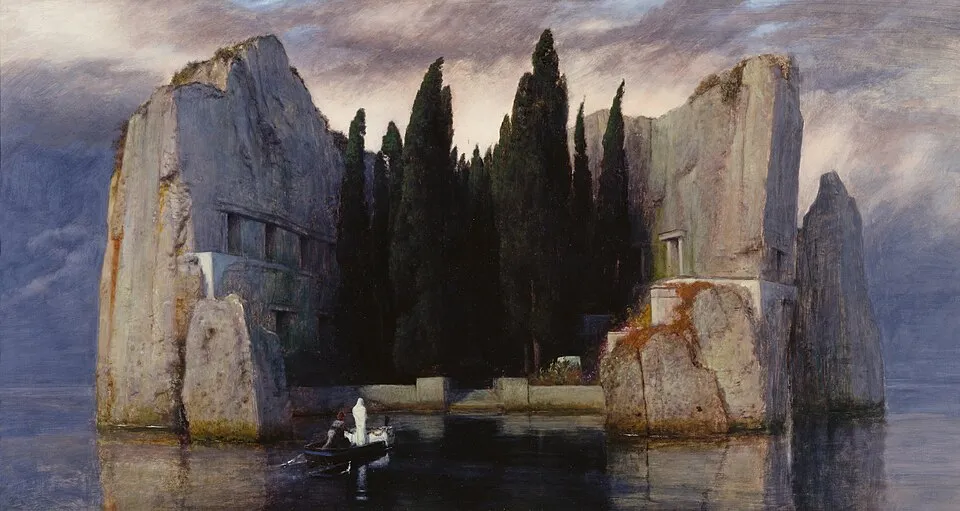
Arnold Bocklin, "Isle of the Dead" (third version, 1883). Oil on panel, 80 x 150 cm. Alte Nationalgalerie, Berlin. Image: Public domain, via Wikimedia Commons
The composition is simple and powerful. A rocky island with dark cypress trees. A boat arriving with a white-clad figure and a coffin. The oarsman resembles Charon from Greek mythology. Bocklin described the painting as "a dream picture: it must produce such a stillness that one would be awed by a knock on the door." The painting's popularity was extraordinary. By the early 20th century, prints of the Isle of the Dead were, as Vladimir Nabokov observed, "found in every Berlin home." It was one of the most reproduced paintings in central Europe.
The painting's afterlife is as remarkable as the painting itself. Sergei Rachmaninoff wrote a symphonic poem based on it in 1909. Freud reportedly had a print in his office. Hitler owned the third version. The painting's meaning shifts depending on who is looking at it, which is exactly what a Symbolist image is supposed to do. It does not illustrate a story. It creates a mood, and the mood is open to projection.
Belgian Symbolism: Khnopff and Spilliaert
Fernand Khnopff (1858 to 1921) was the leading Belgian Symbolist. "I Lock My Door Upon Myself" (1891) takes its title from a poem by Christina Rossetti. The painting shows a woman in a blue robe, eyes closed, surrounded by symbolic objects. The interior is a mental space, not a physical one. Khnopff painted states of mind, not stories, and his work is more introspective than the French Symbolism of Moreau.
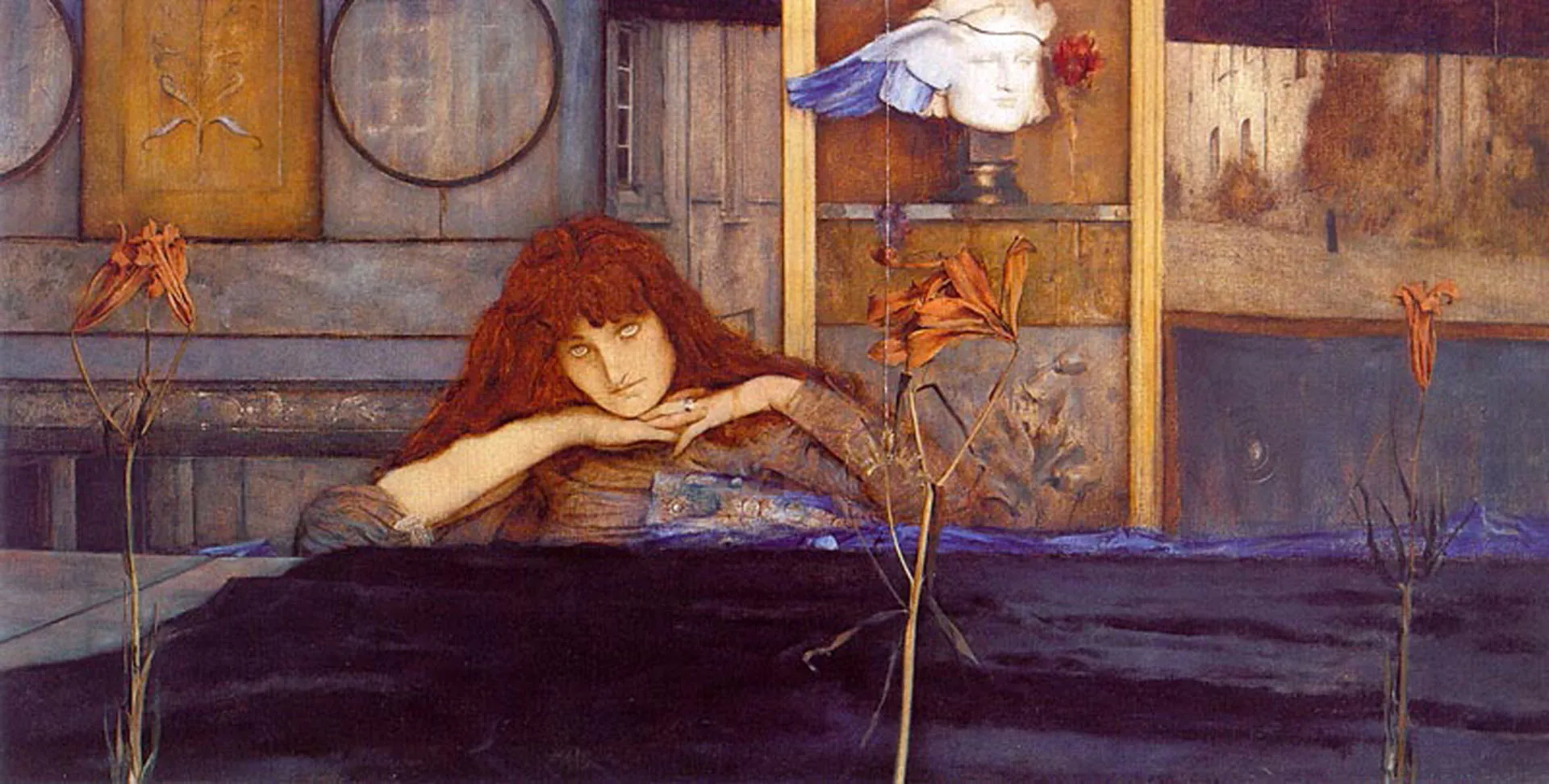
Fernand Khnopff, "I Lock My Door Upon Myself" (1891). Oil on canvas. Neue Pinakothek, Munich. Image: Public domain, via Wikimedia Commons
Leon Spilliaert (1881 to 1946) was a later Belgian Symbolist, working in the 1900s and 1910s. His beach scenes at Ostend are empty, vertiginous, and unsettling. Spilliaert applied Symbolism to landscape rather than myth, and the result is a body of work that feels closer to Expressionism than to Moreau. The Belgian difference is real. Belgian Symbolism was more introspective and less mythological than French Symbolism. Khnopff and Spilliaert painted states of mind, not stories.
Gauguin, the Nabis, and the Symbolist Expansion
Paul Gauguin (1848 to 1903) was a Symbolist who used color symbolically rather than descriptively. "The Yellow Christ" (1889) and "Where Do We Come From? What Are We? Where Are We Going?" (1897 to 1898) use color as emotional signifier rather than visual record. The yellow in "The Yellow Christ" is not the yellow of any observed landscape. It is the color of spiritual intensity, and Gauguin used it that way deliberately.
Albert Aurier's 1891 article in the Mercure de France defined Symbolism in aesthetic terms and named Gauguin its leading figure. The article argued that Symbolist art should be "ideist, symbolist, synthetist, subjective, and decorative." The labels were awkward, but they gave the movement a theoretical framework. For more on Gauguin's complicated legacy, see our post on Gauguin: Tahiti, Primitivism, and a Complicated Legacy.
The Nabis were a group of young painters who took Symbolism into domestic interiors and decorative arts. Edouard Vuillard, Pierre Bonnard, and Maurice Denis were the key figures. Denis's famous statement of 1890 is both a Symbolist and an early modernist declaration: "Remember that a picture, before being a war horse or a nude woman or some anecdote, is essentially a flat surface covered with colors assembled in a certain order." That sentence would become foundational for abstract painting. For more on Symbolism's connection to spiritual art, see our post on Gustav Klimt and the Vienna Secession and our guide to art and religion.
The Salon de la Rose+Croix
Sar Peladan's Salon de la Rose+Croix ran from 1892 to 1897 in Paris. It was an annual exhibition that brought Symbolist artists together under a quasi-mystical, Rosicrucian banner. The salon's rules were strict: no realism, no impressionism, no "modern" subjects. Only mythological, mystical, or religious subjects were allowed.
The salon gave Symbolist artists a public platform and helped define the movement's visual identity. But Peladan's eccentric personality, which included wearing Babylonian robes in public, made the movement easy to parody. The salon ended in 1897 when Peladan quarreled with his musicians and dissolved the organization. By then, Symbolism was already being absorbed into Art Nouveau and the early modernist movements. The salon's contribution was real but brief. It concentrated Symbolist energy for five years and then disappeared.
Why Symbolism Matters: The Road to Surrealism
The direct line from Symbolism to Surrealism is clear. Andre Breton's Surrealist manifesto of 1924 explicitly acknowledged Symbolist poets as precursors. The visual language of floating heads, dream landscapes, and uncanny juxtapositions passes from Moreau and Redon to Magritte and Dali. Without Symbolism, Surrealism is unimaginable.
The difference is philosophical. Symbolists were mystical and often religious. Surrealists were materialist and Freudian. But both painted the unconscious, and both insisted that art should explore the interior rather than the exterior. Symbolism's insistence that art should look inward is now so accepted that it is invisible. Every artist who paints dreams, nightmares, or psychological states is working in a tradition that Symbolism established.
The Art Institute's "Strange Realities" exhibition made this point by showing Symbolism's geographic range. The show included works from Norway (Munch), Sweden (Fjaestad), Austria (Mediz-Pelikan), Belgium (Spilliaert), and France (Mossa, Redon, Gauguin). The movement was never a school. It was a mood, and the mood traveled. For the broader context, see our art movements timeline and our art history cheat sheet.
Final Thoughts
Symbolism lasted roughly 30 years, from about 1886 to 1914, and produced some of the strangest and most psychologically intense paintings in European art. Its insistence on the primacy of dreams, myths, and the unconscious over observed reality permanently expanded what art could depict.
The Art Institute of Chicago's "Strange Realities" exhibition, which closed January 5, 2026, was the largest Symbolist exhibition in America in years. If you missed it, the museum's online collection of Redon works is exceptional and freely accessible. The exhibition catalogue, with essays by Jay A. Clarke and others, is the best recent English-language resource on the movement.
Redon is the painter to spend time with. Start with the noirs, the charcoal drawings and lithographs of spiders and floating heads from the 1870s and 1880s. Then move to the pastels, the flower clouds and cyclops eyes of the 1890s and 1900s. The transition from black to color is the story of an artist who found a way to carry strangeness into light without diluting it. That is what Symbolism at its best achieved, and it is why the movement still matters.


