
In 2019, the National Galleries of Scotland held an exhibition simply titled "Gauguin's Portraits." The wall labels named the ages of his Tahitian models and wives. The catalogue discussed his relationship with Teha'amana, who was thirteen years old when he took her as a companion and painted her extensively. There were complaints from visitors who felt the exhibition had been politicized. There were also critics who argued the labels did not go far enough. This is the current state of Gauguin's place in art history: a painter widely acknowledged as central to the development of modern art, and increasingly impossible to discuss without confronting what he actually did in Tahiti.
The paintings are genuinely powerful. The saturated color, the simplified flat forms, the combination of spiritual gravity with sensory richness in the best Tahitian work: these are real achievements that changed what painting could do. The biography is genuinely troubling: the abandonment of his wife and five children, the exploitation of Tahitian girls as young as thirteen as sexual partners and models, the construction of a primitivist fantasy that served his artistic project at the direct expense of the people who actually lived there. Both of these things are facts. Holding them simultaneously is not a question of political taste. It is a basic requirement for thinking clearly about the work.
This guide covers Gauguin's life and visual language, his major paintings, the primitivism problem in specific detail, and his influence on modern art.
The Man Who Walked Away
Paul Gauguin was born in Paris in 1848 and spent part of his childhood in Lima, Peru, where his mother's family had Peruvian aristocratic connections. He returned to France, worked as a merchant sailor, and became a successful stockbroker in Paris while painting as an amateur on the side. In the late 1870s he began showing with the Impressionists and became increasingly serious about painting. In 1883, at thirty-five, he left his stockbroking career to paint full-time.
What followed was a series of relocations that read as a systematic departure from everything he associated with European civilization. He moved his family to Copenhagen to use his wife Mette's family connections for income. When that failed, he left Mette and their five children in Denmark and returned to France. He spent periods in Brittany, where he idealized the local Breton peasant culture as pre-modern and spiritually authentic, producing "The Vision After the Sermon" (1888), one of his best early works. He spent two months with Van Gogh in Arles in 1888, a collaboration that ended in the crisis during which Van Gogh severed part of his own ear.
In 1891, Gauguin sailed to Tahiti, which he had constructed in his imagination from travel books and from the reconstructed Tahitian villages at the 1889 Paris Universal Exposition. He would return to Europe once, in 1893, and then go back to the Pacific in 1895, spending his final years in Tahiti and the Marquesas Islands. He died in May 1903 on Hiva Oa.
The Visual Language: Synthetism and Flat Color
Gauguin called his mature approach Synthetism: the combination of observed forms with flat areas of pure color, simplified outlines, and decorative elements drawn from non-Western visual traditions. Where Impressionism sought to capture the visual sensation of a specific moment, Synthetism aimed to fuse sensation, feeling, memory, and symbolic meaning into a single image. The painted surface was no longer a window onto a scene. It was a field of expressive relations between color areas.
His Tahitian paintings use color that makes no attempt to describe what the scene actually looked like. In "Fatata te Miti" ("By the Sea", 1892), now at the National Gallery of Art in Washington, the sea is rendered in flat planes of brilliant yellow-green and orange. These colors belong to the painting's internal emotional logic, not to any observation of actual seawater. The simplified outlines enclosing these color areas draw on his study of Japanese woodblock prints and on the medieval Breton religious carvings he had encountered in Pont-Aven. The National Gallery of Art's collection entry for this work provides useful technical notes. The Tahitian figures are monumentalized and treated as timeless in ways that deliberately remove any sense of individual identity or specific historical moment.
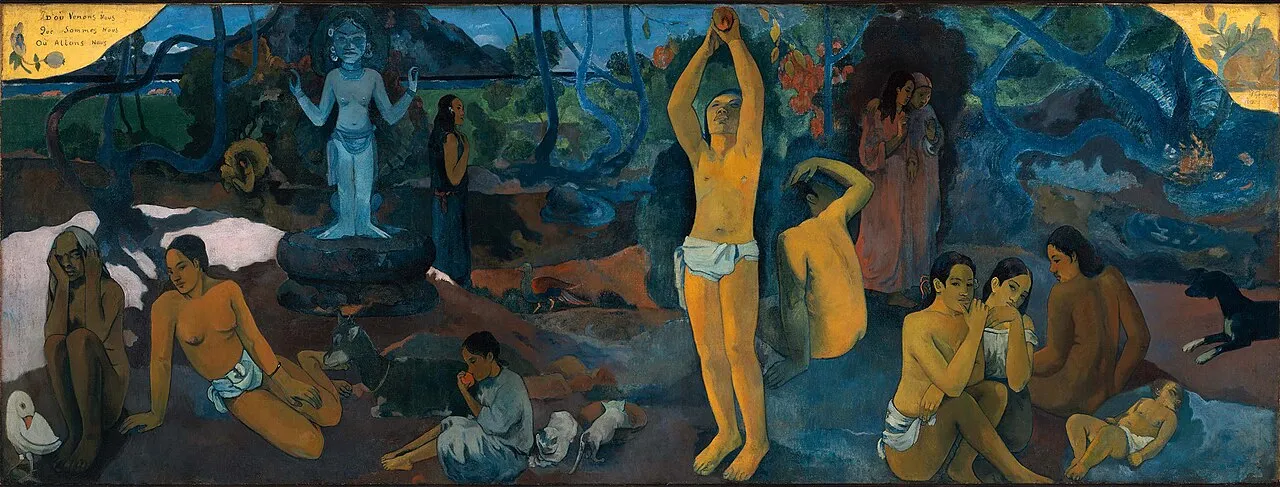
Paul Gauguin, "D'où venons-nous? Que sommes-nous? Où allons-nous?" ("Where Do We Come From? What Are We? Where Are We Going?"), 1897-98. Oil on canvas, 139 x 375 cm. Museum of Fine Arts, Boston. Gauguin considered this his masterpiece and painted it in a state of suicidal despair before attempting to poison himself. Image: Public domain, via Wikimedia Commons.
Where Do We Come From? What Are We? Where Are We Going?
Gauguin painted this work in late 1897 under extreme conditions. He had just received news of his favorite daughter Aline's death. He was ill, in debt, and increasingly isolated on the island. He later claimed to have worked on the canvas for a month of near-continuous effort and then immediately attempted suicide by swallowing arsenic, surviving only because he vomited most of it before it could take effect. He described the painting as his last will and testament.
The composition reads from right to left: a sleeping infant on the right, a progression through figures of adult life and activity in the center, to an old woman crouching at the far left beside a white bird. The large blue figure in the center reaches upward to pick fruit from a tree. The painting does not answer the three questions of its title. It holds them open across 375 centimeters of canvas, from birth to death, without resolving the movement into a narrative that makes sense of it.
Whatever one concludes about the man who made it, this painting is one of the most formally and philosophically ambitious canvases produced in the 19th century. Its scale, its color relationships, the integration of figures into landscape through continuous color transitions rather than conventional spatial separation, and its use of the horizontal frieze format to make a meditation on time rather than a narrative sequence: these are genuinely original solutions to the problem of using paint to address questions that have no pictorial answers. The Museum of Fine Arts Boston, which holds the work, provides detailed curatorial analysis of its structure and context.
The Primitivism Problem
Gauguin arrived in Tahiti with a fantasy constructed from travel books and the reconstructed Tahitian villages at the 1889 Paris Universal Exposition. The actual Tahiti he found was a French colony whose indigenous culture had been substantially disrupted by missionary activity, colonial administration, and epidemic disease. It was not the pre-modern paradise he had imagined. His response was to project the fantasy onto the reality regardless.
He painted Tahitian women in poses borrowed from Egyptian friezes and Javanese temple carvings he had sketched at the 1889 Exposition. He described them in letters and in his published memoir "Noa Noa" as "primitive," meaning by this term something he considered positive: authentic, spiritually vital, uncorrupted by the materialism and emotional repression he associated with European civilization. This is the central problem of primitivism as an artistic ideology. It does not only misrepresent the actual culture being described. It treats indigenous people as symbolic material for the European artist's spiritual project rather than as individuals with their own histories, contradictions, and interior lives. The Tahitian women in Gauguin's paintings are not Tahitian people in any meaningful sense. They are components of his visual language.
The most direct confrontation with Gauguin's biography is unavoidable. During his first stay on the island, he entered a relationship with Teha'amana, who was thirteen years old at the time. He painted her extensively and wrote about their relationship in "Noa Noa" in terms that presented the situation as mutual and natural within his primitivist framework. He subsequently had relationships with other young Tahitian women, at least one of whom bore his child. The exploitation is direct and documented. Major institutions are now dealing with this explicitly: the National Galleries of Scotland, the Art Institute of Chicago, and others have begun incorporating this context into wall labels and catalogue essays rather than treating the biography as separate from the art. This is the right approach. The paintings cannot be understood without understanding whose image they constructed, and at what cost.
The Influence on Modern Art
Gauguin's formal innovations had direct and traceable effects on what came after him. His use of flat color, simplified outline, and decorative surface organization fed directly into Fauvism. Henri Matisse cited Gauguin explicitly as a primary influence. The Fauves, including Matisse, Derain, and Vlaminck, extended Gauguin's liberation of color from descriptive function into work of extraordinary chromatic intensity at the 1905 Salon d'Automne, the exhibition that first shocked Paris with its violence of color.
Gauguin's insistence that non-European visual traditions contained formal principles that European art should learn from also opened a conversation that became central to Modernism. Picasso's engagement with African and Oceanic objects in the period leading to "Les Demoiselles d'Avignon" (1907) builds directly on the precedent Gauguin established, even if Picasso's relationship to African art has its own distinct set of colonial complications. The guide to Post-Impressionism places Gauguin within the broader movement that transformed painting in the generation after Impressionism.
Final Thoughts
"Where Do We Come From?" is a genuinely great painting. That statement does not require ignoring what Gauguin did in Tahiti, and ignoring what he did does not make the painting more powerful. The two facts simply coexist without resolving each other. His formal innovations transformed modern art in ways that are historically documented and cannot be undone by confronting his biography. But understanding the Tahitian paintings fully requires understanding what they idealized, whose reality they systematically distorted, and whose individual identities were dissolved into Gauguin's symbolic language. The Tahitian women in those canvases were real people who are almost entirely invisible in Gauguin's account of them. That invisibility is part of what the paintings are.
Serious engagement with art history looks like this when its most celebrated figures are also its most compromised ones: holding the achievement and the harm in view simultaneously, without using either to cancel the other. For context on the Post-Impressionist generation Gauguin belonged to, the guide to Post-Impressionism covers Van Gogh, Cézanne, and Seurat alongside him. For another artist whose spiritual ambitions and formal innovations carry comparable weight, see the guide to Edvard Munch. How do you approach Gauguin's work given what we know about him? Share in the comments.


