
There are two figures on the floor of the National Gallery in London. Not paintings, not sculptures. What you see is a distorted, smeared shape in the bottom center of Holbein's "The Ambassadors" (1533). Walk past it at the right oblique angle and the smear snaps into focus: a skull, dead center, in a painting about two enormously successful men surrounded by every instrument of worldly knowledge and power. Holbein put a reminder of death under the feet of men who had everything. No label, no text, just a shape that reveals itself to the viewer who knows how to look. This is what symbolic reading does: it turns a painting into a second conversation running underneath the first one.
Symbolism in art is the use of objects, colors, animals, gestures, and spatial arrangements to carry meanings beyond their literal description. It functioned as a shared visual language between artist and audience for centuries, encoding religious doctrine, moral commentary, social status, and emotional states into images that could communicate across literacy levels and national boundaries. Learning to read that language opens up layers of meaning in paintings that look, on first encounter, like straightforward depictions of interiors, portraits, or landscapes.
Why Artists Used Symbols
The most practical reason was the limitation of the single image. A painting of the Virgin Mary could not include a theological treatise, but by placing a white lily beside her (purity), a crescent moon at her feet (associated with the Immaculate Conception), or a snake underfoot (the defeat of original sin), the painter communicated precise doctrinal content to any viewer who shared that symbolic vocabulary. The meaning is compressed into an object. The object is visible to everyone. The meaning is available only to those who can read it.
The second reason was social reach. In cultures where literacy was limited, symbolism allowed complex moral and narrative content to reach broad audiences. The carved exterior programs of Gothic cathedrals, covered with figures, animals, and narrative scenes, were intended to be read by largely illiterate parishioners as visual theology. According to the [Getty's survey of Gothic iconography programs](https://www.getty.edu/art/collection/), every grotesque, every saint, every narrative frieze was part of a coherent symbolic system designed to be read from bottom to top, earth to heaven, in a sequence that matched the theological structure of the interior.
The third reason was protection. Symbols could carry subversive or personal content that could not be stated openly. A political prisoner in a Renaissance court portrait might be depicted with a broken column (endurance under suffering). A merchant patron of a religious painting might have his portrait inserted as a donor figure, associating himself with sacred subjects he was not permitted to appear in directly. The symbol provided plausible deniability while delivering meaning to those with eyes to see it.
The Most Common Symbols and What They Mean
Vanitas and the Still Life
Dutch and Flemish still life painting of the 17th century is probably the densest body of symbolic imagery in Western art history. The vanitas tradition, taking its name from Ecclesiastes ("vanity of vanities"), embedded reminders of mortality and the transience of worldly pleasures into seemingly straightforward arrangements of objects.
A skull was the most explicit memento mori (reminder of death). But many still lifes encoded the same message more subtly: a half-peeled lemon for beauty concealing bitterness, an overturned goblet for interrupted pleasure, a watch or hourglass for time passing, a butterfly for the soul and the transience of beauty, a guttered candle for a life ending, a soap bubble for the briefness of existence. A wilting flower in a vase beside fresh blooms told a narrative about the inevitability of decay without a skull in sight.
At the same time, these same objects carried positive associations that created productive tension. A nautilus shell displayed the collector's wealth and sophistication. Chinese porcelain indicated global trade and prosperity. A map on the wall signaled a cosmopolitan household. The vanitas tradition worked precisely because its objects were also genuine status symbols, making the moral commentary inseparable from the display of the very things being questioned.
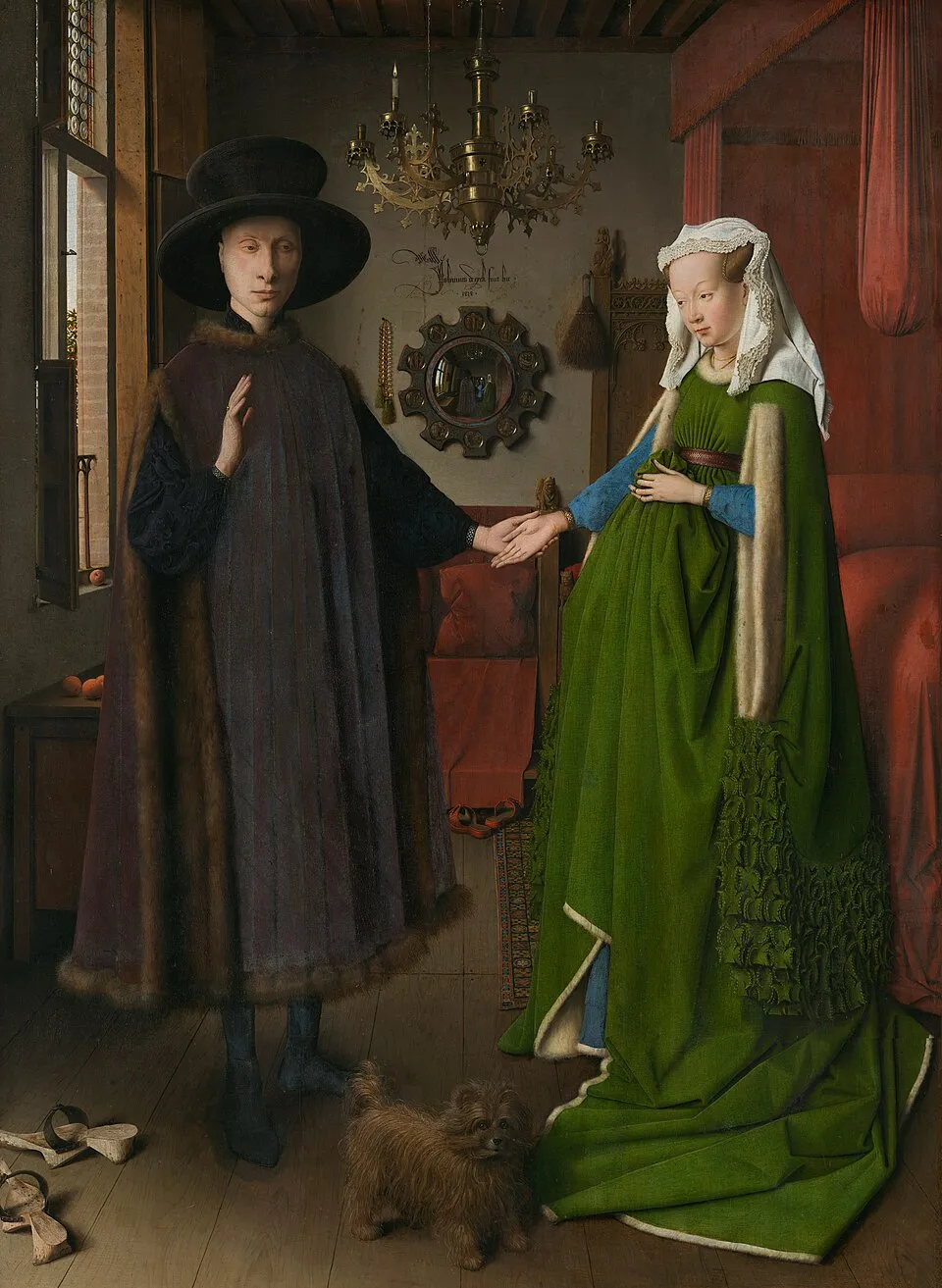
Jan van Eyck, "The Arnolfini Portrait" (1434), oil on oak panel, 82.2 x 60 cm. National Gallery, London. Almost every element carries symbolic weight: the single candle (divine witness), the dog (fidelity), the discarded shoes (holy ground), the convex mirror (omniscience), and the ripe fruit on the windowsill (fertility). Reading the painting requires knowing this vocabulary. Image: Public domain, via Wikimedia Commons
Color Symbolism
Color carried consistent symbolic weight in medieval and Renaissance painting, though its meanings shifted across time and culture. In Christian iconography, blue was the color of heaven and divinity, reserved primarily for the Virgin Mary's mantle, which is why ultramarine (made from lapis lazuli, the most expensive pigment available) was specified in contracts for major commissions: the blue had to be worthy of its subject. Red indicated sacrifice, martyrdom, and Christ's blood. White represented purity and resurrection. Green signified hope and new life. Black was associated with mourning, and gold with divine light.
These associations were not arbitrary. They derived from a long tradition of theological writing that artists, patrons, and viewers all shared. When Raphael painted the Virgin in blue and red in "The Sistine Madonna" (1512), he was using a color code that every viewer in his audience would have read immediately. The red dress beneath the blue mantle referred simultaneously to her human motherhood (red, the color of blood and earthly life) and her heavenly status (blue, the color of the divine). Both meanings were present at once, and both were intended.
Animals
Animal symbolism in European art derives from two main sources: the Physiologus, an early Christian text that assigned moral and theological meanings to animal behaviors, and the Classical tradition of associating specific animals with specific gods. The lamb stood for Christ (the Agnus Dei, Lamb of God). The dove represented the Holy Spirit and peace. The eagle symbolized St John the Evangelist and divine vision. The ox stood for St Luke. The lion for St Mark.
In secular painting, associations were more varied. A peacock could mean pride, immortality (because its flesh was believed not to decay), or vanity depending on context. The fox denoted cunning. The dog, as Van Eyck demonstrates in the Arnolfini Portrait, meant fidelity. The horse indicated nobility, military prowess, and political power, which is exactly why so many royal portraits showed the subject on horseback rather than standing or seated.
Reading Symbols in Practice: A Worked Example
Stand in front of Van Eyck's "Arnolfini Portrait" and apply this approach systematically. First, identify the unusual: why is there only one candle lit when there are two holders? The lit single candle above the man's head referred to the marriage candle or nuptial torch, a symbol of the presence of God as witness. Why is the dog there at all? Lapdogs were common in Flemish interiors, but in this specific context, the small dog placed between the couple encoded fidelity directly into the composition.
Second, look at what is absent. Why are the shoes removed and placed near the window? In biblical tradition, removing shoes indicated standing on holy ground (Exodus 3:5). Van Eyck translated this into the secular setting of a domestic interior to give the scene a sacred quality without a religious subject.
Third, look at the position of figures. The man's raised right hand is typically interpreted as an oath-taking gesture. The woman's hand rests in his, the traditional gesture of the joining of hands in a marriage ceremony. Their positions relative to the window (light, the exterior world) and the bed (domestic interior, the conjugal) are deliberate compositional choices, not naturalistic placement.
This approach, noticing the unusual, asking what is absent, and attending to positioning and gesture, works on any painting from the medieval period through the 19th century where symbolic conventions were operative. It is the same method used by art historians working with the [Iconclass classification system](https://iconclass.org/), the standard scholarly tool for cataloguing iconographic subjects in Western art. Our broader introduction to how to look at art covers the foundational visual skills that support this kind of reading. For a deeper look at iconographic systems in religious art specifically, our guide to understanding iconography covers the theological and classical traditions in greater detail.
When Does Symbolism Stop?
Not every element in every painting is symbolic. A 17th-century Dutch interior might include objects that are simply documented with extraordinary fidelity because the painter was proud of painting them convincingly. Over-reading, finding hidden meanings where the artist intended none, is a real risk. The test is always contextual: does this interpretation cohere with other evidence about the work's date, commission, intended audience, and the iconographic conventions operating in that tradition?
Symbolism becomes less operative as painting moves toward Realism in the 19th century, and largely disappears from Modernist abstraction. But it resurfaces constantly in contemporary art. Joseph Beuys used fat and felt as symbols of warmth, healing, and survival, derived from a personal story about being rescued by Tatar nomads after his plane was shot down in the Crimea in 1944. Frida Kahlo's self-portraits are dense with symbolic objects, Mesoamerican imagery, and personal narrative symbols that require biographical knowledge to decode fully. And in digital and conceptual art, symbolic language continues to operate wherever artists need to communicate more than the literal subject of an image can carry.
Final Thoughts
Learning to read symbolism in art does not require memorizing a dictionary of meanings. It requires developing one habit: pausing at the unusual, the precisely placed, and the apparently incidental, and asking why it is there. Art made between roughly 1000 and 1850 CE in the Western tradition operates on this symbolic level consistently, and developing fluency in its language transforms the experience of walking through any collection of pre-modern painting. What looks like a bowl of fruit becomes a moral argument. What looks like a domestic interior becomes a legal document. What looks like a landscape becomes a theological statement. The meanings were always there. You just needed to know how to look.
For a companion approach to the compositional and spatial reading of paintings, our guide to understanding composition covers the formal structures that organize symbols and figures into coherent visual arguments.


