
Every culture eventually produces an image that names a feeling no one had previously found words for. Edvard Munch produced one in 1893, and the image has not stopped circulating since. "The Scream" appears on mugs, phone cases, and Halloween costumes. It surfaces whenever journalists need a visual shorthand for panic or dread. But the compulsive repetition of this image obscures the artist who made it and the larger body of work from which it emerged. Munch was not a one-painting artist. He was one of the most systematic, autobiographically driven, and emotionally ambitious painters of the modern era, and understanding "The Scream" properly requires understanding his life.
That life was organized around illness, loss, and a profound preoccupation with the states between life and death. Munch grew up in Christiania (now Oslo) in the 1870s in a family he later described as existing under a curse of disease and psychological suffering. His mother died of tuberculosis when he was five. His favorite sister Sophie died of the same disease at fifteen. Munch himself was chronically ill throughout his childhood and into adulthood. His father, a devout Christian with a melancholic temperament, raised Edvard and his siblings in an atmosphere of religious anxiety and grief. The combination left Munch with what he described as a permanent awareness of death's proximity, and that awareness became the central subject of almost everything he made.
The Sick Child: Where It Began
"The Sick Child" (1885-86), which Munch made at age twenty-two, is widely regarded as the first masterpiece of his mature work. It depicts a pale girl in a white bed, turned toward an older woman who bends toward her in grief. The brushwork is raw and agitated, the surface dragged and worked over until the paint itself registers the anxiety of looking at someone dying. Munch repainted and reissued the composition six times over his career, in oil, lithography, and etching, suggesting that for him it was not a single image but a recurring confrontation with a defining memory: the death of his sister Sophie.
The painting was poorly received when first exhibited in Christiania. Critics found it unfinished and offensive. But it established the method Munch would use for the rest of his career: not the precise observation of external appearances but the translation of internal states into visual form through color, distortion, and the physical surface of the paint. This is the practice that would later be codified as Expressionism, and Munch arrived at it before most of the German artists who would give the movement its name.
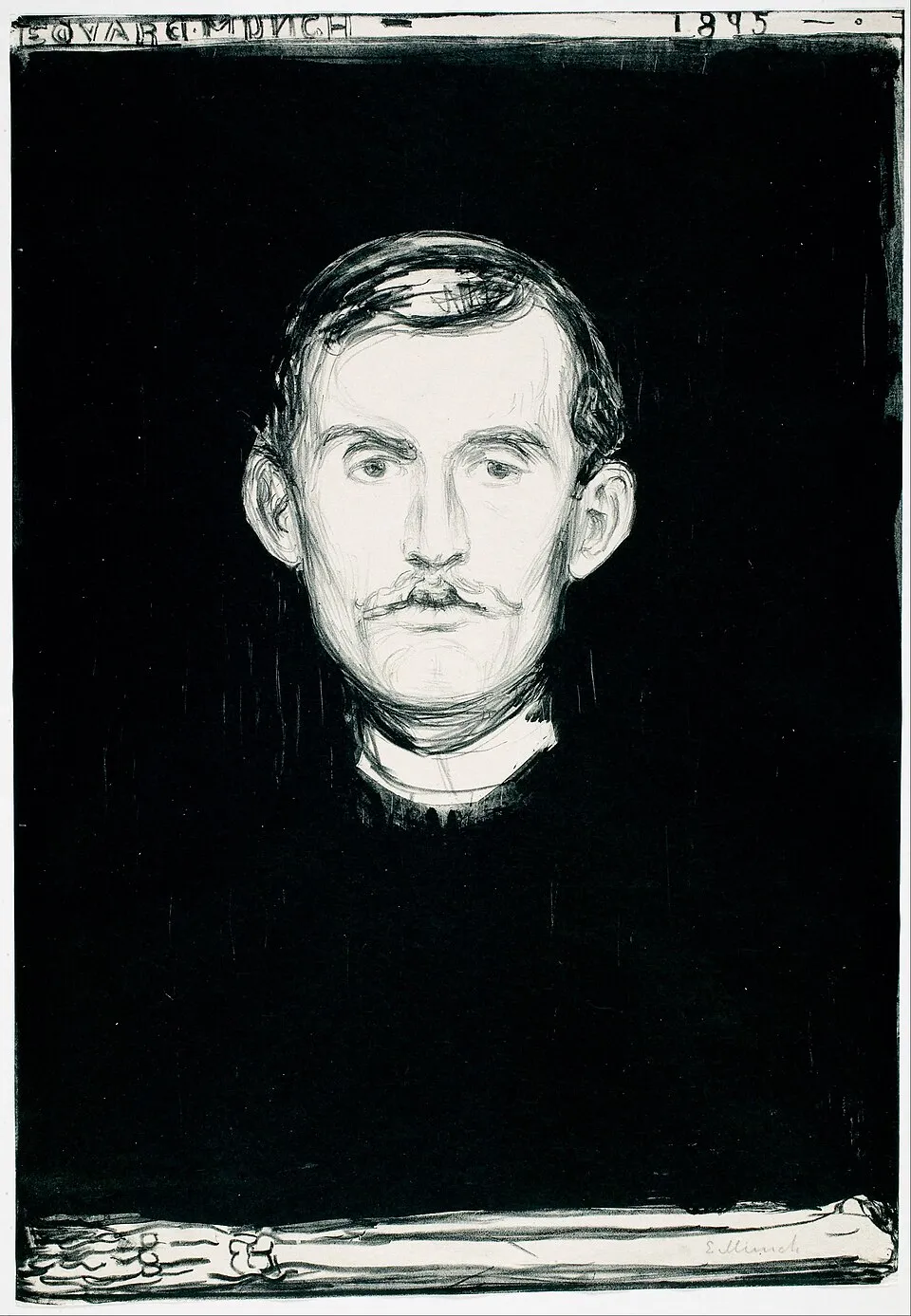
Edvard Munch, "Self-Portrait" (1895). Oil on canvas. Munch's self-portraits are among his most searching works, using his own face as a laboratory for exploring states of anxiety and psychological intensity. Wikimedia Commons.
The Frieze of Life
Munch conceived of his entire body of work as a single interconnected project he called "The Frieze of Life." He described it as a poem about life, love, and death, divided into four chapters: "The Awakening of Love," "The Blossoming and Dissolution of Love," "Fear of Life," and "Death." Nearly every major painting he made between 1890 and 1910 was conceived as part of this project, which he periodically organized into large thematic exhibitions.
This conception of his work as a continuous project rather than individual paintings is essential to understanding Munch. The repetitions, variations, and returns that characterize his practice were not failures to move forward. They were a deliberate and systematic investigation of a limited set of subjects. The same compositions recur across decades in different media and different moods, as if Munch were circling a set of core experiences that could never be fully expressed in any single version.
The "Fear of Life" chapter, which contains "The Scream" (1893), "Anxiety" (1894), and "Evening on Karl Johan Street" (1892), is the most psychologically concentrated section of the Frieze. These paintings share a visual vocabulary of empty, staring faces, sinuous landscape forms, and figures that seem to be dissolving into their surroundings. The anxiety they express is not the acute anxiety of a specific moment but the chronic, existential anxiety of a consciousness that cannot turn off its awareness of mortality.
The Scream in Context
"The Scream" exists in four versions made between 1893 and 1910, in oil, tempera, pastel, and lithograph. The image shows a figure on a walkway above a fjord, hands pressed to the sides of a distorted face, while two figures recede along the path behind it and the sky curves overhead in waves of red and orange. The figure's expression reads as horror, but Munch's diary entry that gave the image its meaning describes not the figure screaming but the landscape: "I felt an infinite scream passing through nature."
This distinction matters. The figure is not the source of the scream but the receiver of it. Munch was describing an episode of panic and dissociation in which the world around him seemed to vibrate with an unbearable intensity that passed through him rather than originating in him. The painting is a record of what that experience looked like from the inside. That is why it has connected with so many people across so many contexts: it depicts a kind of experience that is genuinely universal, the sudden overwhelming awareness that the world is indifferent and vast and that consciousness is impossibly fragile.
The pastel version of "The Scream," sold at Sotheby's in 2012 for $119.9 million, remains one of the highest auction prices ever achieved for a work on paper. The oil version from 1893 is in the National Museum of Norway in Oslo, and the other versions are at the Munch Museum on the Oslo waterfront. The MUNCH museum, which holds over 26,000 works that Munch bequeathed to the City of Oslo, opened a spectacular new building designed by estudio Herreros in 2021 and remains the world's largest collection dedicated to a single artist's work.
Love, Illness, and Later Work
Munch's romantic life was as tormented as his health. His most significant relationship, with Tulla Larsen, ended in 1902 when a confrontation resulted in a gunshot wound to Munch's left hand. The incident damaged two of his fingers permanently and coincided with one of the most psychologically turbulent periods of his life. By 1908, after years of heavy drinking and increasing paranoia, he admitted himself to a clinic in Copenhagen for treatment of what his doctors described as a nervous breakdown.
He emerged from the clinic in 1909 substantially changed. His work after 1910 is broader, more expansive, more open to light and color. Large outdoor scenes replace the interiors and intimate anxiety of the Frieze period. Munch bought property outside Oslo and began a series of large public commissions, most importantly the decorations for the Aula (ceremonial hall) of the University of Christiania, completed in 1916, depicting allegories of history, alma mater, and the sun in a style far removed from the anguished intimacy of his most famous works.
He continued to work prolifically until his death in January 1944, leaving virtually his entire estate, thousands of paintings, prints, drawings, and photographs, to the City of Oslo. In 2026, the MUNCH museum is presenting an exhibition titled "Edvard Munch and the Chocolate Factory," which brings Munch's large-scale paintings commissioned for the Freia chocolate factory in 1922 out of the factory canteen and into the museum for the first time, allowing close examination of works that have been inaccessible for over a century. A separate interactive exhibition, "Connect the Lines," running through November 2026, uses an AI system developed with Tata Consultancy Services to connect visitors' own drawings with similar works in the museum's archive of approximately 7,000 Munch drawings, most of which are too fragile to display conventionally.
Munch and Expressionism
Munch is often described as a precursor to Expressionism rather than an Expressionist himself, because his breakthrough work predates the German movement by a decade and because he was Norwegian rather than German. But his influence on the Expressionist generation was direct and acknowledged. The artists of Die Brucke, particularly Ernst Ludwig Kirchner, studied and admired his prints. The distortion of faces, the anguished line, the use of color to convey psychological states rather than describe light: all of these practices flow from Munch to the German Expressionists and through them to an enormous range of 20th-century figurative art.
His influence is also visible in the graphic novel tradition, in the work of artists like Bill Sienkiewicz and Dave McKean, and in the visual language of horror cinema, which has borrowed his imagery of faces dissolving in fear since the silent era. The Scream's face reappears in Wes Craven's "Scream" franchise not as a direct homage but as evidence that Munch's image had become part of the common visual vocabulary of terror. For the broader context of the movement his work helped create, the guide to Expressionism covers the full movement.
The Prints
Any serious engagement with Munch requires attention to his printmaking. He was one of the great printmakers of the modern era, producing over 700 prints in lithography, woodcut, etching, and drypoint. His prints are not reproductions of his paintings but independent works in which the technical properties of the medium serve the image's emotional purpose. His woodcuts, made from planks of sawn wood with the grain visible in the printed surface, achieve a rawness and directness that no photographic reproduction can adequately capture. His lithographs, printed in color from multiple stones, are among the most technically ambitious color prints of the late 19th century.
The prints also distributed his imagery internationally. Because prints were reproduced and sold at lower prices than paintings, Munch's visual vocabulary reached European artists and collectors who had never seen his canvases. The emotional directness of his printmaking was arguably his most influential technical contribution to modern art, and the MUNCH museum's online collection now provides digital access to a significant portion of this graphic work.
Final Thoughts
Edvard Munch made one of the most recognizable images in the history of Western art, and the image's recognizability has paradoxically obscured the artist's actual significance. He was not a painter of panic attacks. He was a systematic investigator of the psychological terrain between life and death, a terrain he knew intimately from personal experience and returned to obsessively across a seventy-year career.
His work connects the psychological introspection of late Symbolism to the emotional directness of Expressionism, and from there to every subsequent attempt to use visual art as a vehicle for inner states rather than outer appearances. "The Scream" is a beginning, not a summary. If you want to understand what it means, start with "The Sick Child," read through the Frieze of Life, and then make the trip to the MUNCH museum in Oslo and let the full scope of what he made come into view. For the movement his work belongs to and helped create, the guide to Expressionism provides essential context. For the specific painting that has made his name universal, the guide to The Scream explores the image in depth. Which Munch painting stays with you beyond "The Scream"? Share in the comments.


