
Berlin's art history is a history of rupture. Every political upheaval in Germany's last 150 years — the Empire, the Weimar Republic, the Nazi regime, the division into East and West, the reunification — destroyed and rebuilt the city's art scene. Berlin never had the continuity that Paris or Florence enjoyed. What it had instead was a pattern of creative reinvention, where each new political order produced its own art and its own institutions, and where the ruins of the previous order became the material for the next. This guide covers Berlin's art scene from the Expressionists to the present: the Weimar years, the Nazi destruction, the Cold War division, the East Side Gallery, and the post-reunification gallery scene that made Berlin one of the most important art cities in Europe.
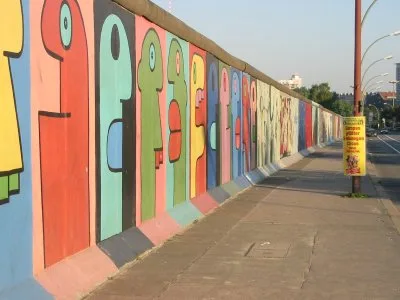
The East Side Gallery, Berlin. The longest remaining section of the Berlin Wall, painted by 118 artists from 21 countries in 1990 after the Wall fell. The East Side Gallery is 1.3 kilometers long and is the world's largest open-air mural gallery. It turned the Wall — the symbol of Cold War division — into a public art installation. Image via Wikimedia Commons.
The Weimar Years: Expressionism, Dada, and the Bauhaus
Berlin's first great period as an art city was the Weimar Republic (1919-1933). Berlin was the capital of a defeated empire, a city of political chaos, economic crisis, and cultural explosion. The Expressionists — Ernst Ludwig Kirchner, Emil Nolde, Max Beckmann — painted the energy and anxiety of the city. Kirchner's "Street, Berlin" (1913) shows the sharp, angular figures of Berlin's bourgeoisie walking the streets with a sense of danger and sexuality. For more on the movement, see our guide to Expressionism.
Berlin Dada was angrier than the Zurich original. The Berlin Dadaists — George Grosz, John Heartfield, Hannah Hoch, Raoul Hausmann — used collage and photomontage to attack the military, the bourgeoisie, and the Weimar government. Grosz's drawings of corrupt businessmen and crippled veterans were published in magazines and exhibited in galleries. Hoch's photomontages questioned gender roles and mass media. Heartfield's anti-Nazi photomontages, made in the 1930s after he fled Berlin, are some of the most powerful political art ever made. For more, see our guide to Dadaism.
The Bauhaus, founded in Weimar in 1919 by Walter Gropius, moved to Dessau in 1925 and to Berlin in 1932. The Berlin phase was brief — the Nazis closed the Bauhaus in 1933 — but the school's influence on modern design, architecture, and art education was enormous. For more, see our guide to the Bauhaus.
The Nazi Destruction
The Nazis destroyed Berlin's art scene. Modern art was declared "degenerate" and removed from museums. Jewish artists were banned from exhibiting. The 1937 "Degenerate Art" exhibition in Munich displayed works by Kirchner, Nolde, Beckmann, Kandinsky, and others as examples of what the regime considered corrupt art. Many of these works were destroyed or sold abroad. Kirchner committed suicide in 1938. Max Beckmann fled to Amsterdam. George Grosz fled to New York. The Bauhaus faculty scattered — Gropius went to Harvard, Mies van der Rohe went to Chicago, Klee went to Switzerland.
The destruction was not just of art but of the infrastructure that supported it. Galleries closed. Museums were purged. Critics were silenced. The artists who remained in Germany were required to produce work in the approved style — heroic realism, classical nudes, pastoral landscapes. For more on this period, see our guide to art under fascism.
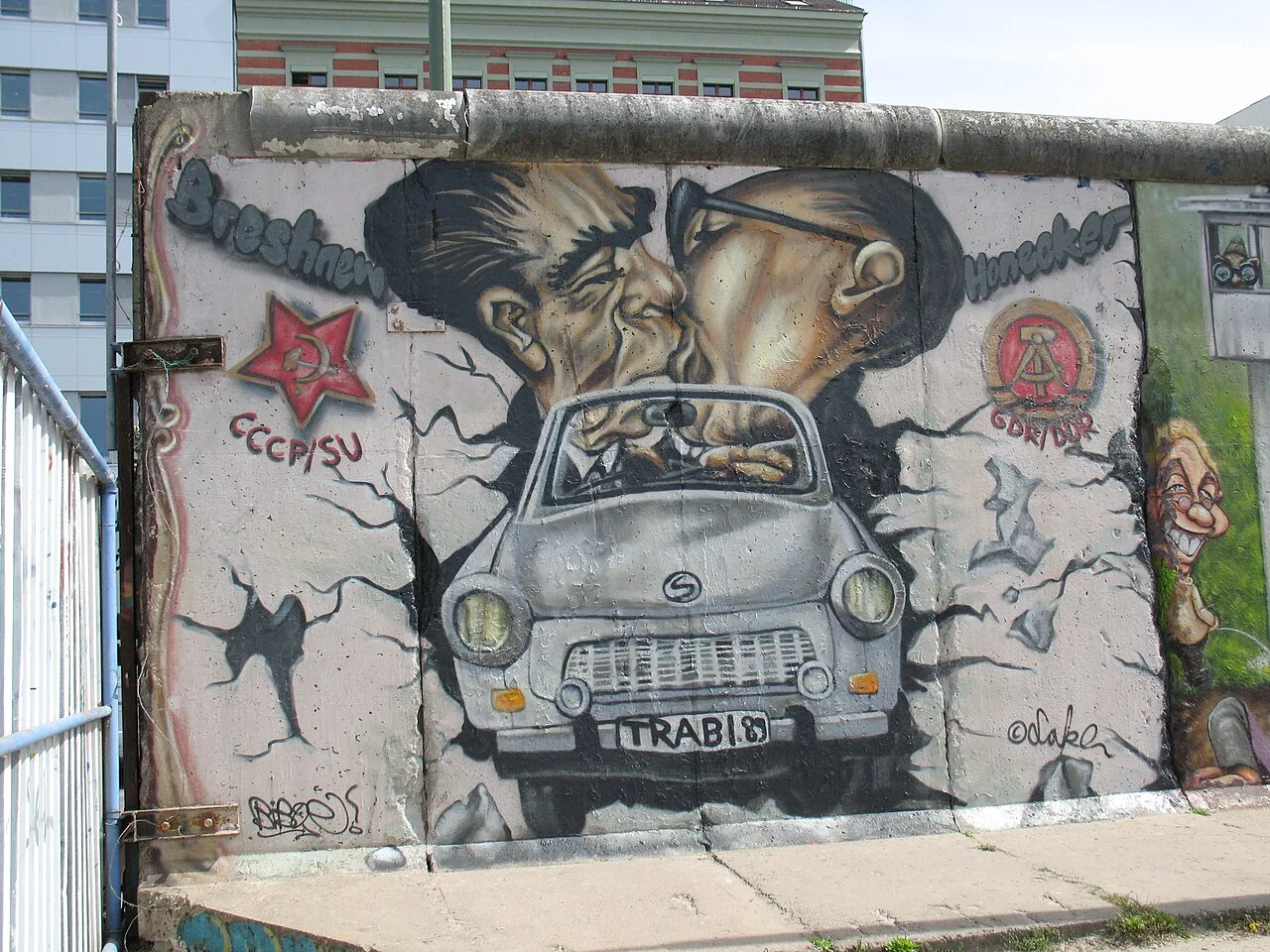
The "Fraternal Kiss" mural at the East Side Gallery, painted by Dmitri Vrubel in 1990. The mural depicts the 1979 kiss between Soviet leader Leonid Brezhnev and East German leader Erich Honecker. The caption reads: "My God, help me to survive this deadly love." It is one of the most photographed murals on the Wall. Image via Wikimedia Commons.
The Cold War: East and West
After 1945, Berlin was divided. The city became a front line in the Cold War, and its art scene split in two. West Berlin, subsidized by the West German government, developed a gallery scene and a cultural infrastructure that was meant to demonstrate the superiority of the free world. The Berlin Academy of Fine Arts, the Hochschule der Kunste, and the Berliner Festspiele were all West Berlin institutions. Artists like Georg Baselitz and Markus Lupertz, who would later be called Neo-Expressionists, worked in West Berlin in the 1960s and 1970s.
East Berlin was the capital of the German Democratic Republic, and its official art style was Socialist Realism. The state commissioned murals, sculptures, and paintings that depicted workers, farmers, and party officials in a heroic style. The East German government also built public art — the Marx-Engels Forum, the Fernsehturm (TV tower), the Palast der Republik. Socialist Realism was mandatory for state commissions, though some East German artists found ways to work around it. For more on this style, see our guide to Soviet art and Socialist Realism.
The Wall Falls and the East Side Gallery
The Berlin Wall fell on November 9, 1989. Within months, artists began painting on the remaining sections of the Wall. The East Side Gallery, officially opened in September 1990, was the organized version of this impulse. 118 artists from 21 countries painted the 1.3-kilometer stretch of the Wall that runs along the Spree River in Friedrichshain. The murals are a mix of celebration, satire, and memorial. Some are famous — the "Fraternal Kiss" by Dmitri Vrubel, the Trabant breaking through the Wall by Birgit Kinder — and others are less known but equally powerful.
The East Side Gallery is the largest open-air mural gallery in the world, and it is one of the few places where the Berlin Wall is still standing. It is also a contested site. Sections have been removed for construction. The murals have been restored, sometimes badly. The question of whether the Wall should be preserved as a memorial or allowed to disappear is a Berlin-specific version of the larger question of how cities deal with painful history. For more on how art engages with public memory, see our guide to art and society.
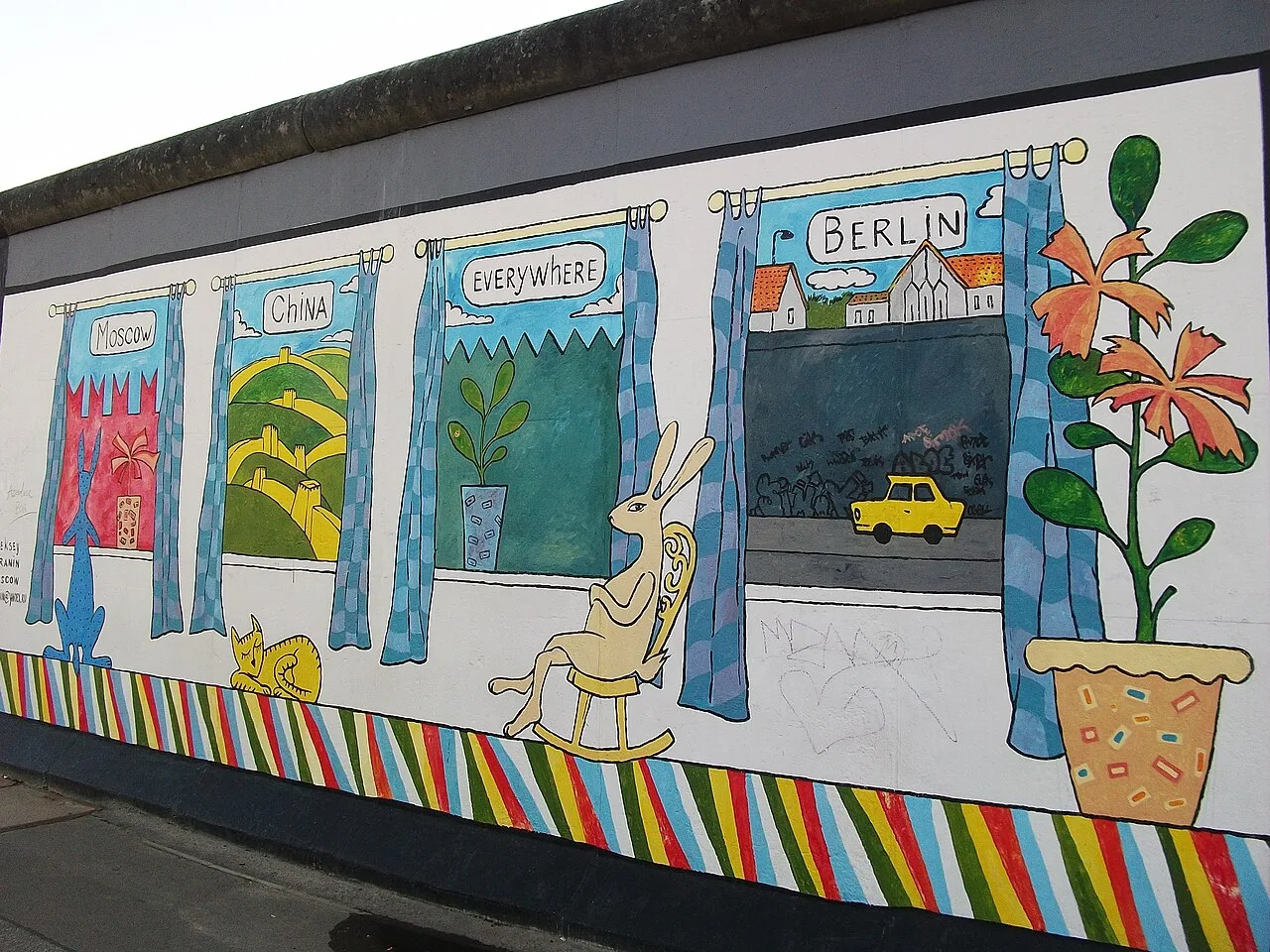
Street art on the East Side Gallery, Berlin. The murals on the Wall range from political satire to abstract decoration. The Wall, once a barrier, is now a gallery — a transformation that captures Berlin's pattern of turning political rupture into creative opportunity. Image via Wikimedia Commons.
Post-Reunification: Galleries, Museums, and the Creative City
After reunification in 1990, Berlin became the cheapest major city in Europe. Rents were low, space was abundant, and the city attracted artists from across Germany and beyond. The gallery scene that emerged in the 1990s and 2000s was centered in Mitte (the old East Berlin center) and later in Kreuzberg and Wedding. Galleries like Eigen+Art, Contemporary Fine Arts, and Spruth Magers opened in Berlin and built international reputations. The Berlin Biennale, founded in 1996, became one of the most important contemporary art exhibitions in Europe.
The museums also rebuilt. The Museum Island, a UNESCO World Heritage Site in the Spree River, houses five museums including the Pergamon Museum and the Bode Museum. The Hamburger Bahnhof, a former railway station converted into a contemporary art museum, holds the collection of the Nationalgalerie's contemporary works. The Boros Collection, a private collection housed in a former bunker, is one of the most visited private art spaces in Berlin. The KW Institute for Contemporary Art, located in a former margarine factory in Mitte, is one of the most important non-commercial art spaces in the city.
What Berlin Is Now
Berlin's art scene is defined by its affordability and its openness. The city still has more artists per capita than any other European capital, though rising rents are putting pressure on the community. The gallery scene is spread across the city — Mitte, Kreuzberg, Wedding, Neukolln — and the museum landscape is one of the richest in Europe. The Berlin Biennale, the Gallery Weekend (held every April), and the Berlin Art Week (held every September) are the major events.
Berlin is not the art market capital that New York or London is. It does not have the auction houses or the collector base. What it has is the artist community — the largest in Europe — and the institutional infrastructure to support it. The city's history of rupture and reinvention is its defining characteristic. Every era of Berlin's art scene was built on the ruins of the previous one. That pattern is still visible, and it is what makes Berlin different from Paris, London, or New York. For more on how the art world is organized, see our guide to how the art market works.
Final Thoughts
Berlin's art scene has been destroyed and rebuilt more times than any other city's. The Weimar Republic produced Expressionism, Dada, and the Bauhaus. The Nazis destroyed it. The Cold War split it. The reunification opened it. Each rupture produced a new kind of art, and the city's current scene — galleries, museums, biennials, and the largest artist community in Europe — is the latest version of a pattern that began in 1919.
Start at the East Side Gallery for the most direct experience of Berlin's history as art. Go to the Hamburger Bahnhof for contemporary art. Go to Museum Island for the Old Masters. Walk through Mitte and Kreuzberg to see the gallery scene. For more on the movements that shaped Berlin, see our guides to Expressionism, Dadaism, and the Bauhaus. For the broader picture, see our guide to art movements from ancient to now.


