
In 1937, Nazi Propaganda Minister Joseph Goebbels made plans to show the public the forms of art that the regime deemed unacceptable, according to the Holocaust Encyclopedia. The result was the "Entartete Kunst" (Degenerate Art) exhibition, organized by Adolf Ziegler, opening in Munich on July 19, 1937. The exhibition presented 650 works of art, confiscated from German museums, as Wikipedia documents. It was displayed in counterpoint to the Great German Art Exhibition, which opened one day earlier in the newly built Haus der Deutschen Kunst, the Nazi regime's showcase of approved art. The Degenerate Art exhibition was designed to mock modern art. Works by Beckmann, Kirchner, Nolde, Kokoschka, Chagall, Kandinsky, and others were displayed with derogatory labels, crowded on walls, surrounded by graffiti and slogans. Over 16,000 works were confiscated from German museums between 1937 and 1938. Nazi leaders sought to control Germany not only politically, but also culturally. The regime restricted the type of art that could be produced, displayed, and sold.
In Italy, Mussolini's regime took a different but parallel path. It initially tolerated the avant-garde, then imposed a state-approved style that merged classical realism with fascist ideology. The story of art under fascism is a story of control, persecution, and destruction, but also of resistance, exile, and survival. Artists were banned, exiled, or killed. But their art, in many cases, survived, in museum basements, in exile, and in the collections of those who recognized its value when the state did not. This guide covers the "Entartete Kunst" exhibition, the confiscation campaign of 16,000-plus works, the persecuted artists, the Great German Art Exhibition, the Italian parallel under Mussolini, and what happened to the art and the artists. For more on how art reflects the politics around it, see our guide to art and society.
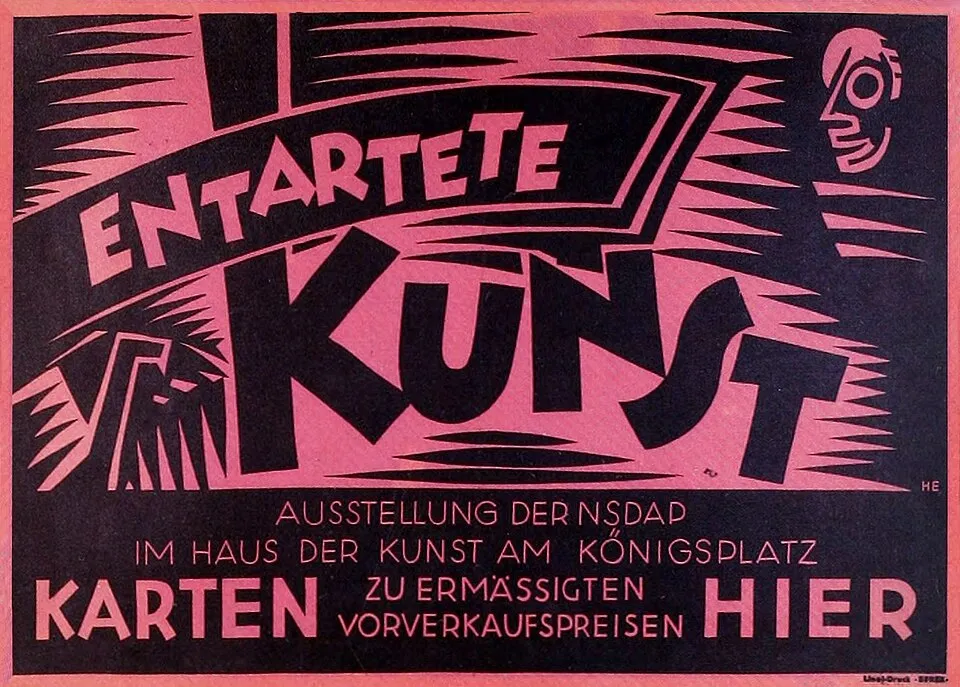
Poster for "Entartete Kunst" (1937). The Degenerate Art exhibition was organized by Adolf Ziegler and the Nazi Party in Munich from 19 July to 30 November 1937. The exhibition presented 650 works of art, confiscated from German museums, and was staged in counterpoint to the Great German Art Exhibition. Image via Wikimedia Commons
The "Entartete Kunst" Exhibition (1937)
The exhibition was organized by Adolf Ziegler, a painter of academic nudes who was appointed president of the Reich Chamber of Visual Arts. It ran in Munich from July 19 to November 30, 1937. The 650 works on display had been confiscated from German museums. They were shown in the Hofgarten arcades, a cramped, poorly lit space, in deliberate contrast to the spacious, well-lit Haus der Deutschen Kunst next door. The walls were covered with graffiti and slogans: "An insult to German womanhood," "Nature as seen by sick minds," "The ideal: cretin and whore." The intention was not to display the work but to humiliate it.
The attendance figures tell a story the Nazis did not intend. The Degenerate Art exhibition attracted over 2 million visitors. The Great German Art Exhibition drew about 400,000. The regime's attempt to mock modern art had the unintended effect of giving millions of people their first, and in many cases only, exposure to it. After Munich, the exhibition toured to Berlin, Leipzig, Dusseldorf, and other cities through 1939. The National WWII Museum notes that the exhibition was staged in counterpoint to the approved art on view one day earlier, a deliberate juxtaposition designed to let the public see both and choose. The public chose the degenerate art, five to one.
The Confiscation Campaign: 16,000 Works Seized
Nazi leaders sought to control Germany not only politically, but also culturally. The regime restricted the type of art that could be produced, displayed, and sold. Over 16,000 works were confiscated from German museums between 1937 and 1938. The inventory survives. The complete inventory of artworks confiscated by the Nazi regime from public institutions in Germany, 1937 to 1938, compiled by the Reichsministerium fur Volksaufklarung und Propaganda, is held at the Victoria and Albert Museum in London. It is a document of bureaucratic thoroughness, listing each work by artist, title, medium, and the museum from which it was taken.
Thousands of confiscated works were burned or destroyed. In 1939, the Nazis burned approximately 5,000 confiscated works in the courtyard of the Berlin fire station. Some works were sold abroad to raise foreign currency. The Nazis appointed art dealers to sell confiscated works on the international market, a paradox, since the regime condemned the art as degenerate but was willing to sell it for profit. Beyond the confiscation from museums, the Nazi regime systematically looted Jewish collections across occupied Europe. The looting of art from Jewish families is one of the largest thefts of cultural property in history, and the restitution of these works is still ongoing. For more on building your own understanding of art history, see our guide to teaching yourself art history.
The Persecuted Artists: Beckmann, Kirchner, Nolde
Max Beckmann (1884 to 1950) was labeled "degenerate." Over 500 of his works were removed from German museums. He fled to Amsterdam on the day after the opening of the Entartete Kunst exhibition in 1937 and emigrated to the United States in 1947. He never returned to Germany.
Ernst Ludwig Kirchner (1880 to 1938) was a founder of Die Brucke (The Bridge), the German Expressionist group. Over 600 of his works were removed from museums. Kirchner destroyed many of his own works and committed suicide in 1938 in Davos, Switzerland.
Emil Nolde (1867 to 1956) was a member of Die Brucke. Over 1,000 of his works were removed from museums, more than any other artist. Nolde was a member of the Nazi Party, but his modernist style was condemned nonetheless. He was prohibited from painting, even in private, after 1941. He defied the ban, producing small watercolors he called the "Unpainted Pictures." Oskar Kokoschka (1886 to 1980) was labeled "degenerate," fled to Prague, then to London, and continued to paint in exile.
The persecution of artists under fascism was not just about suppressing art. It was about controlling identity, who could be an artist, what an artist could make, and what art could say. The artists who were persecuted were not just making modern art. They were making art that challenged the fascist vision of order, hierarchy, and racial purity. For more on the stories behind specific works, see our guide to famous paintings.
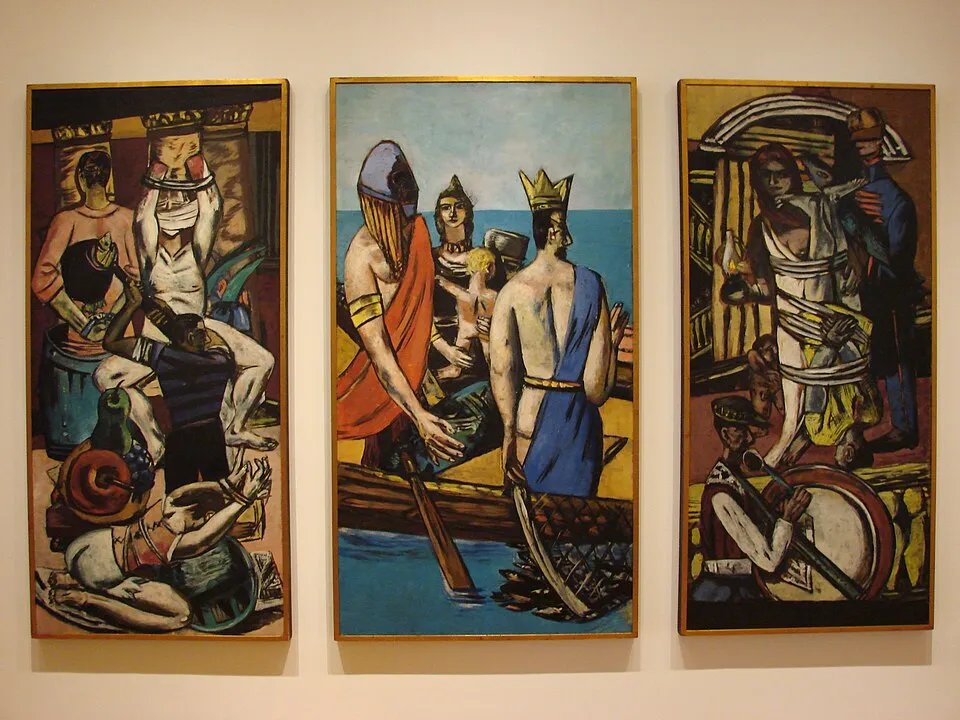
Max Beckmann, "Departure" (1932-33). Beckmann was labeled "degenerate" by the Nazi regime. Over 500 of his works were removed from German museums. He fled to Amsterdam on the day after the opening of the Entartete Kunst exhibition in 1937 and never returned to Germany. Image via Wikimedia Commons
The Great German Art Exhibition: Fascist Aesthetics
The Great German Art Exhibition (Grosse Deutsche Kunstausstellung) opened on July 18, 1937, one day before the Degenerate Art exhibition, in the newly built Haus der Deutschen Kunst in Munich. It was the Nazi regime's showcase of approved art: academic painting, monumental sculpture, landscapes, nudes, and military scenes. Fascist art favored representational, academic, and monumental styles. The subjects were heroic soldiers, fertile mothers, idealized peasants, and mythological scenes. The style was a fusion of 19th-century academic painting and classical sculpture, art that conveyed order, hierarchy, and racial purity.
The two exhibitions, opening one day apart, presented a clear contrast. Approved art in the Haus der Deutschen Kunst, degenerate art in the Hofgarten arcades. The contrast was deliberate. The Nazis wanted the public to see both and choose. The public chose the degenerate art, 2 million visitors against 400,000. For more on how to approach unfamiliar work, see our guide to how to look at art.
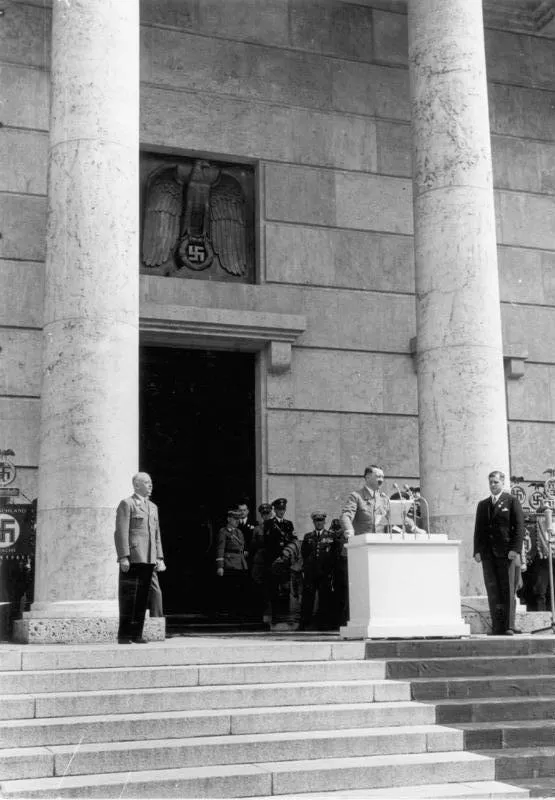
Great German Art Exhibition (Grosse Deutsche Kunstausstellung), Munich, 1937. The exhibition was staged in counterpoint to the Degenerate Art exhibition, approved art in the Haus der Deutschen Kunst, degenerate art in the Hofgarten arcades. The two exhibitions opened one day apart. Image via Wikimedia Commons
The Italian Parallel: Mussolini and the Novecento
Mussolini's regime took a different approach to art than Hitler's. Initially, the Italian fascist regime tolerated the avant-garde. Futurism, with its celebration of speed, violence, and modernity, had affinities with fascist ideology. Marinetti, the founder of Futurism, was a member of the Fascist Party. In the 1920s, the Novecento Italiano movement, founded by Margherita Sarfatti, a critic and Mussolini's mistress, proposed a return to classical order. The movement's artists, including Mario Sironi, Felice Casorati, and Arturo Martini, combined modernist techniques with classical subjects, creating a style that was both modern and traditional, and compatible with fascist ideology.
By the 1930s, the Italian regime moved closer to the German model. In 1938, Italy adopted racial laws, and the regime's tolerance for the avant-garde diminished. Jewish artists were persecuted. The Biennale, which had been a showcase for international modernism, was brought under state control. The Italian case demonstrates that fascism's relationship to art is not uniform. It varies by regime, by period, and by artist. But the underlying logic is the same: art must serve the state. Whether the state prefers Futurism or classical realism, the principle is control.
What Happened to the Art and the Artists
Thousands of works were destroyed. Thousands more were sold abroad or stored in depots. Some survived in museum basements. Some were looted from Jewish families and have never been returned. The restitution of Nazi-looted art is still ongoing. The 1998 Washington Conference Principles established a framework for returning looted art, but many works remain in museums and private collections, their ownership disputed.
Some artists fled, including Beckmann, Kokoschka, and Chagall. Some stayed and were persecuted, like Nolde, who was prohibited from painting. Some died, like Kirchner, who committed suicide in 1938. Some collaborated. The story of artists under fascism is not a story of uniform resistance or uniform collaboration. It is a story of individual choices made under extreme pressure. After 1945, the Degenerate Art exhibition became a symbol of the dangers of state censorship. The works that survived were restored to museums. The artists who had been persecuted were celebrated. But the story is not over. The restitution of Nazi-looted art continues, and the question of what art should be under a system of state control remains relevant. For more on where to begin, see our guide to art for beginners.
Final Thoughts
The Degenerate Art exhibition was organized by Adolf Ziegler and the Nazi Party in Munich from July 19 to November 30, 1937. It presented 650 works of art, confiscated from German museums. Over 16,000 works were confiscated between 1937 and 1938. The inventory survives at the Victoria and Albert Museum. Thousands were burned. The Great German Art Exhibition opened one day earlier, staged in counterpoint to the Degenerate Art exhibition. The Degenerate Art exhibition attracted over 2 million visitors. The Great German Art Exhibition attracted about 400,000. Max Beckmann fled to Amsterdam on the day after the opening. Ernst Ludwig Kirchner committed suicide in 1938. Emil Nolde had over 1,000 works removed and was prohibited from painting after 1941, defying the ban with the "Unpainted Pictures." In Italy, the Novecento Italiano movement, founded by Margherita Sarfatti, proposed a return to classical order. By the 1930s, the Italian regime moved closer to the German model. In 1938, Italy adopted racial laws. The restitution of Nazi-looted art is still ongoing.
Go to the Victoria and Albert Museum in London. It holds the complete inventory of artworks confiscated by the Nazi regime. Go to the Haus der Deutschen Kunst in Munich, now the Haus der Kunst. It has been transformed from a showcase of Nazi-approved art into a contemporary art museum, a deliberate act of historical reversal. Go to the MoMA in New York. Many of the works labeled "degenerate" by the Nazis are now in American museums, having been saved by collectors and dealers who bought them from the Nazis or rescued them in exile. Look at Beckmann's "Departure" (1932-33) at the MoMA, a triptych painted on the eve of the Nazi takeover, depicting figures struggling against tyranny. Then look at the empty frames at the Isabella Stewart Gardner Museum, a different kind of loss, but the same principle: when art is stolen or destroyed, something is lost that cannot be replaced. The Nazis burned 5,000 works. The Gardner thieves stole 13. Both are losses that diminish us all. For more on the broader context of state-controlled art, see our guide to Soviet art and Socialist Realism and our complete guide to art movements.


