
Installation Art: When Art Becomes an Experience
Discover how installation art transforms spaces into immersive experiences. From Olafur Eliasson's artificial sun to Christo's wrapped buildings, learn why stepping inside art changes everything.
Your cart is empty
Browse the store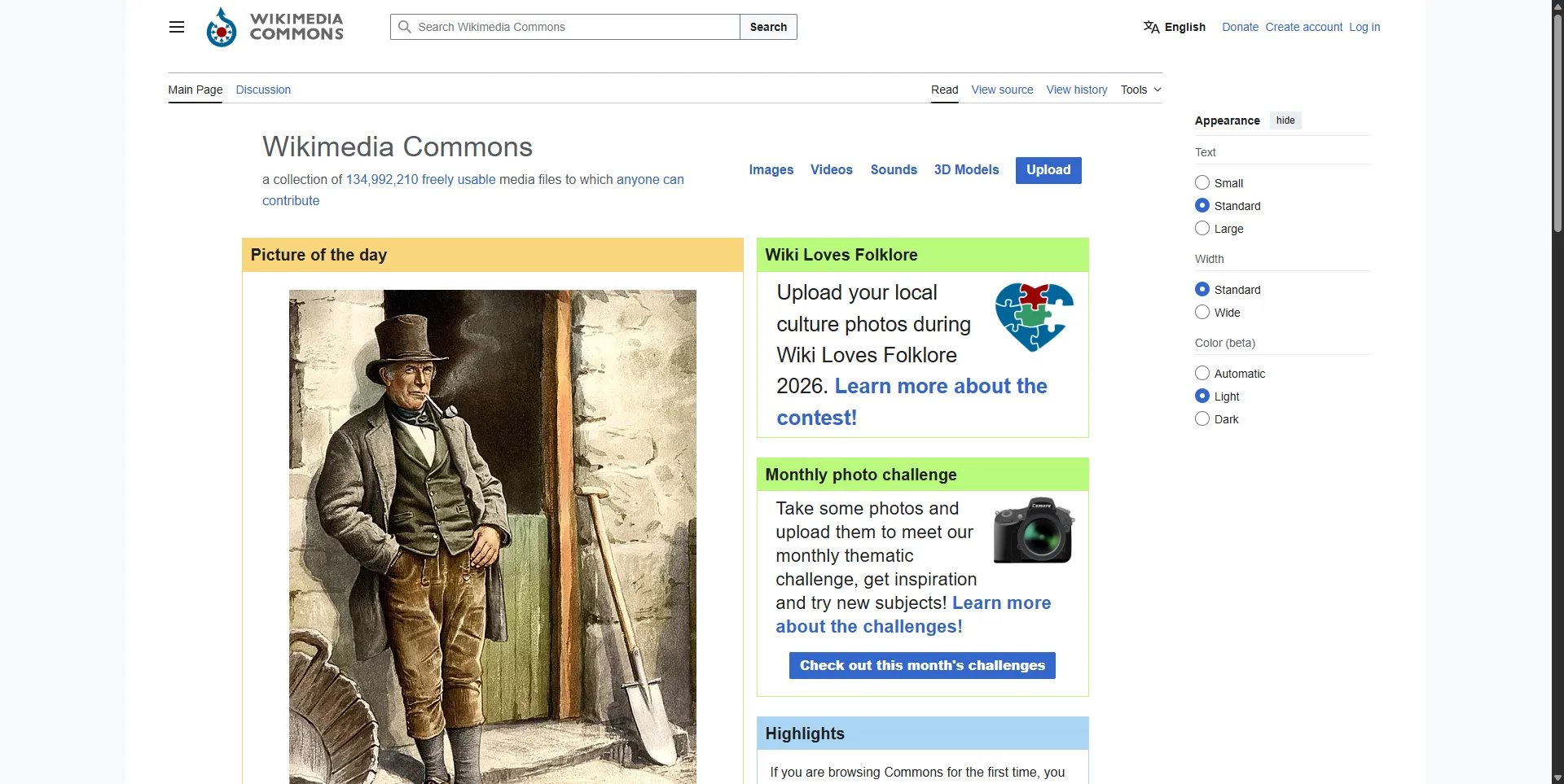
Wikimedia Commons hosts 140M+ freely licensed media files. Public domain art, historical photos, and scientific illustrations. Free with attribution for CC content.
Discover other stock image sites you might be interested in
The Biodiversity Heritage Library holds 63 million pages of natural history literature with centuries of botanical and zoological illustrations. Free, with a new home at CLIR and technical infrastructure moving to the Field Museum.
View details
The Art Institute of Chicago offers 50,000-plus CC0 images from one of the finest Impressionist and American art collections in the world. Free, no attribution, with a well-documented public API.
View detailsRead more about this topic on our blog
142 million files. That is the current count on Wikimedia Commons as of mid-2026, up from 132 million at the start of the year. It crossed the 100 million mark in November 2023 and has been growing at roughly 10 to 15 million files per year since. No other openly licensed media repository comes close to this scale.
But scale is not the same as quality. Wikimedia Commons is a chaotic, community-maintained archive where a high-resolution scan of a Rembrandt from the Rijksmuseum sits next to a blurry phone photo of a parking lot. The search interface is functional but inconsistent. Licensing varies file by file. If you need guaranteed quality and clean metadata, a dedicated museum open access program like the Met Open Access or the Smithsonian Open Access will serve you better. But if you need breadth, if you need a 19th-century photograph of a Norwegian fishing village or a botanical illustration from an 1840s German botanical journal, Commons is the only place that will have it.
Wikimedia Commons launched in 2004 as a central media repository for Wikipedia and other Wikimedia projects. It is maintained by the Wikimedia Foundation and built by volunteers: 41,000 active users, 170 administrators, and over 14 million registered accounts. Anyone can upload files, anyone can edit descriptions, and anyone can categorize content. This open model is why Commons has 142 million files and also why the quality is inconsistent.
The platform reached 1 billion page edits in 2025, a milestone that reflects both the scale of the community and the amount of cleanup work required to keep the archive usable.
For artists, the most valuable parts of Commons are not the amateur photos but the institutional contributions and public domain reproductions.
Museum contributions. Major museums have uploaded high-resolution images directly to Commons. The Rijksmuseum contributed over 700,000 images. The Met, the National Gallery of Art in Washington, and dozens of other institutions have contributed selected works. These files typically have reliable metadata, clear licensing, and high resolution.
Old master paintings. Works by Rembrandt, Vermeer, Caravaggio, Velazquez, Raphael, and hundreds of other historical painters are available in resolutions high enough to study brushwork and surface texture. Most are public domain.
Anatomical illustrations. Historical medical and scientific texts are well-represented, including the anatomical drawings of Andreas Vesalius and illustrations from Gray's Anatomy. For figure painters and illustrators, this collection is a free alternative to expensive anatomy reference books.
Botanical and zoological illustrations. Pre-photographic natural history illustrations from the 18th and 19th centuries are abundant. These are exceptional reference material for illustrators working in naturalistic styles.
Historical costume and fashion. Paintings, photographs, and illustrated publications covering every period and culture. If you are illustrating historical subjects, the costume reference on Commons saves hours of scattered research.
Architecture and interiors. Photographs of buildings and spaces from every period and style, useful for background reference in illustration and concept art.
This is where Commons gets complicated. Content falls into multiple categories, and you must check each file individually.
Public domain content has no copyright restrictions. Use it for anything, commercially or otherwise, with no attribution required. Works published before 1929 are generally public domain in the United States, but rules vary by country.
CC BY requires attribution but allows commercial use. You must credit the creator.
CC BY-SA requires attribution and share-alike licensing of derivative works. This can complicate commercial projects.
CC BY-NC prohibits commercial use entirely. Do not use these for client work.
The search interface lets you filter by licence type. For commercial work, filter for public domain and CC BY only. The haswbstatement search syntax also lets you query by structured data: for example, haswbstatement:P275=Q6938433 finds all CC0-licensed files.
Commons has two search systems. The default since 2021 is MediaSearch, which provides a visual grid of image results and uses structured data from Wikidata to improve relevance. The older Special:Search is still available and offers more advanced syntax.
Category browsing is often more effective than keyword search. The category system organizes files by subject, creator, period, and other attributes. Categories like "Paintings by Rembrandt" or "19th-century photographs of Paris" contain thousands of files. Learning to navigate categories takes time but produces better results than open-ended keyword searches.
Use the DeepcatSearch gadget. If you enable it in your preferences, it adds tabs to category pages that let you search files in a category and all its subcategories at once. This is the fastest way to browse large category trees.
Check the source institution. Each file page links to the source. Sometimes the institution's own website offers a higher-resolution version than what Commons hosts.
Against the Met Open Access, Commons has far more files but far less consistency. The Met provides 490,000 carefully photographed images under uniform CC0. Commons provides 142 million files under a patchwork of licences with variable resolution.
Against Europeana, Commons is more global but less curated. Europeana aggregates from European institutions with metadata standards. Commons accepts uploads from anyone.
Against the Internet Archive, Commons is better organized for visual art reference. The Internet Archive has more raw volume from digitized books, but its search is inconsistent and licensing is harder to verify.
Filter by licence before anything else. If you are doing commercial work, set the licence filter to public domain and CC BY. This prevents you from finding the perfect image only to discover it carries a CC BY-NC licence.
Use structured data search. The haswbstatement syntax lets you query by Wikidata properties. This is powerful for finding files with specific characteristics, like CC0 licence or specific depicted subjects.
Check file resolution before downloading. Commons hosts files at whatever resolution the uploader provided. Some files are 100-megapixel TIFFs. Others are 200-pixel JPEGs. Always check the file dimensions on the file page.
Use the Reverse Image Search gadget. Enable it in preferences to add a tab on file pages that searches Google Images, TinEye, and Yandex for similar images. Useful for finding higher-resolution versions of the same image elsewhere on the web.
Contribute your own work. If you are a photographer or illustrator, uploading your work to Commons under a CC licence gives it a permanent, stable home. The community provides guidance on uploading, licensing, and categorization.
Wikimedia Commons is for artists, illustrators, and researchers who need free visual reference material across an unmatched range of subjects and periods. It is for educators who want legally clear images for teaching. It is for anyone who needs a specific historical image that no commercial stock site or museum collection will have.
It is not for you if you need guaranteed high resolution, uniform licensing, or a polished search experience. For those needs, a dedicated museum open access program like the Met or a commercial stock site like Freepik will save you time.
Visit commons.wikimedia.org and start with MediaSearch. For better results, learn the category system and use the licence filter. For developers, the Wikimedia API provides programmatic access to the full repository. Commons is free, requires no registration for basic browsing, and is available in any language supported by MediaWiki.
Quiet Canvas is a space for artists and art lovers: essays, glossary terms, tools, and curated directories to support your creative practice.
Learn more →


