
In October 2003, visitors to the Tate Modern in London walked into the Turbine Hall and found the sun. An artificial one: a massive semicircular disc made of hundreds of mono-frequency lamps, suspended behind a fine mist of water vapor. The ceiling was covered in mirrors, completing the disc into a perfect glowing circle and doubling the space above visitors' heads. People lay on their backs on the floor, watching their tiny reflections in the mirrored ceiling, bathed in warm amber light. Over two million people visited Olafur Eliasson's "The Weather Project" during its six-month run. Many came back multiple times.
That behavior tells you something important. People were not coming to study the work or check it off a list. They were returning because the experience of being inside it was worth repeating. This is what installation art does that a painting or a sculpture cannot: it changes the space you are standing in and makes you aware of your own body within it. You do not look at installation art. You inhabit it.
This guide explains what installation art is, how it developed from early 20th-century experiments, who the major practitioners are, and how to actually experience it well when you encounter it.
What Installation Art Is
Installation art is a three-dimensional art form designed for a specific space and experienced by the viewer from within. Unlike a painting on a wall or a sculpture on a pedestal, an installation occupies an entire environment. It typically combines multiple materials and media: objects, sound, light, video, temperature, scent. The viewer does not stand at a remove. They enter the work and move through it.
Several qualities distinguish installation from other forms. Most installations are site-specific, meaning they are conceived for a particular space and often cannot be meaningfully relocated. The space itself is part of the work. Most are also temporary: they exist for the duration of an exhibition, then disappear. This impermanence is frequently part of the meaning rather than incidental to it. And most require viewer presence to be complete. An installation in an empty room is not the same work as an installation with people moving through it. The human presence is the final material.
A History That Goes Back Further Than Most People Think
Early Precedents
The roots of installation art stretch back to the early 20th century, well before the term existed. Marcel Duchamp's "1,200 Bags of Coal" (1938) suspended coal sacks from the ceiling of a Surrealist exhibition in Paris, transforming the gallery space into part of the artwork. Kurt Schwitters began his "Merzbau" in 1923: a sculptural environment that gradually consumed his entire house in Hanover, growing room by room over more than a decade. The Merzbau was inseparable from its architectural space, which is a basic condition of installation art.
The 1960s: Environments and Happenings
Installation art became a recognized form in the 1960s, driven by artists who found painting and sculpture too limiting. Allan Kaprow coined the term "Environment" for his immersive assemblages and organized "Happenings," performance events staged within these environments. Yayoi Kusama made her first Infinity Mirror Rooms in the mid-1960s, turning finite gallery rooms into apparently infinite cosmic spaces by covering every surface with mirrors and filling the space with hanging lights. Half a century later, these rooms remain among the most visited artworks in the world.
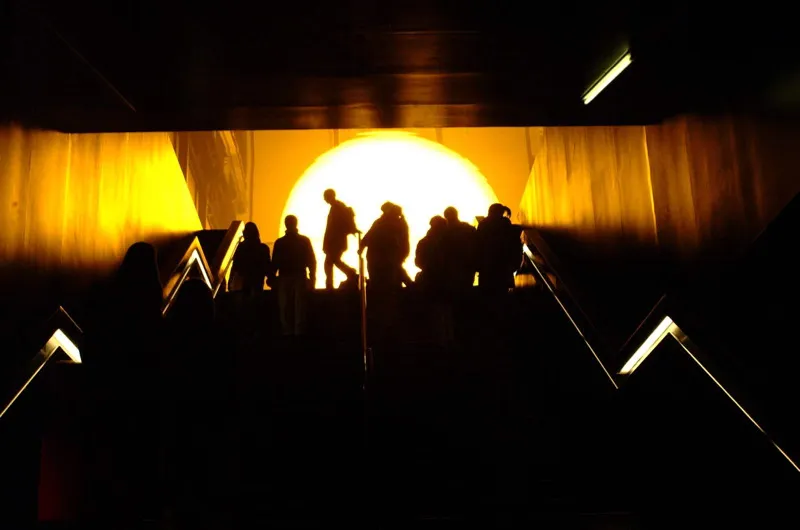
Olafur Eliasson, "The Weather Project" (2003), Turbine Hall, Tate Modern, London. Over two million visitors came during the six-month installation. Many lay on the floor to watch their reflections in the mirrored ceiling. Photo by Marta. Image: CC BY 2.0, via Wikimedia Commons
Dan Flavin began making installations using commercial fluorescent light tubes in 1963. His work demonstrated something that remains useful to understand: an installation does not need to be physically elaborate. Three strategically placed fluorescent tubes in a corner can completely change how a gallery room feels. The simplicity was the point. He was showing that light itself is a material, not just a condition for seeing other materials.
The 1970s Through the 1990s
By the 1970s, installation had become a mainstream contemporary form. James Turrell began creating rooms and architectural spaces where light is the sole medium: no objects, no images, just precisely controlled light that activates perception in unusual ways. His ongoing "Roden Crater" project in Arizona, transforming an extinct volcanic crater into a naked-eye observatory, has been in development since 1977. It remains one of the most ambitious art projects in history.
Christo and Jeanne-Claude worked at the opposite end of the scale: they wrapped buildings, bridges, islands, and coastlines in fabric, then removed all trace of the work after a brief installation period. "The Gates" (2005) placed 7,503 saffron-fabric panels along 23 miles of Central Park pathways for 16 days, then was taken down completely. The only lasting evidence was documentation and memory. That was intentional. The work existed in the experience of walking through it, not in any object that remained.
Ilya and Emilia Kabakov built installations recreating communal Soviet apartment spaces, letting viewers walk through reconstructed kitchens, dormitories, and shared corridors. Being inside a Kabakov installation is being inside a specific historical experience of collective life under Soviet rule. The physical immersion makes the history feel immediate in a way that looking at photographs of Soviet housing does not.
Major Works Since 2000
Olafur Eliasson
Eliasson's practice consistently uses natural phenomena, light, water, fog, temperature, to heighten visitors' awareness of their own perception. His "Ice Watch" series (beginning 2014) placed large blocks of glacial ice harvested from Greenland in public squares in Copenhagen, Paris, London, and elsewhere. Visitors could watch the ice melt in real time and touch it directly. The work made climate change physically present rather than abstractly statistical. The Tate's collection holds significant documentation of his practice.
teamLab
The Japanese collective teamLab has built permanent immersive museums in Tokyo, Shanghai, Singapore, and other cities using projections, sensors, and algorithms that respond to viewer movement. Flowers bloom at your feet. Fish scatter when you step toward them. This work sits at an interesting and uncomfortable edge. It delivers genuine sensory immersion. It also sometimes resembles an expensive theme park attraction. The line between art and entertainment is not always easy to locate in their installations, which is worth thinking about as you experience them.
Kara Walker
Kara Walker's "A Subtlety, or the Marvelous Sugar Baby" (2014) placed a monumental sphinx figure made from approximately 80 tons of refined white sugar inside the Domino Sugar refinery in Brooklyn before its demolition. The sphinx had the body of an ancient sphinx and the face of a Black woman, with features drawn from the racist caricature tradition. Fourteen smaller molasses-covered resin figures of children surrounded her. The installation placed viewers physically inside the history of the sugar industry and its dependence on enslaved labor. You could not look at this work from outside. You had to stand in it, which was the point. More on Walker's broader practice is in our dedicated profile.
Why Installation Art Has Become Central to Contemporary Practice
Installation art resists easy commodification. You cannot hang it on a collector's wall. Its scale, temporality, and site-specificity make it difficult to own in the conventional sense. The experience is the artwork, and experiences cannot be possessed. This gives installation a certain integrity that object-based art sometimes loses when it enters the market.
It also creates genuine shared experiences at a moment when those have become scarce. Walking through an installation alongside strangers, all of you subject to the same transformed space, is a fundamentally different social experience from scrolling through images on a phone. The communal physical presence is part of the work.
Installation art is also well suited to addressing subjects that cannot be contained in a single image: climate change, migration, surveillance, collective trauma. Creating an environment that viewers physically inhabit is different from showing them a picture of the issue. The body registers the experience differently.
How to Experience Installation Art Well
The biggest mistake most people make with installation art is treating it like a painting: glancing at it, taking a photo, moving on. That approach misses what the form actually offers. A few principles that help:
Give it time. Spend at least ten minutes inside. Sit down if the work allows. Your first impression is usually incomplete. The work often opens up after a few minutes of sustained presence.
Pay attention to your body, not just your eyes. How does the temperature feel? What do you hear? How does the space make you want to move? These physical sensations are not incidental to the experience. They are the content.
Move deliberately. Look up, look down, approach different elements closely, step back. Your position within the installation changes what you see. The work is designed for a body in motion, not a fixed viewer.
Read the wall text after, not before. Let your direct sensory experience happen first. The conceptual framework matters, but it lands differently if you have already had the experience rather than reading about it in advance.
For more guidance on getting the most from museum visits, see our guide to how to visit an art museum.
Final Thoughts
Installation art has been one of the dominant forms of serious contemporary practice for fifty years, and its centrality has only grown. It demands more from viewers than a painting does: more time, more physical commitment, more willingness to surrender the comfortable distance that looking at objects on walls allows. In return, it offers experiences that stay with you in ways that more passive encounters with art often do not.
The next time you walk into an installation, resist every impulse to move quickly. The work is not asking you to study it. It is asking you to be inside it, and there is a difference. For more on how contemporary artists work with space and environment, our guide to digital art as a creative frontier covers how technology has expanded what is possible. And for a deeper look at how art communicates without images, explore how art communicates emotion without words.


