Europeana: 61 Million European Cultural Heritage Items, Free to Download
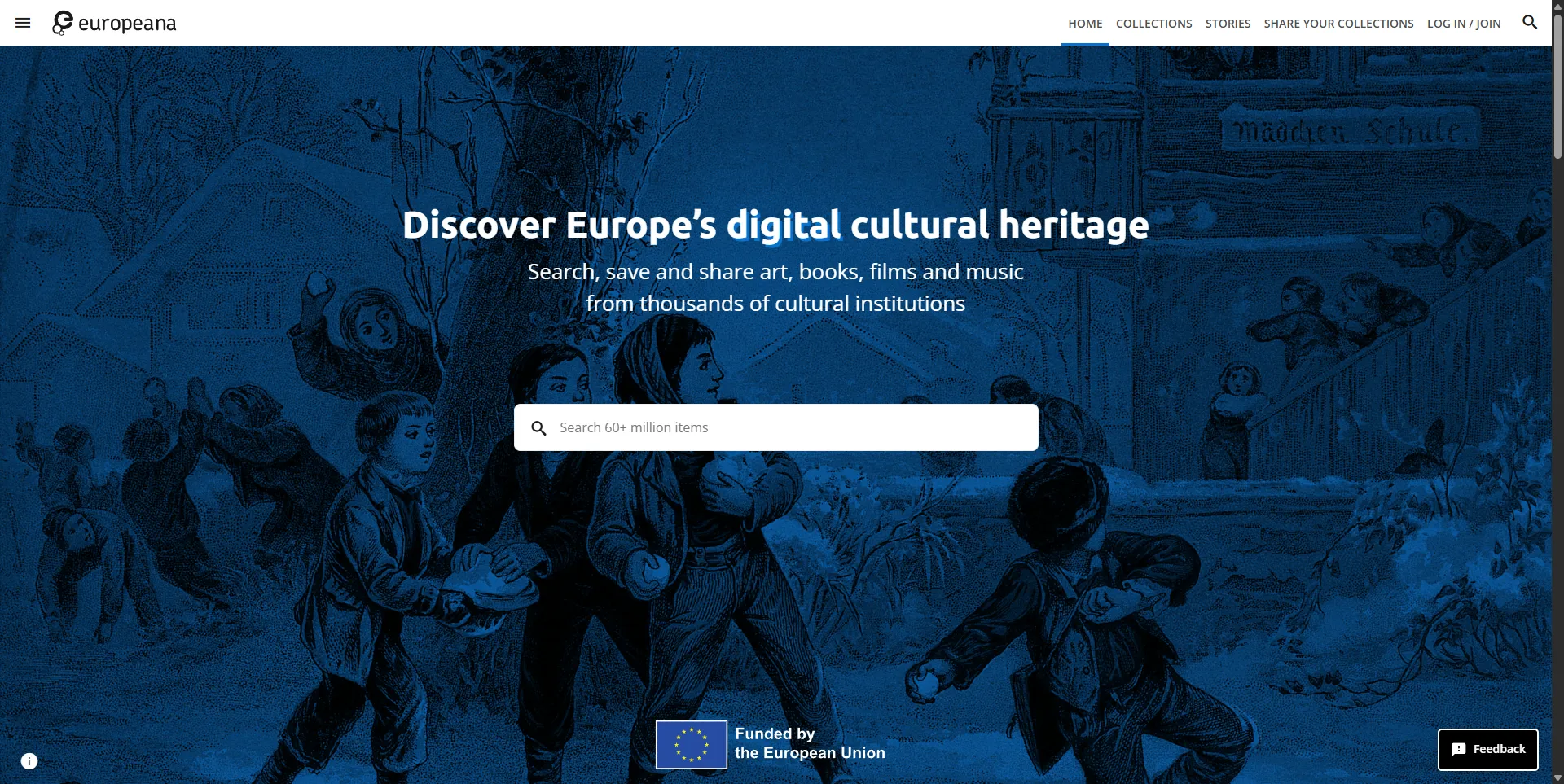
Where else can you find a medieval Hungarian manuscript, a 19th-century Norwegian fishing photograph, and a Renaissance Italian painting in the same search? Europeana is the only platform that aggregates cultural heritage from across the entire European continent, and as of 2025, it holds over 61 million items from more than 3,700 institutions. No other open access resource comes close to this geographic spread.
But here is the catch: the image quality varies wildly. Some contributing institutions provide high-resolution TIFFs suitable for print reproduction. Others upload compressed JPEGs barely large enough for a thumbnail. If you need consistent quality, you will be disappointed. If you need breadth and specificity of European cultural material, nothing else competes.
What Europeana Actually Is
Europeana launched in 2008 as a European Union initiative to create a single digital gateway to European cultural heritage. It has since evolved into what the EU now calls the Common European Data Space for Cultural Heritage, one of 14 EU data spaces funded under the DIGITAL Europe programme. The Strategy 2025-2030, published in January 2026, sets three priorities: building interoperable infrastructure, increasing reuse across sectors, and accelerating AI and 3D digitisation within the cultural heritage sector.
The platform averages 28 million API requests per month and serves a network of nearly 6,000 members through the Europeana Network Association (ENA). A memorandum of understanding signed with the Italian Ministry of Culture in December 2025 is expected to bring approximately 10 million additional Italian records into the data space, which will push the total even higher.
The Collection: What You Will Actually Find
Europeana aggregates from national libraries, regional museums, university archives, and specialist collections across every European country. The strength is in material that English-language databases ignore.
Eastern European and Nordic heritage is where Europeana outperforms every competitor. The Met Open Access and Getty Open Content focus on Western European and American collections. Europeana gives you Polish folk art, Estonian ethnographic photographs, Bulgarian icons, and Finnish textile samples from institutions that do not have the budget to run their own digital platforms.
Illuminated manuscripts from national libraries across Europe are a standout. The collection includes material from the Bibliotheque nationale de France, the British Library, and dozens of smaller national and university libraries. For artists studying medieval illumination techniques, the geographic range here is unmatched.
Historical photographs from the 19th and early 20th centuries document European life, landscape, and culture. The photographic collections are particularly strong for the period 1860 to 1940, with contributions from national archives and regional museums.
Decorative arts, textiles, and fashion cover every European country and period. If you are illustrating historical European costume or designing period-accurate material culture, the depth here saves hours of scattered research.
Licensing: Read the Fine Print
This is where Europeana gets complicated. Items carry a range of licences, and you must check each one individually.
CC0 (Creative Commons Zero) items can be used for any purpose, including commercial, with no attribution required. These are the ones you want for client work.
CC BY items require attribution to the contributing institution but allow commercial use. Manageable, but you need to keep records.
CC BY-SA items require attribution and share-alike licensing of derivative works. This can complicate commercial projects.
Restricted items are available for viewing and educational use only. The search interface lets you filter by licence type, which is essential if you are working on a commercial project. Always verify the licence on the individual item page before downloading.
Europeana vs. Other Open Access Platforms
Compared to the Met Open Access, Europeana offers far more geographic diversity but far less consistency in image quality. The Met provides 492,000+ carefully photographed, high-resolution images under a uniform CC0 licence. Europeana provides 61 million items under a patchwork of licences with variable resolution.
Compared to the Internet Archive, Europeana is more curated and better organised for art-specific research. The Internet Archive has more raw volume from digitised books, but its search is inconsistent and licensing is harder to verify.
Compared to the Library of Congress, Europeana covers European material that the LoC does not touch. The LoC is the better choice for American historical imagery, but European cultural heritage is Europeana's exclusive strength.
Insider Tips for Working with Europeana
Use the API for batch research. Europeana's API is free and well-documented. If you need to pull metadata for dozens of items, the API is faster than manual browsing. The API handles 28 million requests per month, so it is production-tested.
Filter by licence first. If you are doing commercial work, set the licence filter to CC0 before anything else. This saves you from finding the perfect image only to discover it carries a restrictive licence.
Check the source institution. Each item page links to the contributing institution. Sometimes the institution's own website offers a higher-resolution version than what Europeana hosts.
Explore the Collections feature. Thematic collections like fashion, art nouveau, and World War I curate items from across the full database. These are faster to browse than open-ended keyword searches, especially for broad topics.
Watch for 3D assets. The Twin It! campaign produced 55 3D-digitised monuments and artefacts from 26 EU member states. More 3D content is coming as the data space strategy pushes for advanced digitisation.
Who Is This For?
Europeana is for artists, illustrators, and designers who need European historical reference material that goes beyond the standard Western European canon. It is for researchers who need primary source material from Eastern European, Nordic, and Mediterranean institutions. It is for educators who want free, legally clear images for teaching.
It is not for you if you need guaranteed high-resolution output, uniform licensing, or a polished commercial-grade search experience. For those needs, a dedicated stock platform like Freepik or a museum open access program like the Met will serve you better.
Getting Started
Visit europeana.eu and start with a keyword search filtered by licence type. For developers, the Europeana API documentation provides everything you need to integrate the collection into your own tools. The platform is free, requires no registration for basic browsing, and offers multi-language support across all EU official languages.