Internet Archive Images: 2 Million Historical Book Illustrations on Flickr, Plus Millions More
In 2014, the Internet Archive extracted over 14 million images from digitised books and uploaded 2.6 million of them to a Flickr account called Internet Archive Book Images. Each image was automatically tagged with the text on the page where it appeared, making them searchable by keyword. A decade later, this Flickr collection remains one of the most underused visual research resources on the internet.
The Internet Archive, founded in 1996, is primarily known for the Wayback Machine and its massive collection of digitised books. But its image collections are where artists, illustrators, and designers find material they cannot find anywhere else. The Archive does not verify the copyright status of items, so you must check licensing yourself before using anything commercially.
The Flickr Book Images Collection
The Internet Archive Book Images Flickr account is the fastest way to browse the Archive's visual content. Over 2 million images extracted from digitised books are tagged with the text from their source pages, making them searchable by topic.
A search hack worth knowing: because the images are tagged with page text, you can search for specific subjects like "anatomy" or "botany" or "architecture" and find relevant illustrations from centuries of published books. The tagging is automated, so results are sometimes inaccurate, but the volume is so large that useful material surfaces consistently.
The collection covers the full range of illustration techniques used across centuries of publishing: woodcuts from early printed books, engravings from the 18th century, lithographs from the 19th century, and early photographic illustrations. For artists studying historical illustration techniques, this is a goldmine of reference material.
The Image Collections on archive.org
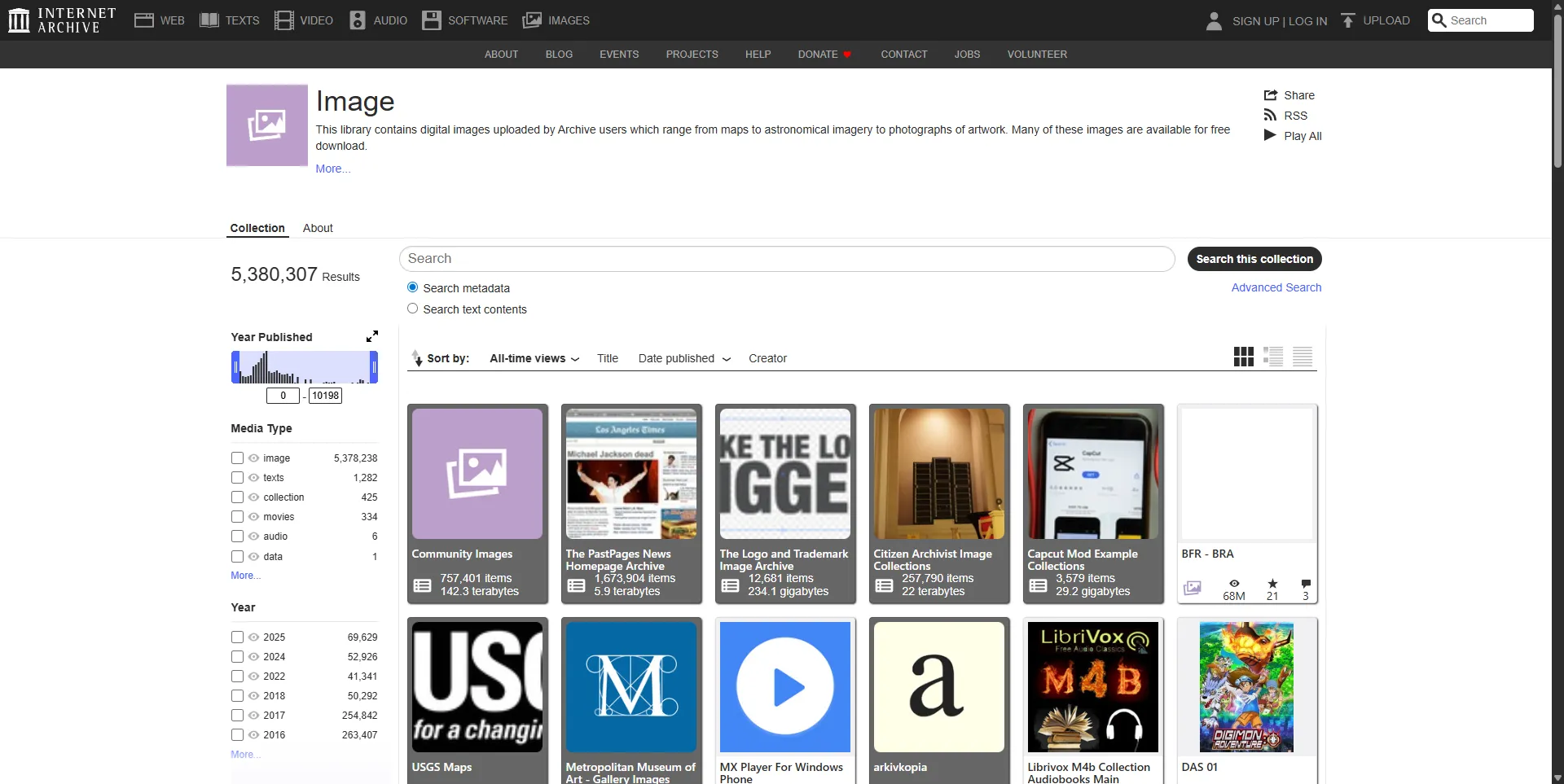
Beyond Flickr, the Internet Archive's image collections contain over 880,000 items organised into sub-collections:
The Cover Art Archive is a joint project with MusicBrainz containing over 330,000 album cover images. For designers studying the history of album art, this is the largest freely accessible collection available.
The Metropolitan Museum of Art Gallery Images collection contains over 140,000 images from the Met, though the Met's own Open Access program is now the better source for these.
NASA Images contains over 100,000 public domain images from NASA's archives, created through a Space Act Agreement. Space and science illustrators will find decades of astronomical photography, mission documentation, and technical imagery.
The USGS Maps collection contains over 59,000 historical maps from the Libre Map Project.
What You Will Actually Find
Nineteenth-century book illustrations are the richest category. The 19th century was the golden age of book illustration, with advances in printing technology making illustrated books possible at scale. The Archive's collections provide access to thousands of illustrations from this period, covering travel, natural history, science, literature, and more.
Scientific illustrations from digitised scientific publications document the development of scientific knowledge across natural history, astronomy, medicine, and other disciplines. These range from early printed scientific illustrations through sophisticated 19th-century colour plates.
Travel and exploration illustrations document European exploration from the 16th through 19th centuries. These include early printed maps, views, and detailed illustrations from travel books. For concept artists working on period settings, this material shows the specific visual culture of different historical contexts.
Historical photographs cover the full history of photography from daguerreotypes through the 20th century. Portrait photographs from digitised books and periodicals provide detailed documentation of historical figures.
Advertising illustrations from digitised periodicals and catalogues document the development of commercial illustration and graphic design from the 19th century through the mid-20th century.
The Search Problem
The Internet Archive's search interface is its biggest weakness. The main search allows filtering by media type, date, and other parameters, but results are inconsistent. The image collections can be accessed through the main search or through dedicated collection pages, but neither approach is reliable for targeted visual research.
Practical workaround: use the Flickr Book Images collection for visual browsing, then cross-reference to archive.org for higher-resolution versions and full source context. The Flickr interface is faster for scanning thumbnails, and the automated text tags provide a rough search capability that the main Archive search lacks.
Internet Archive vs. Other Open Access Resources
Compared to Europeana, the Internet Archive has more raw volume from digitised books but less curation. Europeana's items come from museums and archives with proper metadata and licensing information. The Internet Archive's items are extracted automatically from books, with inconsistent metadata and unverified copyright status.
Compared to the Library of Congress, the Internet Archive is broader in scope but less organised. The LoC provides carefully catalogued items with clear rights information. The Internet Archive provides raw volume with minimal curation.
Compared to museum open access programs like the Met or Getty, the Internet Archive serves a completely different purpose. Museums provide high-quality images of artworks. The Internet Archive provides historical illustrations and photographs from published sources. They are complementary, not competing.
Insider Tips
Start on Flickr, not archive.org. The Flickr Book Images collection is faster to search and browse than the main Archive interface. Cross-reference back to archive.org for full-resolution downloads and source context.
Always verify copyright status. The Internet Archive does not verify the copyright status of items. Most material from before 1928 is likely in the public domain in the United States, but you must check individually for commercial use.
Use the API for batch research. The Internet Archive has a public API that allows programmatic access to metadata and download URLs. For researchers pulling data on hundreds of items, the API is faster than manual browsing.
Check the Cover Art Archive for music-related projects. If you are designing album covers or music-related visual content, this 330,000-item collection is a unique resource.
Download at multiple resolutions. Many items offer JPEG, PNG, TIFF, and PDF versions. Always download the highest resolution available for your needs, as lower-resolution versions may not be sufficient for print work.
Who Is This For?
The Internet Archive's image collections are for illustrators and designers who work with historical subjects and need reference material covering centuries of visual culture. They are for concept artists building period settings who need documentation of historical clothing, architecture, and technology. They are for researchers who need primary source visual material from published works.
This is not for you if you need guaranteed licensing clarity (use Europeana or a museum open access program), if you need a polished search experience, or if you need consistent image quality. The Internet Archive is raw, messy, and enormous. That is both its strength and its weakness.
Getting Started
Browse the Internet Archive Book Images on Flickr for visual searching, or explore the image collections on archive.org for full-resolution downloads. No registration is required for downloading. For developers, the Internet Archive API provides programmatic access to collection metadata.