
There is a persistent misconception about The Birth of Venus that is worth clearing up immediately. Venus is not being born in this painting. She is not rising out of the sea. She is already fully formed, standing on a shell at the edge of the water, being blown toward the shore by the wind gods while a goddess offers her a flower-strewn cloak. The moment Botticelli chose is the arrival, not the birth: Venus comes into the world as a complete adult, fully divine, fully beautiful, fully present.
This distinction matters because the painting is not, despite its title, a narrative scene of miraculous creation. It is a depiction of an ideal: the moment at which divine beauty enters the human world. Everything in the composition, the pose of Venus, the behaviour of the surrounding figures, the quality of the light and the colour, serves this single idea. Understanding the painting means understanding what beauty meant to the Florentine Neoplatonists of the 1480s and why representing it in this form was considered not just permissible but philosophically necessary.
The Painting: What You Are Looking At
The Birth of Venus is painted in tempera on canvas and measures 172.5 by 278.9 centimetres. It has been at the Uffizi Gallery in Florence since 1815, and before that in the collection of the Medici family, for whom it was almost certainly painted. The large scale and the horizontal format are deliberate: this is a painting designed to be seen in a room, not on an altar. Its destination was a private Medici villa, and its subject was explicitly secular, the first large-scale secular nude in Italian Renaissance painting on canvas.
Venus stands at the centre on a large shell, her long golden hair blown to the right by the wind. To her left, the wind gods Zephyr and Chloris (or Zephyr and Aura, depending on the source) blow the shell toward shore. To her right, a goddess, usually identified as one of the Horae (the goddess of the Seasons or Spring), holds out a pink flower-embroidered cloak to wrap around the newly arrived deity.
Venus's pose is the Venus pudica (modest Venus), the classical stance in which the goddess uses her hands and hair to partially cover herself. This pose descends from ancient Greek and Roman sculpture, particularly the Aphrodite of Cnidos by Praxiteles, and its use here connects Botticelli's Venus directly to the ancient tradition. But where the ancient sculptural Venuses are static and self-contained, Botticelli's Venus looks directly at the viewer with a gaze that is neither inviting nor rejecting: it is simply present, complete, and indifferent to the world's opinion.
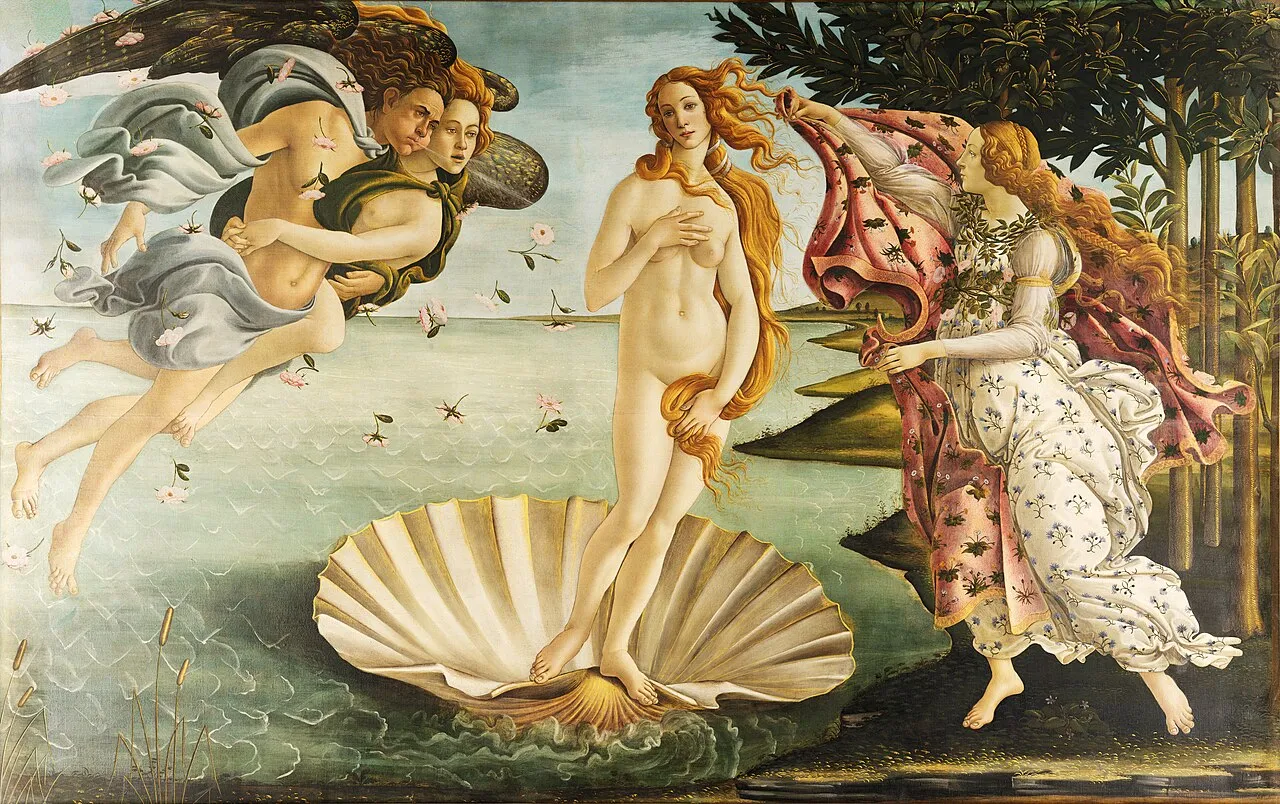
Sandro Botticelli, "The Birth of Venus" (c.1484-1486), tempera on canvas, 172.5 x 278.9 cm. Uffizi Gallery, Florence. The first large-scale secular nude in Italian Renaissance painting and one of the defining images of the period. Image: Public domain, via Wikimedia Commons
The Commission and the Medici Circle
The Birth of Venus was almost certainly commissioned by Lorenzo di Pierfrancesco de' Medici, a cousin of Lorenzo the Magnificent, for a villa near Castello outside Florence. The commission is not documented by a surviving contract, but circumstantial evidence, including the painting's early provenance in the Medici collection and its pairing with Botticelli's "Primavera," which was also at the Castello villa, makes this attribution highly probable.
The Medici circle in Florence in the 1480s was deeply engaged with Neoplatonist philosophy, largely through the work of Marsilio Ficino, who had translated Plato's complete works into Latin under Medici patronage. Ficino's synthesis of Platonic philosophy and Christian theology produced a framework in which beauty was understood as the visible form of divine goodness: to look at a beautiful thing was, in a sense, to perceive divine truth through the senses. This framework gave Botticelli's patrons a philosophical justification for depicting the nude goddess that went beyond simple pleasure in the female form.
The direct literary source for the painting is a stanza from Angelo Poliziano's poem "Stanze per la giostra" (c.1475-78), which describes Venus being born from the sea and blown to shore by Zephyr. Poliziano was a member of the Medici circle and his poem was well known to Lorenzo di Pierfrancesco. The choice to base the composition on this specific poem, rather than on the older mythological sources (Hesiod, Ovid), places the painting firmly within the cultural world of Medici Florence rather than in a generic classical tradition.
The Neoplatonic Programme
In Ficino's Neoplatonist framework, Venus had two aspects: Venus Caelestis (Celestial Venus), representing spiritual love and the contemplation of divine beauty, and Venus Vulgaris (Earthly Venus), representing physical love and generation. Botticelli's Venus is almost certainly the Celestial variety: she has not yet engaged with the earthly world (the cloak is still being offered, not yet received), and her expression carries no suggestion of earthly desire.
This philosophical framing allowed a nude goddess to be presented in a private aristocratic context without contradiction or anxiety about propriety. The painting is not erotic, though it depicts a beautiful naked woman. It is, within its intellectual framework, an image of an idea: the idea of beauty as a form of truth, visible and serene and entirely beyond the grasp of desire in the ordinary sense. This is what distinguishes the Uffizi Venus from later paintings that borrowed her pose and visual vocabulary for less elevated purposes.
The flowers scattered through the painting reinforce this reading. Roses fall from Zephyr's breath around the figures; the cloak offered by the goddess is embroidered with flowers; the grass of the shore is full of daisies. This floral abundance connects the painting to the spring and to the generative power of nature, but it also connects it to Primavera, the companion painting that shares its programme and its provenance. Taken together, the two paintings constitute a meditation on love, beauty, and the relationship between divine and earthly experience that is thoroughly Florentine and thoroughly Neoplatonic.
The Model: Simonetta Vespucci
The golden-haired Venus in the painting has traditionally been identified with Simonetta Vespucci, a Florentine noblewoman celebrated for her beauty who died in 1476 at age 23, several years before the painting was made. Simonetta was the beloved of Giuliano de' Medici (Lorenzo the Magnificent's brother, assassinated in the Pazzi Conspiracy of 1478) and was widely mourned in Florentine literary culture. Botticelli himself reportedly requested that he be buried at her feet in the church of the Ognissanti, which he was, in 1510.
For centuries, historians assumed tuberculosis killed Simonetta. It was common, often fatal, and fitted the pattern of a young woman fading quickly. But a 2025 paper published in Endocrinology, Diabetes and Metabolism proposed a different explanation. Researchers examined Botticelli's portraits of her alongside written descriptions from the period and found gradual changes in her facial features across multiple paintings: subtle shifts to the jaw, the brow, the soft tissue of the face. These are the kind of changes seen in patients with a pituitary adenoma, a tumour of the small gland at the base of the brain that controls hormone production. The researchers argued that her sudden, rapid death, described in contemporary letters between Piero Vespucci and Lorenzo de' Medici as involving collapse at a ball followed by headaches, hallucinations, vomiting, and fever, is consistent with pituitary tumour apoplexy, a medical emergency where the tumour bleeds or swells rapidly. None of this amounts to certainty, but it offers a more complete medical reading than tuberculosis alone can provide.
Whether Venus's face is actually based on Simonetta's is impossible to confirm. No authenticated portrait of Simonetta survives. But the cultural association between the painting and a specific celebrated beauty would have been part of the painting's meaning within the Medici circle, giving the abstract ideal a personal face and a poignant history.
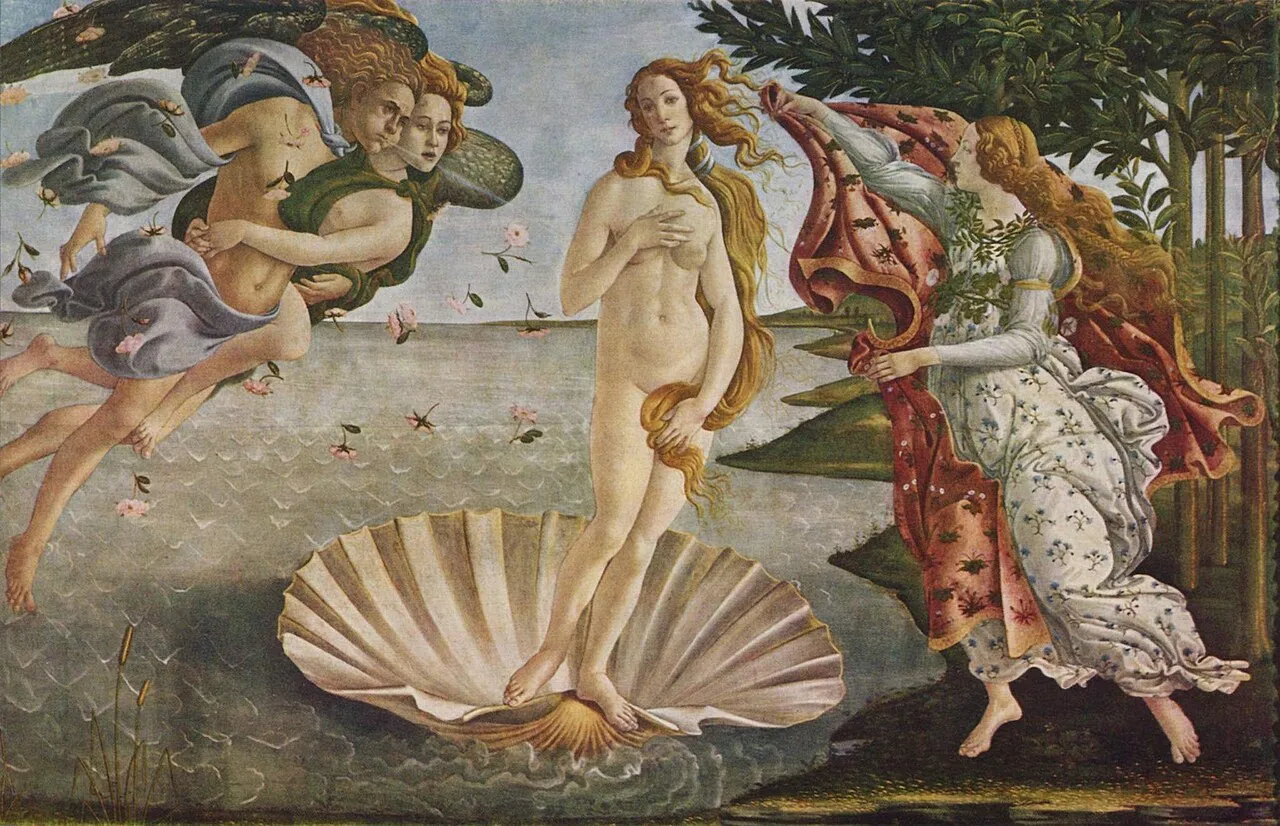
The Botticelli room at the Uffizi Gallery, Florence, with "The Birth of Venus" and "Primavera" displayed facing each other. Both paintings were made for the same Medici patron and share their Neoplatonic programme. Image: Public domain, via Wikimedia Commons
The Technique: Tempera on Canvas
The choice of tempera on canvas rather than oil on wood panel was unusual for a large secular work of this period and gives the painting its distinctive quality of surface. Tempera, made from pigment mixed with egg yolk, dries quickly and produces a chalky, slightly matte surface that holds line with exceptional crispness. It cannot be blended easily; transitions between tones are built up through cross-hatching and careful layering rather than the wet-into-wet blending available in oil.
This means that the soft, continuous modelling of flesh tones achieved in contemporary Flemish and Italian oil paintings was not available to Botticelli in this work. The skin of Venus and the figures around her has a linear, slightly flat quality that is sometimes called archaic but is more accurately described as deliberate: Botticelli was drawn to the linear clarity of Florentine drawing tradition throughout his career, and the tempera technique served this preference better than oil would have.
The hair is painted in long, individual lines of gold and ochre, each strand separately visible. The sea behind the figures is rendered in stylised repeated arcs rather than naturalistic waves. These choices give the painting a visual rhythm that is more like music or textile than like a window onto a real scene. The painting is not trying to be illusionistic; it is trying to be beautiful in the way that a poem is beautiful, through the coherent organisation of its elements into a satisfying whole.
Botticelli After the Renaissance
Botticelli's reputation collapsed in the early 16th century as Leonardo, Michelangelo, and Raphael defined a new standard of High Renaissance art that made his work look flat and old-fashioned. He died in 1510 in relative obscurity and was largely forgotten for over three centuries. The revival of his reputation in the 19th century was driven primarily by the English Pre-Raphaelite painters and critics, particularly John Ruskin and Walter Pater, who found in Botticelli's linear style and mythological subjects exactly the qualities they were looking for in their reaction against academic painting.
Ruskin's and Pater's enthusiasm brought Botticelli to the attention of a broad Victorian public and cemented the Uffizi's Birth of Venus as one of the canonical images of Western art. Today, the painting occupies a room at the Uffizi alongside Primavera and is one of the museum's primary attractions. For how Botticelli fits within the broader story of Italian Renaissance painting, see the Renaissance art guide. For the Pre-Raphaelites who revived his reputation, the Pre-Raphaelite guide covers the movement in full.
Visiting the Uffizi: The 2026 Refurbishment
In June 2026, the Uffizi Galleries unveiled a major refurbishment of the Botticelli Rooms, placing The Birth of Venus and Primavera opposite one another for the first time. The reorganisation, part of a broader reinstallation of the Uffizi's collections initiated by Director Simone Verde in January 2024, includes new digital screens displaying explanatory videos and notes, upgraded lighting, and walls repainted in "Renaissance grey" to enhance the chromatic subtleties of Botticelli's paintings.
The protective glass screens previously installed over both paintings have been replaced with new airtight, state-of-the-art display cases that allow for a clearer view. An Uffizi source told The Art Newspaper that the effect was immediate: "I got goosebumps looking at the works because the effect is incredible. The works are close but there is elegance and a sense of space that wasn't there before." The Birth of Venus is now flanked by Botticelli's circular paintings Madonna of the Magnificat (c.1483) and Madonna of the Pomegranate (c.1487), suggesting how Venus was believed by some Neoplatonists to be a prefiguration of the Virgin Mary. This juxtaposition directly reflects the doctrine of the prisca theologia developed by Marsilio Ficino within the Neoplatonic Academy fostered by the Medici.
The morning, when the museum first opens, is the best time to visit if you want the paintings to yourself even briefly. Look at both paintings together: they are designed to be read in relation to each other, and the experience of seeing them face to face across the room is richer than seeing either one in isolation. For the broader story of what the Uffizi contains and how to approach it, the beginners reading guide suggests a sequence for approaching major collections. And for the symbolism embedded throughout the painting, the symbolism guide provides the tools to read it systematically. For more on the broader context of Renaissance painting, see our Renaissance art guide.


