
John Everett Millais painted "Ophelia" in 1851 by having his model Elizabeth Siddal lie in a bathtub full of water for months during a cold London winter. The bathtub was heated by oil lamps placed underneath. The lamps kept going out. The water grew cold. Siddal developed a serious illness. Millais kept painting. The botanical detail of the flowers, the exact way light hits the surface of the water, the texture of Ophelia's dress as it spreads around her sinking body: these required a commitment to direct observation that bordered on the fanatical.
That commitment is the heart of the Pre-Raphaelite Brotherhood. In 1848, three young artists at the Royal Academy of Arts in London formed a secret society in protest against the Academy's teaching and the conventions it enforced. They believed painting had gone wrong with Raphael, whose smooth idealization they saw as the beginning of a long decline into formula. They wanted to paint the way artists before Raphael had painted: from nature, with specific detail, with the kind of observation that reality actually demands.
The result was one of Victorian England's most contested and eventually most beloved art movements. Paintings of extraordinary detail and saturated color, usually depicting medieval or literary subjects, made by artists who worked with a dedication to surface reality that has never quite been matched.
The Formation of the Brotherhood
What They Were Against
To understand the Pre-Raphaelites, you need to understand what they were rebelling against. The Royal Academy in 1848 taught painting through a hierarchical system that placed "Grand Manner" historical and mythological subjects at the top. Students copied plaster casts of antique statues before they were allowed to draw from life. Academic technique favored smooth finish, subdued color, and idealized forms derived from classical and Renaissance models.
The young founders found this system deadening. They nicknamed the respected academic painter Sir Joshua Reynolds "Sir Sloshua" for what they saw as his formulaic approach. They passed around a book of engravings after Italian artists who worked before Raphael, including Memling, Ghirlandaio, and Botticelli, and found in their detailed, almost naive directness a freshness that later academic painting had lost.
The PRB and Its Secret Symbol
The Brotherhood had seven founding members: Millais, Rossetti, Hunt, James Collinson, Thomas Woolner, Frederic George Stephens, and Rossetti's younger brother William Michael Rossetti as critic and secretary. They signed their early works with the mysterious initials PRB. The art establishment did not decode those initials until 1850. The revelation provoked fierce critical attack, with Charles Dickens writing a venomous review of Millais's "Christ in the House of His Parents" (1850) that called the figures ugly and the composition sacrilegious.
The attack nearly broke the group. But the critic John Ruskin stepped in with a defense, arguing that the Pre-Raphaelites were doing exactly what he had been calling for: painting with "truth to Nature." Ruskin's support transformed the Brotherhood's reputation. Though the original group dissolved within a few years, the Pre-Raphaelite style survived and flourished through the 1850s and 1860s.
Key Works and What They Show
Millais: Ophelia (1851 to 1852)
Millais painted the background of "Ophelia" entirely outdoors on location at the Hogsmill River in Surrey, spending weeks capturing every plant, every stone, every reflection with meticulous precision. The human figure was added later in the studio, with Elizabeth Siddal as the model. The painting shows Ophelia from Shakespeare's "Hamlet" at the moment of her drowning, singing fragments of songs as she sinks.
The technical achievement is staggering. The botanical detail is accurate enough that individual species can be identified. Each flower carries a symbolic meaning from traditional floriography: rosemary for remembrance, pansies for thought, violets for faithfulness. The water, the light, the texture of fabric: everything has been observed from life. The emotional effect is strange and dreamlike precisely because of this hyperreal specificity. Ophelia seems to inhabit both a real river and a symbolic space at the same time.
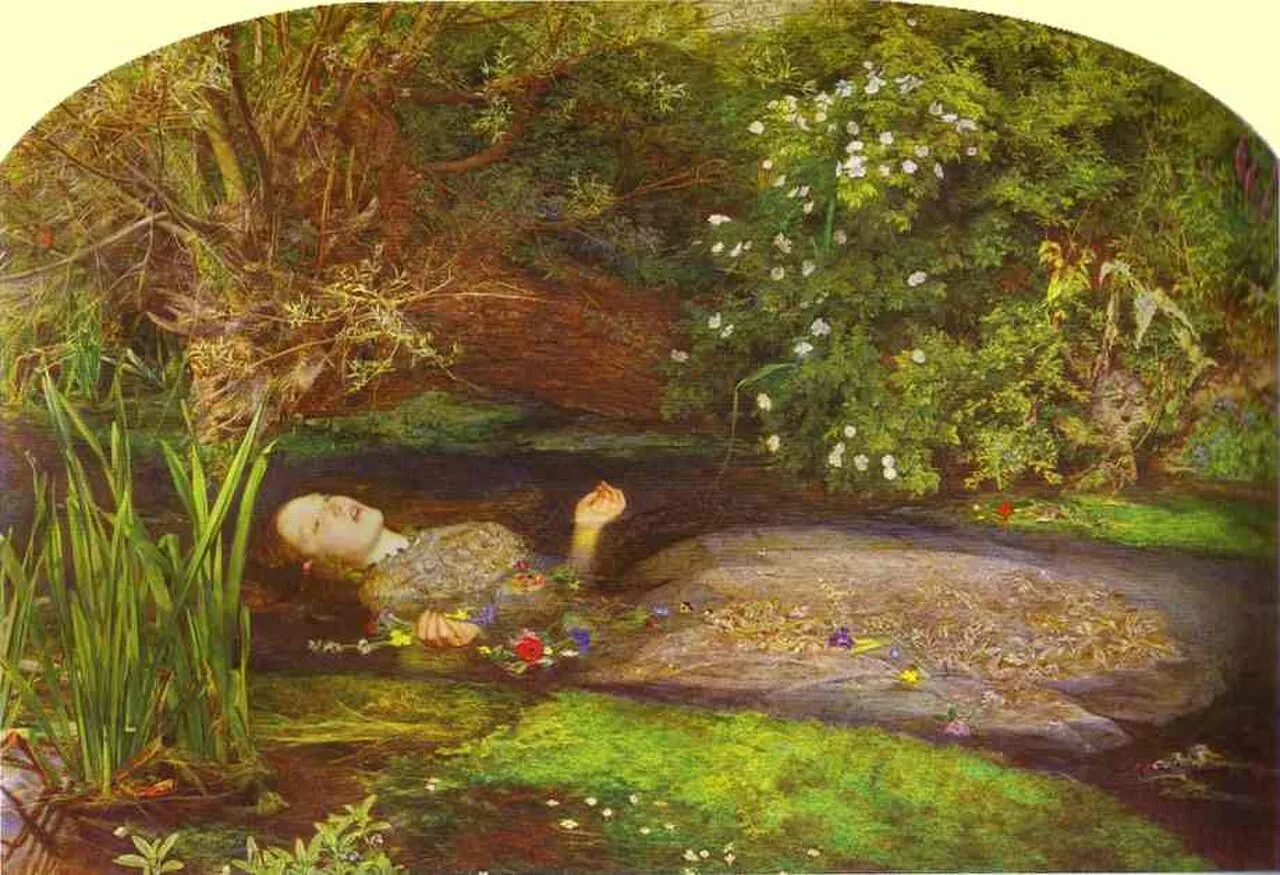
John Everett Millais, "Ophelia" (1851 to 1852), oil on canvas, 76.2 x 111.8 cm. Tate Britain, London. Millais painted the riverbank background on location at the Hogsmill River in Surrey, then painted the figure of Siddal in a bathtub in his studio. Image: Public domain, via Wikimedia Commons
Dante Gabriel Rossetti: Beata Beatrix (1864 to 1870)
Rossetti's relationship with Siddal, who became his wife in 1860 and died of a laudanum overdose in 1862, shapes his most famous work. "Beata Beatrix" was begun as a memorial to Siddal, using Dante's idealized Beatrice as a frame through which to express personal grief. Siddal's face appears in a trance-like state of spiritual transport. A red dove delivers a poppy, the source of laudanum, into her open hands.
Rossetti was the most literary and symbolically minded of the Brotherhood. Where Millais prioritized direct observation, Rossetti was drawn to dream states, femme fatales, and the intersection of erotic and spiritual longing. His later paintings of women with abundant hair, full lips, and heavy-lidded eyes defined a visual type that became enormously influential: what we now call the Pre-Raphaelite beauty.
William Holman Hunt: The Light of the World (1851 to 1853)
Hunt was the most religiously motivated of the Pre-Raphaelites, and "The Light of the World" is his most famous work. Christ knocks at an overgrown door in the darkness, holding a lantern, his crown half thorns and half gold. The painting is full of symbolic detail that Hunt documented in extensive notes. The weeds around the door represent spiritual neglect. The lantern is the light of conscience. The door has no handle because it can only be opened from within.
Hunt's combination of religious seriousness with meticulous naturalism was uniquely his own. He traveled to Egypt and the Middle East on multiple occasions specifically to paint biblical scenes from observation, bringing the Pre-Raphaelite principle of truth to nature to its logical extreme.
The Later Pre-Raphaelites and the Aesthetic Movement
By the 1860s, the original Brotherhood had dissolved, but its influence continued through artists who had absorbed its lessons and moved in different directions. Edward Burne-Jones, who never joined the original group but became Rossetti's student, carried the Pre-Raphaelite aesthetic into the later 19th century with paintings of Arthurian legends and mythological subjects rendered in a flattened, decorative style that owed as much to medieval tapestries as to Italian primitives.
Burne-Jones became a key figure in the Aesthetic Movement and the Arts and Crafts Movement, which took Pre-Raphaelite ideas about beauty, craft, and the integration of art into everyday life in a more practical direction. William Morris, who became close to Rossetti and Burne-Jones, used Pre-Raphaelite imagery in his enormously influential wallpaper, textile, and book design work. The connection to Art Nouveau's use of organic ornament and the integration of art and design is direct and acknowledged.
Recent Scholarship: The Pre-Raphaelite Sisterhood
Recent scholarship has substantially reshaped how we understand the movement. A 2024 exhibition at the San Domenico Museum in Forli, Italy, titled "Pre-Raphaelites: Modern Renaissance," brought together 360 works and was the first major exhibition in Italy to examine the profound influence of Italian Renaissance art on the British Pre-Raphaelite movement. Co-curated by Elizabeth Prettejohn, Peter Trippi, Cristina Acidini, and Francesco Parisi, the show placed British Pre-Raphaelite works directly alongside Italian Old Masters from Cimabue to Veronese, making the Italian influence visible in a way that exhibitions in Britain or America never could. As Artnet reported, the exhibition also spotlighted the often overlooked contributions of women artists like Evelyn De Morgan, Elizabeth Siddal, and Julia Margaret Cameron.
The recovery of Pre-Raphaelite women as artists in their own right, not just as models and muses, is one of the most significant developments in recent scholarship. A 2025 PhD thesis by Alex Round at Birmingham City University reconstructed the friendships and collaborative practices of women in the Pre-Raphaelite circle, arguing that the term "Sisterhood" has been used to collectivize these women while still relegating them to secondary roles. The thesis recovers the creative agency of women like Siddal, Georgiana Burne-Jones, and Marie Spartali Stillman through their correspondence and unpublished manuscripts. The 2024 "Victorian Radicals" exhibition at the Birmingham Museum and Art Gallery, reviewed in The Guardian, similarly reframed the Pre-Raphaelites as something more than a guilty pleasure, showing how the movement's commitment to craft and observation still rewards serious attention.
Why Pre-Raphaelite Art Still Captivates
Pre-Raphaelite paintings occupy an interesting space in visual culture. They are immediately appealing in ways that much serious art is not. The colors are saturated and beautiful. The subjects are recognizable and often literary. The detail is endlessly rewarding to look at. Museums that hold major Pre-Raphaelite collections, particularly the Tate Britain and the Birmingham Museum and Art Gallery, find them consistently among their most-visited works.
But they also repay more serious attention. The tension in a Pre-Raphaelite painting between its hyperreal surface and its dreamlike subject matter is genuinely strange. A painting like "Ophelia" is too precise to be romantic and too emotional to be a nature study. It inhabits a space between direct observation and symbolism that has no exact equivalent elsewhere in art history.
The Pre-Raphaelites were also among the first Victorian artists to treat women as subjects with inner complexity rather than idealized symbols, even if they sometimes fell back on idealization. Rossetti's women are enigmatic. Hunt's Mary in "The Shadow of Death" is shown as a real mother wrestling with foreknowledge of her son's suffering. Ford Madox Brown's "Work" (1852 to 1865) depicts Victorian social classes with a specificity and sympathy that anticipated later Social Realist painting.
To understand where the Pre-Raphaelites fit in art history, they connect backward to Gothic art's tradition of detailed devotional painting and forward to the decorative arts revolution of Art Nouveau. They are also a reminder that rebellion in art does not always mean abstraction or formal experiment. Sometimes it means looking more carefully, more honestly, and more lovingly at what is actually in front of you.
For the technical foundations of the oil painting techniques that made Pre-Raphaelite detail possible, see the oil painting guide. The Pre-Raphaelites typically used a "wet white ground" technique: painting over a wet white ground that gave their colors a luminosity that dry-over-dry layering could not achieve. And to understand how color theory explains the particular saturated quality of Pre-Raphaelite painting, that guide covers exactly the principles they worked with. For the broader context of Victorian art and its relationship to earlier movements, the guide to Romanticism traces the ideology of the artist as outsider that the Pre-Raphaelites both inherited and challenged.


