
Florence is a small city. Its population in 1500 was about 50,000 — smaller than many medieval European capitals. Yet between 1400 and 1600, this one city produced more art of lasting significance than any other city in Europe. Brunelleschi's dome, Donatello's bronze David, Botticelli's "Birth of Venus," Leonardo da Vinci's early work, Michelangelo's David — all Florentine. The Renaissance started in Florence, and the reasons it started there are specific and identifiable: the Medici bank, the guild system, the competition for civic commissions, and the revival of classical antiquity. This guide covers why Florence changed everything: the political and economic conditions, the invention of linear perspective, the role of the Medici, the key artists, and the museums that hold the work today.
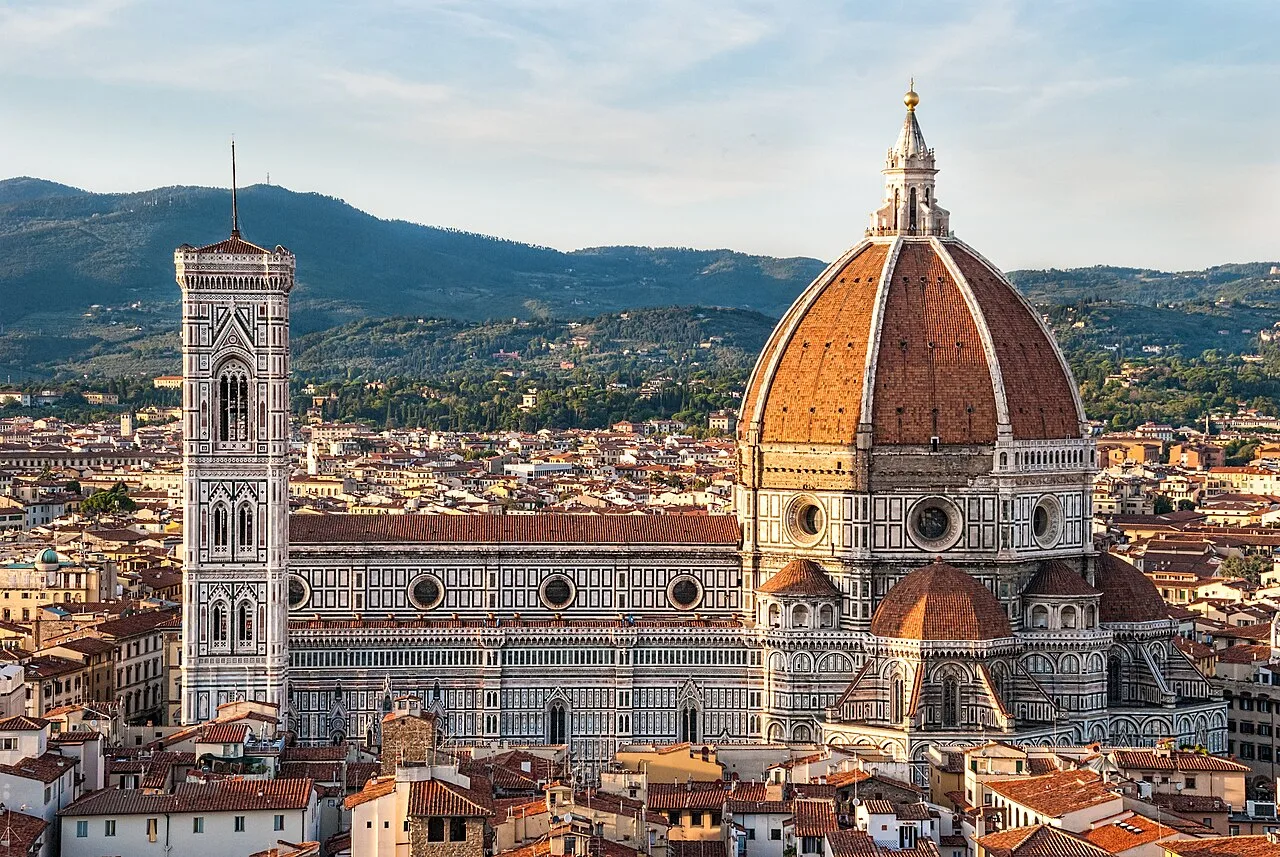
The Florence Cathedral (Cattedrale di Santa Maria del Fiore), with Brunelleschi's dome. The dome, completed in 1436, was the largest dome built since the Roman Pantheon — a feat of engineering that had been thought impossible. Brunelleschi solved the problem by inventing a double-shell construction with herringbone brickwork. The dome became the symbol of Florence's ambition and the opening achievement of the Renaissance. Image via Wikimedia Commons.
The Medici and the Economy of Art
The Medici were bankers. Cosimo de' Medici (1389-1464) was the richest man in Europe, and he used his money to fund art and architecture on a scale that no private individual had attempted since the Roman emperors. Cosimo paid for the construction of the San Marco monastery, the Medici Palace, and the reconstruction of the convent of Sant'Antonio. He commissioned works from Donatello, Fra Angelico, and Brunelleschi. His grandson Lorenzo de' Medici (1449-1492), known as Lorenzo the Magnificent, continued the patronage and expanded it, supporting Botticelli, Leonardo, and Michelangelo.
The Medici were not the only patrons in Florence. The guilds — the Arte della Lana (wool merchants) and the Arte della Seta (silk merchants) — commissioned major public works. The guilds funded the competition for the Baptistery doors in 1401, which is often cited as the starting point of the Renaissance. Lorenzo Ghiberti won the competition, and his bronze doors took 27 years to complete. Michelangelo later called them the "Gates of Paradise." The competition between Ghiberti and Brunelleschi, who lost, drove both men to innovate. Brunelleschi went to Rome to study ancient architecture, and what he learned there became the basis for Renaissance architecture. For more on the period, see our guide to Renaissance art and the birth of modern art.
The Invention of Linear Perspective
Florence is where linear perspective was invented. Filippo Brunelleschi, around 1413, conducted the first known perspective experiments. He painted a panel of the Florence Baptistery as seen from the cathedral doorway, using a single vanishing point. He then drilled a hole in the panel and had viewers look through the hole at a mirror that reflected the painting, comparing it to the actual building. The demonstration proved that a flat surface could create a convincing illusion of three-dimensional space.
Leon Battista Alberti codified the method in his treatise "Della Pittura" (On Painting, 1435), which explained how to construct a perspective image using a single vanishing point and a horizon line. Alberti's treatise was the first theoretical manual for painters, and it made perspective a teachable technique. Masaccio applied the new method in his frescoes in the Brancacci Chapel (1425-1428), where he painted figures with weight, volume, and spatial depth that had not been seen since antiquity. For more on how this technique shaped later art, see our guide to how to look at art.
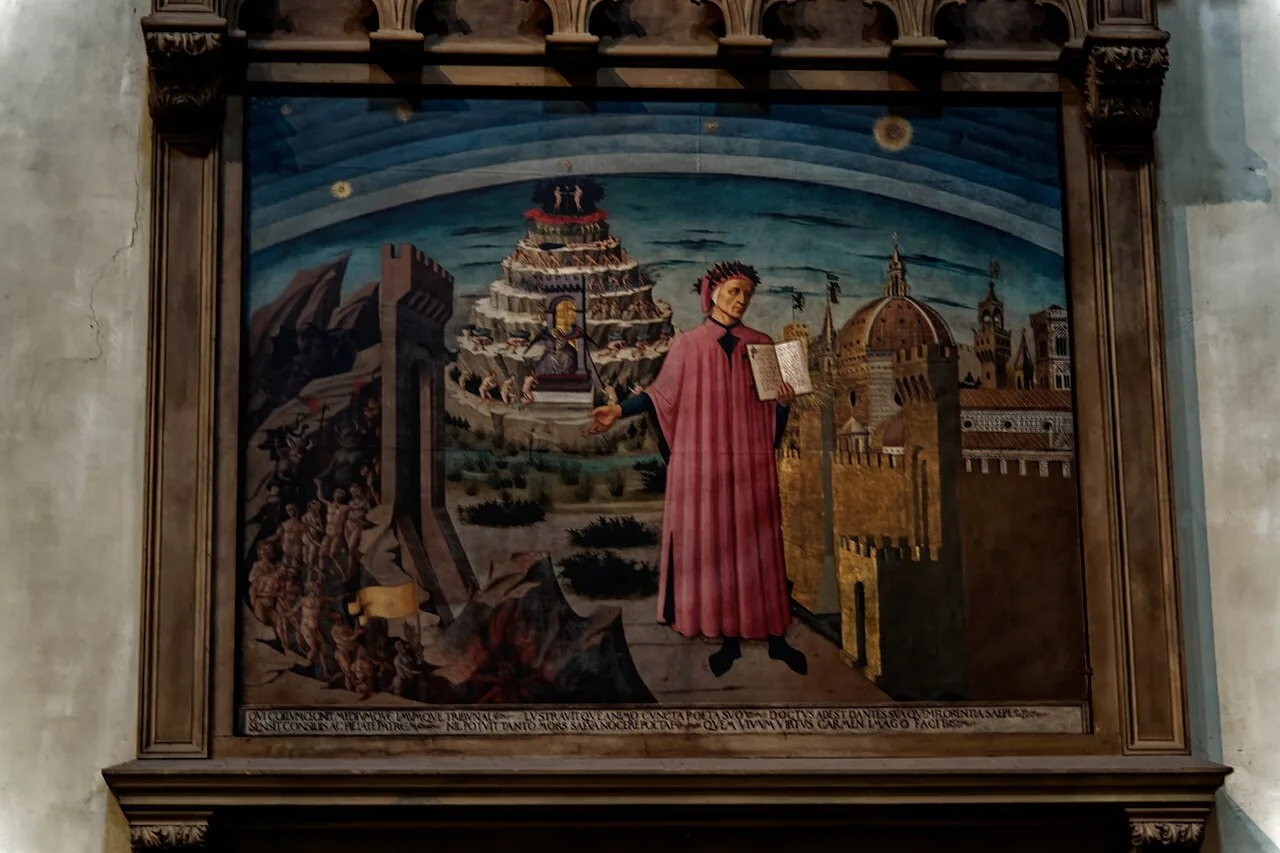
Domenico di Michelino, "Dante in front of the City of Florence" (1465). Oil on canvas. Florence Cathedral. The painting shows Dante Alighieri standing before a panoramic view of Florence, with the Duomo visible in the background. The city depicted is the Florence of 1465 — the city that had exiled Dante in 1302 and that, by the time this painting was made, had become the center of the Renaissance. Image via Wikimedia Commons.
The Artists
Florence produced an extraordinary concentration of artistic talent. Donatello (c. 1386-1466) was the greatest sculptor of the early Renaissance. His bronze David (c. 1440) was the first free-standing nude sculpture since antiquity. Sandro Botticelli (1445-1510) painted "The Birth of Venus" (c. 1485) and "Primavera" (c. 1480), both now in the Uffizi. Botticelli's work combined classical mythology with a new kind of linear beauty that was distinctly Florentine. For more on Botticelli, see our guide to The Birth of Venus and Renaissance ideals.
Leonardo da Vinci (1452-1519) was born in the Florentine town of Vinci and trained in the workshop of Andrea del Verrocchio. His early work, including the "Annunciation" (c. 1475), was done in Florence. Leonardo left Florence for Milan in 1482 and did not return for decades, but his formation was Florentine. For more, see our guide to Leonardo da Vinci and the Renaissance ideal.
Michelangelo Buonarroti (1475-1564) was born in Florence and spent his early career there. His David (1501-1504) was carved from a single block of marble that had been abandoned by an earlier sculptor. The statue was originally placed in the Piazza della Signoria, the political center of Florence, as a symbol of the Republic. Michelangelo later painted the Sistine Chapel ceiling for the Pope in Rome, but his formation was Florentine. For more, see our guide to Michelangelo and his obsessed genius.
The Uffizi and the Preservation of Florence's Art
Florence's art survived because it was never dispersed. The Medici collection, which included works by Botticelli, Raphael, Caravaggio, and Titian, was bequeathed to the city of Florence by Anna Maria Luisa de' Medici in 1743, on the condition that it remain in Florence and be open to the public. This bequest is the reason the Uffizi Gallery exists. The Uffizi, originally built by Giorgio Vasari in 1560 as government offices (uffizi means "offices"), became a museum in 1769. It is one of the oldest museums in the world and holds the most important collection of Renaissance art. For more on visiting it, see our guide to the Uffizi Gallery.
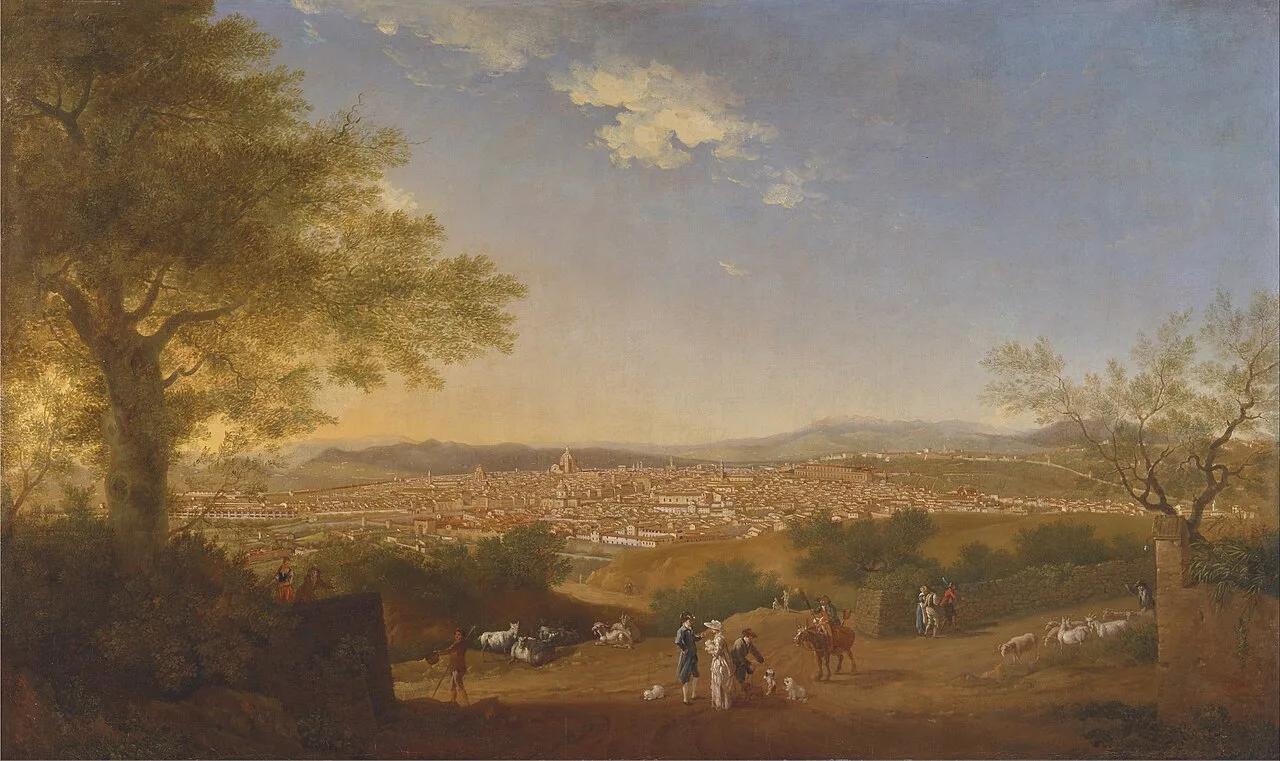
Thomas Patch, "A Panoramic View of Florence from Bellosguardo" (18th century). Oil on canvas. The painting shows Florence from the hills above the city, with the Duomo dominating the skyline. Patch was a British painter who lived in Florence and painted its views for the Grand Tourists who visited the city. The view has not changed much — the Duomo still dominates the skyline, and the city's historic center is a UNESCO World Heritage Site. Image via Wikimedia Commons.
Why Florence and Not Somewhere Else
The question is why Florence and not Rome, Venice, or Milan. Rome had the Pope and the ancient ruins, but it did not have the merchant banking economy that Florence had. Venice had trade and wealth, but its artistic tradition was different — more focused on color and light than on line and perspective. Milan was a duchy, not a republic, and its artistic culture was more courtly than civic. Florence had a unique combination: a republican government that commissioned public art as a form of civic identity, a banking economy that produced enormous private wealth, a guild system that organized artistic patronage, and a humanist intellectual culture that revived interest in classical antiquity.
The republican government mattered. In Florence, public art was political. The David was a symbol of the Republic standing against tyrants. The Baptistery doors were a civic project funded by a guild. The Duomo was a civic project funded by the state. In a monarchy or a papal state, art served the ruler. In Florence, art served the city — and the city, through its guilds and its government, commissioned art on a scale that no individual patron could match. For more on how art and politics interact, see our guide to art and society.
Final Thoughts
Florence changed the course of Western art because it combined money, ambition, and a new way of seeing. The Medici paid for it. The guilds organized it. Brunelleschi invented the perspective that made it look real. Donatello, Botticelli, Leonardo, and Michelangelo made the work that the rest of Europe spent the next 400 years trying to match. The Renaissance was not a gradual evolution. It was a specific event that happened in a specific city at a specific time, and the reasons it happened in Florence are identifiable and concrete.
Go to the Uffizi for Botticelli, Caravaggio, and the High Renaissance. Go to the Accademia for Michelangelo's David. Go to the Duomo and climb Brunelleschi's dome. Go to the Brancacci Chapel for Masaccio's frescoes. Then walk across the Ponte Vecchio and look at the city from the Piazzale Michelangelo. For more on the period, see our guides to Leonardo da Vinci and Michelangelo. For a structured approach to the whole field, see our guide on how to teach yourself art history.


