
The Uffizi Gallery has the world's deepest collection of Italian Renaissance painting. It is housed in a building designed by Giorgio Vasari in 1560 as government offices for Cosimo I de' Medici. The word "uffizi" means "offices." The Medici hung their art collection here, and in 1769 the gallery opened to the public. In 2024, the Uffizi welcomed over 5.2 million visitors, making it the second most visited museum in Italy after the Colosseum. The core of the collection is a chronological walk through Italian painting from Giotto to Caravaggio, roughly 1300 to 1600, with the Botticelli rooms as the emotional center.
The Uffizi is not a general museum. It is a Renaissance museum. If you want Impressionism or modern art, go elsewhere. If you want to understand how Western painting developed from medieval icons to the Baroque, the Uffizi is the best single museum in the world for that story. I would argue it is better than the Louvre for understanding art history, because it tells one story rather than trying to cover everything. The Louvre is an encyclopedia. The Uffizi is a narrative.
This guide covers the chronological route, the newly redesigned Botticelli Hall, the Leonardo room, the Caravaggio room, Titian's Venus of Urbino, practical tips, and what most visitors miss.
The Chronological Route: How the Uffizi Works
The Uffizi is organized as a single chronological path. You enter on the ground floor, climb the stairs to the second floor, and walk through approximately 100 rooms in order from medieval to Baroque. The path is one-way. You cannot easily go back. This is both the museum's greatest strength and its main logistical challenge: if you miss something, you have to walk the whole route again.
Rooms 1 through 3 cover the medieval period. Cimabue, Giotto, and Duccio anchor this section. Giotto's "Madonna Enthroned" (c. 1310) is the key work. It looks stiff to modern eyes, but in 1310 it was revolutionary. Giotto replaced the flat, hieratic style of Byzantine icons with figures that had weight and volume. The Madonna sits on a throne that occupies real space. The angels around her are positioned at different depths. This is the painting that starts the story of Western painting as a naturalistic project.
Rooms 5 and 6 cover the early Renaissance. Fra Angelico, Masaccio, and Paolo Uccello are here. Masaccio's use of perspective and single-source light changed painting permanently. His "Trinity" fresco in Santa Maria Novella (not at the Uffizi but visible elsewhere in Florence) is the first painting to use systematic linear perspective, and the effects of that breakthrough ripple through every room that follows.
Rooms 7 and 8 are dedicated to Filippo Lippi. "Madonna and Child with Two Angels" (c. 1460-1465) is the most copied early Renaissance image in the collection. The Madonna's face is modeled on Lippi's lover, a nun named Lucrezia Buti. The child's face is one of the most naturalistic baby faces in 15th-century painting. For more on the broader context of this period, see our guide on Renaissance art: perspective, humanism, and the birth of modern art.
The Botticelli Hall (Rooms 10-14)
The Botticelli rooms are the emotional center of the Uffizi. In June 2026, the museum unveiled a complete redesign of these spaces under director Simone Verde, who has been leading a broader reorganization of the Uffizi's collections since his appointment in January 2024. The most significant change: "Birth of Venus" (c. 1485) and "Primavera" (c. 1480) now hang facing each other for the first time. They were previously in the same room but on adjacent walls. Now they are in a direct dialogue across the connecting passage.
"Birth of Venus" is 172.5 x 278.9 cm, painted in tempera on canvas, which was unusual for the period. Most panel paintings of the era used wood supports. Venus stands on a shell, blown to shore by wind gods, while a nymph rushes to cover her with a cloak. The model may have been Simonetta Vespucci, considered the most beautiful woman in Florence. She died of tuberculosis at 22, and Botticelli asked to be buried at her feet, a request that was honored when he died in 1510.
"Primavera" is 202 x 314 cm. It is an allegory of spring with nine figures standing in an orange grove. The meaning has been debated for 500 years. The most widely accepted reading, proposed by the art historian Ernst Gombrich, is that the painting illustrates the Neoplatonic philosophy of the Medici circle: Venus as the embodiment of divine love, with the other figures representing the seasons, the virtues, and the progression from base desire to spiritual love. The truth is that nobody knows for certain, and the uncertainty is part of what makes the painting endlessly fascinating.
The new installation also replaces the old protective glass with hermetically sealed display cases that eliminate the glare and reflection that previously made the paintings hard to see. The walls have been repainted in a pale "Renaissance grey" that enhances the subtle color palette of Botticelli's work. Digital screens and QR codes now provide interpretive content directly in the rooms.
The tip: arrive at 8:15 AM, when the museum opens, and go directly to Rooms 10-14. By 9 AM you will be in a crowd. At 8:20 AM you may have the room to yourself. Five minutes alone with the Birth of Venus is worth the early alarm. You can read more about the painting on the Uffizi's official page on the Birth of Venus.
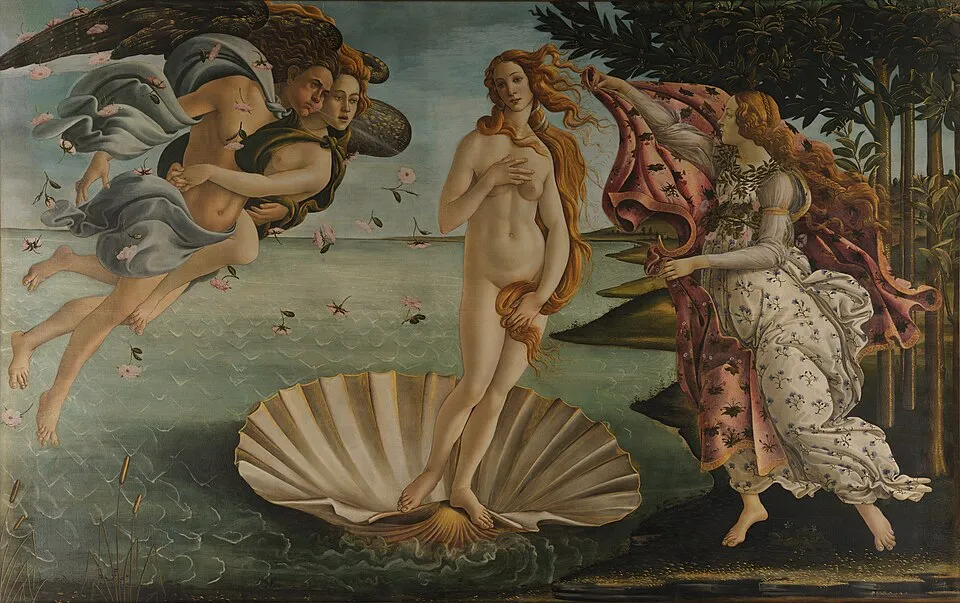
Sandro Botticelli, "The Birth of Venus" (c. 1485). Tempera on canvas, 172.5 x 278.9 cm. Uffizi Gallery, Rooms 10-14. Wikimedia Commons.
Leonardo, Raphael, and the High Renaissance
Room 15 is the Leonardo room. "The Annunciation" (c. 1472-1475) is his earliest known major painting, completed when he was about 20 years old and still in the workshop of Verrocchio. The Archangel Gabriel kneels before the Virgin Mary in a walled garden. The perspective is slightly off: the Virgin's right arm is too long, and the spatial relationship between the figures and the background is not quite resolved. These imperfections are part of the painting's fascination. You can see Leonardo working out problems that he would solve in later works.
Room 26 holds Raphael. "Madonna of the Goldfinch" (1505-1506) shows the young Virgin with the Christ Child and a young John the Baptist holding a goldfinch, a symbol of the Passion. Raphael painted this when he was 22. The composition is balanced, the color is warm, and the figures have a tenderness that Raphael made look effortless. Also in this room: "Pope Leo X with Two Cardinals" (c. 1518), a portrait of the Medici pope that shows Raphael's skill at psychological observation.
Room 35 is the Michelangelo room. "Doni Tondo" (c. 1507) is the only finished panel painting by Michelangelo. It is circular, 120 cm in diameter, and depicts the Holy Family with the infant John the Baptist in the background. The colors are intense: bright pinks, blues, and greens that are unlike anything else in Michelangelo's work. The nude figures in the background are references to pagan antiquity, which creates a deliberate contrast with the Christian foreground. For more on Leonardo's approach to art and science, see our guide on Leonardo da Vinci: art, science, and the ultimate Renaissance mind.
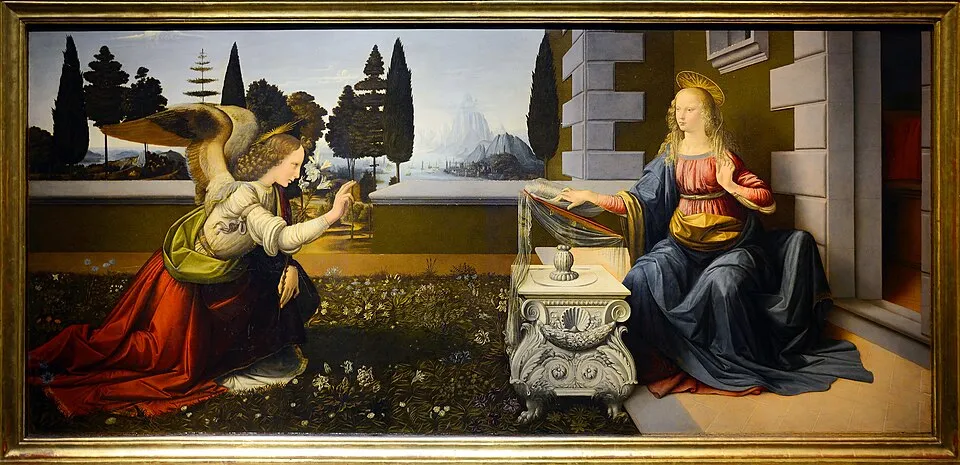
Leonardo da Vinci, "The Annunciation" (c. 1472-1475). Oil and tempera on panel, 98 x 217 cm. Uffizi Gallery. Wikimedia Commons.
Caravaggio, Titian, and the Late Renaissance
Room 90 is the Caravaggio room. "Medusa" (c. 1597) is painted on a circular wooden shield, 60 x 55 cm. It shows the severed head of Medusa with snakes for hair, her face frozen in a scream, blood streaming from her neck. Caravaggio painted his own face as Medusa, using a mirror. The shield was commissioned by Cardinal Francesco Maria del Monte as a gift to the Grand Duke of Tuscany. Also in this room: "Bacchus" (c. 1596), a young god of wine holding a glass of red wine with rotting fruit on the table in front of him. The fruit is a memento mori, a reminder that pleasure is temporary and decay is certain.
Room 83 is the Titian room. "Venus of Urbino" (1538) is 119 x 165 cm and is the most famous reclining nude in Western art. Venus lies on a bed in a Renaissance palace, looking directly at the viewer. In the background, servants rummage through chests, presumably for wedding clothes. The painting was commissioned by Guidobaldo della Rovere, the Duke of Urbino, and was intended for his private chambers. Mark Twain called it "the foulest, vilest, the obscenest picture the world possesses." Edouard Manet quoted it directly in "Olympia" (1863), replacing the Venus with a contemporary Parisian courtesan and provoking one of the biggest scandals in 19th-century French art.
Room 44 has Bronzino's "Portrait of Eleonora di Toledo" (c. 1545). Eleonora was the wife of Cosimo I de' Medici. The dress she wears is rendered with a precision that makes it the most detailed portrait of Renaissance clothing in any museum. The brocade pattern, the pearls, the gold embroidery: every thread is visible. For more on the stories behind iconic paintings like these, see our guide on famous paintings explained.
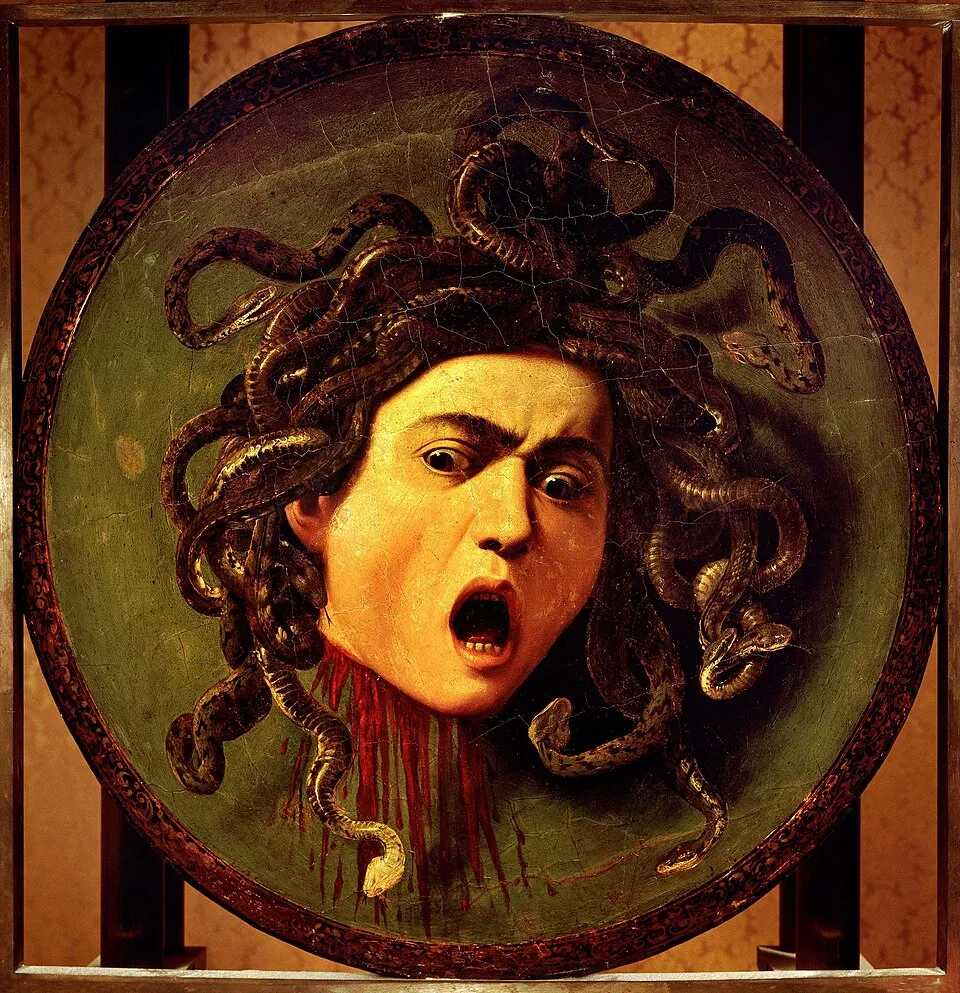
Caravaggio, "Medusa" (c. 1597). Oil on canvas mounted on wood shield, 60 x 55 cm. Uffizi Gallery. Wikimedia Commons.
What Most Visitors Miss
The Vasari Corridor is a 1-kilometer elevated passageway connecting the Uffizi to the Pitti Palace, built by Vasari in 1565 so that the Medici could cross the city without mingling with the public. It contains over 700 artist self-portraits, the largest such collection in the world. The corridor was closed for renovation since 2016 but has now reopened as part of the broader Uffizi reorganization. If it is open during your visit, go. The self-portrait collection includes Rembrandt, Rubens, Velazquez, Delacroix, and Chagall. The corridor also passes over the Ponte Vecchio, giving you a view of the Arno from windows that are normally shuttered.
The Prints and Drawings Department holds one of the world's largest drawing collections, including works by Leonardo, Raphael, and Michelangelo. The displays rotate, and what is on view changes every few months. Ask at the information desk what is currently shown.
The rooftop cafe on the loggia is small and easy to miss. It has views over Piazza della Signoria and the Palazzo Vecchio. The coffee is fine. The view is the reason to go.
The Tribune (Room 18) is an octagonal room designed in 1584 by Bernardo Buontalenti for Francesco I de' Medici. The walls are deep red. The ceiling is inlaid with mother-of-pearl. It is the oldest gallery space in the museum and the most atmospheric. It was originally designed to display the most precious items in the Medici collection, and it still functions that way. You can read more about the Uffizi's layout on the Florence Tourism Uffizi guide.
Practical Tips
Book online in advance. The Uffizi uses timed-entry tickets, and the queue for unbooked visitors can be 2 to 3 hours in peak season. Book at uffizi.it, not through a third-party reseller, which will charge you a markup.
Arrive at 8:15 AM. Go directly to Rooms 10-14 for the Botticellis. Then work backward through the chronological route. The one-way path means you cannot easily go back, so if you want the Botticelli rooms to yourself, you have to make them your first stop.
Plan 2 to 3 hours for highlights. A thorough visit takes 4 to 5 hours. The museum is closed on Mondays. It is open Tuesday through Sunday, 8:15 AM to 6:30 PM.
A note for summer 2026: during the June heatwave, the Uffizi temporarily limited visitor access due to air conditioning strain. If you are visiting in summer, check the museum's official channels before traveling, especially during extreme heat warnings. Florence under a red heat alert is no joke, and the building's cooling systems are not always adequate.
For more on navigating large museums efficiently, see our guide on how to visit an art museum without getting overwhelmed. For a quick overview of where the Renaissance fits in the broader history of art, the art history cheat sheet covers the full timeline in a single read.
Final Thoughts
The Uffizi is the best museum in the world for understanding the Italian Renaissance. It tells a single story, how painting developed from medieval icons to Baroque drama, with a depth that no other museum can match. The newly redesigned Botticelli rooms, unveiled in June 2026, make the two most famous paintings in the collection visible without glass glare for the first time in years. The Botticelli rooms alone justify the trip to Florence.
Book at uffizi.it. Go early. Get coffee on the rooftop loggia. Walk to the Palazzo Vecchio and the Ponte Vecchio afterward, both 2 minutes from the museum exit. For more on how to approach looking at art, see our guide on how to look at art for beginners. Have you been to the Uffizi? What did you think of the new Botticelli installation? Share in the comments below.


