
In 1978, the Palestinian-American literary critic Edward Said published "Orientalism." The book's cover featured Jean-Léon Gérôme's "The Snake Charmer" (c. 1879), a painting of a naked boy holding a snake before a group of old men, against a wall of blue Islamic tiles. Said's argument was that the painting was not a depiction of the East. It was an invention of the East, a fantasy created by and for the West, in which the "Orient" was exotic, erotic, backward, and passive. "The Orient was almost a European invention," Said wrote, "a place of romance, exotic beings, haunting memories and landscapes, remarkable experiments." Orientalist painting was not innocent. It was a visual form of colonial power, a way of defining the East as the West's inferior Other, thereby justifying domination.
Orientalism in art refers to Western, primarily French and British, painting of the 19th century that depicted scenes from the Middle East, North Africa, and Asia. The movement peaked between 1830 and 1900, fueled by colonial expansion, tourism, and the European fascination with the "exotic." Artists like Ingres, Delacroix, Gérôme, and John Frederick Lewis produced hundreds of paintings of harems, bazaars, mosques, and desert landscapes. Most of them did so without ever visiting the places they depicted. This guide covers Said's argument, the key Orientalist painters, the postcolonial critique from Linda Nochlin and Houria Niati, and why Orientalism still matters in 2026.
Said's Argument: The Orient as Invention
Edward W. Said (1935-2003) was a Palestinian-American literary critic and professor at Columbia University. "Orientalism" (1978) transformed the study of Western representations of the East and founded the field of postcolonial criticism. Said defined Orientalism as "a style of thought based upon an ontological and epistemological distinction made between 'the Orient' and (most of the time) 'the Occident.'" The West created the "Orient" as a conceptual category, a place that was everything the West was not: irrational, sensual, decadent, static, feminine. This category bore little relationship to the actual cultures it claimed to describe. It was a projection, the West's fantasy of its own Other.
Said drew on Michel Foucault's concept of discourse, the idea that knowledge and power are inseparable. Orientalism was not just a set of images. It was a discourse that produced the "Orient" as an object of knowledge and control. The Orientalist scholar, the colonial administrator, and the Orientalist painter all participated in the same project: defining the East for the West, and thereby justifying Western domination. Said's book focused on literature and academic discourse, not painting. But the application to visual art was made by art historians, most notably Linda Nochlin in her 1983 essay "The Imaginary Orient." TheArtStory has a clear overview of the Orientalism movement as a whole.
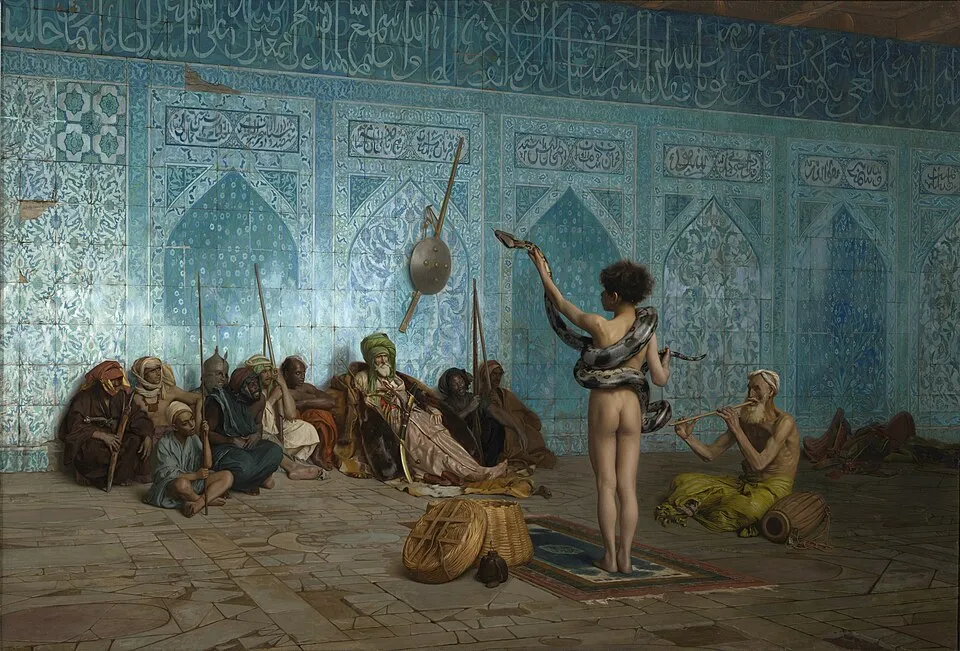
Jean-Léon Gérôme, "The Snake Charmer" (c. 1879). Oil on canvas. Clark Art Institute, Williamstown, MA. Image via Wikimedia Commons
Ingres and the Harem Fantasy
Jean-Auguste-Dominique Ingres (1780-1867) was a French Neoclassical painter. "La Grande Odalisque" (1814), 91 x 162 cm, now in the Louvre, was commissioned by Queen Caroline Murat of Naples, Napoleon's sister. The painting shows a reclining nude woman with an elongated back (anatomists have counted five vertebrae too many), looking over her shoulder at the viewer, in a Turkish harem setting with a fan, a hookah, and Oriental textiles. The woman is not a person. She is a fantasy of Eastern sensuality, created for a Western male viewer.
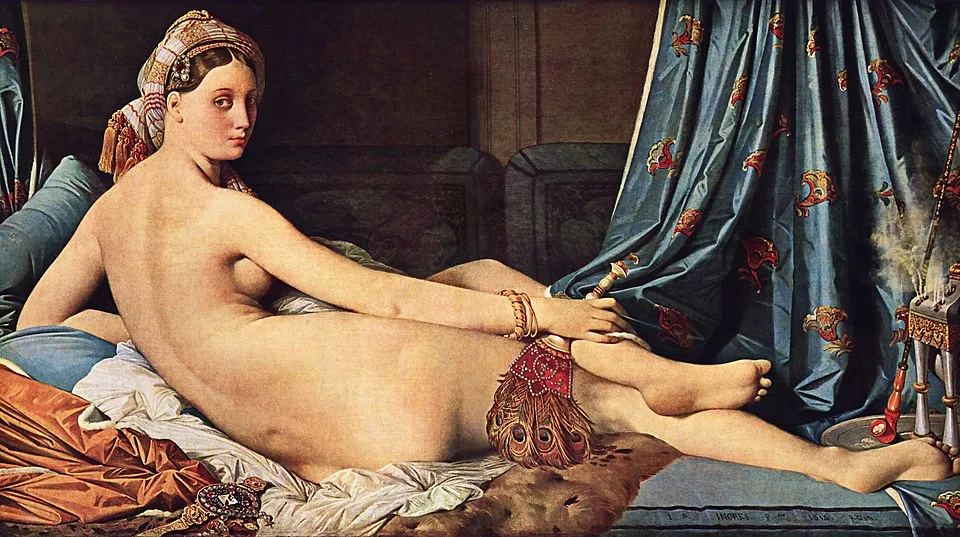
Jean-Auguste-Dominique Ingres, "La Grande Odalisque" (1814). Oil on canvas, 91 x 162 cm. Louvre, Paris. Image via Wikimedia Commons
The key point is that Ingres never traveled to the East. He never visited a harem. He never saw a Turkish woman. The painting is entirely imaginary, a fantasy constructed from travel literature, engravings, and other paintings. The "Orient" in Ingres's painting is not a place. It is a fantasy space where Western male desire could be projected without the constraints of Western morality. "The Turkish Bath" (1862), 108 x 108 cm, also in the Louvre, is Ingres's late work, a dense composition of nude women in a Turkish bath, painted when he was 82. The women are indistinguishable, generic female bodies in an Oriental setting. The painting is the purest expression of Orientalism's fantasy: the East as a space of unlimited female availability.
Ingres's odalisques are the male gaze projected onto an Oriental fantasy. The woman is passive, available, and exotic. She exists for the Western male viewer's pleasure. The Oriental setting provides the excuse. What would be pornographic in a French setting becomes "ethnographic" in a Turkish one. The mechanism is the same one Laura Mulvey identified in film, covered in our guide to the male gaze in art, but here the gaze is doubled: male and colonial at once.
Delacroix and the Ambivalence of the Witness
Eugène Delacroix (1798-1863) was a French Romantic painter. "Women of Algiers in Their Apartment" (1834), 180 x 229 cm, now in the Louvre, is a more complicated case. Delacroix visited Algeria and Morocco in 1832 as part of a diplomatic mission to the Sultan of Morocco. This was just two years after France conquered Algeria. Delacroix was one of the few Orientalist painters who actually visited the places he depicted.
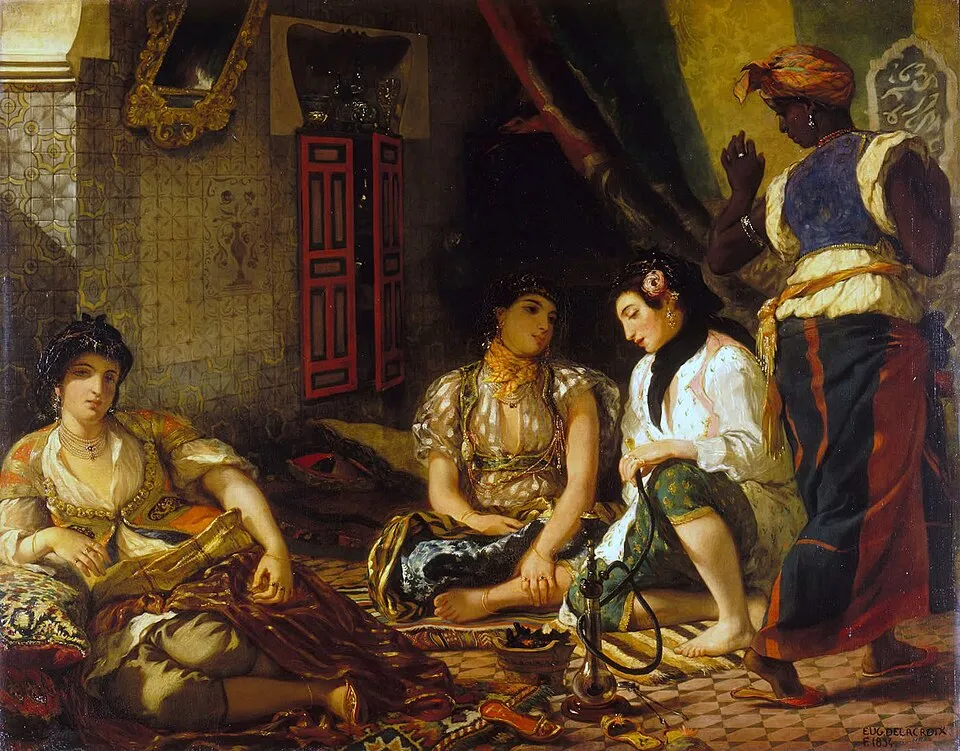
Eugène Delacroix, "Women of Algiers in Their Apartment" (1834). Oil on canvas, 180 x 229 cm. Louvre, Paris. Image via Wikimedia Commons
The painting shows three women reclining in an ornate Oriental interior with Persian rugs and woven tapestries. A fourth woman, a Black servant, exits the room. The women are clothed, unlike Ingres's odalisques, and their expressions are ambiguous. One looks at the viewer with what might be challenge or appraisal. Delacroix made detailed studies of dress and interior decoration during his visit, and the painting has a claim to authenticity that Ingres's fantasies lack. But the scene is still a harem, a space that Delacroix could not have entered as a Western man. He likely saw it through a European intermediary or constructed it from fragments. The "authenticity" is partial, and the fantasy of the harem as a space of languid female availability is still present.
Delacroix represents the ambivalence of Orientalism, the tension between genuine observation and fantasy. He went to Algeria. He drew what he saw. But what he saw was already framed by Orientalist expectations, and what he painted was a compromise between observation and fantasy. For the movement that shaped Delacroix's broader project, see our guide to Romanticism.
Gérôme and the Illusion of Accuracy
Jean-Léon Gérôme (1824-1904) was a French academic painter and the most commercially successful Orientalist painter of the 19th century. "The Snake Charmer" (c. 1879) is in the Clark Art Institute. "The Prisoner" (c. 1861) and "The Slave Market" (c. 1866) are among his other Orientalist works. Gérôme was a "studio Orientalist." He visited Egypt and Turkey but painted most of his Orientalist scenes in his Paris studio, using sketches, photographs, and collected objects. His paintings are characterized by meticulous detail. Every tile, every textile, every architectural feature is rendered with photographic precision.
The problem is that Gérôme's precision creates an illusion of accuracy. The paintings look like documents, records of real places and real events. But they are fantasies. "The Snake Charmer" depicts a naked boy in a palatial setting that is not any real place. The tiles are from Istanbul. The architecture is from Cairo. The figures are from Gérôme's imagination. The painting assembles fragments of "the Orient" into a coherent scene that never existed. Linda Nochlin argued in "The Imaginary Orient" (1983) that Gérôme's precision was not accuracy but ideology. The photographic detail creates the impression of objectivity, which masks the fantasy. The viewer thinks they are seeing "the real Orient" when they are seeing a construction, a Western fantasy disguised as a document. "The Snake Charmer" was used as the cover of Said's "Orientalism" because it perfectly illustrates the book's thesis: the "Orient" is a Western invention, and the illusion of accuracy is the most powerful form of invention. Khan Academy has a clear introduction to Orientalism as an art-historical issue, and the Wikipedia entry on Orientalism provides useful background on the broader discourse.
The Postcolonial Response
Houria Niati, an Algerian artist, produced "No to Torture" (1982), a series of paintings that directly respond to Delacroix's "Women of Algiers." Niati's work deconstructs the Orientalist fantasy. She replaces Delacroix's languid odalisques with images of Algerian women who resist, fight, and survive. The series was exhibited alongside Picasso's "Les Femmes d'Alger" series (1954-1955), which was itself based on Delacroix. Niati's work exposes the chain of appropriation: Delacroix invented the fantasy, Picasso abstracted it, Niati deconstructed it.
Lalla Essaydi, a Moroccan artist, produced the "Harem" series (2009). Essaydi photographs women in actual Moroccan harems, covered in calligraphy that she has written on their skin and clothing. The work directly challenges the Orientalist tradition. The women are not passive objects but active subjects who write their own stories on their own bodies. The contemporary museum is increasingly contextualizing Orientalist paintings rather than displaying them as neutral. The 2019-2020 exhibition "Inspired by the East: How the Islamic World Influenced Western Art" at the British Museum paired Orientalist paintings with the Islamic objects that inspired them, exposing the gap between the fantasy and the reality. For the broader frame, see our guide to art and society.
Why Orientalism Still Matters in 2026
The Orientalist fantasy, the East as exotic, erotic, and dangerous, persists in film, advertising, and political discourse. Hollywood's depiction of the Middle East, from "Lawrence of Arabia" to "American Sniper," is a direct descendant of Orientalist painting. The "exotic" East is still a marketing category, for perfume, for travel, for fashion. The visual grammar has not changed. What has changed is that we can now name it.
Orientalist painting was produced during the period of European colonial expansion (1830-1900). The paintings justified colonialism by depicting the colonized as incapable of self-governance: irrational, sensual, and in need of Western control. The colonial legacy is not just in the paintings but in the museums that hold them. Many Orientalist paintings sit in museums that also hold looted colonial artifacts, the Benin Bronzes, the Parthenon Marbles. The question of display follows. Should museums display Orientalist paintings? The answer is yes, but with context. The paintings are historically important and aesthetically significant. But they should not be displayed as neutral images of "the East." They should be displayed as Western fantasies, images that tell us more about the West than about the East. For the current state of these debates, see our guide to contemporary art trends in 2026, and for the long view, the art movements timeline. Our guide on how to look at art for beginners and our piece on canon formation round out the picture of who gets represented and how.
Final Thoughts
Orientalism in art was a Western fantasy of the East: exotic, erotic, and passive. Ingres invented harems he never saw. Delacroix visited Algeria but painted fantasies dressed as observations. Gérôme assembled fragments of "the Orient" into scenes that never existed, with a precision that created the illusion of accuracy. Said exposed the fantasy in 1978, and postcolonial artists like Niati and Essaydi have deconstructed it in their work. The Orientalist fantasy persists in 2026, in film, advertising, and political discourse. The question is not whether to look at Orientalist paintings but how to look at them: as Western projections, not Eastern realities.
My position is straightforward. Orientalist paintings are aesthetically accomplished and politically toxic, and the two facts cannot be separated. The technique that makes Gérôme's "Snake Charmer" visually arresting is the same technique that makes it ideologically effective. The question is not whether to display them but how to contextualize them. Display them as Western fantasies that tell us about the West, not the East. Next time you see an Orientalist painting in a museum, ask yourself three questions. Who painted this? Did they actually go to the place they depict? What is the fantasy, and who does it serve? The answer will tell you more about the painter's culture than about the painted one.


