
Art criticism as a distinct genre of writing was invented by one man. Denis Diderot (1713-1784), already famous as the editor of the Encyclopédie, began writing reviews of the Paris Salon exhibitions in 1759. He sent them to Correspondance littéraire, a publication banned in Paris, which was mailed twice a month to a secret international readership of a few dozen people. Unpressured by the Academy or the king's censors, Diderot could speak openly and at great length. His 1765 Salon review is roughly 180 pages, equal to all the criticism written by all authors about any Salon held in the 1750s. Théophile Gautier wrote in 1854: "In his immortal Salons, Diderot founded the criticism of painting."
Before Diderot, writing about art was either art theory (Leonardo's notebooks, Vasari's Lives) or art history (Winckelmann). Diderot invented something new: the spontaneous, opinionated, first-person response to contemporary art. He praised, complained, joked, and moralized. He told painters what they should have done differently. He described the experience of looking, the physical sensation, the emotional response, the moral judgment. This is still what art criticism does. This guide covers the history of art criticism from Diderot through Baudelaire, Ruskin, Greenberg, and Berger, the five critics who defined the genre and changed how we look at art.
Diderot and the Invention of Art Criticism (1759-1781)
The Paris Salon was the official exhibition of the Académie Royale de Peinture et de Sculpture, held biennially in the Louvre. It was open to the public from 1737, making it the first public art exhibition in Europe. The livret, or catalogue, was first published in 1673. Initially a pamphlet of listed works organized by how they were displayed in the gallery, it gave no critical commentary.
In 1746, the livret included five essays by Étienne La Font de Saint-Yenne. This was the first serious example of art criticism. La Font complained about the hanging, the lighting, and the quality of the work. He was attacked by the Academy for his presumption. The idea that someone outside the Academy could judge art was considered outrageous. The Academy's position was that only trained artists and academicians were qualified to evaluate paintings.
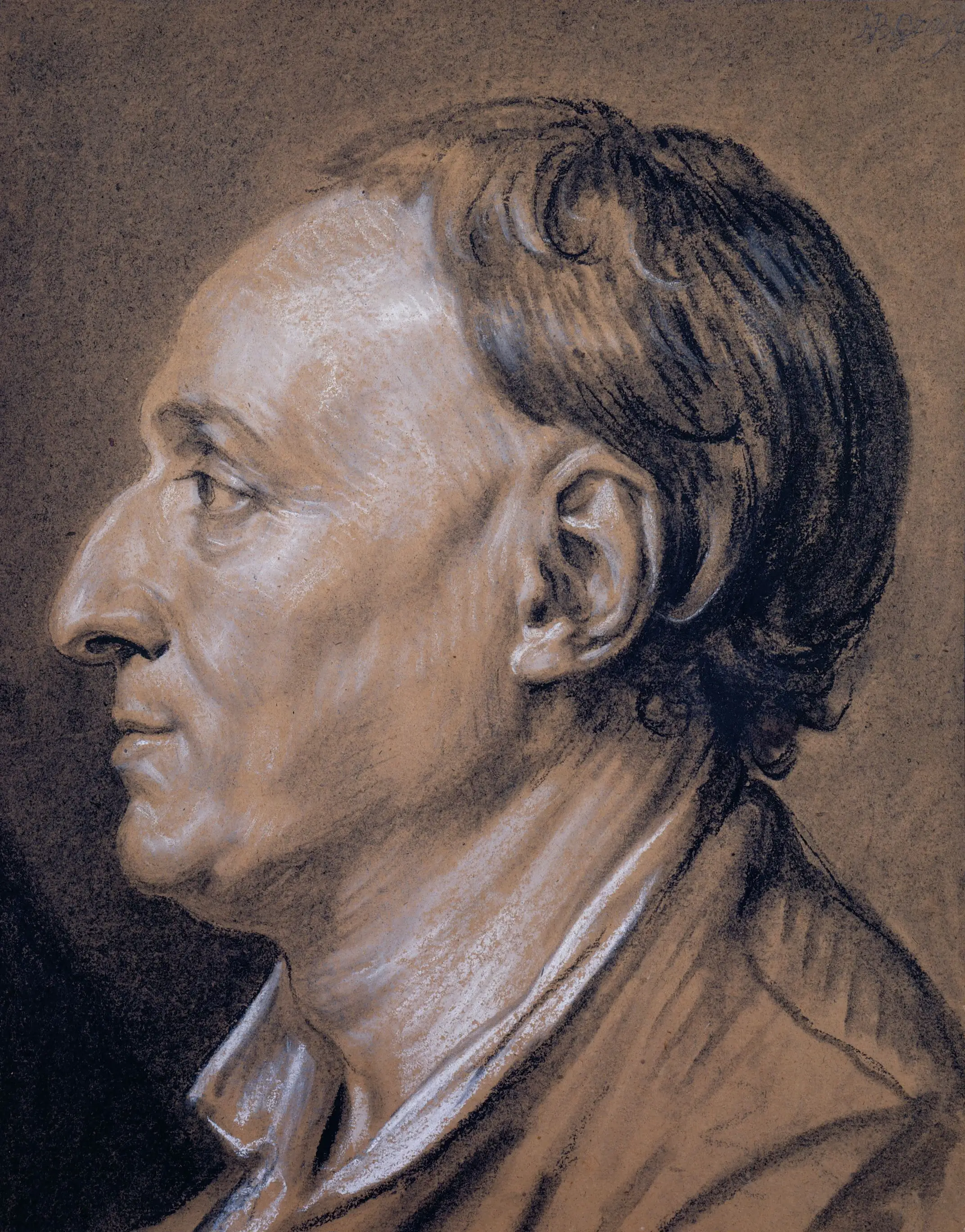
Jean-Baptiste Greuze, "Portrait of Denis Diderot" (c. 1760). Oil on canvas. Image: Public domain, via Wikimedia Commons
Diderot reviewed every Salon from 1759 to 1781, a span of 22 years. His method was simple: walk through the exhibition, describe what he saw, judge it, and use the paintings as springboards for philosophical digressions. He demanded that art be moral, realistic, and emotionally powerful. His most famous statement of purpose: "First of all, move me, surprise me, rend my heart; make me tremble, weep, shudder, outrage me, delight my eyes, afterwards, if you can."
On Boucher, in the 1765 Salon: "Depravity of morals has been closely followed by the debasement of taste, color, composition." Diderot hated Rococo frivolity and championed the moral seriousness of Greuze and Chardin. He was wrong about Greuze, whose sentimental domestic scenes have not aged well, but he was right about Chardin, whose still lifes are still the best argument for the seriousness of everyday subject matter.
The irony of Diderot's position is worth noting. He was writing for Catherine the Great of Russia, who subscribed to Correspondance littéraire. The founder of art criticism, a genre defined by its democratic, public-facing voice, was writing for an absolute monarch. Diderot never met most of his readers. He was writing into the dark, and the fact that his readership was tiny and secret gave him a freedom that public critics did not have. You can read more about the origins of art criticism at Art History Unstuffed.
Baudelaire and the Critic as Modernist (1845-1863)
Charles Baudelaire (1821-1867) was a poet, critic, and the first writer to treat modernity as a subject worthy of art. His Salon reviews of 1845, 1846, 1855, and 1859, and his essay "The Painter of Modern Life" (1863), redefined what art criticism could do.
"The Painter of Modern Life" (1863) is the founding document of modernist criticism. Baudelaire argued that the modern artist should not look to the past for subjects but to the present: the fashions, the streets, the cafes, the crowds. His most quoted sentence: "Modernity is the transient, the fleeting, the contingent; it is one half of art, the other being the eternal and the immovable." This sentence launched modernism. It told artists that the world around them, not the world of classical mythology or biblical narrative, was the proper subject of art.
Baudelaire's model of the modern artist was not a painter most people have heard of. He chose Constantin Guys, an illustrator for newspapers. Guys captured the fleeting experience of modern Paris: the horse races, the soldiers, the women in the streets. Baudelaire celebrated him because he painted the present moment without trying to make it look like antiquity. The critic's job, for Baudelaire, was not to judge quality against an eternal standard. It was to identify what was new and to explain why it mattered.
The shift from Diderot to Baudelaire is the shift that made modern art criticism possible. Diderot judged art by moral standards. Baudelaire judged art by its relationship to the present. Diderot wanted paintings that moved the heart. Baudelaire wanted paintings that captured the experience of being alive right now. Both positions are still alive in criticism today. For more on the cultural context of this period, see our guide to Romanticism: Passion, Nature, and the Rebellion Against Reason.
Ruskin and the Critic as Crusader (1843-1860)
John Ruskin (1819-1900) was the most influential English-language art critic of the 19th century. His five-volume "Modern Painters" (1843-1860) was written initially to defend J.M.W. Turner against attacks by critics who called his late work "blots" and "splashes." Ruskin was 24 when the first volume was published anonymously. It made him famous.
Ruskin argued that Turner's landscapes were not merely beautiful but true. He claimed they represented nature more accurately than any painter before him. To prove this, he spent hundreds of pages describing Turner's skies, mountains, and water with a precision that was itself a form of art. He could spend 20 pages on a single Turner sky, cataloguing the cloud formations, the quality of light, the way the atmosphere dissolved the horizon. His writing was a performance. The critic as artist, the prose as artwork.
"The Stones of Venice" (1851-1853) shifted Ruskin's attention from painting to architecture. He argued that the health of a society could be measured by its buildings. The chapter "The Nature of Gothic" became one of the most influential texts in architectural history. Ruskin believed that the quality of a building depended on the freedom and dignity of the workers who made it. Machine-made ornament was a sign of moral decay. Handmade ornament, even when imperfect, was a sign of a healthy society.
The Whistler trial of 1878 marked the end of Ruskin's authority. Ruskin had written that Whistler's "Nocturne in Black and Gold: The Falling Rocket" (1875) was "flinging a pot of paint in the public's face." Whistler sued for libel. He won, but was awarded only a farthing (a quarter of a penny) in damages. The trial was a public humiliation for both men, but it marked a turning point. Ruskin represented the old model of criticism: the critic as moral authority who judged art by its truthfulness to nature. Whistler represented the new model: art for art's sake, independent of moral or naturalistic standards. The trial signaled that the critic's authority was no longer automatic. For more on the history of art criticism, see Britannica's overview of art criticism.
Greenberg and the Critic as Kingmaker (1939-1969)
Clement Greenberg (1909-1994) was the most powerful American art critic of the 20th century. His essays "Avant-Garde and Kitsch" (1939) and "Modernist Painting" (1960) defined how modern art was understood for 30 years.
"Avant-Garde and Kitsch" (1939) argued that avant-garde art was the only authentic culture left in a capitalist society, and that kitsch, meaning mass-produced popular culture, was its enemy. This essay made the distinction between "high art" and "low art" that dominated American criticism until the 1980s. Greenberg wrote it at a time when fascism was using kitsch as propaganda. His argument was political: avant-garde art was difficult because it resisted the simplifications that both capitalism and fascism required.
"Modernist Painting" (1960) argued that modern art was a process of self-criticism. Each art form should strip away everything not essential to its medium. Painting's essential quality was flatness. Therefore, the best modern paintings were the most flat. The history of modern painting was the history of painting becoming more flat: Manet to Cézanne to Cubism to Pollock to Noland. Greenberg's narrative was elegant, totalizing, and wrong about almost everything except the art he personally liked. His eye for quality was unmatched. His theory of why that quality mattered was narrow and eventually sterile.
Greenberg's approval could make or break an artist's career. He championed Pollock, David Smith, and the Color Field painters (Noland, Olitski, Stella). His disapproval could sink a career. He dismissed Pop Art and Minimalism as "novelty art." He was wrong about both. Pop Art and Minimalism turned out to be the two most influential movements of the 1960s, and Greenberg's refusal to engage with them seriously damaged his credibility.
The backlash came in the 1970s. Contextualist critics like T.J. Clark argued that Greenberg ignored the social and political content of art. Clark's 1982 essay "Clement Greenberg's Theory of Art," published in Critical Inquiry, was the most sustained attack on Greenberg's formalism. Clark argued that Greenberg's account of modernism excluded everything that made modern art interesting: its negations, its social content, its relationship to capitalism. Clark wrote: "The medium has appeared most characteristically as the site of negation and estrangement." Flatness was not a purification but a refusal, a refusal of the bourgeois fantasy of transparent representation. For more on the movement Greenberg championed, see our guide to Abstract Expressionism: Pollock, Rothko, and American Painting at Its Peak.
Berger and the Critic as Democrat (1972)
John Berger (1926-2017) was a British art critic, novelist, and painter. His BBC television series "Ways of Seeing" (1972) and the accompanying book democratized art criticism. Berger took Greenberg's elitism and turned it inside out. He argued that art should be accessible to everyone, that the meaning of a painting changes depending on who looks at it, and that the traditional art history canon was a product of male, upper-class privilege.
"Ways of Seeing" was a four-part BBC series that became a book. The book is still in print and has sold over a million copies. It is required reading in most art schools. Berger's key arguments were three. First, the invention of the camera changed the meaning of paintings: a reproduced image has a different meaning from the original, because it can be seen in a different context, by a different audience, for different purposes. Second, the female nude in Western art was created for the male gaze: women were depicted as objects to be looked at, not as subjects who look. Third, oil painting was the art form of capitalism: it celebrated possessions, property, and the ownership of things.
Each of these arguments has been challenged, refined, and expanded in the decades since. But the impact of "Ways of Seeing" was not just in its specific claims. It was in its method. Berger spoke directly to the viewer. He used plain language. He showed reproductions and asked the viewer to look at them differently. He treated the audience as intelligent participants in the interpretation of art, not as students receiving instruction from an authority. This was a radical departure from Greenberg, whose prose was dense, theoretical, and addressed to an elite readership.
Berger made art criticism political in a way that Greenberg's formalism explicitly was not. Greenberg believed that politics and aesthetics were separate domains. Berger believed they were inseparable. The meaning of a painting, for Berger, was not just in its formal qualities but in its social function: who it was made for, who it served, who it excluded. For more on the relationship between art and society, see our guide on how art reflects and shapes culture.
The State of Art Criticism Today
Art criticism has been declared dead roughly every decade since 1960. The internet has democratized publishing but deprofessionalized criticism. Anyone can write a review, but few can make a living from it. The economic model that supported professional art criticism for a century, newspapers and magazines paying staff critics to review exhibitions, has collapsed. The Village Voice eliminated its art criticism section in 2008. The New York Observer closed in 2016. Artforum and Frieze survive but pay freelance rates that do not support full-time work.
The best criticism in 2026 comes from a mix of sources. Academic journals like October and Critical Inquiry continue to publish theoretically rigorous work, though their readership is small and specialized. Magazines like Artforum, Frieze, and The Burlington Magazine maintain professional standards but increasingly compete with free online content. Independent writers on Substack and personal blogs have created a new ecosystem of criticism that is more accessible and more varied than the print model, but also more precarious.
The 2026 Whitney Biennial, reviewed in Art in America, illustrates the current moment. The review by Emily Watlington argued that the Biennial "swaps identity for infrastructure," shifting from the politics of identity to the politics of systems. This is the kind of observation that only a trained critic can make: connecting individual artworks to larger cultural and political patterns. The review was published online, free to read, and shared widely on social media. This is the new model: criticism that is accessible, opinionated, and distributed through networks rather than institutions.
Does art criticism still matter? Yes, but differently. Diderot invented it as a public conversation about public art. Greenberg turned it into a disciplinary discourse with its own theoretical framework. Berger turned it into a political tool. Today, it is all of these things at once. The best critics working now, people like Hilton Als at The New Yorker, T.J. Clark in the London Review of Books, and Olivia Laing in her books and essays, combine all three traditions. They describe the formal qualities of the work, connect it to its social and political context, and write in a voice that is accessible to a general reader. For more on how art criticism emerged from its earliest forms, see Hyperallergic's account of how art criticism emerged from Salon catalogues.
Final Thoughts
Art criticism was invented by Diderot in 1759 as a secret newsletter to a Russian empress. It became a public genre through Baudelaire, a moral crusade through Ruskin, a theoretical system through Greenberg, and a political tool through Berger. The thread connecting all five is the belief that writing about art is not secondary to art. It is its own creative act, and it changes how we see.
Diderot is still the best art critic who ever lived. His Salons are funnier, more honest, and more useful than anything written in the last 50 years. He described paintings with a physical immediacy that no critic has matched. He was opinionated, wrong, brilliant, and readable. If you want to understand what art criticism is supposed to do, read Diderot's 1765 Salon. Then read Berger's "Ways of Seeing." Then go to a museum and write your own review. That is what Diderot would have done.
For the broader context of art history, see our Complete Guide to Art Movements and our Art History in 10 Minutes. For more on how to look at art, see our guide on how to look at art for beginners. For more on the famous paintings these critics wrote about, see our guide to famous paintings explained.


