
Stand in front of Jackson Pollock's "Number 1A" (1948) at MoMA. A formalist will tell you that what matters is the paint: the rhythm of the drips, the density of the surface, the relationship between the canvas edge and the paint. A contextualist will tell you that what matters is the context: Pollock's alcoholism, his Jungian psychoanalysis, the Cold War politics that made Abstract Expressionism an American cultural weapon, the masculinity of the drip gesture. Same painting. Two completely different accounts of what it means and why it matters. This is the central argument in art criticism, and it has been running for 80 years.
Formalism is the position that art should be judged by its formal qualities: color, line, shape, composition, medium. Contextualism is the position that art should be judged by its context: the social, political, historical, and biographical circumstances in which it was made. The argument is not academic. It determines what gets displayed in museums, what gets taught in art schools, and what counts as "important" art. This guide covers the formalist position (Clive Bell, Clement Greenberg, Michael Fried), the contextualist position (T.J. Clark, Griselda Pollock), the 1981 Critical Inquiry debate, and why both sides are partially right.
The Formalist Position: Art Is About Form
Clive Bell (1881-1964) was a British art critic whose book "Art" (1914) argued that all art, across all periods, shares one quality: "significant form." By this he meant combinations of line, color, and shape that produce aesthetic emotion in the viewer. Bell did not care what a painting depicted. He cared about how it looked. A Cézanne landscape and a Byzantine icon could both have significant form. A Victorian narrative painting and a Dutch genre scene could both lack it. The subject matter was irrelevant. The form was everything.
Bell's theory has a circular quality. Significant form is defined as that which produces aesthetic emotion, and aesthetic emotion is defined as that which is produced by significant form. This circularity has been mocked by critics for a century, but Bell's instinct was not wrong. He was trying to explain why some art moves us and some does not, and he located the difference in the formal properties of the work rather than in its subject matter or its moral message. This was a radical claim in 1914, when most criticism was still concerned with what paintings depicted rather than how they were made.
Clement Greenberg (1909-1994) was the most powerful formalist. "Modernist Painting" (1960) argued that each art form should purify itself by stripping away everything not essential to its medium. Painting's essence was flatness. The history of modern painting was the history of painting becoming more flat: Manet to Cézanne to Cubism to Pollock to Noland. Greenberg's narrative was elegant, totalizing, and wrong about almost everything except the art he personally liked. His eye for quality was real. His theory of why that quality mattered was a straitjacket.
Jackson Pollock painting in his studio, photographed by Hans Namuth in 1951. Pollock's drip technique involved pouring and flicking industrial paint directly onto unprimed canvas laid on the floor. Image: Public domain, via Wikimedia Commons
Michael Fried (born 1939) was Greenberg's successor. "Art and Objecthood" (1967) argued that the best art creates "absorption": the viewer forgets they are looking at an object and is absorbed into the experience. Fried attacked Minimalism as "theatrical" because it acknowledged the viewer's presence and depended on the physical space around the work. The essay destroyed Fried's relationship with the art world. Minimalism won, and Fried's attack on it is now read as a monument to a lost position. But "Art and Objecthood" remains the most passionate defense of formalism ever written. Fried's prose has an urgency that Greenberg's never quite achieved. He believed that the stakes were existential: if art became theatrical, it ceased to be art.
Here is the formalist test: if you can describe everything that matters about a painting without mentioning the artist's biography, the historical period, or the subject matter, you are a formalist. The painting is self-sufficient. It contains its own meaning. The critic's job is to describe the formal properties and explain how they produce the aesthetic effect. For more on the movement that Greenberg championed, see our guide to Abstract Expressionism: Pollock, Rothko, and American Painting at Its Peak.
The Contextualist Position: Art Is About Context
T.J. Clark (born 1943) is a British art historian and the leading contextualist. "Image of the People: Gustave Courbet and the 1848 Revolution" (1973) and "Farewell to an Idea: Episodes from a History of Modernism" (1999) argued that Greenberg's formalism was not just wrong but politically dangerous. It stripped art of its social content and turned it into an aesthetic object detached from history. Clark's 2025 book "Those Passions: On Art and Politics" collected his essays from the last quarter century and confirmed his position as the most important social art historian of his generation.
Clark's 1982 essay "Clement Greenberg's Theory of Art," published in Critical Inquiry, was the most sustained attack on Greenberg's formalism. Clark argued that Greenberg's account of modernism was "a narrative of flatness" that excluded everything that made modern art interesting: its negations, its social content, its relationship to capitalism. Clark wrote: "The medium has appeared most characteristically as the site of negation and estrangement." Flatness was not a purification but a refusal, a refusal of the bourgeois fantasy of transparent representation. The paint does not assert its flatness as a positive value. It asserts its flatness as a rejection of the illusion that painting can transparently represent the world.
Clark's work on Courbet was the foundational contextualist study. He showed that Courbet's "The Stone Breakers" (1849) was not just a painting of two laborers. It was a political statement about class, made in the year of the 1848 revolution. The painting's rough surface, its refusal of academic finish, its choice of subject (rural poverty) were all determined by the political context. Courbet was not painting poor people because he found them picturesque. He was painting them because the 1848 revolution had made the working class visible as a political subject for the first time. The painting's form and its context are inseparable.
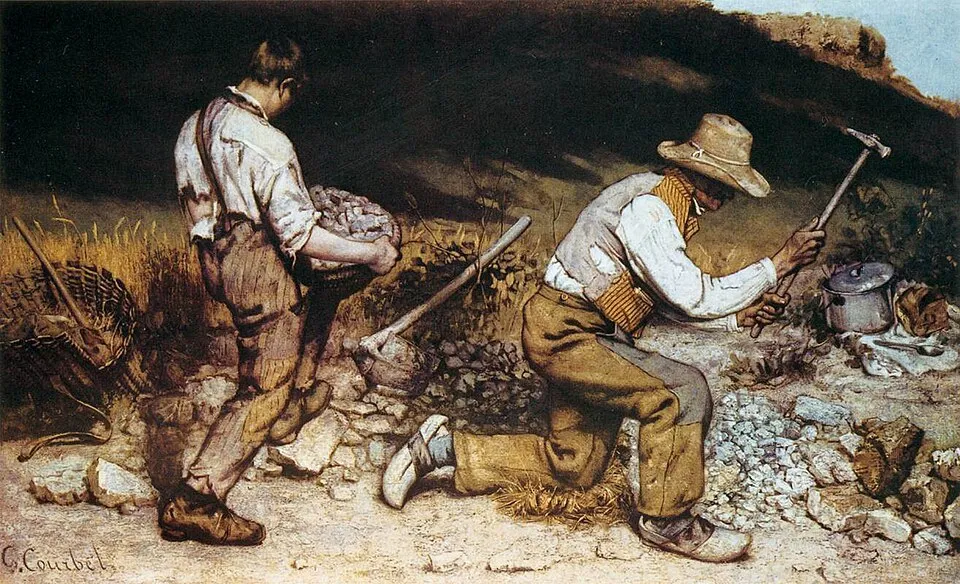
Gustave Courbet, "The Stone Breakers" (1849). Oil on canvas, 165 x 257 cm. Destroyed in World War II. Image: Public domain, via Wikimedia Commons
Griselda Pollock (born 1949) extended the contextualist critique into feminist art history. "Old Mistresses: Women, Art and Ideology" (1981, with Rozsika Parker) argued that the formalist canon was male. Greenberg's narrative of modernism excluded women artists not because their work was formally inferior but because the criteria for "formal quality" were gendered. The qualities that formalism celebrated: scale, ambition, formal innovation, medium-specificity were coded as masculine. The qualities it dismissed: intimacy, domesticity, craft, narrative were coded as feminine. Pollock showed that the formalist standard was not neutral. It was a standard that had been designed, consciously or not, to value the work of men over the work of women.
Here is the contextualist test: if you cannot describe what matters about a painting without mentioning the artist's biography, the historical period, or the subject matter, you are a contextualist. The painting is not self-sufficient. Its meaning is produced by the interaction between its formal properties and the social conditions in which it was made and viewed. The critic's job is to describe both the form and the context and explain how they relate. For more on the relationship between art and society, see our guide on how art reflects and shapes culture.
The 1981 Critical Inquiry Debate
In 1981, the journal Critical Inquiry held a symposium on "The Politics of Interpretation." The centerpiece was an exchange between Michael Fried (formalist) and T.J. Clark (contextualist) over the legacy of Clement Greenberg. The stakes were high. Greenberg's formalism had been the dominant framework for understanding modern art for 20 years. Clark's contextualism was the emerging challenge. The debate was not just about art. It was about whether art criticism should be an aesthetic practice or a political one.
Fried defended Greenberg's emphasis on medium but acknowledged that Greenberg's narrative was too narrow. Clark attacked Greenberg's formalism but acknowledged that formal qualities mattered. A painting's social content is inseparable from its formal properties. You cannot separate what a painting says from how it says it. The debate established that the formalist-contextualist divide was not a binary but a spectrum.
The lesson of the 1981 debate is that the most productive art criticism combines formal analysis with contextual understanding. You cannot understand Pollock's drip paintings without understanding both the paint (formal) and the Cold War (contextual). You cannot understand Courbet's "Stone Breakers" without understanding both the surface (formal) and the 1848 revolution (contextual). The formalist who ignores context produces descriptions that are accurate but empty. The contextualist who ignores form produces explanations that are rich but ungrounded. You can read Clark's full essay on Greenberg's theory of art at Marginal Utility.
Why Both Sides Are Partially Right
The formalist insight is real: form matters. A painting's color, composition, and surface are not secondary to its content. They are its content. The experience of looking at a Rothko is not about what Rothko was feeling when he painted it. It is about the relationship between the colors on the canvas and your eyes. The edges where one color meets another, the way the light hits the surface, the scale of the painting relative to your body: these are the things that produce the aesthetic experience. If you remove form from art criticism, you are writing sociology, not criticism.
The contextualist insight is also real: form does not exist in a vacuum. Rothko's color fields were made in a specific historical context. Postwar America. The rise of Abstract Expressionism as a Cold War cultural weapon, funded and promoted by the CIA through front organizations like the Congress for Cultural Freedom. The commercialization of the art market. The masculinity of the Abstract Expressionist group, which excluded women like Lee Krasner and Joan Mitchell from its inner circle despite their equal talent. If you remove context from art criticism, you are writing formal analysis, not criticism.
The synthesis is not a compromise. It is a recognition that a painting's form and its context are inseparable. Courbet's rough surface is a formal property. It is also a political statement, because in 1849, smooth academic finish was the standard, and roughness was a refusal of that standard. Pollock's drip technique is a formal property. It is also a gendered gesture, because in 1948, the physical act of pouring paint on a floor was coded as masculine, and the critical reception of Pollock's work was saturated with language about virility and American energy. The form is the context made visible. The context is the form made meaningful.
The best art criticism does both. It describes the formal qualities of the work (what does it look like? how does it feel?) and connects them to the context (why was it made? what does it mean?). Diderot did this. Baudelaire did this. Berger did this. Greenberg refused to do this, and his refusal is why his criticism, despite its brilliance, eventually became sterile. By the 1970s, Greenberg was writing about flatness as if it were a self-evident value, disconnected from any social or historical context. The result was criticism that was technically precise but humanly empty. For more on how to look at art, see our guide on how to look at art for beginners.
Final Thoughts
Formalism and contextualism are not enemies. They are two tools for looking at the same object. Formalism tells you what you are seeing. Contextualism tells you why it matters. The best critics use both. They describe the surface and the context, the paint and the politics, the form and the meaning. If you only use one tool, you are only seeing half the painting.
Greenberg's formalism was brilliant and wrong. His account of modernism excluded everything that made modern art interesting: its social content, its political stakes, its relationship to capitalism and war. But his eye for quality was unmatched, and the artists he championed (Pollock, Smith, Noland) are still the artists we study. Clark's contextualism was necessary and right. It restored the social and political dimensions that Greenberg had stripped away. But Clark never denied the importance of formal analysis. His readings of Courbet and Pollock are as formally precise as Greenberg's, and more historically grounded.
Next time you are in a museum, try both approaches. First, look at a painting for 5 minutes without reading the label. Describe the form: the colors, the composition, the surface, the scale. Then read the label and think about the context: who made it, when, where, under what circumstances. The combination of those two readings is what art criticism is. For the broader context of art history, see our Complete Guide to Art Movements and our Art History in 10 Minutes. For more on the movements discussed here, see our guides to Minimalism and art criticism.


