
On October 1, 1975, the British academic journal Screen published an essay by Laura Mulvey titled "Visual Pleasure and Narrative Cinema." It was 13 pages long. It has been cited over 6,800 times. The term "male gaze," which Mulvey used to describe how classical Hollywood cinema structures visual pleasure around a heterosexual male viewpoint, has entered ordinary language. Mulvey herself has acknowledged that the phrase has become "rather a cliché, overused, over-generalised, an identity rather than a concept." But the concept itself remains essential. It describes a structural asymmetry in how images are made, framed, and consumed, and it applies not just to cinema but to five centuries of Western painting.
Mulvey was not the first to identify the problem. John Berger, in his 1972 BBC series "Ways of Seeing," argued that "men act and women appear. Men look at women. Women watch themselves being looked at." Berger was talking about the European nude tradition, Titian, Rubens, Ingres, and his analysis preceded Mulvey's by three years. But Mulvey gave the concept its theoretical framework, drawing on Freud and Lacan to explain not just that the gaze was male but why it was structured that way. This guide covers Mulvey's argument, how it applies to painting (not just film), the three "looks" of the male gaze, the counter-arguments from bell hooks and Camille Paglia, and what the male gaze means for art in 2026.
Mulvey's Argument: Three Looks
"Visual Pleasure and Narrative Cinema" (1975) argued that classical Hollywood cinema is structured around patriarchal ideologies that shape how women are represented onscreen. The imbalance of power between men and women in society is reflected in an imbalance of power on the screen, not just in content but in form. Camera angles, lighting, editing, and narrative structure all reinforce the male gaze.
Mulvey identified three looks that combine to produce it. The first is the look of the camera, how the film is shot through framing, camera movement, and editing. The second is the look of the characters, how male characters gaze at female characters within the story. The third is the look of the audience, how spectators are positioned to adopt a masculine viewpoint. When all three align, the male gaze is at its most powerful. The woman on screen is looked at by the camera, by the male characters, and by the audience, and all three looks converge on her body.
Mulvey's famous coinage was "to-be-looked-at-ness." Women in classical cinema, she wrote, are "simultaneously looked at and displayed, with their appearance coded for strong visual and erotic impact so that they can be said to connote to-be-looked-at-ness." The woman is the image. The man is the bearer of the look. This is not a moral failing of individual directors. It is a structural feature of the medium as it was practiced in classical Hollywood. Mulvey drew on Freud's concept of scopophilia, the erotic pleasure of looking, and voyeurism to explain how cinema reinforces unconscious desires and power structures. "Unchallenged, mainstream film coded the erotic into the language of the dominant patriarchal order." You can read the full text of Mulvey's "Visual Pleasure and Narrative Cinema" to see how the argument is built.

Laura Mulvey (born 1941). Photograph by Mariusz Kubik, 2010. Image via Wikimedia Commons
The Male Gaze in Painting: Before Cinema
The concept did not originate with cinema. The European nude tradition, from Titian to Ingres, is the visual culture that Mulvey's gaze theory describes, five centuries before Hollywood. The same structural asymmetry, the man looking, the woman being looked at, runs through the entire tradition.
Titian's "Venus of Urbino" (1538) measures 119 x 165 cm. The Venus reclines on a bed, looking directly at the viewer. She is displayed for visual pleasure. The painting was commissioned by Guidobaldo della Rovere, Duke of Urbino, and hung in a private bedroom. The "viewer" was always assumed to be male. The Venus exists in the painting to be looked at, and the person doing the looking is a man who owns the painting and owns the room it hangs in.
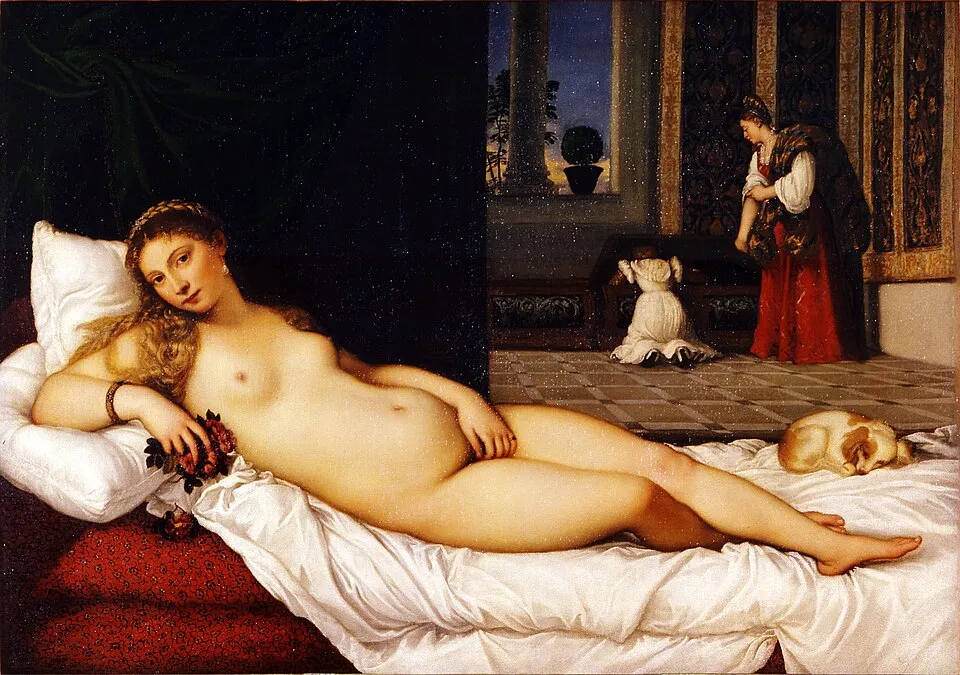
Titian, "Venus of Urbino" (1538). Oil on canvas, 119 x 165 cm. Uffizi Gallery, Florence. Image via Wikimedia Commons
Manet's "Olympia" (1863) measures 130.5 x 190 cm. Manet took Titian's composition and made the gaze confrontational. Olympia looks at the viewer not with invitation but with challenge. The painting caused a scandal at the 1865 Salon, not because of the nudity, nudes were standard Salon fare, but because Olympia's gaze refused the viewer's control. She is not "to-be-looked-at." She is looking back. The 1865 Salon visitors, mostly male, mostly bourgeois, were used to nudes who offered themselves to the eye. Olympia did not offer. She confronted. The scandal was not about sex. It was about power.
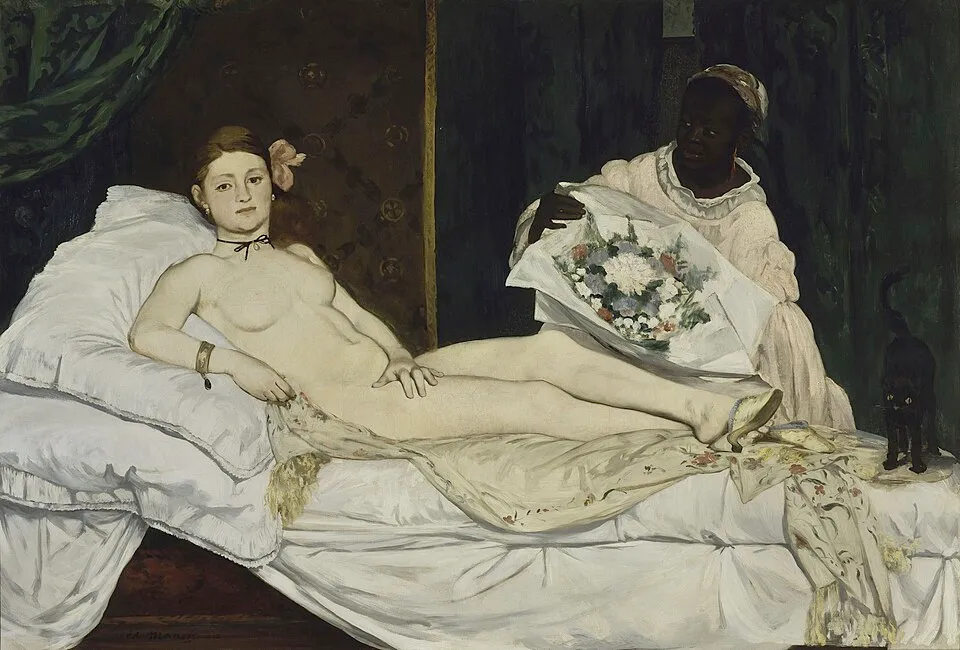
Édouard Manet, "Olympia" (1863). Oil on canvas, 130.5 x 190 cm. Musée d'Orsay, Paris. Image via Wikimedia Commons
Ingres' "La Grande Odalisque" (1814) measures 91 x 162 cm. The odalisque's back is turned, her face in profile. She cannot look back. The viewer's gaze is unchallenged. This is the male gaze at its purest, the female body displayed for visual consumption without the subject's agency. The woman in the painting does not see you. She exists for you to see. John Berger put it directly in 1972: "Men look at women. Women watch themselves being looked at." Berger argued that the nude tradition was not about women's bodies but about the male viewer's possession of them. The painting is not a woman. It is a woman-as-seen-by-a-man. For more on how visual culture encodes social power, read our guide on art and society.
bell hooks and the Oppositional Gaze
bell hooks (1952-2021) was an American feminist scholar. In 1992, hooks published "Black Looks: Race and Representation," which included the essay "The Oppositional Gaze: Black Female Spectators." The essay changed the conversation about the male gaze by pointing out what Mulvey had left out.
Mulvey's male gaze assumed a white, heterosexual male viewer. hooks pointed out that Black women had never been represented in mainstream cinema as subjects. They were either absent or stereotyped. The "male gaze" was also a white gaze. Black women spectators developed what hooks called an "oppositional gaze," a way of looking that refused the dominant cinema's positioning of them as invisible or stereotyped. The oppositional gaze is not passive reception. It is an active, critical practice of looking back at a culture that denies you subjectivity.
hooks did not reject Mulvey's framework. She expanded it. The gaze is not only gendered but racialized. A Black woman looking at a Hollywood film is positioned differently from a white woman, who is positioned differently from a white man. The gaze is intersectional, not binary. The implication for art history is direct. The European nude tradition that Berger and Mulvey analyzed was not only male but colonial. The "Venus" tradition, Titian, Manet, Ingres, depicted white women for white male viewers. The Black female subject in Western art, Manet's maid in "Olympia," for example, is not a subject at all. She is a prop, a signifier of the white woman's exoticism and status. hooks made that visible. For the broader framework of how feminist theory reshaped art criticism, see our guide on feminist art theory.
Counter-Arguments and Criticisms
Camille Paglia called Mulvey's argument "simplistic." Paglia's objection was that the gaze is not always oppressive. "The idea that a man looking at or a director filming a beautiful woman makes her an object, makes her passive beneath the male gaze, I think this is a fundamental misreading of the complexity of human sexuality." Paglia argued that visual pleasure is not automatically domination, and that women can enjoy being looked at without being reduced to objects. The objection has force in individual cases. The problem is that Mulvey was not describing individual cases. She was describing a structure. A structure can produce oppression even when the individuals inside it do not feel oppressed.
Mulvey herself revised the argument. In "Afterthoughts on 'Visual Pleasure and Narrative Cinema'" (1981), she addressed the question of the female spectator. If the gaze is male, what happens when a woman watches a film made for the male gaze? Mulvey's answer was that the female spectator is forced to oscillate between masculine and feminine positions, adopting the active male gaze to follow the narrative while being positioned as the passive female object of the look. The female spectator, in other words, is split. This is not a comfortable position, and it is not a choice. It is a structural consequence of a cinema built for men.
The queer gaze posed another challenge. Mulvey's framework assumed heterosexuality. Queer theorists argued that the gaze is not always male, not always heterosexual, and not always directed at women. The queer gaze disrupts the active/male, passive/female binary that Mulvey described. More recent criticism has argued that Mulvey's framework, rooted in Freud and Lacan, assumes a binary gender system that excludes trans and non-binary viewers and subjects. The British Academy published a useful overview of Mulvey's debt to Freud and Hollywood that traces these complications.
The Male Gaze in 2026
The male gaze is now structural in advertising, fashion photography, and social media. Instagram's visual culture, selfies, filters, the "male gaze" as a compositional strategy, is the most pervasive form of the gaze in history. The difference from 1975 is that women now participate in it voluntarily, internalizing the gaze and performing it for themselves. Whether that participation is agency or internalization is one of the live debates in contemporary feminist theory. My view is that it is both, and that the question is not whether women "choose" the gaze but what choices are available to them within a visual culture that still rewards being looked at.
The counter-movement is real. Artists like Mickalene Thomas, Cindy Sherman, and Nan Goldin have created work that refuses the male gaze, not by avoiding the female body but by controlling who looks at it and how. Thomas's rhinestone-encrusted portraits of Black women celebrate the female body from a female viewpoint. Sherman's "Untitled Film Stills" deconstruct the gaze by performing it, showing how the "female image" in cinema is a construction that can be replicated without an actual film. These artists do not escape the gaze. They make it visible, and in making it visible, they make it available for critique.
Museums are increasingly aware of the gaze problem. The 2023-2024 "Titian: Women, Myth and Power" exhibition at the Isabella Stewart Gardner Museum reexamined the "Poesie" series through the lens of gender and power. The question is not whether to display the nude tradition. It is how to contextualize it. A Titian hung without comment is a Titian that reproduces the male gaze. A Titian hung with a wall text that names the problem is a Titian that invites the viewer to think about it. The difference matters. For what is happening in museums and galleries right now, see our guide on contemporary art in 2026.
Final Thoughts
Mulvey's male gaze described a structural asymmetry in how images are made and consumed. It applies to cinema and to five centuries of Western painting. The concept has been expanded by bell hooks, who added race, challenged by Paglia, who defended agency, and complicated by queer and trans theory, which rejected the binary. But the core insight remains. Images are not neutral. They are made by someone, for someone, and the someone is usually male. The question is not whether to look but how to look, and who gets to look back.
My view is that Mulvey's framework is still essential but incomplete. It assumed a white, heterosexual, cisgender male viewer, and the most productive expansions, hooks on race, queer theory on sexuality, trans theory on gender, have made it more useful, not less. The framework that "overgeneralizes" is also the framework that named the problem. Without Mulvey, there is no hooks. Without hooks, there is no intersectional gaze. The corrections build on the original, they do not replace it. For a different angle on who controls meaning in art, read about the death of the author, and for the practice of writing about what you see, our guide to art criticism covers the field.
Next time you are in a museum, find a nude painting. Ask: who is the viewer? Who is the subject? Who is looking at whom? Then find a painting by a woman artist of a male subject, Artemisia Gentileschi or Élisabeth Vigée Le Brun. The difference in who controls the gaze is the difference Mulvey described. For help training your eye to see these structures, read our guide on how to look at art, and for the stories behind specific works that stage this dynamic, see our breakdowns of famous paintings.


