
The art historical canon, the list of "great artists" that every art history textbook covers, was invented by one man. Giorgio Vasari published "Lives of the Most Excellent Painters, Sculptors, and Architects" in 1550, with an expanded edition in 1568. He biographied 157 artists. All of them were Italian. All of them were men. The canon he created, Leonardo, Michelangelo, Raphael, Titian, is still the canon taught in art history surveys. The exclusion of women, people of color, and non-Western artists from the canon is not an accident. It is a structural feature of how the canon was formed, by Vasari in the 16th century, by Winckelmann in the 18th century, by Hegel in the 19th century, and by art history departments in the 20th century.
The canon is not a neutral record of the best art. It is a construction, a selection made by specific people at specific times for specific reasons. The selectors were almost exclusively white, male, European, and upper-class. The criteria they used, "genius," "masterwork," "progress," "quality," were not neutral but reflected their own values, interests, and blind spots. The canon is not wrong. Leonardo and Michelangelo are great artists. But it is incomplete. Artemisia Gentileschi and Kara Walker are also great artists, and they were excluded for centuries. This guide covers how the canon was formed, who gets left out, and how the canon is being challenged and expanded in 2026.
Vasari and the First Canon (1550)
Giorgio Vasari (1511-1574) was an Italian painter, architect, and writer. "Lives of the Most Excellent Painters, Sculptors, and Architects" appeared in 1550, with the expanded edition in 1568 containing 157 biographies. Vasari ranked artists by quality, from "good" to "better" to "best." His hierarchy was geographic. Tuscan artists (Leonardo, Michelangelo) sat at the top. Venetian artists (Titian) sat below. Non-Italian artists were excluded entirely. His narrative was teleological. Art progressed from Cimabue (primitive) to Giotto (improving) to Leonardo (excellent) to Michelangelo (perfection). Art history was the story of progress toward a peak, and the peak was Michelangelo.
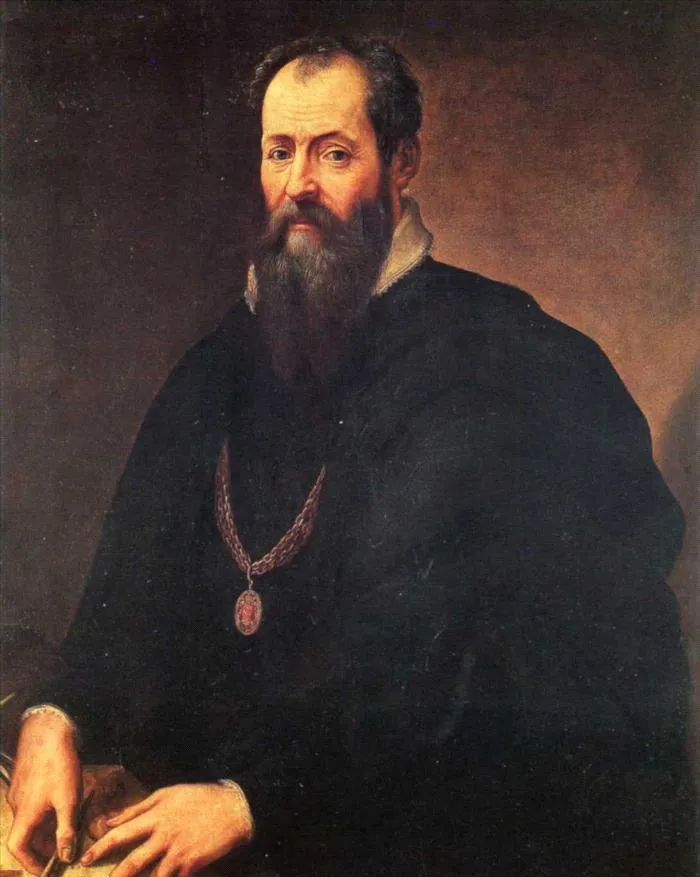
Giorgio Vasari, Self-portrait (c. 1571-1574). Oil on canvas, 101 x 80 cm. Uffizi Gallery, Florence. Image via Wikimedia Commons
Vasari included no women artists. He mentioned Properzia de' Rossi in the 1568 edition, but only briefly and dismissively. He included no non-Italian artists. He included no artists from the Byzantine or medieval traditions, which he regarded as "primitive." The canon was Italian, male, and Renaissance-centric from the start. Vasari's "Lives" is the founding text of art history. It established the genre, the biographical dictionary of great artists, and the criteria, quality, progress, genius, that would dominate art history for 400 years. Every art history survey course is a descendant of Vasari. The Naturalist Gallery has a useful overview of how the art canon is formed and who gets left out.
Winckelmann and the Classical Canon (1764)
Johann Joachim Winckelmann (1717-1768) was a German archaeologist and art historian. "History of the Art of Antiquity" (1764) is considered the founding text of modern art history, the first work to treat art history as a discipline with its own methods and categories. Winckelmann classified ancient art into periods (Archaic, High, Beautiful, Decadent) and argued that Greek art represented the highest achievement of human civilization. "The only way for us to become great," he wrote, "is to imitate the ancients."
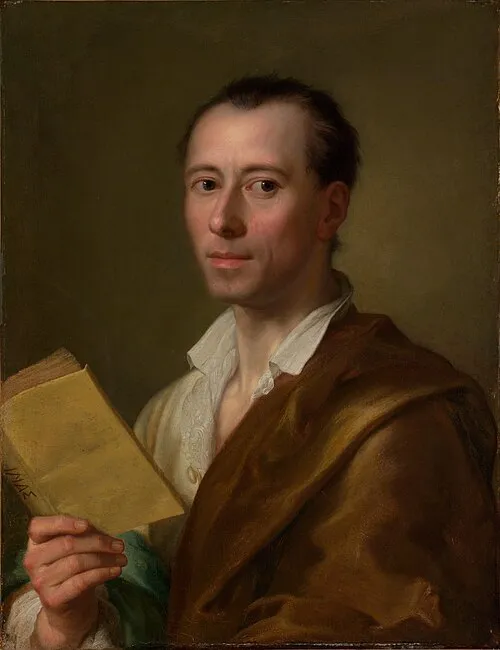
Anton Raphael Mengs, "Johann Joachim Winckelmann" (c. 1777). Oil on canvas, 63.5 x 49.2 cm. Metropolitan Museum of Art. Image via Wikimedia Commons
Winckelmann's canon was exclusively Greek and Roman. He excluded Egyptian, Persian, and Asian art as "non-classical." He also introduced a racial dimension. Greek art was, for Winckelmann, the art of white bodies, and he idealized the white male nude as the universal standard of beauty. This standard would dominate Western art education for 200 years. Winckelmann established the idea that art history has a trajectory, a rise, a peak, and a decline, and that the peak is classical Greece. This narrative excluded everything outside the Greco-Roman tradition and everything that did not conform to the classical ideal of beauty. The consequences are still visible in museum collections and art school curricula. For the long view, see our art movements timeline.
Hegel and the Philosophical Canon
Georg Wilhelm Friedrich Hegel (1770-1831) gave the canon philosophical foundations. "Lectures on Aesthetics," delivered in the 1820s and published posthumously in 1835, argued that art history is the history of Spirit's self-expression through matter. Art progresses from symbolic (ancient Egypt, India, where Spirit struggles with matter) to classical (Greece, where Spirit and matter are in perfect balance) to romantic (Christian Europe, where Spirit transcends matter). The peak is classical Greek art, and the trajectory is European.
Hegel's narrative excluded non-European art as "symbolic," a lower stage of development. It excluded Islamic art, Chinese art, Indian art, and African art as pre-modern or non-progressive. It excluded art by women; Hegel did not discuss any female artists. The Hegelian framework, art as the progress of Spirit, made non-European art structurally inferior. Hegel's lectures shaped the university art history curriculum. The survey course, "Art History 101," that starts with Egyptian art, jumps to Greek art, skips to the Renaissance, and ends with European modernism is a Hegelian narrative. It is the story of art's progress toward European modernity, and everything outside that story is marginal.
Who Gets Left Out
The canon is overwhelmingly male. A 2019 study of 18 major US art museums found that only 11% of acquisitions over the previous decade were by women artists. The reasons are structural. Women were excluded from art academies until the late 19th century. They were excluded from life drawing classes, the core of academic training. They were excluded from the patronage system. Artemisia Gentileschi (1593-1656), one of the greatest Baroque painters, was "rediscovered" only in the 20th century. Her "Judith Slaying Holofernes" (c. 1612-1613, 158.8 x 125.5 cm) is now in the Capodimonte Museum in Naples, but for centuries it was attributed to Caravaggio or to her father Orazio.
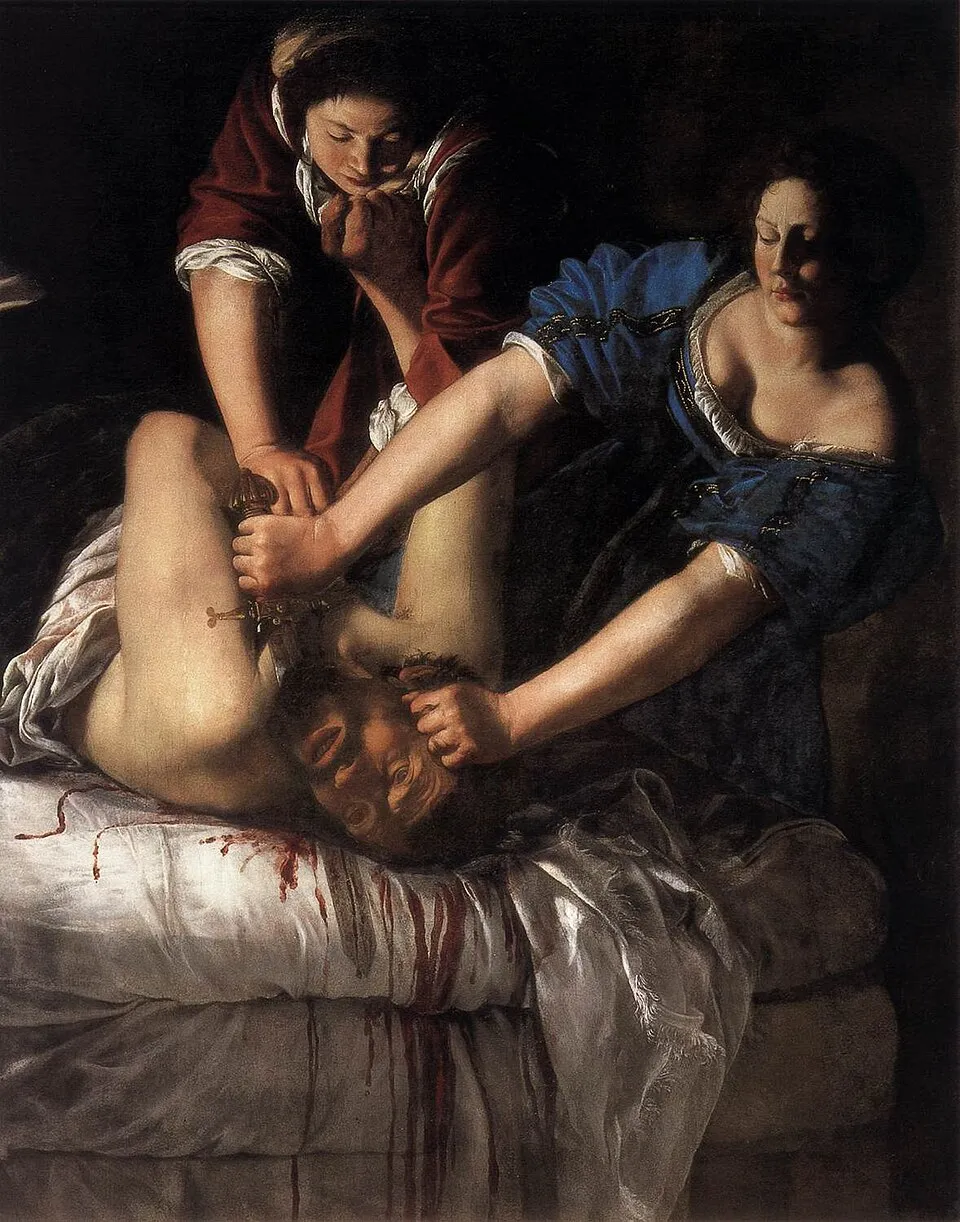
Artemisia Gentileschi, "Judith Slaying Holofernes" (c. 1612-1613). Oil on canvas, 158.8 x 125.5 cm. Capodimonte Museum, Naples. Image via Wikimedia Commons
Artists of color fared no better. The Harlem Renaissance, one of the most important American art movements, was largely excluded from the canon until the 1980s. Aaron Douglas, Jacob Lawrence, and Lois Mailou Jones were not in standard art history textbooks until the late 20th century. The 2020s have seen a correction. Museums have acquired works by Black artists at unprecedented rates. But the canon's structure has not fundamentally changed. The additions are appended to a narrative that was built without them.
Non-Western art is treated as "non-Western," a category that defines it by what it is not. African art, Asian art, Islamic art, and Indigenous art are studied in separate departments, exhibited in separate galleries, and taught in separate courses. The canon's center is Europe. Everything else is periphery. There is also an archive problem. Much of what was excluded is lost. Women artists' works were attributed to male relatives (Gentileschi to Caravaggio, Judith Leyster to Frans Hals). Non-Western artworks were looted or destroyed (the Benin Bronzes, the Baghdad libraries). The canon is not just a selection from what exists. It is a selection from what survived, and what survived was determined by the same power structures that created the canon. For more on how art reflects these structures, see our guide to art and society.
Challenging the Canon
Linda Nochlin asked "Why Have There Been No Great Women Artists?" in 1971. Her answer was that the question was wrong. There were great women artists, but the criteria for "greatness" were male. The canon's standards (genius, originality, mastery) were defined by men and excluded women by definition. The solution was not to add women to the canon but to change the criteria. Griselda Pollock pushed further in "Old Mistresses: Women, Art and Ideology" (1981), arguing that the canon was not just incomplete but actively harmful. It perpetuated the myth that women had not contributed to art history, which discouraged women artists and reinforced gender stereotypes.
Museums and universities are expanding the canon. The Met's 2018 "Like Life" exhibition included non-Western sculpture alongside European painting. The 2019 MoMA reopening rehung its permanent collection to include women artists, artists of color, and non-Western artists. The Baltimore Museum's 2020 initiative to only acquire works by women for one year was a radical and controversial attempt to correct the canon's gender imbalance. The FWMoA blog has a clear primer on the canon as an art term, and TheArtStory covers the broader feminist art movement that drove much of this challenge.
Here is where I part company with the expansionist position. Adding excluded artists to the canon does not change the canon's structure. The canon is still organized around the European narrative: Vasari's progress, Winckelmann's classical ideal, Hegel's Spirit. Adding Gentileschi to the Renaissance section does not challenge the assumption that the Renaissance is the center of art history. It confirms it. The real challenge is to decolonize the canon, to treat non-Western art not as "other" but as equal, and to tell art history as a global story, not a European one with appendices. For the theoretical framework behind this challenge, see our guide to feminist art theory.
The Canon in 2026
Art History 101 is still taught in most universities as a Western narrative: Egypt, Greece, Rome, Medieval, Renaissance, Baroque, Modernism. The push for "global art history" has led to some changes. Many programs now require at least one non-Western course. But the survey remains Western-centric. The museum is the canon's physical manifestation. What is on the walls is what matters. The 2019 MoMA rehang was a landmark. It integrated women artists and artists of color into the permanent collection galleries rather than segregating them in "diversity" shows. Most museums have not followed suit.
The art market is the canon's economic engine. When a painting by a canon artist sells for $100 million, it reinforces the canon. When a painting by an excluded artist sells for $10,000, it reinforces the exclusion. The market is conservative. It values what has already been valued, and it changes slowly. The question is whether the canon should be abolished or expanded. The abolitionist position, associated with critical race theory and decolonial theory, says the canon is irredeemably Eurocentric and should be replaced. The expansionist position says the canon should be broadened to include excluded artists. The practical answer is that the canon is being expanded, slowly and imperfectly, and the expansion is better than nothing. For where the current moment is heading, see our guide to contemporary art trends in 2026.
Final Thoughts
The art historical canon was created by Vasari in 1550, codified by Winckelmann in 1764, philosophized by Hegel in the 1820s, and institutionalized by universities in the 20th century. It is a European, male, and class-bound construction. It excluded women, people of color, and non-Western artists for 400 years. The exclusion is structural, built into the criteria of "greatness," "genius," and "progress." The canon is being challenged and expanded, but the structure has not fundamentally changed. The question is not whether to abolish the canon. It will not be abolished. The question is how to transform it, how to tell art history as a global story rather than a European one. For help thinking about what you encounter in museums, read our guide on how to look at art for beginners, and for the practice of writing about what you see, our guide to art criticism. The stories behind the works that did make it in are covered in our guide to famous paintings explained.
Go to a museum and look at the permanent collection. Count the women. Count the artists of color. Count the non-Western artists. The numbers will tell you whether the museum is serious about challenging the canon or just performing diversity. The count is a blunt instrument, but it is a start. The canon was built by counting some people in and leaving others out. The least we can do is count honestly.


