
Karl Marx posed a question that he could not answer. If art is a superstructure of an economic base, why does its power to move us endure long after the base has been transformed? Why do we still look toward Greek art as an ideal? Marx began to answer the question in his 1857 "Grundrisse" notebooks and then broke off. He never returned to it. The question, how can art be both a product of its economic conditions and something that transcends them, is the founding problem of Marxist art criticism. Every Marxist critic since Marx has tried to answer it.
Marxist art criticism holds that art is not autonomous. It is produced in specific material conditions, by specific classes, for specific audiences. The economic base (the mode of production, the class structure) shapes the cultural superstructure (art, literature, philosophy, religion). But the relationship is not mechanical. Art can reflect, critique, or transcend its economic conditions. The best Marxist criticism explains how. This guide covers the key thinkers in Marxist art criticism, from Marx's founding question, through Walter Benjamin's "aura," T.J. Clark's social art history, and John Berger's Marxism, to the question of who art is actually for in 2026.
Marx's Founding Question
In Marxist theory, the economic base, the forces and relations of production, determines the cultural superstructure, art, law, religion, philosophy. Art is part of the superstructure. It reflects the economic conditions of its production. This is the base-superstructure model, and it is the starting point for all Marxist art criticism.
The problem is immediate. If art merely reflects its economic base, then Greek art should only be meaningful in the context of ancient Greek slave society. But Greek art still moves us. Marx called this the "difficulty." Art from an early stage of development can still provide "aesthetic enjoyment" and serve as "a model and an unattainable norm." Marx began to answer this in the "Grundrisse" (1857). He argued that Greek art reflects the "social childhood" of humanity, and we respond to it the way adults respond to childhood, with nostalgia. But he broke off and never returned to the argument.
The significance of Marx's question is not just about Greek art. It is about all art. If art is determined by its economic base, then it should lose its power when the base changes. But it does not. A Rembrandt painted under Dutch capitalism still moves us under global capitalism. A Courbet painted under the French Second Republic still moves us under neoliberalism. Why? This is the question that every Marxist art critic has tried to answer. Culture Matters published a useful essay on John Berger's theory of art that traces the lineage from Marx through to the present.
Walter Benjamin and the Loss of Aura
Walter Benjamin (1892-1940) was a German-Jewish philosopher associated with the Frankfurt School. "The Work of Art in the Age of Mechanical Reproduction" (1935, revised 1936) is the most influential piece of Marxist art criticism ever written. The essay's central concept is "aura." Benjamin argued that every authentic artwork has an aura, a quality of authenticity, uniqueness, and distance that comes from its being a unique object in a specific place. A painting in a church has aura. A photograph of that painting does not. The aura is tied to ritual, the artwork's original function in religious cult, magic, or civic ceremony.
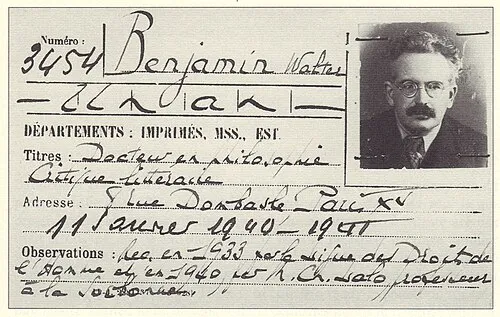
Walter Benjamin (1892-1940). Image via Wikimedia Commons
Mechanical reproduction destroys aura. The camera, the printing press, and the phonograph make it possible to reproduce an artwork infinitely, and when an artwork can be reproduced infinitely, its uniqueness disappears. "From a photographic plate, one can make any number of prints," Benjamin wrote. "To ask for the 'authentic' print makes no sense." The reproduction detaches the artwork from the domain of tradition and makes it available to the masses. A painting that once hung in a church and could only be seen by people who traveled to that church can now be seen by anyone with a book or a screen.
The political dimension is where Benjamin's Marxism becomes explicit. He argued that the destruction of aura was not a loss but a liberation. When art loses its ritual function, it gains a political function. "Instead of being founded on ritual, it is based on a different practice: politics." Fascism uses art to give expression to the masses without changing the property structure. It "aestheticizes politics." Communism responds by "politicizing art." The relevance of this argument, written in 1935, is that it predicted the internet. When every image is reproducible, when every painting is available as a JPEG, aura is gone. The question is whether this is liberation (art for everyone) or loss (art without authenticity). Benjamin's answer is that it is both, and the choice is political. You can read the full text of Benjamin's "Work of Art" essay to see how the argument works.
T.J. Clark and Social Art History
T.J. Clark (born 1943) is a British art historian, the leading Marxist art historian of his generation. "The Absolute Bourgeois: Artists and Politics in France, 1848-1851" (1973) and "Image of the People: Gustave Courbet and the Second French Republic, 1848-1851" (1973) established the method. "Farewell to an Idea" (1999) extended it to modernism as a whole.
Clark reads paintings as documents of social history. He does not ask "what does this painting mean?" He asks "what social conditions made this painting possible?" A painting is not just an aesthetic object. It is a record of the class relations, political conflicts, and economic structures of its time. The method is straightforward in description and difficult in practice. You have to know the social history, the political context, and the visual conventions, and you have to show how all three are present in the painting itself, not just around it.
Clark on Courbet is the classic demonstration. "The Stone Breakers" (1849) measures 165 x 257 cm. The painting was destroyed in World War II, but photographs survive. Clark showed that the painting was not just a depiction of two laborers but a political intervention. Painted in the year after the 1848 revolution, at a time when the French government was commissioning art to promote national unity, Courbet chose to paint rural poverty. The painting's rough surface, its refusal of academic finish, its monumental scale (the figures are life-size), all of these were determined by the political context. Courbet was not just painting laborers. He was declaring that laborers were worthy of monumental art. The scale is the argument. A small painting of a laborer is a genre scene. A life-size painting of a laborer is a history painting, and history painting was the highest rank in the academic hierarchy. Courbet was using the hierarchy against itself.
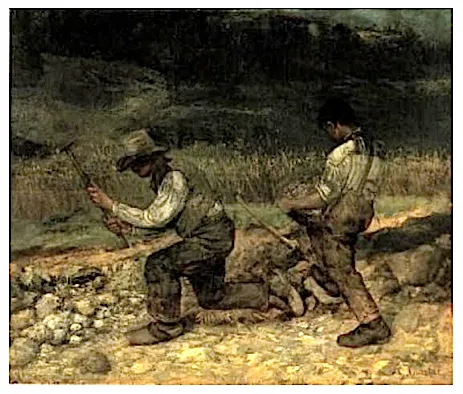
Gustave Courbet, "The Stone Breakers" (1849). Oil on canvas, 165 x 257 cm. Destroyed in World War II. Image via Wikimedia Commons
Clark on modernism, in "Farewell to an Idea" (1999), argued that modernism was a response to capitalism, not a formal progression (as Greenberg had it) but a series of attempts to create art that could resist or critique the capitalist society in which it was produced. Each attempt failed, but the failures are what make modernism interesting. Modernism is "the stubborn resistance of the aesthetic to the social conditions of its existence." This is the answer to Marx's question. Art endures because it resists. It does not escape its economic conditions, but it does not simply reflect them either. It pushes back. For the methodological contrast with formalist criticism, read our guide on formalism vs contextualism.
John Berger and the Marxism of Ways of Seeing
John Berger (1926-2017) was a British art critic, novelist, and painter. "Ways of Seeing" (1972), the BBC series and the book, is the most widely read work of Marxist art criticism ever produced. It sold over a million copies and is still required reading in art schools. Most writers who celebrate Berger avoid his Marxism. As Berger himself wrote about the art historian Frederick Antal: "the importance of his Marxism tends to be underestimated. In a curious way this is probably done out of respect for him: as though to say 'He was brilliant despite that, so let's charitably forget it.' Yet, in fact, to do this is to deny all that Antal was." The same is true of Berger. "Ways of Seeing" is a Marxist text. It argues that oil painting was the art form of capitalism, that the female nude was a product of patriarchal property relations, and that the camera destroyed the aura of the unique artwork (directly from Benjamin).

John Berger (1926-2017). Image via Wikimedia Commons
The key argument is direct. "Oil painting was the art of the capitalist class." Berger argued that oil painting celebrated possessions: property, land, furniture, food, women. The still life, the landscape, the nude, all were ways of asserting ownership. "The possession of works of art is just one more consumer good, multiplying its market value." The first episode of "Ways of Seeing" argued that the camera changed the meaning of paintings, that a reproduced image has a different meaning from the original. This is Benjamin's aura argument translated for a BBC audience.
Berger's most important influence, as revealed in "Landscapes" (2016), was not Benjamin but Max Raphael (1889-1952), a German-Jewish art historian whose work is largely forgotten. Raphael argued that art does not merely reflect its social context. It transforms it. "The function of the work of art is to lead us from the work to the process of creation which it contains." This is the answer to Marx's question. Art endures because it contains the trace of human creative labor, and that trace transcends its economic base. A painting is not just a commodity. It is a record of a human being making something, and that record survives the economic conditions that produced it. For the broader practice of writing about art, see our guide on art criticism.
Who Is Art Actually For?
The question of who art is for is not abstract. It is economic. Museums are free in London (since 2001) and cheap in most European cities. In the US, the Met charges $30, the MoMA charges $30, the Guggenheim charges $30. Free museums democratize access. Expensive museums restrict it. The admission price is a class barrier, and it is invisible in most art criticism, which treats museum attendance as if it were equally available to everyone.
The art market makes the question sharper. In 2025, the global art market was valued at approximately $65 billion. The top 1% of artists by sales volume account for roughly 50% of total sales. The art market is a wealth concentration mechanism. It takes public culture (art) and converts it into private asset (investment). This is the Marxist critique in its purest form. Art under capitalism is not a public good. It is a commodity, and the commodity form determines who can own it, who can see it, and who can make it.
Art education is the other barrier. In the US, an MFA at a top program costs $60,000 to $100,000 per year. The result is that art is increasingly made by people who can afford to make it, the upper middle class. This is a structural constraint on who becomes an artist, and it is invisible in most art criticism, which treats artistic production as if it were a matter of talent rather than economics. The answer that Marxist art criticism gives is that art is "for" the class that controls its production and consumption. Under capitalism, that is the bourgeoisie. The question is whether art can be for everyone, whether it can escape its class conditions and speak across class lines. Marx thought it could (Greek art). Benjamin thought it could (mechanical reproduction). Clark thought it could (Courbet). Berger thought it could (Ways of Seeing). The answer is: sometimes, under certain conditions, for certain works. But never automatically, and never without struggle. For more on how art encodes social structures, read our guide on art and society.
Final Thoughts
Marxist art criticism asks who art is for and answers: the class that controls its production. Marx posed the question of why art endures beyond its economic base. Benjamin answered that mechanical reproduction destroys aura and democratizes art. Clark answered that paintings are documents of class struggle. Berger answered that oil painting is the art of capitalism and that the camera is its undoing. The thread connecting all four is the belief that art is not autonomous. It is embedded in material conditions, and those conditions determine who makes it, who sees it, and who it is for.
My view is that Marxist art criticism is the most useful framework for understanding who art is for and why it matters, not because Marxism is right about everything but because it asks the question that other frameworks avoid: who pays, who benefits, who is excluded. The formalist tradition asks what a painting looks like. The iconographic tradition asks what a painting means. The Marxist tradition asks who the painting is for. All three questions are worth asking. But only the third one forces you to look at the museum's donor wall and the admission price and the art school tuition. For the long view of how we got here, the art movements timeline puts the whole story in sequence. For help training your eye, read our guide on how to look at art, and for a different angle on who controls meaning, see our piece on the death of the author. The stories behind specific works that stage these dynamics are in our guide to famous paintings.
Next time you visit a museum, ask: who paid for this building? Who donated these paintings? What did they do for a living? The answers will tell you more about the collection than any wall label.


