
In 1748, archaeologists began excavating Pompeii. The buried Roman city emerged with its frescoes, mosaics, and household objects largely intact, and the effect on European taste was immediate and dramatic. For decades, the Rococo style had dominated European interiors with its pastel colors, asymmetrical curves, and decorative excess. Pompeii offered an alternative: straight lines, clear geometry, and the moral seriousness of Roman virtue.
Neoclassicism emerged in the 1760s as a deliberate rejection of Rococo frivolity. It was fueled by the Grand Tour, the practice of wealthy young Europeans traveling to Italy to study antiquity, by Enlightenment philosophy's emphasis on reason and civic virtue, and by the excavations at Pompeii and Herculaneum. By the 1780s, it was the dominant style in European painting, sculpture, and architecture.
This guide covers the origins, the key artists (David and Ingres above all), the relationship between Neoclassicism and the French Revolution, and why the style's moral seriousness still commands respect even as its politics feel complicated.
The Origins: Pompeii, the Grand Tour, and Winckelmann
The excavations at Herculaneum began in 1738 and at Pompeii in 1748, and their impact on European taste cannot be overstated. Buried under volcanic ash since 79 AD, both sites preserved Roman domestic life with an intimacy that no surviving architecture could match. Frescoes appeared on walls. Mosaics covered floors. Bronze utensils sat where their owners had left them. The effect on artists and collectors was electric.
The German art historian Johann Joachim Winckelmann provided the intellectual framework. His 1755 essay "Thoughts on the Imitation of Greek Works in Painting and Sculpture" argued that Greek art achieved "noble simplicity and quiet grandeur." Winckelmann believed that the highest purpose of art was to express moral virtue through idealized form, and his writing shaped European taste for the next century. He was also, it must be said, working from Roman copies of Greek originals, and he had no idea that Greek sculpture was originally painted in bright colors. The white marble he admired was a historical accident.
The Grand Tour completed the picture. Young British and French aristocrats traveled to Rome, Naples, and Florence, returning with classical casts, prints, and a taste for antiquity. James Stuart and Nicholas Revett's "Antiquities of Athens" (1762) brought measured drawings of Greek architecture to a Northern European audience for the first time. The shift from Rococo to Neoclassical in architectural taste followed quickly. As Christie's overview of Neoclassicism notes, the style spread through pattern books, engravings, and the patronage of collectors who had seen Roman ruins firsthand.
Jacques-Louis David and the Painting of Civic Virtue
Jacques-Louis David (1748 to 1825) is the painter who turned Neoclassicism from a style into a weapon. He trained in Rome from 1775 to 1780, where he absorbed classical antiquity and the works of Nicolas Poussin, the 17th-century French painter whose severe compositions and moral seriousness had already pointed toward a classical revival.
"The Oath of the Horatii" (1784) is the painting that announced Neoclassicism as a dominant force. David painted it in Rome and exhibited it at the Salon of 1785. The composition is 329.8 by 424.8 centimeters, and it shows three brothers swearing an oath to their father, swords raised. The women collapse in grief on the right. The message is civic duty over personal feeling, and it landed with extraordinary force. The painting was commissioned by Louis XVI's administration, but contemporaries read it as a revolutionary statement about loyalty to the state rather than the crown. The irony is built into the canvas.
"The Death of Socrates" (1787) pushed the argument further. Socrates reaches for the cup of hemlock, calm and philosophical, surrounded by agitated disciples. The message is principle over self-preservation, and the painting is 129.5 by 196.2 centimeters. It is now at the Metropolitan Museum of Art in New York. As TheArtStory's analysis of Neoclassicism explains, David's classical subjects were never purely academic exercises. They were arguments about what a citizen owes to the state and to principle.
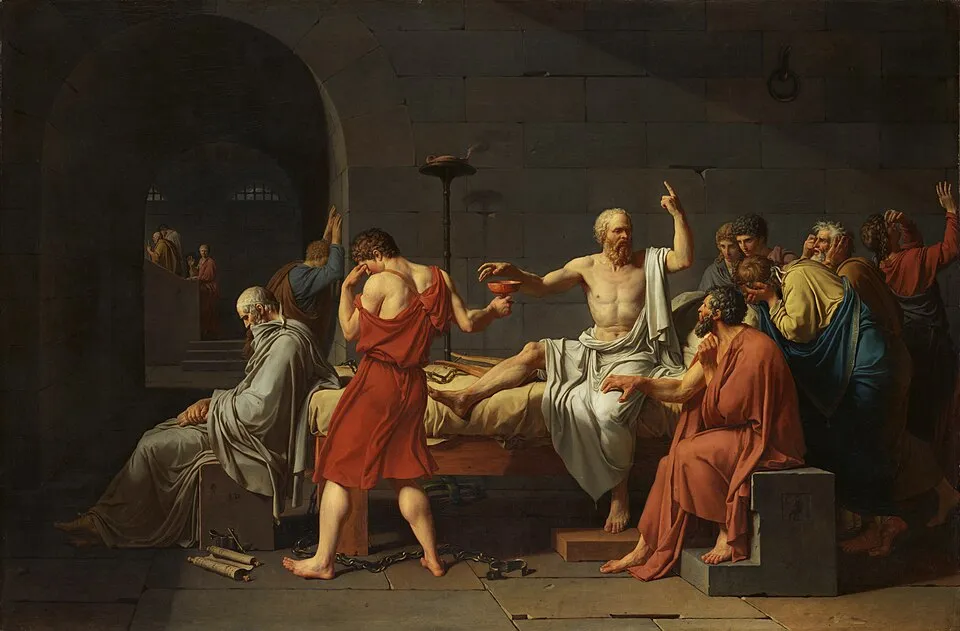
Jacques-Louis David, "The Death of Socrates" (1787). Oil on canvas, 129.5 x 196.2 cm. Metropolitan Museum of Art, New York. Image: Public domain, via Wikimedia Commons
David and the Revolution
David did not just paint revolution. He participated in it. He was elected to the National Convention in 1792 and voted for the execution of Louis XVI. He organized revolutionary festivals, designed propaganda, and used his position to control the French art world. His politics were not separate from his painting. They were the same project.
"The Death of Marat" (1793) is the painting that captures this fusion most directly. Jean-Paul Marat, the radical journalist, was murdered in his bathtub by Charlotte Corday on July 13, 1793. David painted him within months, producing what is essentially a secular martyr painting. Marat lies dead in the tub, holding a letter, his head slumped. The background is dark and empty. David painted the body in a pose that echoes Christ's deposition from the cross. The painting is 165 by 128 centimeters and is now at the Royal Museums of Fine Arts of Belgium in Brussels.
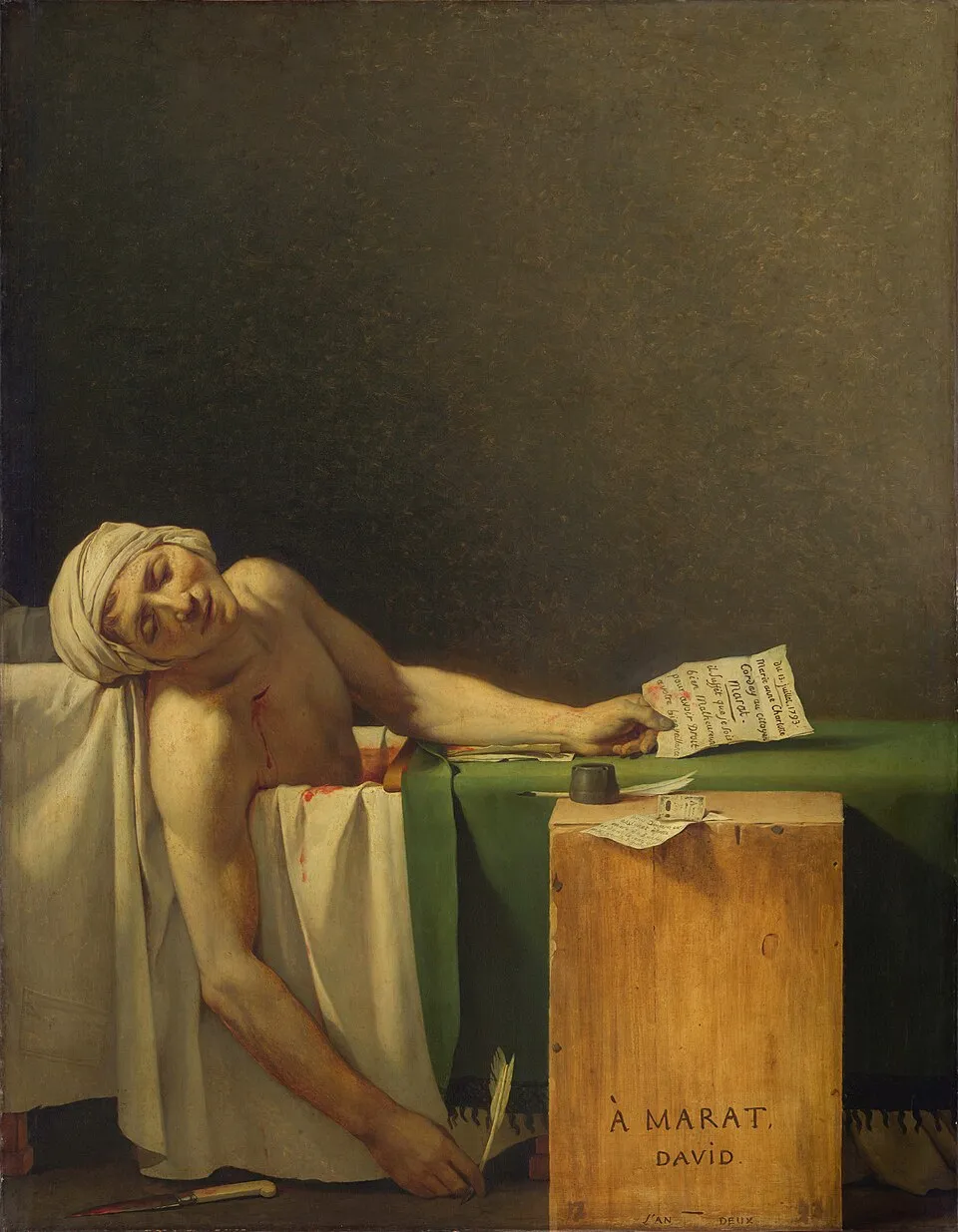
Jacques-Louis David, "The Death of Marat" (1793). Oil on canvas, 165 x 128 cm. Royal Museums of Fine Arts of Belgium, Brussels. Image: Public domain, via Wikimedia Commons
The Louvre's 2025 to 2026 retrospective, mounted to mark the bicentennial of David's death in Brussels in 1825, assembled three versions of "The Death of Marat" in a single room. The exhibition, curated by Sebastien Allard and Come Fabre, gathered 100 works and was the first major David survey since 1989. As The Art Newspaper's review noted, the curators deliberately avoided the term "Neoclassicism" altogether, arguing that it carries a formalist connotation that flattens David's political ambition. Their reading positions him as both a realist and an idealist, an artist who looked to the past only to give society a future.
David's revolutionary career ended with Robespierre's fall in 1794. He was imprisoned, narrowly escaped execution, and then reinvented himself as Napoleon's court painter. "The Coronation of Napoleon" (1805 to 1807) is 6 by 9 meters, one of the largest paintings in the Louvre. It represents the shift from Roman republican virtue to imperial propaganda, and it is a shift that reveals the central contradiction of David's career. His revolutionary paintings are more historically significant than his Napoleonic ones because they genuinely risked something. The Coronation is magnificent, but it is also safe. For more on how governments have used visual culture for political ends, see our guide to art and politics.
Ingres and the Conservative Line
Jean-Auguste-Dominique Ingres (1780 to 1867) was David's student and successor, but with a different emphasis. Where David painted civic drama, Ingres painted perfect surfaces. Where David used Neoclassicism as a political tool, Ingres used it as an aesthetic discipline. The difference matters.
"Grande Odalisque" (1814) is the painting where this difference becomes visible. Commissioned by Caroline Murat, Napoleon's sister, the painting is technically Neoclassical in its smooth surface and precise line. But the subject, a reclining nude in a Turkish harem, is Orientalist rather than classical. The elongated back has five vertebrae too many, as critics later noted. Ingres prioritized line over anatomy, and the result is a body that exists outside both classical proportion and natural observation. The painting is 91 by 162 centimeters and is now at the Louvre.

Jean-Auguste-Dominique Ingres, "Grande Odalisque" (1814). Oil on canvas, 91 x 162 cm. Louvre, Paris. Image: Public domain, via Wikimedia Commons
The tension between Ingres and Eugene Delacroix defined 19th-century French painting. Ingres stood for line, restraint, and classical tradition. Delacroix stood for color, movement, and Romantic passion. The debate between them was not just about technique. It was about what painting is for. Ingres believed painting should discipline the eye. Delacroix believed painting should stir the blood. The argument never resolved, and it produced some of the most extraordinary painting in European history on both sides. For more on the other side of this debate, read our post on Romanticism: Emotion, Nature, and the Revolt Against Reason.
Ingres's late portraits, including "Madame Moitessier" (1851) and "The Turkish Bath" (1862), perfected the smooth surface he had been working toward his entire career. As Britannica's biography of Ingres notes, his influence on academic painting extended well into the 20th century. Degas admired him. Picasso studied him. The discipline of drawing that Ingres represented became the foundation of academic art training, and it remains so today.
Neoclassicism Beyond France
Neoclassicism was not a French phenomenon alone. In sculpture, Antonio Canova (1757 to 1822) produced the movement's greatest achievements. "Psyche Revived by Cupid's Kiss" (1793) is marble so smooth it looks like flesh. Canova's surfaces achieve a softness that seems impossible in stone, and his work became the standard against which all subsequent Neoclassical sculpture was measured. The Pinacoteca di Brera in Milan opened a Canova exhibition in May 2025 titled "Beauty and the Ideal," featuring 12 restored plaster busts and the marble Vestal, on view through May 2027.
Bertel Thorvaldsen (1770 to 1844) was Canova's northern counterpart. His "Jason with the Golden Fleece" (1803) was so classically pure that Thorvaldsen was called "the sculptor of the Greeks." The comparison with Canova is instructive. Canova's marble is warm and alive. Thorvaldsen's is cooler, more austere, more literally classical. Both were responding to the same Winckelmannian ideal, but they produced very different bodies.
Neoclassical architecture had the widest reach of all. The British Museum, the US Capitol, and Thomas Jefferson's Monticello all belong to the style. Neoclassicism became the default for government buildings because it communicated permanence, order, and democratic virtue. The connection to Renaissance art is direct: both movements looked to classical antiquity as a model for contemporary practice. For the broader context of how this fits into the history of art movements, see our art movements timeline.
What Neoclassicism Got Wrong
Neoclassicism's admiration for Greek and Roman art was based on a misunderstanding. Greek sculpture was originally painted in bright colors, not white. The "noble simplicity" Winckelmann admired was a projection. He was looking at Roman copies of Greek originals that had lost their paint over centuries, and he read that absence as a virtue. The polychromy of Greek sculpture is now well established by archaeology, but it took over 200 years to correct the error, and the white marble aesthetic that Neoclassicism established still shapes how we imagine the classical world.
The political irony is equally sharp. A style born from admiration for Roman republicanism became the preferred style of empires and monarchies. Napoleon's Neoclassical architecture was imperial, not republican. The US Capitol, built in Neoclassical style, housed a government that practiced slavery. The style's association with democratic virtue was always more aspirational than actual.
The exclusion of women is another problem. Neoclassicism's heroes are almost all male. Women appear as allegorical figures (Liberty, Justice) or as grieving wives and mothers, rarely as agents. This is not unique to Neoclassicism, but the style's moral seriousness makes the omission more glaring. A movement that claimed to represent universal civic virtue could not see half the human population as participants in it.
For a deeper framework on analyzing paintings like these, see our guide on how to read a painting. And for a quick overview of where Neoclassicism sits in the bigger picture, our art history cheat sheet covers the full timeline.
Final Thoughts
Neoclassicism lasted roughly 80 years, from the 1760s to the 1840s, and produced some of the most physically impressive paintings and sculptures in Western art. Its belief that art should teach moral lessons through classical examples now feels naive, but its formal discipline, the clear compositions, the precise drawing, the controlled palette, remains the foundation of academic art training.
The Louvre's 2025 to 2026 David retrospective made a compelling case for separating David from the Neoclassical label entirely. The curator Sebastien Allard argued that David's classical choices were not formalist exercises but political acts, a way of imposing order on the chaos of a society reinventing itself. That reading does not invalidate the label, but it does complicate it. David was not painting ancient Rome. He was painting 1789 through ancient Rome, and the difference is the difference between imitation and argument.
If you are in Paris, compare David's "Oath of the Horatii" at the Louvre with Ingres's "Grande Odalisque" in the same building. The two paintings are 30 years apart and represent the beginning and end of Neoclassicism's dominance. The Oath is civic virtue rendered as geometry. The Odalisque is geometry rendered as desire. Between them, you can see an entire style born, mature, and transform into something its founder would not have recognized.


