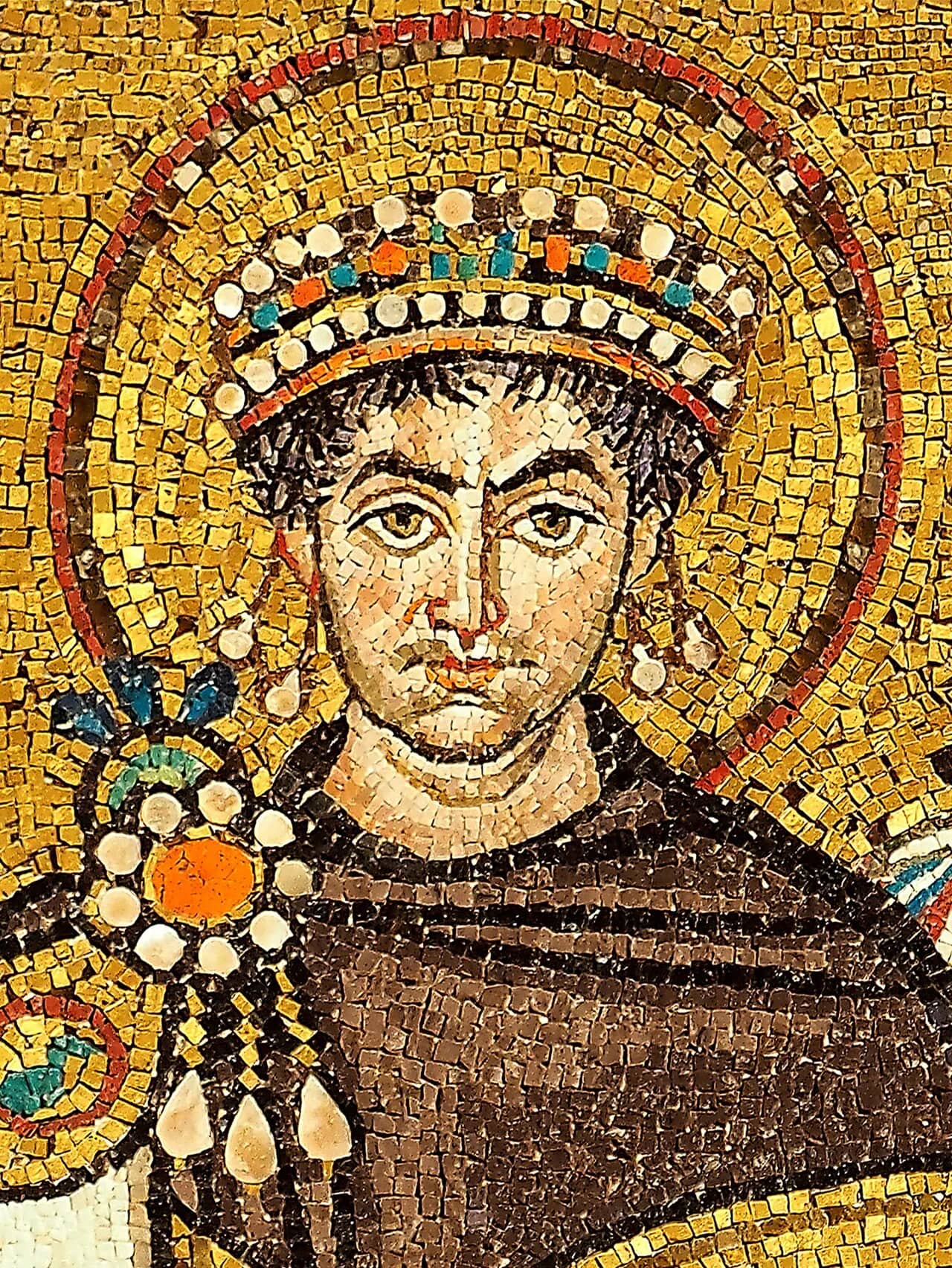
The mosaics at the Basilica of San Vitale in Ravenna, Italy, completed around 547 CE, are among the most technically accomplished and visually overwhelming works of art that survive from antiquity. Emperor Justinian and his court face the viewer in a procession across the apse wall, their figures flattened against a field of pure gold tessera, their eyes wide and direct in a gaze that has not changed in fifteen centuries. The gold glass catches and redistributes the light in the basilica differently throughout the day, making the images literally flicker. No reproduction adequately captures this quality. It requires presence.
Mosaic achieves effects that no other medium can replicate, because it is made of light-catching surfaces rather than pigment that absorbs or reflects light. Each small piece of glass, stone, or ceramic (a tessera) reflects independently, creating an image that changes with viewing angle and lighting conditions. The surfaces that Byzantine and Roman mosaicists created were not just pictures. They were environments of luminous material.
This guide traces mosaic's history from the ancient world through the Byzantine golden age to Gaudi's trencadis and contemporary practice, explains the materials and methods that define the craft, and offers a practical starting point for making mosaic work yourself.
A Brief History of Mosaic: From Greece to Ravenna to Barcelona
Mosaic has a longer continuous history than almost any other art form in the Western tradition. The earliest known examples, using pebbles set in bitumen, come from Mesopotamia around 3000 BCE. Greek floors from the 4th and 3rd centuries BCE, like those excavated at Pella in Macedonia, show extraordinary technical skill in pebble mosaic, creating hunting and mythological scenes of great complexity in natural stone.
The Romans adopted mosaic from the Greeks and elevated it into an industrial-scale art form. Roman floor mosaics (opus tessellatum) covered public baths, villas, and triumphal arches throughout the empire. The mosaic workshops of Rome could produce standardized decorative borders and figurative panels for export and installation across a vast geographic area, creating a visual consistency that united Roman taste from Britain to Syria. The most celebrated surviving Roman mosaic, the "Alexander Mosaic" from the House of the Faun at Pompeii (c. 100 BCE), is so finely worked in such small tesserae that it is often initially mistaken for a painting.
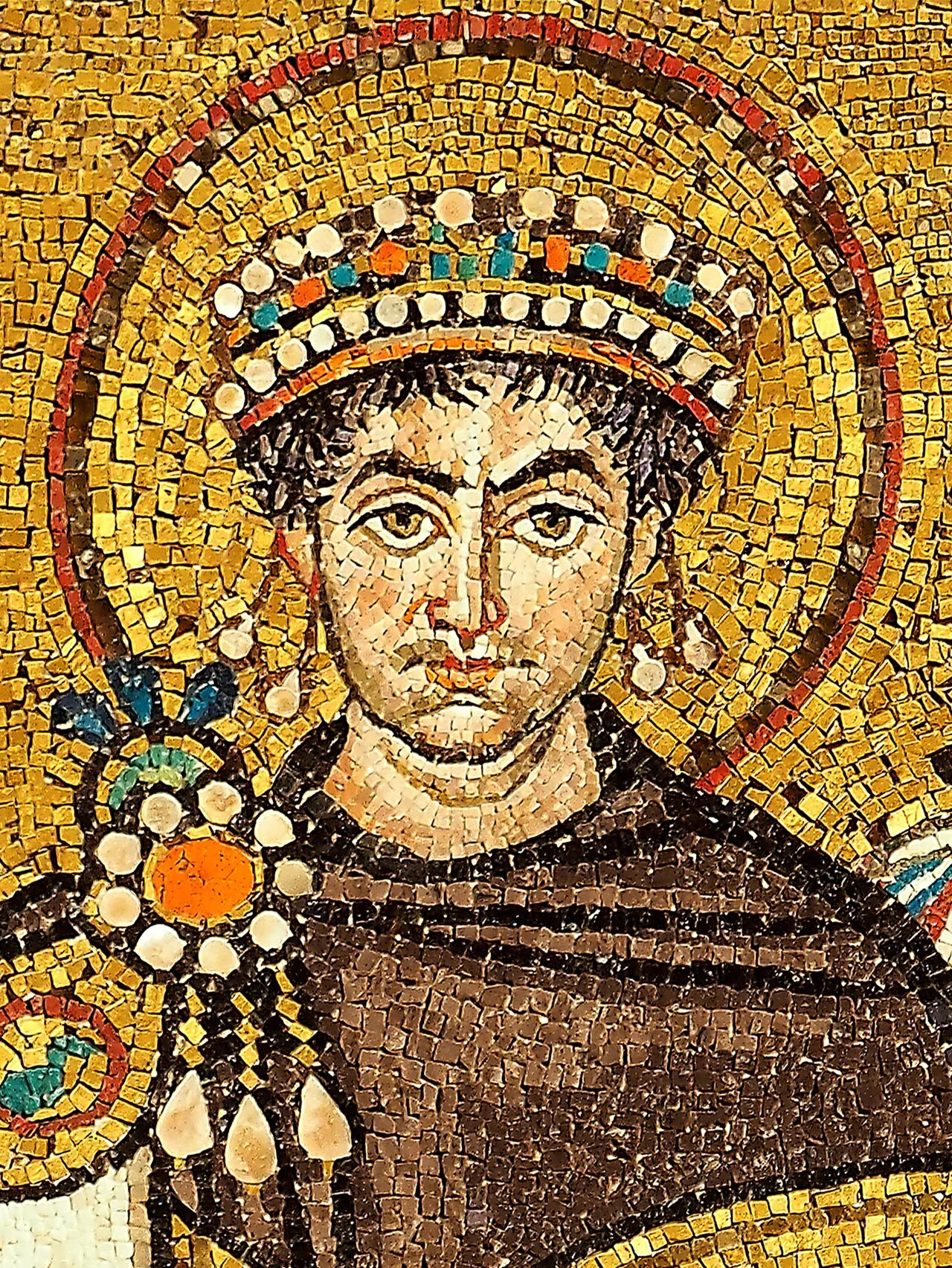
Mosaic of Emperor Justinian I, Basilica of San Vitale, Ravenna (c. 547 CE). One of the finest surviving Byzantine mosaics, this work uses gold glass tesserae set at varying angles to create the flickering golden light that defines the Byzantine aesthetic. Image: Public domain, via Wikimedia Commons
Byzantine mosaic represented a conscious development away from the Roman floor-based tradition. Moving mosaics onto walls and ceilings allowed gold-glass tesserae to catch light from windows and lamps rather than being viewed from above. Byzantine craftspeople used smalti, a particular type of opaque colored glass that holds pigment more evenly than natural stone, and gold tesserae made from glass with gold leaf fused inside. By tilting individual tesserae at varying angles relative to the surface, they created the characteristic Byzantine shimmer: walls that seem to breathe with reflected light.
The golden age of Byzantine mosaic, spanning from the 6th to the 14th century and ranging geographically from Ravenna to Constantinople to Sicily, produced the most technically sophisticated mosaic work in history. Hagia Sophia in Istanbul, the Palatine Chapel in Palermo, and the churches of Ravenna represent different moments and regional traditions within this tradition, all united by the use of gold-glass tesserae and formal, hieratic figure styles. Ravenna remains the world capital of mosaic. The city hosts the Biennale di Mosaico Contemporaneo, which held its 9th edition in 2025, featuring an international conference on mosaic and architecture that examined the evolution of the medium within public space from Gaudi's trencadis to contemporary site-specific works.
Gaudi and the Trencadis Tradition
Antoni Gaudi (1852 to 1926) transformed mosaic from a flat pictorial medium into a three-dimensional sculptural one through his development of trencadis, a technique of covering curved organic surfaces with fragments of broken ceramic tile. Applied to the chimneys and rooflines of the Casa Batllo and Casa Mila in Barcelona, the park benches and viaducts of Park Guell, and the exterior surfaces of the Sagrada Familia, trencadis gave Gaudi's architecture a distinctive skin that integrates color, texture, and light across non-planar surfaces.
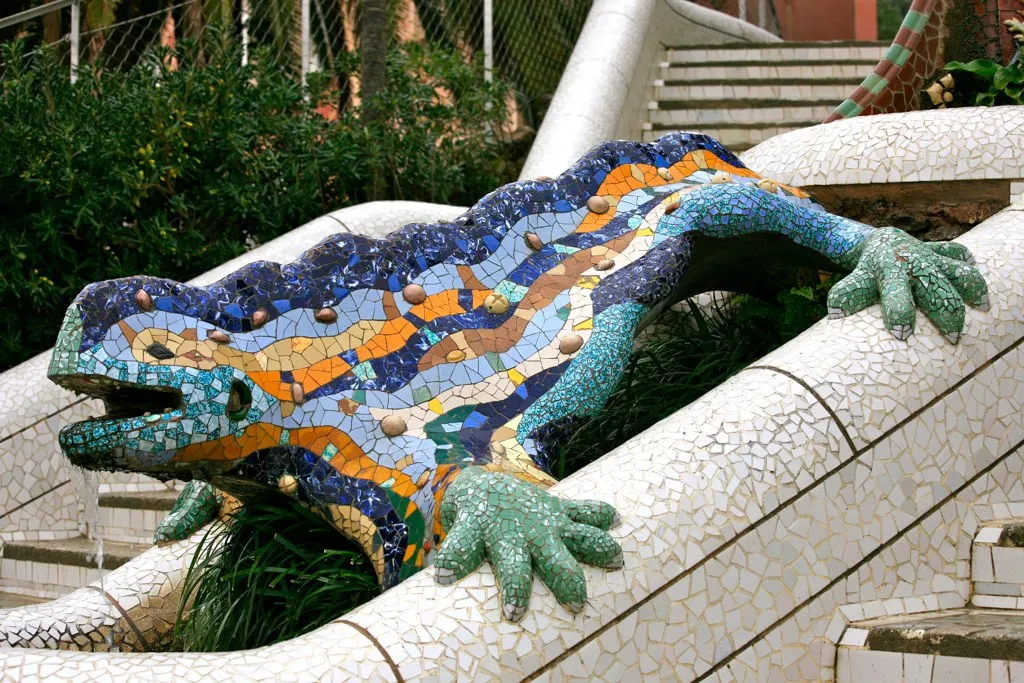
The salamander fountain at Park Guell, Barcelona (1900 to 1914), Antoni Gaudi. Covered in trencadis mosaic of broken ceramic tile, this iconic image demonstrates Gaudi's ability to use fragmentary mosaic to cover three-dimensional organic forms. The technique creates surfaces that change color and texture continuously as the viewer moves. Image: Public domain, via Wikimedia Commons
Trencadis differs from traditional Byzantine mosaic in that it uses salvaged or broken material rather than purpose-manufactured tesserae, and it covers continuous curved surfaces that conventional flat mosaic cannot accommodate. The deliberate use of imperfect, broken pieces creates a surface that looks both improvised and exquisitely controlled. Gaudi's design assistant Josep Maria Jujol was responsible for much of the specific trencadis design in Park Guell, developing color sequences and abstract arrangements within the overall compositional framework Gaudi established. The 2025 Ravenna Biennale conference specifically examined Gaudi's trencadis as a pivotal moment in the evolution of mosaic from flat surface to architectural skin, with scholar Chiara Curti presenting research on the technique's relationship to contemporary architectural practice.
Materials and Tesserae Types
Tesserae, the individual pieces that make up a mosaic, vary enormously in material and properties. Understanding the differences shapes both the visual outcome and the technical process.
Smalti: The traditional Byzantine material, smalti are opaque glass rods or slabs cut into irregular pieces. They have the richest, deepest color of any mosaic material and the most responsive surface for light. Professional smalti are still made in Venice and Rome using methods unchanged since the Byzantine period. They are expensive and require cutting tools (nippers or a hammer and hardie) to prepare, but produce the most luminous finished surfaces.
Vitreous glass tile: Machine-manufactured square glass tiles, sold in sheets, are the most accessible mosaic material for beginners. They are consistent in size and thickness, come in a wide color range, and can be cut cleanly with tile nippers. Less expensive than smalti and with a more uniform appearance, they are the practical choice for large-scale work.
Ceramic tile: Unglazed ceramic (like terracotta or quarry tile) and glazed ceramic give different results. Unglazed ceramic has a matte, earthy quality well-suited to naturalistic work. Glazed ceramic adds shine but can look slick if overused. Ceramic is the most forgiving material to cut and is appropriate for beginners.
Natural stone: Marble, granite, and river pebbles have been used in mosaic since antiquity. Stone has a natural warmth and variation that manufactured materials cannot replicate, but it is harder to cut consistently and more expensive than glass or ceramic alternatives.
How Mosaics Are Designed and Set
Traditional mosaic is set in one of two ways: direct setting, in which tesserae are pressed directly into fresh mortar or adhesive on the final surface; and indirect (reverse) setting, in which tesserae are assembled face-down on a temporary paper backing, then transferred in sections to the permanent surface. The indirect method is used for complex figurative work where precise positioning matters, since the artist can refine the arrangement before final installation.
The design principle of "andamento" governs the direction in which rows of tesserae run across the surface. Following the forms of figures and shapes with the direction of the tesserae (as Byzantine mosaicists did) reinforces the three-dimensional reading of the image. Competing andamento directions in different areas create visual tension and energy.
Grout, applied after the tesserae are set and adhesive is dry, fills the gaps between pieces and unifies the surface. Grout color significantly affects the finished image. Dark grout makes individual tesserae read as separate units and emphasizes the mosaic's fragmentary nature. Light grout creates a more unified surface that reads more like a painting from a distance.
Contemporary Mosaic Practice
Mosaic is not a dead art. The Ravenna Academy of Fine Arts, which became a state institution in January 2023, offers the only dedicated mosaic degree programs in the Italian higher arts system, with a library of approximately 8,000 volumes. The GAeM Award for Young Artists and Mosaic, running its 2025 edition in collaboration with Orsoni Venezia 1888 and the Fondazione Cingoli, selects works by artists under 35 that push mosaic beyond its historical boundaries through new conceptual and formal approaches. The winning works enter the Collection of Contemporary Mosaics at the MAR, Museo d'Arte della citta di Ravenna, creating a living archive of contemporary mosaic practice.
Contemporary mosaic also intersects with sustainability in ways that ancient practitioners could not have anticipated. A 2025 study in the International Journal of All Research Writings examined how ceramic mosaic practices now align with global Sustainable Development Goals through the reuse of ceramic waste, connecting Gaudi's trencadis principle of recycling broken material to contemporary environmental concerns.
Getting Started With Mosaic
For a first project, choose a small, flat surface: a wooden board, a terracotta pot, or a mirror frame. Use vitreous glass tile or broken ceramic plate (the technique Gaudi used for trencadis). Cut tiles with wheeled glass nippers; ceramic can often be broken by hand pressure in specific directions. Use PVA adhesive or pre-mixed tile adhesive to set the pieces, and grout when the adhesive is dry.
Design a simple geometric pattern or an abstracted image rather than complex figurative work for a first attempt. Geometric mosaic forgives irregularities in cutting more easily than figurative work, and it teaches the fundamental skills of consistent spacing, andamento direction, and color arrangement that all mosaic work requires.
Final Thoughts
Mosaic's fifteen-hundred-year continuous history as a major art form across the Mediterranean world testifies to something irreplaceable in what fragmented light-catching material can do on a wall or a floor. Its revival in the 20th century, through Gaudi's organic sculptural applications and the contemporary craft movement, demonstrates that the medium's possibilities have not been exhausted. The Ravenna Biennale and the GAeM Award prove that new generations of artists are still finding ways to push mosaic into territory its ancient practitioners would not recognize.
The connection between mosaic and other fragmented-material techniques is direct. The principles governing how tesserae create a unified image from small separate pieces are not unlike those governing collage, and both share the fundamental challenge of creating visual unity from diversity. For more on how artists across history have used ornament and pattern as serious visual language, our guide to the evolution of art styles places Byzantine and decorative traditions within a broader historical context. If you are interested in how other ancient techniques survive in contemporary practice, our guide to fresco painting covers another medium with roots in antiquity that remains active today.


