
Stand in front of Botticelli's "Primavera" in the Uffizi Gallery in Florence and you will see something peculiar happen. Tourists walk in, glance at the painting, take a photo, and move on. They spent maybe thirty seconds. The painting is more than three metres wide and contains nine figures from classical mythology arranged in a grove of orange trees, but without the visual vocabulary to read it, "Primavera" is just a pretty picture with some naked people in a garden.
Here is what you miss in those thirty seconds. Venus stands at the centre, presiding over a Neoplatonic allegory about love and civic virtue. Mercury on the right pushes clouds away with his caduceus, clearing the air for contemplation. The Three Graces dance in translucent drapery, representing the circulation of divine beauty through the world. On the far right, the wind god Zephyr seizes the nymph Chloris, and from her mouth spill flowers that transform her into Flora, the goddess of spring. The entire painting is a philosophical argument about how civilization grows from the union of natural force and divine love. That argument is written in a visual language called iconography, and it was completely legible to its first audience in 1480s Florence.
Iconography is the study of the conventional visual signs used to identify figures and communicate meaning in art. The word comes from the Greek "eikon" (image) and "graphia" (writing). It is, literally, the written language of images. Once you learn even a fraction of this vocabulary, entire centuries of art that looked like decorative arrangements of figures suddenly become readable as complex theological and philosophical arguments. This guide will walk you through the major iconographic systems, from Christian saints to classical gods to Buddhist mudras, and show you how to start reading art the way its original audiences did.
What Is Iconography and Why It Matters
Iconography is not symbolism in the loose sense that people use the word today. It is a formal, codified system of visual identification. The key mechanism is the attribute: a specific object, animal, color, or contextual element that identifies a figure. Saint Peter always carries keys. Saint Catherine of Alexandria always has a wheel. Venus is always associated with doves or roses. These are not creative choices by individual artists. They are conventions as fixed as written characters in a language.
Without knowing these attributes, you can still appreciate a painting aesthetically. You can respond to its color, its composition, its emotional tone. But you cannot read what it says. And for centuries, that is exactly what art was doing: saying something specific, to audiences who understood the vocabulary. The Getty Iconography Authority maintains a comprehensive database of these visual conventions, and the Iconclass system provides a numerical classification for iconographic subjects used by museums worldwide. Both resources are worth bookmarking if you want to look up attributes before a museum visit.
The distinction between iconography and the broader field of symbolism matters. Symbolism can be personal, ambiguous, or culturally specific. Iconography is conventional and shared. When you see a lily next to the Virgin Mary, it always means purity. When you see a skull in a seventeenth-century Dutch painting, it always refers to mortality. Our guide to reading symbolism in art covers the more open-ended symbolic practices that operate outside formal iconographic systems.
Christian Iconography: How to Read the Saints
In medieval and Renaissance Europe, most people could not read. Churches were the primary visual environment, and the paintings, sculptures, and stained glass windows inside them functioned as books for the illiterate. The identification of saints through attributes was not decorative. It was functional. A worshipper entering a church needed to know which saint was depicted in a given altarpiece or fresco in order to direct their prayers correctly. The system was largely codified by the thirteenth century, drawing on the "Golden Legend" (c. 1260) by Jacobus de Voragine, a compilation of saints' lives and their visual markers that became one of the most widely read books of the Middle Ages.
The most common attributes are instruments of martyrdom, and they are nothing if not literal. Saint Sebastian is identified by arrows because he was shot with arrows. Saint Lawrence carries a gridiron because he was roasted to death on one. Saint Catherine of Alexandria has a spiked wheel because a wheel was meant to break her body (it shattered at her touch, which is why the wheel is usually shown broken). Saint Bartholomew is shown holding his own skin, having been martyred by flaying. In Michelangelo's "Last Judgment" in the Sistine Chapel, Bartholomew appears holding a flayed skin that bears Michelangelo's own face. These attributes function like name tags, but they also tell the viewer what the saint endured and what they stood for.
Sacred figures carry their own sets of attributes. The Virgin Mary is associated with the colors blue and white, a lily for purity, a crescent moon underfoot (from Revelation 12:1, associated with the Immaculate Conception), and various throne types indicating her queenly status. Christ is identified by specific gestures: the raised right hand with two fingers extended is a blessing, and the hand pressed to an open wound identifies the resurrected Christ. The Sacred Heart, a heart surrounded by thorns and topped with a flame, is a specific iconographic type that emerged from Counter-Reformation devotional practice in the seventeenth century.
Once you start noticing these attributes, you see them everywhere. A lion near a bearded man reading is Saint Jerome (who tamed a lion by removing a thorn from its paw). A woman carrying eyes on a plate is Saint Lucy (whose eyes were plucked out during her martyrdom). A man with a seashell is Saint James the Greater (associated with the pilgrimage to Santiago de Compostela). The National Gallery in London has an extensive collection of Italian Renaissance religious paintings where you can practice identifying these attributes. For more on the architectural spaces where much of this imagery lived, our guide to Gothic art and architecture covers the cathedral context in depth.
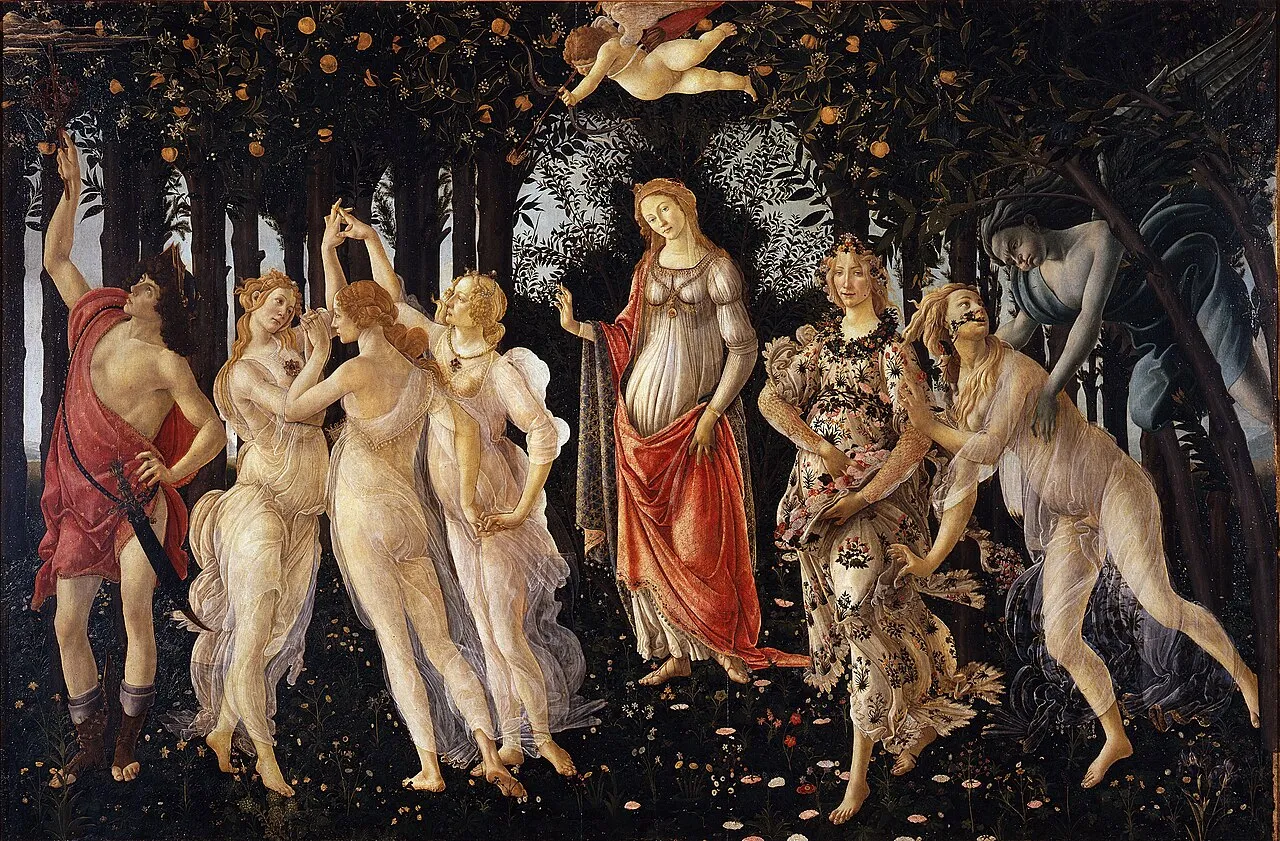
Sandro Botticelli, "Primavera" (c. 1477-1482), tempera on panel, 202 x 314 cm. Uffizi Gallery, Florence. Every figure in this painting is identified by specific attributes drawn from classical mythology: Mercury's caduceus and winged sandals, the Graces' linked hands and translucent drapery, Venus's central placement and garden-goddess attributes. The painting cannot be read without knowing this iconographic vocabulary. Image: Public domain, via Wikimedia Commons
Classical Mythology: The Gods and Their Attributes
When Renaissance humanists began incorporating subjects from classical mythology into their art, they brought a second iconographic system into play alongside the Christian one. The Olympian gods carry attributes just as saints do, and the system is equally codified. Athena and her Roman counterpart Minerva are identified by a helmet, a shield (sometimes bearing the head of Medusa), a spear, and an owl. Apollo carries a lyre or a sun disc. Diana carries a bow and a crescent moon. Hermes, or Mercury, has his caduceus, winged sandals, and broad-brimmed hat. Venus is associated with doves, roses, the sea, and her girdle. Mars has armor and weapons. Bacchus carries a wine cup or a thyrsus, a fennel staff topped with a pine cone, and is accompanied by grapes and leopards.
These figures were not decorative in Renaissance painting. They carried philosophical and moral associations derived from ancient mythology and the allegorical tradition of classical writing. In Botticelli's "Primavera," the Neoplatonic philosopher Marsilio Ficino and the Medici court would have read the Three Graces as an image of the soul's contemplative ascent. Their dance represented the circulation of divine gifts between heaven and earth. Mercury gesturing upward represented the mind directing attention toward the divine. Venus herself, presented as a clothed and modest figure in a garden setting, carried the attributes of "Humanitas" rather than erotic desire. She was, for Botticelli's circle, simultaneously the goddess of love and the personification of Renaissance civic ideals.
This is what makes the "Primavera" so rewarding once you know the iconography. It is not a scene from a single mythological story. It is a synthesis of multiple iconographic traditions into a philosophical statement about how civilization emerges from the union of natural force and divine love. For a closer look at another Botticelli painting that uses classical iconography, our analysis of The Birth of Venus breaks down the attributes and their Neoplatonic meanings. And for the broader context of the period that produced this synthesis of classical and Christian imagery, our overview of Renaissance art provides the historical framework.
Iconographic Systems Beyond the Western Tradition
Iconographic systems operate in every major artistic tradition, not just the Western Christian and classical ones. In Buddhist art, the mudras, or hand gestures, of Buddha figures carry precise meanings. The bhumisparsha mudra, with the right hand reaching down to touch the ground, marks the moment of Buddha's enlightenment, when he called the earth to witness his awakening. The abhaya mudra, with the right hand raised palm outward, communicates protection and fearlessness. Each posture and hand gesture is a precise component of a codified visual language that any practicing Buddhist would read immediately.
In Hindu iconography, the number of arms on a deity indicates their divine attributes and powers. Brahma has four heads, representing the four Vedas. Vishnu carries a conch shell (the sound of the universe), a chakra (the wheel of law), a mace (power), and a lotus (beauty and creation). The multiple arms do not indicate multiple beings. They are a visual device for showing multiple attributes simultaneously within a single image. This is a fundamentally different visual logic from Western naturalism, and recognizing it as a deliberate system rather than a failure of naturalistic representation is the first step to reading Hindu and Buddhist sculpture on its own terms.
For a broader look at how different religious traditions encode meaning in visual form, our guide to sacred images across Christianity, Islam, Buddhism, and Hinduism compares these systems directly. And the formal rules that governed Egyptian art for three thousand years, explored in our guide to ancient Egyptian art, represent yet another fully codified iconographic tradition where every pose, color, and attribute had a specific meaning.
Practical References for Reading Iconography
The essential print reference for Christian iconography remains James Hall's "Dictionary of Subjects and Symbols in Art," first published in 1974 and still in print. It provides alphabetical entries for saints, sacred figures, and classical subjects with their attributes and the artworks in which they appear. George Ferguson's "Signs and Symbols in Christian Art" covers the same territory with more emphasis on theological context. For classical iconography, Erwin Panofsky's essays, particularly those collected in "Meaning in the Visual Arts" (1955), remain the most intellectually engaging introduction to Renaissance iconographic interpretation. Panofsky's distinction between iconography (the identification of subjects) and iconology (the interpretation of their cultural meaning) is still the framework art historians use today.
Online, the Getty Iconography Authority and the Iconclass system provide comprehensive databases with cross-referenced examples. These resources transform museum visits. Knowing before you enter a Renaissance gallery that Sebastian is identified by arrows, that a lamb in a religious painting almost always represents Christ, and that a skull in any pre-nineteenth-century painting is a memento mori changes what you can see. For a systematic approach to analyzing paintings that combines iconographic reading with compositional analysis, our step-by-step framework for reading a painting walks through the process from first glance to informed interpretation.
Final Thoughts
Iconography is not arcane knowledge reserved for art historians. It is a shared visual vocabulary that made art communicate across culture and language for centuries. Learning even a small part of it restores access to a dimension of meaning that most museum visitors walk right past. The core Christian attributes, the main Olympian gods and their symbols, and the basic Buddhist mudras can each be learned in an afternoon. The access they provide to centuries of art repays that investment many times over.
You do not need to become an iconographic scholar. You need to develop enough visual literacy that when you stand in front of a Raphael altarpiece or a Buddhist temple sculpture, you can read what you are looking at. That reading is the beginning of genuine engagement with the traditions those works embody. Next time you are in a museum, pick one painting with multiple figures and try to identify them by their attributes. You might be surprised by how much the painting suddenly says.


