Getty Open Content: 88,000 Free Art Images You Can Use for Anything
Van Gogh's "Irises" is the most downloaded image from the Getty's Open Content Program, with over 3,000 downloads in a single year. You can put it on a t-shirt, use it in a film, print it on wedding invitations, or sell derivative works. No attribution, no licensing fee, no restrictions. That is what CC0 means in practice, and the Getty was one of the first major museums to commit to it fully.
The J. Paul Getty Museum launched its Open Content Program in 2013 with 4,600 images. By 2024, the entire public domain collection had been transitioned to Creative Commons Zero (CC0) licensing, making approximately 88,000 high-resolution images available for unrestricted use. The museum averages about 30,000 downloads per month, and that number is growing.
What Makes the Getty Different from Other Open Access Museums
The Getty is not the largest open access collection. The Met Open Access offers 492,000+ images. The MFA Boston offers 500,000+. The Getty's 88,000 is smaller. But the Getty distinguishes itself in two ways: the exceptional quality of its photography collection, and the depth of its scholarly metadata.
The Getty is also not Getty Images. The J. Paul Getty Trust and Getty Images are completely separate, unaffiliated organisations. If you are looking for stock photography licensing, you are on the wrong website. The Getty Museum's Open Content Program is about fine art and historical photography, not commercial stock.
The Photography Collection: The Getty's Secret Weapon
The Getty holds one of the most important photography collections in the world, and this is where the Open Content Program punches above its weight. The collection covers the full history of the medium from its invention in the 1830s through the present day.
Nineteenth-century photography is the standout. The collection includes major works by William Henry Fox Talbot, Julia Margaret Cameron, and other pioneers. There are over 44,000 albumen silver prints alone, plus calotypes, ambrotypes, collodion prints, cyanotypes, gelatin silver prints, and tintypes. For photographers studying the visual qualities of early photographic processes, the high-resolution scans let you examine tonal ranges and chemical characteristics in detail.
Twentieth-century photography covers Edward Weston, Imogen Cunningham, and other West Coast photographers. The West Coast photography tradition is particularly strong, reflecting the Getty's Los Angeles location.
One search quirk to know: you cannot simply search "photograph" or "photography" and get results. Queries are limited to specific photographic processes. You need to search for "albumen print" or "cyanotype" or "gelatin silver print" specifically. This is frustrating if you are browsing broadly, but useful if you are researching a specific historical process.
The European Paintings
The Getty's European painting collection covers the 13th through 19th centuries, with particular strength in Italian Renaissance and Baroque painting, Dutch and Flemish Golden Age painting, and French Rococo and Neoclassical painting.
The Italian Renaissance holdings include major works by Fra Bartolommeo, Pontormo, and other leading figures. The Dutch and Flemish collection includes Rembrandt, Jan Brueghel the Elder, and exceptional landscape and still life painting. The French paintings cover Nicolas Poussin, Claude Lorrain, Jacques-Louis David, and the Neoclassical and Romantic movements.
For painters studying historical technique, the high-resolution images allow detailed examination of brushwork, glazing, and surface texture. You can zoom into a Rembrandt portrait closely enough to see individual brush strokes.
Greek and Roman Art at the Getty Villa
The Getty Villa in Malibu holds one of the most important collections of ancient Greek, Roman, and Etruscan art in the United States. The collection covers the full range of ancient Mediterranean artistic production, from Greek vases and sculptures through Roman portraits and decorative arts.
The Greek vases are particularly celebrated, with major examples of Attic black-figure and red-figure pottery. The high-resolution images allow detailed study of the painting techniques used by ancient Greek vase painters, including figure drawing and narrative composition approaches.
Illuminated Manuscripts
The manuscript collection includes major examples of medieval and Renaissance illumination from the 9th through 16th centuries, with particular strength in Flemish and Italian illumination. For artists studying historical painting techniques, the manuscript images show the specific approaches to pigments, gold leaf, and miniature painting that characterise these traditions.
The Search Experience
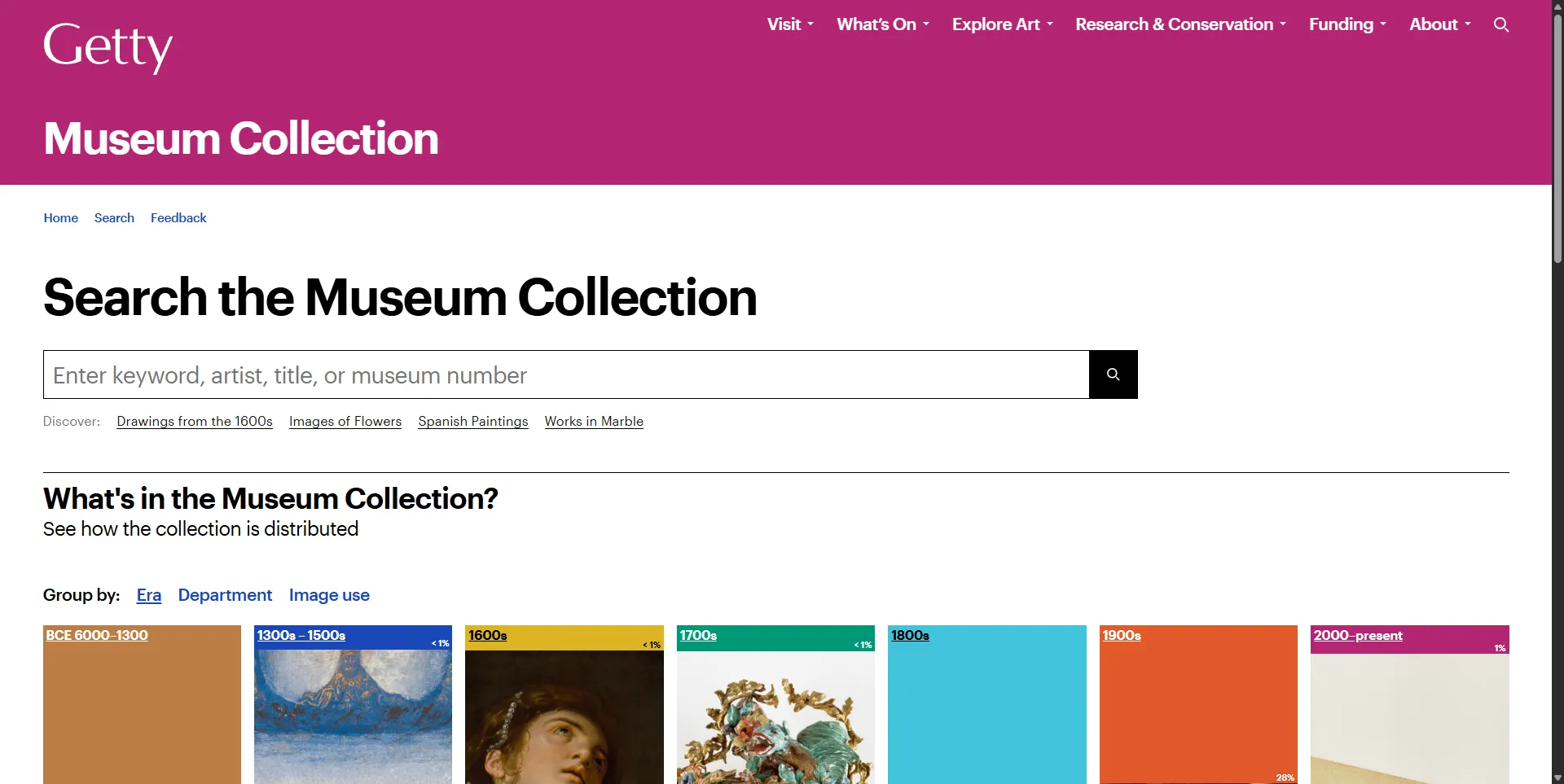
The Getty's online collection search lets you filter by artist, period, medium, and other parameters. The "open content" filter is essential: select it to see only CC0 downloadable images. Each work's page includes a download button for the highest resolution version available.
The Getty also supports IIIF (International Image Interoperability Framework), which allows deep zoom and comparison across institutions. If you use IIIF-compatible viewers like Mirador or OpenSeadragon, you can examine Getty images alongside content from other IIIF-supporting institutions.
The Bigger Picture: Getty's Open Culture Initiative
In 2025, 15 Getty staff members across the Museum, Research Institute, Publications, and Digital units completed the Creative Commons Open Culture Certificate course. They have formed an internal affinity group called Open Culture @ Getty to advocate for open sharing across the institution. The Getty Research Collections Viewer now offers over 75,000 items for download, and the museum is working through approximately 20 miles of archival shelving to make more material publicly available.
This means the Open Content Program will grow. More images will be added as new works enter the public domain and as the Getty digitises more of its archival holdings.
Getty vs. Other Open Access Programs
Compared to the Met Open Access, the Getty offers fewer images (88,000 vs 492,000+) but a stronger photography collection and more consistent scholarly metadata. The Met covers a broader geographic and cultural range. The Getty is more focused on Western art.
Compared to the National Gallery of Art in Washington, the Getty has a comparable CC0 policy but a stronger photography holdings. The NGA offers 60,000+ images with a focus on European and American painting.
Compared to the National Gallery in London, the Getty is far more generous with licensing. The National Gallery London restricts image reuse to CC BY-NC-ND (non-commercial, no derivatives), while the Getty allows any use including commercial.
Insider Tips
Always select the "open content" filter first. Not every image in the Getty's collection is CC0. Some works are still under copyright or have other restrictions. The filter ensures you only see downloadable, unrestricted images.
Search by photographic process, not "photography." The search system requires specific process names. Use "albumen print," "cyanotype," "gelatin silver print," etc. for photography searches.
Use IIIF for deep zoom. If you need to examine brushwork or surface texture in detail, IIIF-compatible viewers give you better zoom control than the standard web interface.
Check back periodically. The Getty is actively digitising more material, and new images are added as they become available and rights are cleared.
Who Is This For?
The Getty Open Content Program is for photographers studying the history of their medium, painters studying European painting techniques, and designers who need high-quality art imagery for commercial projects without licensing complications. It is for educators who want free, legally clear images for teaching.
It is not for you if you need non-Western art (look to the Met instead), if you need massive volume (the Met or Europeana are larger), or if you are looking for stock photography (this is fine art, not commercial stock).
Getting Started
Visit the Getty collection search and select the "open content" filter. Download any image directly from the object page. No registration, no attribution required, no restrictions. For developers, the Getty's IIIF endpoints enable programmatic access to high-resolution image tiles.