National Gallery of Art Washington: 60,000 Free Images Plus 53,000 on Wikimedia Commons
The National Gallery of Art in Washington, DC, has contributed 53,000 high-resolution images to Wikimedia Commons and 120,000 art object records to Wikidata. That means you can query their collection through Wikidata's SPARQL endpoint, combine it with data from other museums, and build visualisations that span multiple institutions. Not many museums offer that level of structured, linked data access.
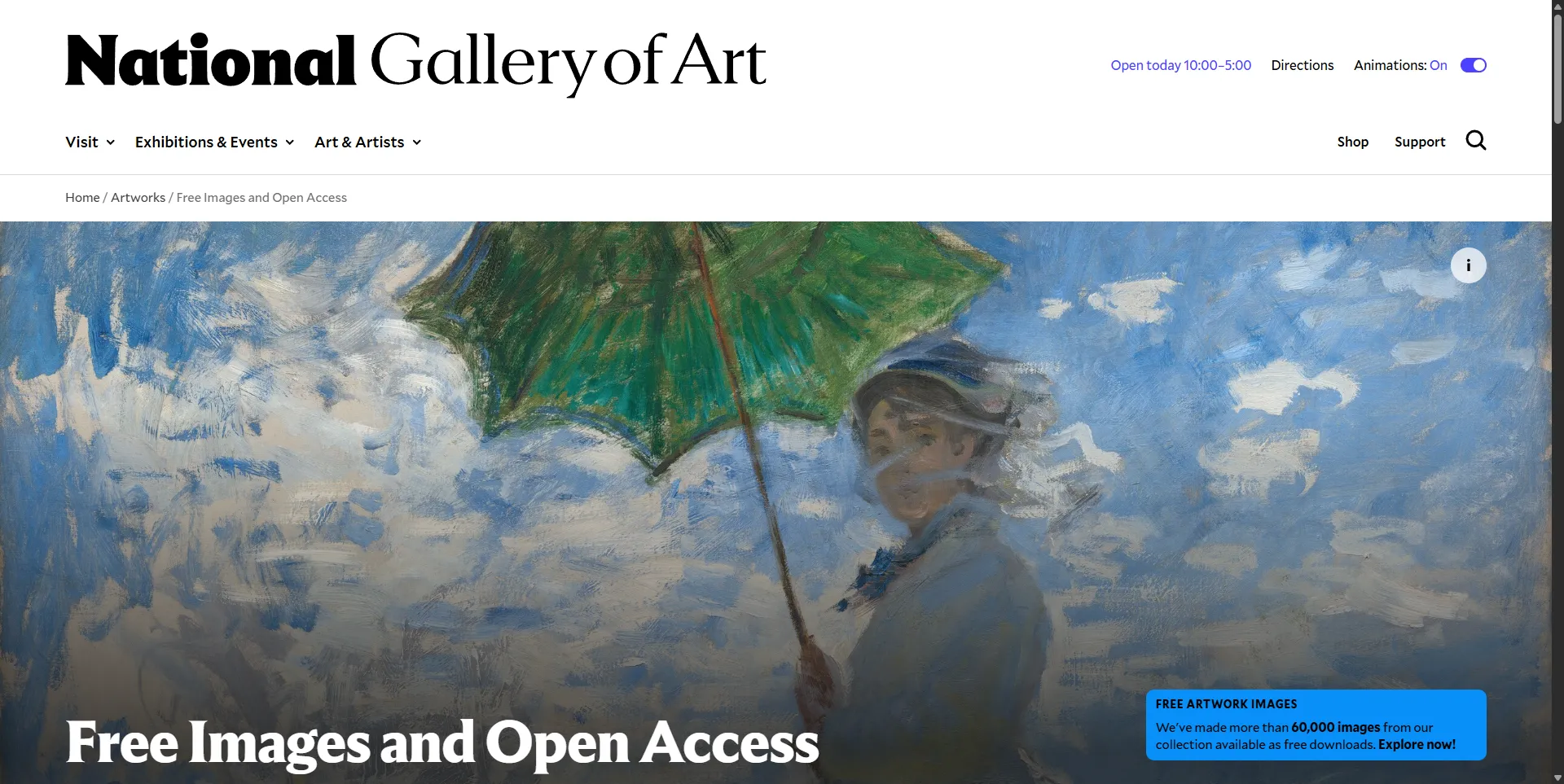
The NGA's Open Access program provides over 60,000 images from its collection of nearly 160,000 works spanning the history of Western art from the Middle Ages to today. All images are released under Creative Commons Zero (CC0), free for any use without attribution, without licensing fees, without restrictions.
What Makes the NGA Different
The NGA is not the largest open access collection. The Met offers 492,000+ images. The MFA Boston offers 500,000+. The NGA's 60,000 is smaller. But the NGA distinguishes itself through its Wikimedia integration and its focus on quality over quantity.
Since 2018, the NGA has been working with the Wikimedia Foundation to donate its open access images and data to Wikimedia platforms. This is not just a bulk upload. It is an ongoing partnership where new images are added to Wikimedia Commons as they enter the public domain. The 120,000 collection records on Wikidata can be queried through SPARQL, enabling structured data exports, maps, and visualisations that combine NGA data with records from other institutions.
The NGA also publishes its full collection dataset as a CSV file on GitHub, updated daily. This includes factual art object information for over 130,000 artworks and artists, released under CC0. The dataset includes links and references to images and other media, though the media files themselves are not included in the CSV.
The Collection: Italian Renaissance and Dutch Golden Age
The NGA's collection covers European and American art from the 13th through the 21st centuries, with particular strength in Italian Renaissance painting and Dutch Golden Age painting.
Italian Renaissance holdings include Leonardo da Vinci's Ginevra de' Benci, the only Leonardo painting in the Americas. Major works by Raphael, Titian, and other leading figures make this one of the finest Italian Renaissance collections in the United States. The high-resolution images allow detailed study of Leonardo's sfumato technique, Raphael's compositional structures, and Titian's colour innovations.
Dutch and Flemish Golden Age paintings include Rembrandt, Vermeer, Rubens, and exceptional genre painting and portraiture. The Vermeer collection is particularly notable. For painters studying Dutch Golden Age technique, the high-resolution images show the specific approaches to light, texture, and optical effects that define this tradition.
French Impressionism and Post-Impressionism are well-represented, with major works by Monet, Renoir, Degas, Cezanne, and other leading figures. The collection covers the full development of Impressionism from its origins in the 1860s through its transformation into Post-Impressionism.
American art spans the colonial period through the 20th century, with major works by John Singleton Copley, Gilbert Stuart, Winslow Homer, John Singer Sargent, and other leading American painters. The American collection reflects the museum's mission as a national institution.
Prints and drawings include major works from every period of European and American printmaking and drawing. The print collection is particularly valuable for printmakers studying historical techniques.
How to Access the Images
The NGA provides three main access points:
Website search: The NGA collection search lets you filter for works with image downloads available. Look for the download icon when browsing. Each object page includes a download button for the highest resolution version.
GitHub CSV: The open access dataset on GitHub provides the full collection metadata in CSV format, updated daily. This is the best option for developers who need structured data rather than individual image downloads.
Wikimedia Commons and Wikidata: The 53,000 images on Wikimedia Commons are directly usable in Wikipedia articles and other Wikimedia projects. The 120,000 records on Wikidata can be queried through SPARQL, enabling cross-institutional research.
NGA vs. Other Open Access Programs
Compared to the Met Open Access, the NGA offers far fewer images (60,000 vs 492,000+) but better Wikimedia integration. The Met has a keyless REST API. The NGA has GitHub CSV and Wikidata SPARQL. Both use CC0. The Met covers global art. The NGA focuses on European and American art.
Compared to the Getty Open Content, both focus on Western art. The NGA has fewer images (60,000 vs 88,000) but better structured data access through Wikidata. The Getty has a stronger photography collection and IIIF support.
Compared to the National Gallery in London, the NGA is far more generous with licensing. The National Gallery London restricts image reuse to CC BY-NC-ND (non-commercial, no derivatives). The NGA allows any use including commercial. Both focus on European painting, but the NGA also covers American art.
Insider Tips
Use the download icon filter. When searching the NGA website, filter for "Image download available" to see only open access images. This avoids finding works you cannot download.
Query Wikidata for cross-institutional research. The NGA's 120,000 records on Wikidata can be combined with records from other museums that also publish to Wikidata. This enables queries like "show me all paintings by Rembrandt across all museums that publish to Wikidata."
Download the GitHub CSV for offline analysis. The daily-updated CSV includes over 130,000 records. If you need to analyse the collection programmatically, this is faster than scraping the website.
Check Wikimedia Commons for Wikipedia-ready versions. If you are contributing to Wikipedia or other Wikimedia projects, the NGA's images on Commons are already formatted and categorised for Wikimedia use.
Use the courtesy credit line. The NGA requests but does not require the credit line "Courtesy National Gallery of Art, Washington" when using their images. Including it is good practice and helps others locate the source.
Who Is This For?
The NGA Open Access program is for painters studying Italian Renaissance or Dutch Golden Age techniques, for researchers who need structured collection data through Wikidata and SPARQL, and for Wikipedia contributors who need high-quality art images for articles. It is for educators who need CC0 images of European and American masterworks.
It is not for you if you need non-Western art (use the Met), if you need large volume (the Met or MFA Boston are larger), or if you need a REST API (the NGA provides CSV and Wikidata access, not a traditional REST API).
Getting Started
Search the NGA collection and filter for downloadable images. For structured data, download the CSV from GitHub. For Wikimedia integration, browse the NGA images on Wikimedia Commons or query the Wikidata SPARQL endpoint. No registration, no attribution required, no restrictions.