
The Vatican Museums receive approximately 6 million visitors per year, roughly 16,000 per day. The complex covers 7 km of galleries across 54 rooms, holding an estimated 70,000 works (20,000 on display). The museums were founded in 1506 by Pope Julius II when he bought a single sculpture: the Laocoön, a Greek marble group showing a man and his sons being crushed by sea serpents. Julius displayed it in the Vatican's Belvedere courtyard, and the collection grew from there. Every pope for 500 years added to it through patronage, commission, purchase, and sometimes seizure. The Vatican Museums are the only major museum in the world founded by a head of state who also commissioned some of the greatest artworks inside it. Julius II hired Michelangelo for the Sistine Chapel ceiling and Raphael for the Raphael Rooms simultaneously, between 1508 and 1512.
The Vatican Museums are not a single museum but a complex of museums: the Pio-Clementino (classical antiquities), the Pinacoteca (paintings), the Egyptian Museum, the Etruscan Museum, the Raphael Rooms, the Gallery of Maps, and the Sistine Chapel. The route is one-way. You enter at Viale Vaticano and walk through galleries until you reach the Sistine Chapel. There is no shortcut.
This guide covers a realistic 3-hour route (Gallery of Maps, Raphael Rooms, Sistine Chapel), the history of papal patronage, the 2026 restoration of the Last Judgment, what most visitors miss, and practical tips including the early-morning VIP option.
The Realistic 3-Hour Route
The Vatican Museums cover 7 km of galleries. A 3-hour visit cannot cover everything. This route covers what matters most. Hour 1 (8:00-9:00 AM if you have early entry, or 9:00-10:00 AM standard): Pio-Clementino Museum for the Laocoön (the founding sculpture), the Apollo Belvedere, and the Belvedere Torso. These are the classical sculptures that Michelangelo studied and quoted in his own work. Hour 2: Gallery of Maps (20 minutes), Gallery of Tapestries (10 minutes), Raphael Rooms (45 minutes). Hour 3: Sistine Chapel (30-45 minutes), then exit through the door to St Peter's Basilica if it is open. The Vatican Museums guide at Rome Spirit has more detail on each section.
The Gallery of Maps
The Gallery of Maps is a 120-meter corridor commissioned by Pope Gregory XIII in 1580, with 40 topographic frescoes of Italy by Ignazio Danti. The accuracy for the period is extraordinary. Danti consulted with cartographers and geographers, and the maps show Italy as it was understood in 1580, before modern surveying and before satellite imagery. The coastline shapes are approximate, but the mountains, rivers, and cities are recognizable.
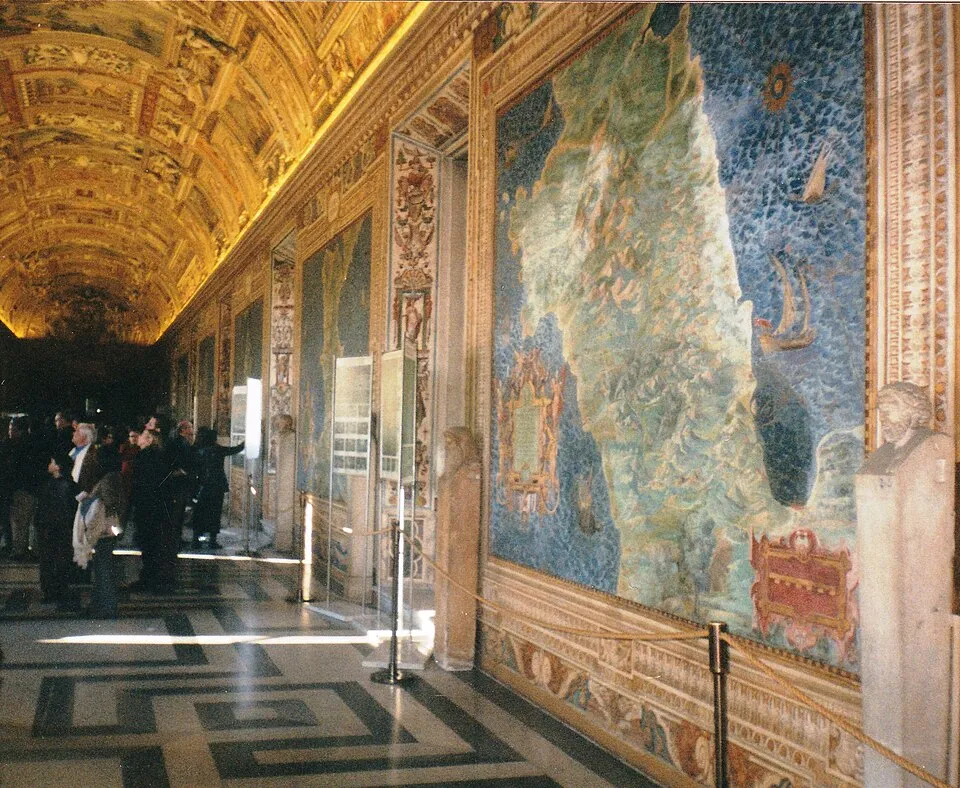
The Gallery of Maps (1580-1583), 120 meters long, with 40 topographic frescoes of Italy by Ignazio Danti. Vatican Museums. Wikimedia Commons.
The ceiling fresco above is often overlooked in the rush to the Sistine Chapel. Look up. The vaulted ceiling is covered in painted architectural frames and allegorical figures. The gallery is the most beautiful corridor in any museum. Walk slowly. Most people rush through it on the way to the Sistine Chapel, which is a mistake.
The Raphael Rooms
Four rooms painted between 1508 and 1524 by Raphael and his workshop for Pope Julius II and Leo X. Julius moved his personal apartments here because he did not want to live in the Borgia Apartment, which he considered tainted by Alexander VI's reputation.
The Stanza della Segnatura contains "The School of Athens" (1509-1511), measuring 500 x 770 cm. Plato and Aristotle stand at the center, with Plato pointing up (the realm of ideas) and Aristotle pointing forward (the realm of experience). Around them: Pythagoras, Euclid, Heraclitus, Diogenes. Raphael painted himself among the philosophers, far right, looking out at the viewer.
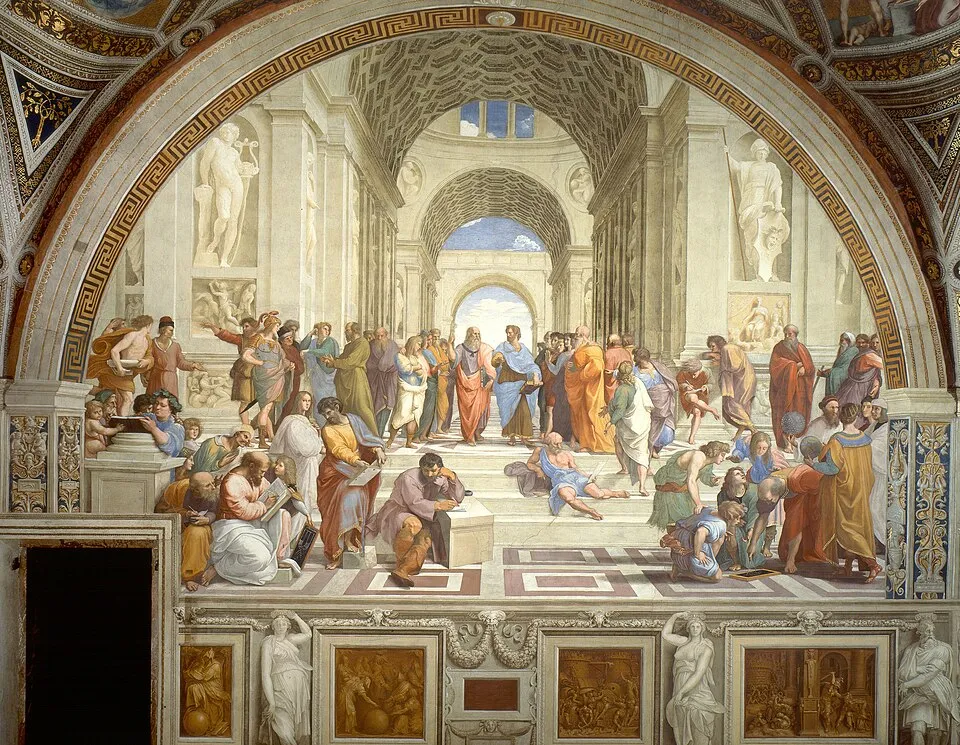
Raphael, "The School of Athens" (1509-1511). Fresco, 500 x 770 cm. Raphael Rooms, Stanza della Segnatura. Vatican Museums. Wikimedia Commons.
The Michelangelo portrait is worth knowing about. The figure of Heraclitus in the foreground, leaning on a block of marble, is a portrait of Michelangelo. Raphael added it after seeing the Sistine Chapel ceiling, which was being painted in the adjacent chapel at the same time. It is the only known portrait of Michelangelo painted from life by another artist.
The Stanza di Eliodoro contains "The Expulsion of Heliodorus from the Temple" (1511-1512), a dramatic, theatrical fresco with divine intervention. Julius II appears as a spectator, carried on a litter (he was ill by this point). "The Fire in the Borgo" (1514-1517) is Raphael's most dramatic fresco: a fire in the Vatican quarter, with Pope Leo IV extinguishing it by making the sign of the cross. The figures in the foreground are escaping the flames. A woman lowers her baby from a wall. A man carries his father on his back.
The Raphael Rooms are as rewarding as the Sistine Chapel and far less crowded. Anyone who rushes through them to reach the Sistine Chapel is making a mistake. For more on the period that produced these works, read our guide to Renaissance art.
The Sistine Chapel and the 2026 Last Judgment Restoration
The Sistine Chapel is the climax and the most crowded space. Guards are strict: no photography, no loud talking. The ceiling is 20 meters above you, and the chapel is 41 meters long. The scale is harder to grasp than in photographs. Binoculars genuinely help.
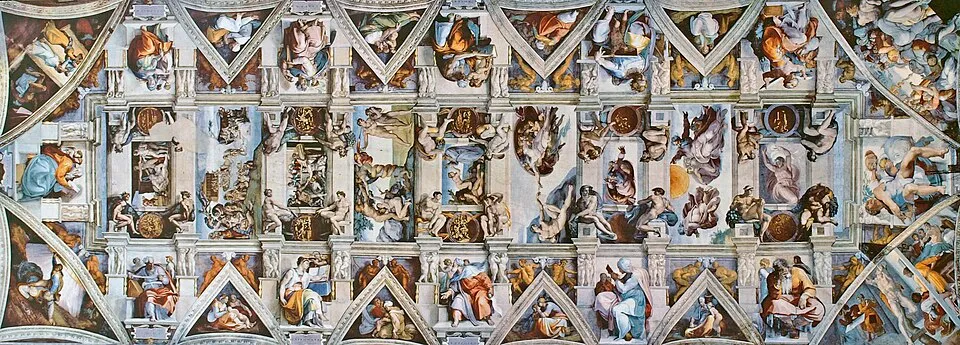
Michelangelo, Sistine Chapel ceiling (1508-1512). Fresco, 40 x 14 meters. Vatican Museums. Wikimedia Commons.
The ceiling (1508-1512) was painted by Michelangelo lying on his back on scaffolding, not standing. The popular image of him painting upright is wrong. He designed his own scaffolding that attached to the walls, not the floor. Nine panels from Genesis run from the Separation of Light and Darkness to the Drunkenness of Noah. The Creation of Adam is the center panel. God extends his finger to Adam, and the space between their fingers is the most famous negative space in art.
"The Last Judgment" (1536-1541) covers the altar wall. Michelangelo was 61 when he started it. The composition is darker, more violent, more personal than the ceiling. Christ is a muscular judge, not a gentle savior. St Bartholomew holds a flayed skin that is widely believed to be Michelangelo's self-portrait.
In early 2026, the Vatican Museums completed an extraordinary maintenance of "The Last Judgment." Scaffolding was erected on February 1, covering the entire surface, and the work took approximately three months. The Sistine Chapel remained open throughout. Restorers worked behind a high-definition reproduction of the fresco while they cleaned the surface. The problem was a widespread whitish film caused by calcium lactate, a salt formed when lactic acid, released through visitor transpiration, reacted with calcium ions on the fresco surface. The cleaning was technically straightforward: Japanese paper and distilled water. But the visual impact was remarkable. The fresco's vibrant colors and chiaroscuro, as they appeared following the major 1994 restoration, are now visible again. Paolo Violini, Chief Restorer of the Painting and Wood Materials Laboratory, noted that the intervention also provided an opportunity to conduct a comprehensive review of the work's state of conservation.
The 1980-1994 cleaning of the ceiling took 14 years and removed centuries of candle soot and animal glue. The colors that emerged were so bright that some scholars accused the restorers of overcleaning. The cleaning changed how we see Michelangelo. He was a colorist, not just a sculptor who painted. The 2026 Last Judgment maintenance confirms that interpretation.
After the Sistine Chapel, a direct exit door on the right leads into St Peter's Basilica, bypassing the external queues. Use it, but only if you are on a guided tour or VIP entry. For standard ticket holders, this door is sometimes closed.
What Most Visitors Miss
The Pinacoteca is a separate building with 18 rooms of paintings. It includes Raphael's "Transfiguration" (1516-1520), his last painting, carried at his funeral. Caravaggio's "Entombment of Christ" (1602-1604). Leonardo da Vinci's unfinished "St Jerome in the Wilderness" (c. 1480). Most visitors skip the Pinacoteca because it is not on the main route to the Sistine Chapel. This is an error. The Caravaggio alone is worth 20 minutes.
The Pio-Clementino Museum holds the Laocoön (the founding sculpture of 1506), the Apollo Belvedere, and the Belvedere Torso. These are the sculptures that defined Renaissance taste. Michelangelo studied the Belvedere Torso and quoted its musculature in the Sistine Chapel.
The Egyptian Museum is a complete collection rivaling the Met's, including mummies with painted coffins and a reconstruction of a tomb. It is almost always empty. The Borgia Apartment, painted by Pinturicchio in the 1490s for Pope Alexander VI (Rodrigo Borgia), has ceilings covered in gold and pagan imagery: astrological symbols, Egyptian gods, fertility figures. Julius II refused to live here, which is why the Raphael Rooms exist. For more on visiting strategies, see the Vatican Museums visitor guide at EuroLandmarks.
Practical Tips
Tickets cost €20 at the door. Online booking costs €25 total (€20 plus a €5 skip-the-line booking fee). Reduced tickets for ages 7 to 18 and students up to 25 cost €10 at the door, €15 online. Children under 7 enter free. The last Sunday of the month is free, with reduced hours from 9:00 AM to 2:00 PM, but it is the most crowded day of the month. Book at the official site tickets.museivaticani.va. The Ridelium Vatican tickets guide compares all ticket options in detail.
Early morning VIP entry (07:30) costs €25 to €40 extra over the standard ticket. The Sistine Chapel with 40 to 80 people instead of 500 to 1,200 is a fundamentally different experience. Book 4 to 6 weeks ahead. Some premium tours offer 6:00 AM entry for €120 to €150, limited to 6 to 10 people. This is the single best upgrade available at the Vatican.
Hours are Monday through Saturday 8:00 AM to 6:00 PM (last entry 4:00 PM). On selected Friday and Saturday evenings from late April through October, the museums stay open until 10:30 PM, which is a quieter and more atmospheric time to visit. Closed Sundays except the last Sunday of the month.
The best time to visit is Tuesday through Thursday at the 8:00 AM opening. Mondays are busiest because other Rome museums are closed. Plan 3 hours for the realistic route and 4.5 to 5 hours if you include St Peter's Basilica. Book 3 to 4 weeks ahead in peak season (April through October) and 4 to 6 weeks for early-morning tours.
For more on managing museum visits of this scale, read our guide on how to visit an art museum without getting overwhelmed. For a broader timeline of the art movements represented in the Vatican's collection, see our complete guide to art movements.
Final Thoughts
The Vatican Museums are the most intense museum experience in the world. Seven kilometers of galleries, 6 million visitors a year, and the Sistine Chapel at the end. The Raphael Rooms and the Gallery of Maps are as rewarding as the Sistine Chapel, and far less crowded. The 2026 restoration of the Last Judgment means the fresco is now visible in colors that haven't been seen this clearly since the 1994 cleaning.
Book at tickets.museivaticani.va, 4 weeks ahead. Pay for the 07:30 early entry if you can. Go to the Raphael Rooms first. The Sistine Chapel will still be there at the end.
For more context, read our art history cheat sheet, our guide to famous paintings explained, and our overview of Baroque art and the power of the Catholic Church. If you are new to looking at paintings, our guide on how to look at art for beginners will help you get more out of the visit.


