
In 1809, six students at the Vienna Academy of Fine Arts formed a secret brotherhood. They were barely twenty years old. They wore their hair long and parted in the middle, in imitation of Christ. They called themselves the Brotherhood of St. Luke (Lukasbund), after the patron saint of painters. They rejected the academic training they were receiving, which they considered spiritually dead, and vowed to return art to what they saw as its original purpose: the expression of Christian faith through the styles of medieval and early Renaissance painting. A year later, in May 1810, most of them moved to Rome and settled in the abandoned monastery of Sant'Isidoro. Romans called them "I Nazareni" because of their Christ-like hair. The name stuck.
The Nazarene Movement is the most misunderstood movement in 19th-century art. Art history has dismissed it as retrograde, backward-looking, and conservative. This dismissal is wrong. The Nazarenes were the first anti-academic, anti-establishment movement in modern European art. They rejected the neoclassical orthodoxy of the academies before the Impressionists rejected the Salon, before the Pre-Raphaelites rejected the Royal Academy. The Nazarenes were rebels who happened to choose medieval art as their weapon.
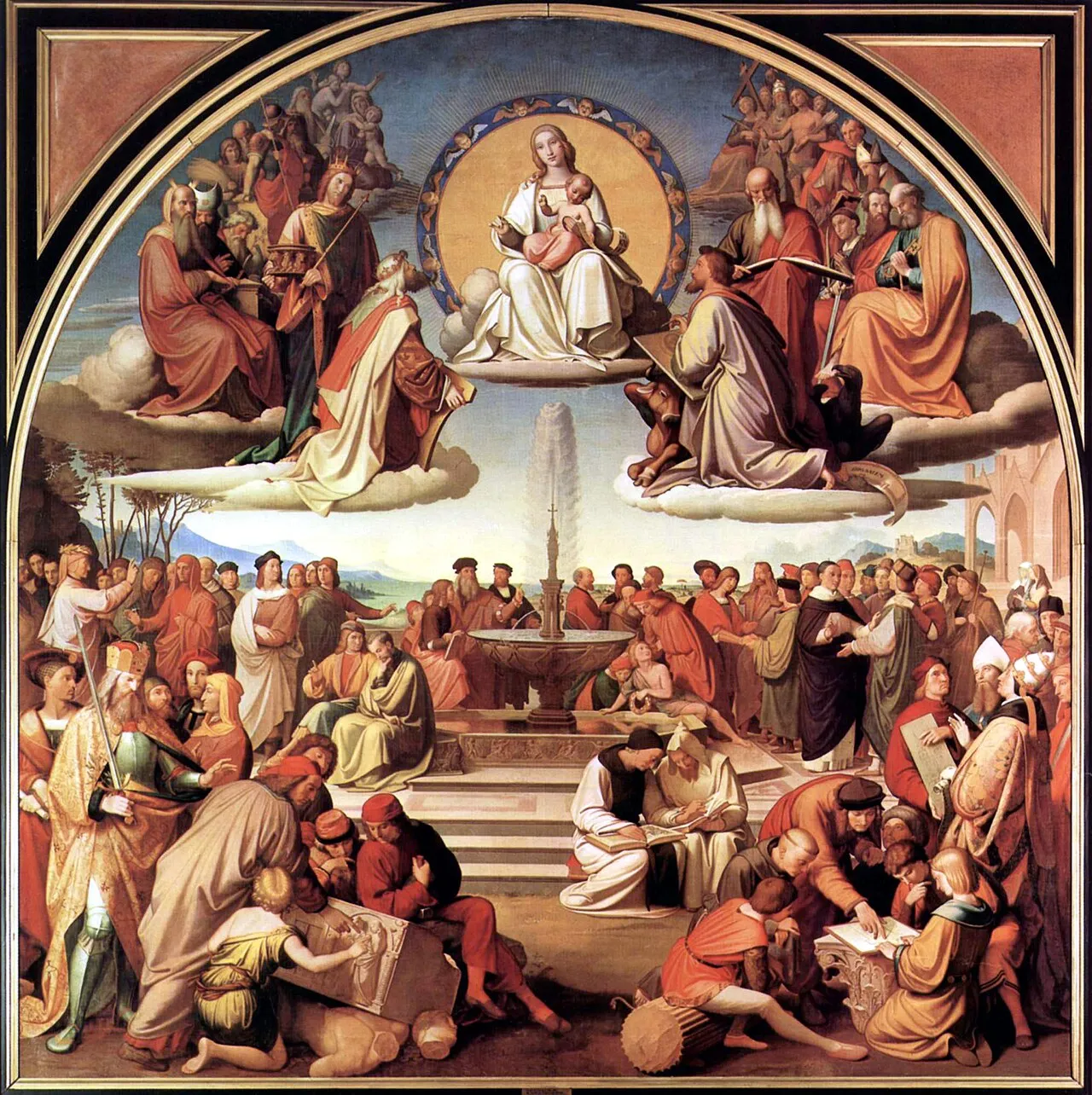
This guide covers the founding of the Lukasbund, the move to Rome, the key artists (Overbeck, Cornelius, Schnorr von Carolsfeld), the fresco projects, the influence on the Pre-Raphaelites, and why the Nazarenes deserve reconsideration as proto-modernists.
The Brotherhood of St. Luke and the Vienna Academy
Johann Friedrich Overbeck (1789 to 1869) was born in Lubeck, the son of a senator. He entered the Vienna Academy in 1806 at age 17. Franz Pforr (1788 to 1812) was born in Frankfurt, an orphan who entered the Academy the same year. The two quickly became friends and began searching for alternatives to the academic training they received.
The Vienna Academy taught neoclassical painting based on the study of antique sculpture, anatomical precision, and hierarchical composition. Overbeck and Pforr found this training deadening. They believed art should express spiritual truth, not technical virtuosity. Their new heroes were not Greek and Roman sculptors but medieval and early Renaissance painters: Raphael, Albrecht Durer, and the Italian primitives (Giotto, Fra Angelico).
Johann Friedrich Overbeck, "Portrait of the Painter Franz Pforr" (1810). Oil on paper. Alte Nationalgalerie, Berlin. Wikimedia Commons.
The Brotherhood of St. Luke was founded on July 10, 1809. The founding members were Overbeck, Pforr, Joseph Sutter, Ludwig Vogel, Joseph Wintergerst, and Johann Konrad Hottinger. They took monastic-style vows, committed to communal living, and agreed to paint only religious subjects. The group's formation was a direct challenge to the Academy's authority. A DFG-funded research project at the Alte Nationalgalerie in Berlin (2018 to 2021), led by Dr. Eva Reinkowski-Hafner at the Otto Friedrich-Universitat Bamberg, analyzed the painterly techniques of the Nazarenes using X-ray, UV, and infrared imaging. The project confirmed that the Nazarenes were not just interested in the motifs of Old Masters but also in their materials and techniques, grinding their own pigments and experimenting with egg tempera and oil glazes in emulation of 15th-century practice.
Rome and the Sant'Isidoro Community
In May 1810, Overbeck, Vogel, and Hottinger left Vienna for Rome. Pforr stayed behind and died of tuberculosis in 1812 at age 24, never making the journey. In Rome, the group moved into the abandoned Franciscan monastery of Sant'Isidoro. They lived communally, shared meals, prayed together, and painted in a studio that was also a chapel.
The Sant'Isidoro community attracted additional artists. Peter von Cornelius (1783 to 1867) arrived in 1811. Julius Schnorr von Carolsfeld (1794 to 1872) arrived in 1818. Friedrich Wilhelm Schadow (1788 to 1862) arrived in 1813. The community grew to about twenty members at its peak.
The Nazarenes' lifestyle was deliberately medieval. They wore long hair, simple clothing, and maintained a devotional atmosphere. This was not eccentricity. It was a performative rejection of the secular, academic art world. The Nazarenes understood that artistic renewal required not just new paintings but a new way of life. This is what the art historian Cordula Grewe, in her 2009 book "The Nazarenes: Romantic Avant-Garde and the Art of the Concept," identifies as the movement's proto-modern character: the Nazarenes understood that art could be a form of social and intellectual practice, not just a technical skill.
The connection to Romanticism is direct. The Nazarenes were products of the same intellectual climate that produced Caspar David Friedrich and the German Romantic philosophers. The difference is that where Friedrich painted landscapes as vehicles for spiritual contemplation, the Nazarenes painted religious narratives. Both rejected Enlightenment rationalism in favor of spiritual experience.
The Fresco Projects
The Nazarenes' most ambitious project was the fresco decoration of the Casa Bartholdy in Rome (1816 to 1817), commissioned by the Prussian consul Jakob Salomon Bartholdy. The frescoes illustrated the story of Joseph from the Book of Genesis. Cornelius, Overbeck, Veit, and Schadow each painted one wall. The frescoes were later removed and transferred to the Alte Nationalgalerie in Berlin, where they remain.
Cornelius's "Joseph Interpreting Pharaoh's Dream" (1816 to 1817) shows the influence of early Renaissance composition: clear outlines, flat space, monumental figures arranged in a frieze-like pattern. The style is deliberately archaic. Cornelius was not trying to fool anyone into thinking this was a 15th-century fresco. He was trying to recover what he saw as the spiritual seriousness of 15th-century art.
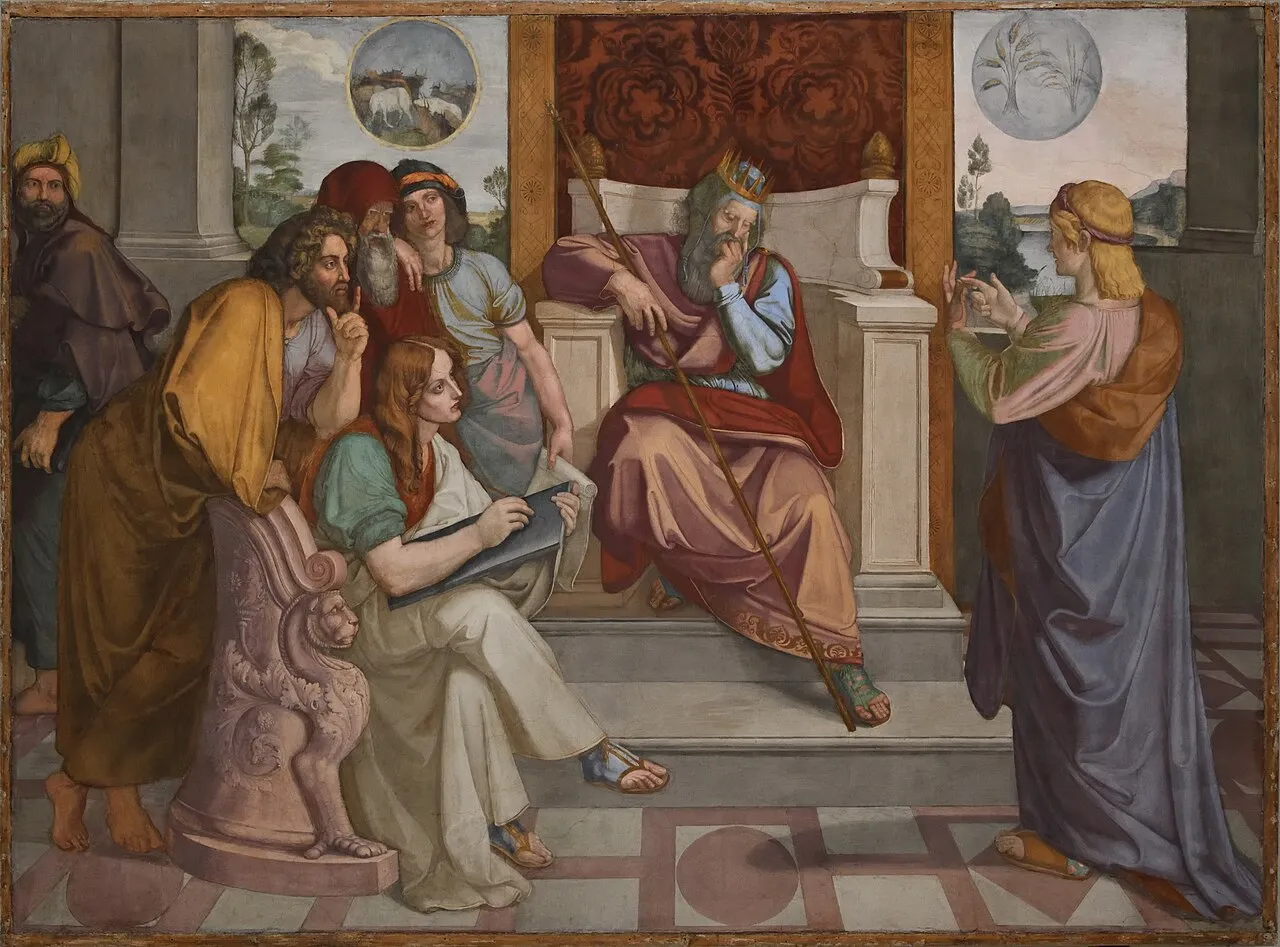
Peter von Cornelius, "Joseph Interpreting Pharaoh's Dream" (1816-17). Fresco, transferred to canvas. Alte Nationalgalerie, Berlin. Wikimedia Commons.
The second major project was the fresco decoration of the Casino Massimo in Rome (1819 to 1829), illustrating scenes from Dante, Tasso, Ariosto, and Petrarch. Overbeck, Cornelius, and Schnorr von Carolsfeld each took a room. The project took ten years and demonstrated the Nazarenes' commitment to large-scale, public, narrative art. This was not easel painting for private collectors. It was mural painting for public spaces, in the tradition of the Italian Renaissance.
The technique of fresco, painting on wet plaster so the pigment bonds chemically with the wall, was itself a deliberate choice. Fresco is the most permanent form of painting. It cannot be moved, rolled up, or sold. By choosing fresco, the Nazarenes rejected the commodification of art that easel painting enabled. This commitment to permanence and public accessibility is another proto-modern trait that connects them to the muralism tradition that emerged a century later.
Key Artists
Johann Friedrich Overbeck (1789 to 1869)
Overbeck was the movement's spiritual leader and the only founding member who remained in Rome for his entire life. He never returned to Germany. His "Christ's Entry into Jerusalem" (1824) is a large oil painting that shows the Nazarene style at its most characteristic: clear outlines, flat composition, Renaissance-inspired figures, and deep religious sincerity. Overbeck's paintings are the purest expression of the Nazarene ideal because he never compromised with academic taste or market pressure.
A Gallery 19C exhibition in Westlake, Texas (November 2023 to January 2024), titled "The Nazarenes: Germany's 19th Century Avant-Garde Artists," featured Overbeck's "Banishment of Hagar" (1841), described as among the most important works by Overbeck to appear on the market in decades. The exhibition was the first commercial gallery show devoted to the Nazarenes and argued that they were "the first anti-academic, anti-establishment movement in 19th century European art."
Peter von Cornelius (1783 to 1867)
Cornelius was the movement's most technically ambitious member and its most successful. After the Casa Bartholdy frescoes, he was summoned to Munich by King Ludwig I of Bavaria to direct the fresco decoration of the Ludwigskirche (1829 to 1840). The "Last Judgment" fresco in the apse, measuring 22 by 12 meters, was the largest fresco painted since Michelangelo's Sistine Chapel. Cornelius's monumental style influenced German history painting for decades.
Julius Schnorr von Carolsfeld (1794 to 1872)
Schnorr von Carolsfeld was the most narrative of the Nazarenes. His "Bible in Pictures" (1851 to 1860), a series of 240 woodcut illustrations of the Bible, became the most widely reproduced Nazarene work. The woodcuts were used in Protestant and Catholic Bibles across Europe and America for the rest of the 19th century. If you have seen a 19th-century family Bible with illustrations, you have seen Schnorr von Carolsfeld's work. The images shaped how millions of people visualized biblical stories.
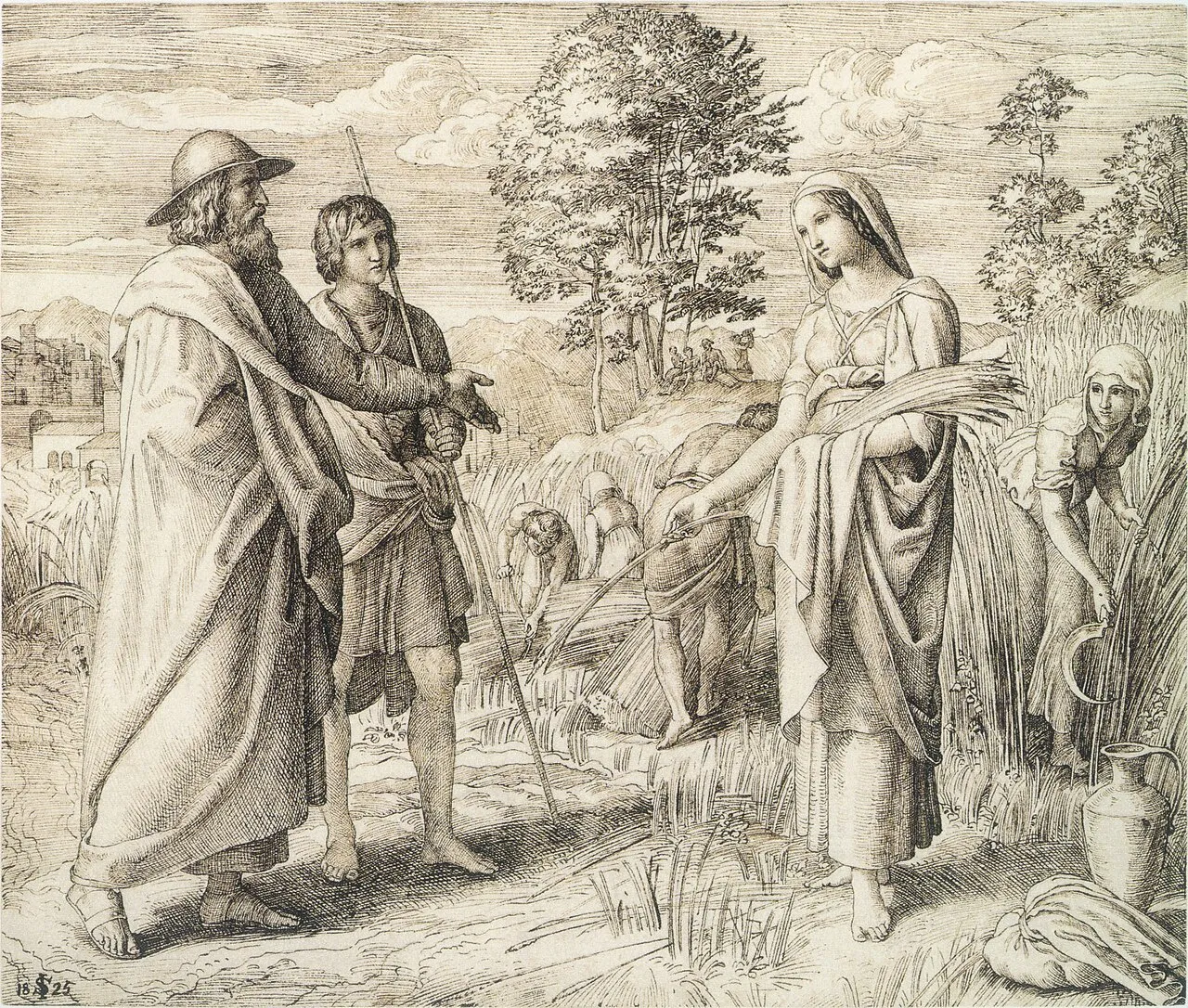
Julius Schnorr von Carolsfeld, "Ruth and Boaz" from "Bible in Pictures" (1851-60). Woodcut. Wikimedia Commons.
The Nazarenes and the Pre-Raphaelites
The Nazarenes directly influenced the Pre-Raphaelite Brotherhood, founded in London in 1848. The Pre-Raphaelites (Rossetti, Millais, Hunt) shared the Nazarenes' rejection of academic art, their admiration for early Renaissance painting, and their commitment to religious and literary subjects. The connection was explicit: Ford Madox Brown studied in Rome in 1845 to 1846 and met Overbeck. The Pre-Raphaelite technique of painting on a wet white ground, the use of bright primary colors, and the commitment to moral seriousness all derive from Nazarene precedent.
The Nazarenes were the first movement to argue that the solution to academic stagnation was not to push forward but to go back further, past the High Renaissance to the primitives. The Pre-Raphaelites adopted this strategy wholesale. Without the Nazarenes, there is no Pre-Raphaelite Brotherhood. The connection is not just stylistic but ideological: both movements believed that art had gone wrong after Raphael and that the path forward lay in recovering what came before him.
This "primitivist" strategy, looking backward to move forward, connects the Nazarenes to a broader tradition that includes Renaissance art's recovery of classical antiquity and even modernism's appropriation of non-Western art. The Nazarenes were the first to use this strategy as a deliberate artistic program.
Why the Nazarenes Were Misunderstood
The Nazarenes' critical reputation collapsed in the 20th century. Modernist art history, which valued innovation, formal reduction, and secularism, had no framework for a movement that looked backward, used narrative, and was explicitly religious. Quentin Bell asked in 1967: "Who were these painters and why did they attract so much attention at a time when Ingres and Delacroix, Gericault, Corot, and Daumier were so little regarded by Englishmen?"
The answer is that the Nazarenes were not conservative. They were radical in a way that modernist art history could not recognize. Their radicalism was not formal (new styles) but conceptual (new ways of thinking about what art is for). Grewe's book argues that the Nazarenes practiced an "art of the concept" that anticipated conceptual art. The Schirn Kunsthalle Frankfurt's 2005 exhibition "Religion Power Art: The Nazarenes" was the first major museum exhibition to reconsider the movement in decades, arguing that its modernity lay "not only in its attitude toward religion and its protest against a society but also in its conceptual definition of art."
The DFG research project at the Alte Nationalgalerie has further complicated the picture. By analyzing the Nazarenes' materials and techniques, the project revealed that their emulation of Old Masters was not naive copying but sophisticated technical experimentation. They were researching 15th-century painting methods the way a contemporary artist might research digital fabrication: as a means to an end, not as an end in itself.
The Nazarenes' rejection of the art market, their commitment to communal living, and their insistence that art should serve moral and spiritual purposes rather than decorative ones all connect them to Conceptual Art's later rejection of the art object. The difference is that the Nazarenes replaced the object with faith, while the Conceptualists replaced it with idea. Both rejected the same thing: art as commodity.
Final Thoughts
The Nazarene Movement lasted roughly 50 years (1809 to c. 1860) and was the most influential religious art movement of the 19th century. Its visual language shaped Bible illustrations, church decoration, and devotional art across Europe and America for a century. The movement's critical rehabilitation is ongoing, driven by Grewe's scholarship, the DFG technical research project, and exhibitions like Gallery 19C's 2023 show and the Schirn Kunsthalle's 2005 survey.
The Alte Nationalgalerie in Berlin has the Casa Bartholdy frescoes and several key Overbeck portraits. The Stadel Museum in Frankfurt has Nazarene works in its collection. The Neue Pinakothek in Munich has Cornelius and Schnorr von Carolsfeld works. For the broader context of how the Nazarenes fit into 19th-century art, see our art movements timeline and art history cheat sheet. The movement's influence on the Pre-Raphaelites connects it to Arts and Crafts and through that to the Bauhaus. The Nazarenes were the beginning of a chain that leads, through the Pre-Raphaelites and Arts and Crafts, to modern design. Not bad for a group of students who wanted to paint like medieval monks.


