In the winter of 1932, Diego Rivera climbed scaffolding inside the Garden Court of the Detroit Institute of Arts and began painting twenty-seven fresco panels covering all four walls of the room. His subject was the Ford River Rouge Complex, the largest industrial facility in the world at that time, and he approached it with the eye of a documentary photographer and the ambition of a cathedral decorator. Workers toil at blast furnaces and assembly lines. Machines tower over human figures. The panels contain more than three hundred individual portraits drawn from the factory workers Rivera observed over months of research.
The Detroit Industry Murals are one of the greatest public art projects of the 20th century. They are also a perfect demonstration of what Mexican Muralism was about: art made not for galleries and collectors, but for walls that everyone could see, depicting the lives of ordinary people, and carrying a clear political argument. This movement grew directly from one of the most violent and transformative events in early 20th-century Latin America.
The Mexican Revolution and the Birth of Muralism
The Mexican Revolution of 1910 to 1920 killed perhaps one million people and overthrew the 35-year dictatorship of Porfirio Diaz. The revolution had multiple and often conflicting goals: land reform for the peasantry, labor rights for the urban working class, and a new national identity that rejected the colonial hierarchy privileging European ancestry over Indigenous Mexican heritage.
When the revolutionary government consolidated power in the early 1920s, Minister of Education Jose Vasconcelos launched an extraordinary cultural program. He invited Mexican artists to paint the walls of public buildings, schools, hospitals, and government offices with images that would educate an overwhelmingly illiterate population about Mexican history, Indigenous culture, and revolutionary values. He saw public mural painting not as decoration but as the equivalent of a public education system. The walls were the textbooks.
The artists who responded to this commission formed the movement known as Muralismo Mexicano. Three artists dominated it so completely that they became known as Los Tres Grandes — the Three Giants. Diego Rivera, Jose Clemente Orozco, and David Alfaro Siqueiros were its leading figures, but the movement included dozens of other artists working across Mexico throughout the 1920s, 1930s, and into the 1940s. According to the Detroit Institute of Arts, Rivera's Detroit commission remains one of the finest examples of fresco painting in North America.
Diego Rivera: History on the Wall
Diego Rivera (1886 to 1957) was the most internationally famous of the three, partly because of his turbulent marriage to Frida Kahlo and partly because he received major commissions in the United States. He trained in Europe, spending fourteen years in Paris where he worked alongside Picasso and engaged seriously with Cubism, before returning to Mexico in 1921 to take up Vasconcelos's invitation.
Rivera's most important Mexican works are in the National Palace in Mexico City, where he painted the History of Mexico mural series across a grand staircase between 1929 and 1951. The murals cover 4,580 square feet and depict Mexican history from the pre-Columbian civilizations through the Spanish Conquest, colonial rule, independence, and revolution in extraordinary detail. The pre-Columbian sections show Tenochtitlan at its height, with the market of Tlatelolco crowded with hundreds of figures trading textiles, ceramics, flowers, and food. The colonial sections show the brutality of the Conquest with unflinching directness.
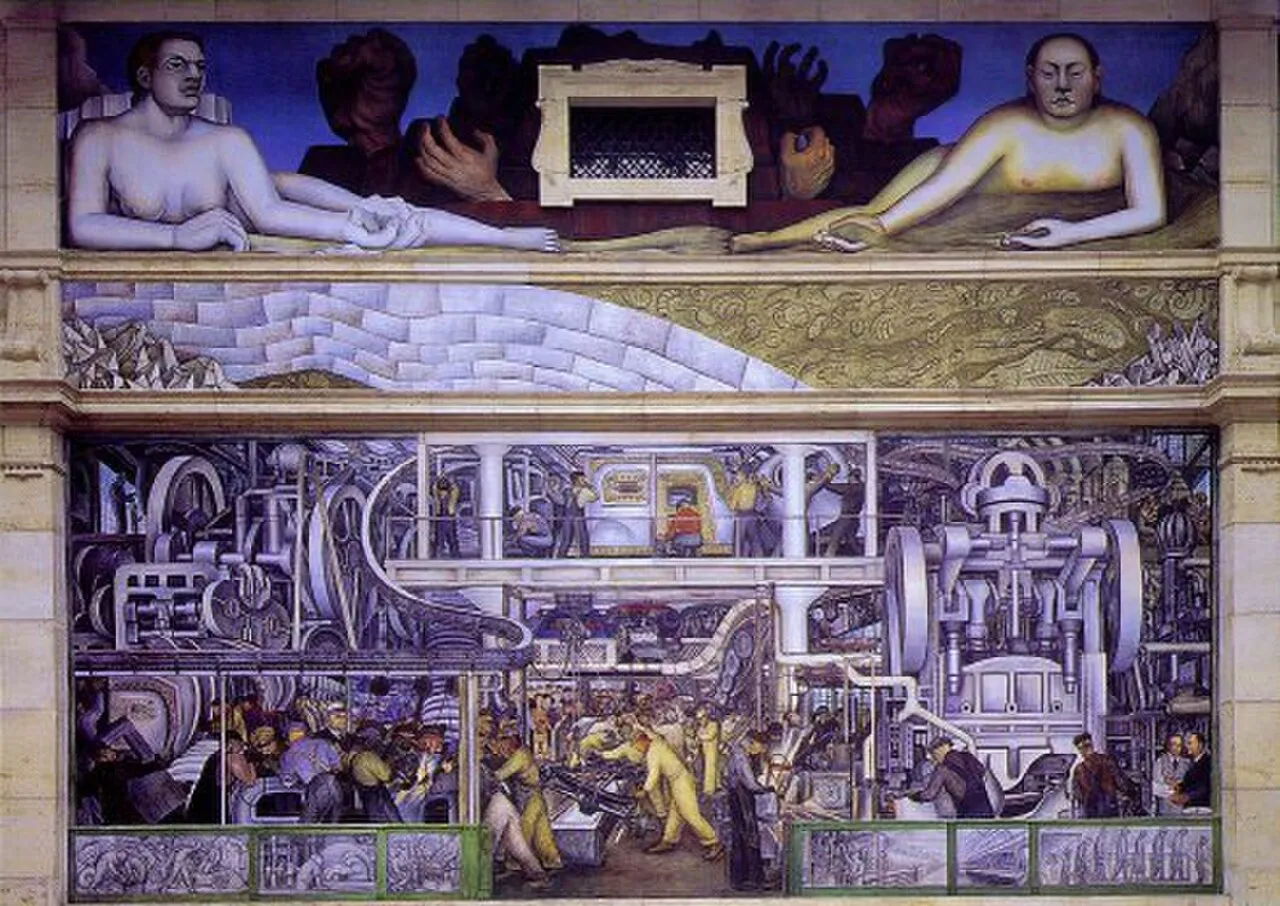
Diego Rivera, Detroit Industry Murals, South Wall (1932 to 1933), fresco, Detroit Institute of Arts. The south wall shows the final assembly of Ford automobiles, with workers depicted as the true creators of industrial civilization. Image: Public domain, via Wikimedia Commons
Rivera's United States commissions brought him into direct conflict with American political sensibilities. His mural for Rockefeller Center in New York, commissioned in 1933, included a portrait of Vladimir Lenin. When Nelson Rockefeller demanded its removal, Rivera refused. The mural was destroyed. Rivera later recreated a version at the Palacio de Bellas Artes in Mexico City, titled "Man at the Crossroads" (1934), where it remains today.
Jose Clemente Orozco: The Dark Prophet
Jose Clemente Orozco (1883 to 1949) is the most formally audacious and thematically dark of the three giants. Where Rivera documented and celebrated, Orozco interrogated and indicted. His murals refuse the triumphalism of Rivera's historical narratives, showing revolution not as liberation but as a cycle of violence and betrayal. He distrusted all ideologies equally, mocking political leaders from left and right with equal ferocity.
Orozco spent several years in the United States, painting murals at Dartmouth College in New Hampshire (1932 to 1934) and at Pomona College in California. His Dartmouth cycle, "The Epic of American Civilization," is a 3,200-square-foot panorama covering the history of the Americas from pre-Columbian civilization through the European conquest to the modern industrial world. The final panels, showing an enormous figure of Christ destroying his own cross in frustration while weapons and machinery accumulate around him, are among the most powerful anti-war images in 20th-century painting.
His most celebrated Mexican work is the fresco cycle at the Government Palace in Guadalajara (1937), where a panel showing Miguel Hidalgo, the father of Mexican independence, holding a blazing torch above a chaotic scene of war and revolution creates an image of deeply ambivalent power. The torch illuminates and it also burns. Revolution liberates and it also destroys. Orozco never let you forget the second half of that equation.
David Alfaro Siqueiros: Experiment and Innovation
David Alfaro Siqueiros (1896 to 1974) was the most politically committed and technically experimental of the three. He was a committed Communist who spent years in exile and imprisonment for his political activities, including a period in the late 1930s when he was implicated in an assassination attempt on Leon Trotsky. He was also the most restless innovator, constantly searching for new materials and techniques that could expand the possibilities of mural painting.
Siqueiros pioneered the use of industrial paints — pyroxilin, later known as Duco lacquer — in place of traditional fresco. He experimented with spray guns, airbrushes, and photography as aids to composition. He developed a theory of "polyangular" perspective in which the viewer moving through a space experiences different relationships with the painted composition, making the mural responsive to movement rather than designed for a single fixed viewpoint.
His most technically ambitious work is "The March of Humanity on Earth and Toward the Cosmos" (1971), created for the Polyforum Cultural Siqueiros in Mexico City. The interior dome covers nearly 4,600 square meters and was executed using projectors, photographs, and industrial lacquers. It is the largest mural painted by a single artist in history.
Fresco Technique: The Ancient Medium Revived
Most Mexican muralist work was executed in buon fresco, the ancient technique of painting with pigment dissolved in water on freshly applied wet plaster. As the plaster dries and carbonates, it locks the pigment into the wall surface. Properly executed fresco is extraordinarily durable: Rivera's National Palace murals have survived nearly a century in Mexico City's seismic environment largely intact.
The process demands meticulous planning and rapid execution. The painter must apply only as much plaster as can be painted in a single session, typically three to five hours. There is no revision once the plaster dries. The muralists typically made extensive preparatory drawings, transferred to the wall using a grid system, before committing to the fresco. This is the same decisive commitment required in Japanese ink painting, discussed in our guide to Japanese art.
Legacy and Influence on American Art
Mexican Muralism had a direct and documented influence on art in the United States. The Federal Art Project of the New Deal era, which employed thousands of American artists to paint murals in post offices, schools, and government buildings throughout the 1930s, was explicitly inspired by the Mexican example. Artists including Thomas Hart Benton and Grant Wood absorbed the muralist tradition. Jackson Pollock worked briefly under Thomas Hart Benton before developing his drip painting technique, and art historians have traced the scale and physical engagement of his mature work back through Benton to the muralists.
In the Chicano civil rights movement of the 1960s and 1970s, Mexican Muralism provided direct inspiration for the community murals that transformed neighborhoods in Los Angeles, San Francisco, and Chicago. The East Los Angeles mural tradition, still active today, traces its lineage directly to Rivera, Orozco, and Siqueiros. A 2023 study published in the Latin American Research Review documents the continuous transmission of muralist techniques and politics through Chicano community mural programs from the 1970s to the present.
Frida Kahlo, Rivera's wife and a major artist in her own right, is the subject of our dedicated spotlight post. For more on how art communicates political content through visual form, the guide to how art communicates without words covers the strategies artists use to make argument through image.
Final Thoughts
Mexican Muralism answered a question that every generation of artists faces: who is art for? Rivera, Orozco, and Siqueiros answered it by putting art on walls that everyone could see, depicting the people who had been excluded from art history, and making political argument inseparable from aesthetic experience. The three artists disagreed sharply about politics, technique, and the role of ideology in art, and that disagreement produced some of the richest internal tension in 20th-century art history.
If you visit Mexico City, the murals at the National Palace and the Palacio de Bellas Artes are essential viewing. In the United States, the Detroit Industry Murals at the Detroit Institute of Arts are worth a special trip. These are not just historical documents. They are arguments about what art owes its public, arguments that remain unresolved. What do you think art owes its audience? Share your thoughts in the comments below.