
In 1917, Marcel Duchamp placed a porcelain urinal on its back, signed it "R. Mutt 1917," titled it "Fountain," and submitted it to a juried exhibition in New York. The exhibition committee rejected it. The original object was lost. We know it only from Alfred Stieglitz's photograph, published in a Dada magazine called The Blind Man. More than a hundred years later, "Fountain" appears on nearly every list of the most influential artworks ever made. Not because of what it looks like. Because of what it proposed: that an artist could designate any manufactured object as art simply by the act of choosing it. The skill, the hand, the aesthetic quality of the object were beside the point. What mattered was the idea.
That proposition spent decades as a marginal curiosity. By the 1960s, a younger generation of artists recognized it as something more: the foundation for an entirely different way of thinking about what art was and what it needed to do. Conceptual Art, the movement that emerged explicitly around 1966-1967, argued that the idea behind a work of art was not just significant but was the artwork itself. The physical object was optional. The execution was a formality. What mattered was the thought.
This guide traces Conceptual Art from Duchamp's readymades through the core movement's key figures and propositions, covers the important critical frameworks that shaped it, and addresses what it actually means to claim that an idea can be a work of art. It is worth understanding. The questions Conceptual Art raised are the questions every subsequent art movement has had to answer.
Duchamp's Readymades: The Seed
Between 1913 and 1921, Duchamp produced a series of "readymades": ordinary manufactured objects designated as art by selection, sometimes repositioning, and signing. "Bicycle Wheel" (1913) was a bicycle wheel mounted upside-down on a kitchen stool. "In Advance of the Broken Arm" (1915) was a snow shovel hung from the ceiling. "L.H.O.O.Q." (1919) was a reproduction of the Mona Lisa with a pencil moustache and a title that formed an obscene pun in French. "Fountain" (1917) was the urinal.
What Duchamp was questioning was where an artwork's value resided. Traditional art valued what the artist's hand made: the skill, the technique, the physical transformation of material. Duchamp asked whether the artist's real contribution might be the act of selection and nomination instead. If pointing to something and saying "this is art" was itself a creative act, then technical skill was irrelevant to artistic identity. What mattered was the decision, the concept, the frame.
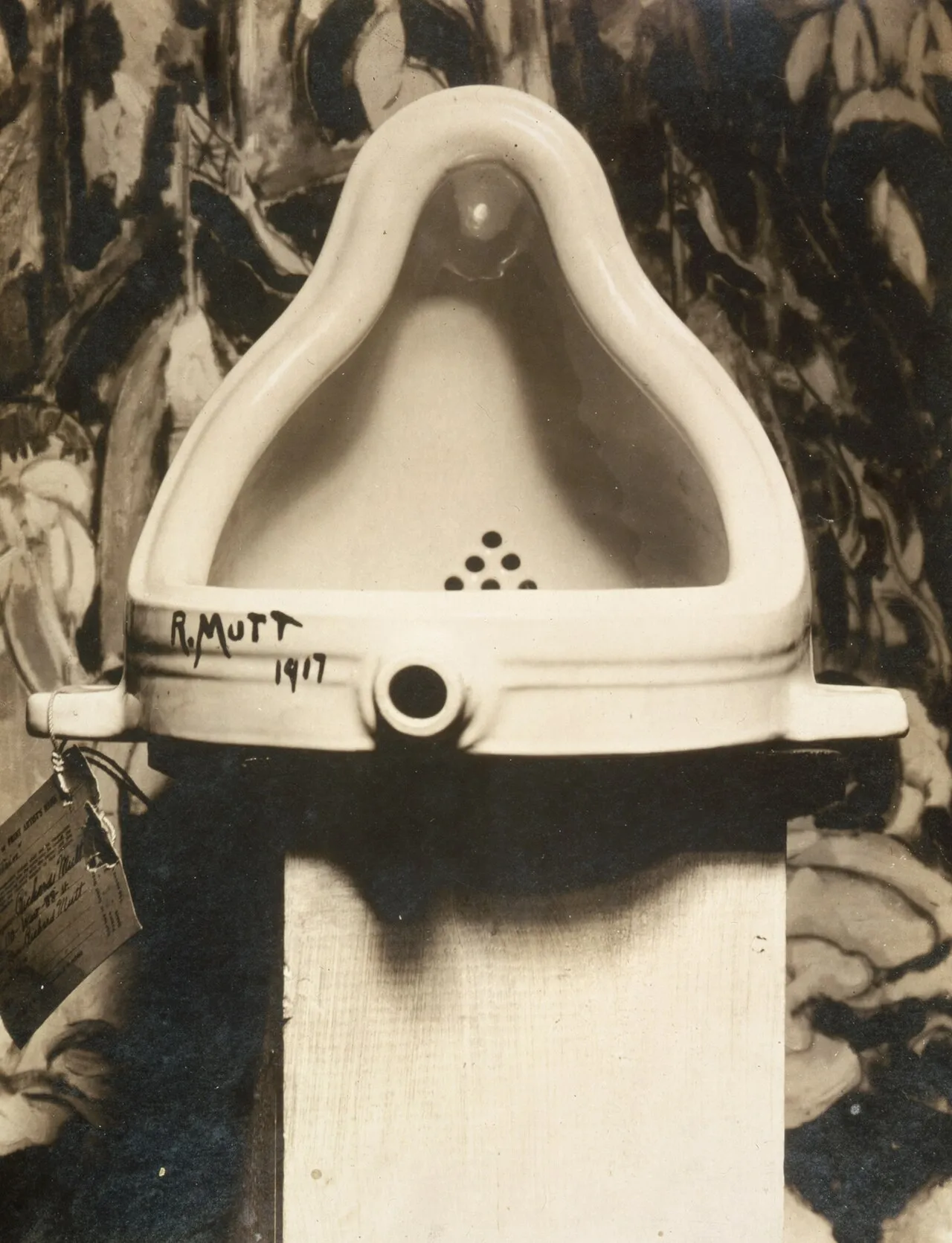
Alfred Stieglitz, photograph of Marcel Duchamp's "Fountain" (1917). Published in The Blind Man, 1917. The original was lost. This photograph is the primary document of one of the most argued-about works in art history. Image: Public domain, via Wikimedia Commons
The art world of 1917 was not ready. "Fountain" was rejected and then lost. Duchamp remained a marginal figure for three decades. By the 1960s, a younger generation rediscovered him and recognized that he had anticipated something they were trying to systematize. As documented by the Museum of Modern Art's documentation of Duchamp's legacy, the readymades were not taken seriously as a major art historical contribution until the 1960s retrospective interest brought them fully into view.
The Movement Names Itself: 1965-1975
The Conceptual Art movement coalesced explicitly in the mid-1960s. Its founding documents are Sol LeWitt's "Paragraphs on Conceptual Art," published in Artforum in June 1967, and Joseph Kosuth's "Art After Philosophy," published in Studio International in 1969. Both texts argued, with different emphases, that the concept behind a work of art was the most important element, and that the physical execution of that concept was secondary or, in some versions of the argument, entirely irrelevant.
LeWitt's "Paragraphs" is direct on this point: "In conceptual art the idea or concept is the most important aspect of the work. When an artist uses a conceptual form of art, it means that all of the planning and decisions are made beforehand and the execution is a perfunctory affair." This inverted the values that had defined Western art for centuries. The making was secondary to the thinking. The hand mattered less than the mind.
Joseph Kosuth: Art as Proposition
Kosuth's "One and Three Chairs" (1965) is the most-reproduced single work from this period, and for good reason. It presents three things together: an actual folding chair, a full-size photograph of that chair, and an enlarged photograph of a dictionary definition of the word "chair." The question the work poses is: which of these three is most essentially a chair? Which is most real? The physical object, the photographic representation, or the linguistic definition?
The work draws on Ludwig Wittgenstein's philosophy of language, which argued that the meaning of words is determined by use within a form of life, not by correspondence to physical objects. Kosuth was extending this argument into visual art: if meaning is linguistic and contextual rather than visual, what exactly is painting doing when it represents an object? That is not a simple question, and "One and Three Chairs" does not answer it. It makes the question unavoidable.
"Art After Philosophy" argued more programmatically that after Duchamp, all art is essentially a proposition about the nature of art. Every artwork asks, implicitly or explicitly: "What is art?" That question is philosophical. The visual appeal of a work is, in Kosuth's view, irrelevant to its status as art. You can argue with this claim. Many serious critics have. But you need to engage with it, because it has shaped how artists and institutions think about art from the late 1960s to the present.
Sol LeWitt: Instructions as the Work
Sol LeWitt's wall drawings are the most practically interesting demonstration of Conceptual Art's principles. Each consists of a set of written instructions specifying how a large-scale geometric drawing should be made on a wall. The instructions might read: "Lines, not short, not straight, crossing and touching, drawn at random using four colors, uniformly dispersed with maximum density, covering the entire surface of the wall." Anyone who can read English and hold a pencil can execute this. The instructions are the artwork. The wall drawing produced by following them is a manifestation of the artwork, but not the artwork itself.
The implications are significant. LeWitt's wall drawings can be destroyed and recreated. They can exist simultaneously in multiple locations. They do not require the artist's physical presence to be realized. The MASS MoCA museum in North Adams, Massachusetts hosts the largest permanent installation of LeWitt's wall drawings in the world: 27,000 square feet across multiple galleries, maintained by trained draftspeople following the original instructions. LeWitt died in 2007. His hand never touched these walls. That is precisely the point of the project.
Yoko Ono: Instructions as Poems
Yoko Ono had been making conceptual work since the late 1950s, independently of and parallel to what would become the Conceptual Art movement. Her "Instruction Paintings" from 1960 onward were short text pieces describing impossible or open-ended actions: "Painting to be constructed in your head. Drill a hole in a canvas and put a rope through it. Look at the rope for as long as you like." Her book "Grapefruit" (1964) collected these instruction pieces and is now recognized as a founding document of both conceptual and performance art. It went out of print, became a cult object, and was republished with a foreword by John Lennon in 1970.
Ono's instructions are often impossible to execute literally, which means they can only be executed in the imagination. They are conceptual artworks that exist in the viewer's mind rather than in any physical space. The work of art is the mental event, the image that forms when you try to "fly" or to "imagine the clouds dripping." This approach connects Conceptual Art to poetry and to meditation rather than to philosophy and systems theory.
Fluxus: Conceptual Art as Performance
Ono was associated with Fluxus, an international network of artists, composers, and performers who shared an interest in process, event, and the dissolution of boundaries between art and daily life. John Cage, George Maciunas, Nam June Paik, and many others organized Fluxus events in which instructions, rather than objects, constituted the work. Fluxus "event scores" were brief written instructions performed live: "Drop a piano from a great height" (Maciunas). "Perform at some distance" (George Brecht). The performances were often deliberately anti-climactic, refusing the drama and virtuosity of conventional performance in the same way the readymade refused the skill of conventional sculpture.
Fluxus connects Conceptual Art to performance art and to video art: Nam June Paik, who collaborated with both Fluxus and Ono, brought the same questioning spirit to television and video as a medium, asking what these technologies could do if freed from their commercial and entertainment functions.
Dematerialization: The Political Argument
In 1968, the critic Lucy Lippard introduced the term "dematerialization" to describe what was happening across Conceptual Art. Her argument was that the physical art object, the thing that collectors bought and museums displayed, was being systematically devalued in favor of the idea, the process, the documentation, or the instruction. This was not accidental. It was a strategy to resist the art market's power to commodify creative work.
If an artwork is a written instruction set, it cannot be uniquely owned. If it is a temporary performance, it disappears. If it is a photograph documenting an action, it can be reproduced at will. These strategies were meant to place the work outside the traditional market's capacity to absorb and sell it. Lippard's 1973 book "Six Years: The Dematerialization of the Art Object from 1966 to 1972" remains one of the most important documents in 20th-century art criticism and is still in print.
The paradox, as Lippard later acknowledged with considerable frustration, is that Conceptual Art was almost immediately absorbed by the market anyway. Certificates of authenticity for ideas became collectible. LeWitt's instructions sold at auction for significant sums. Kosuth's text-based works entered major museum collections at high valuations. The market proved more inventive than the artists had anticipated, finding ways to commodify even the concept of dematerialization. This does not invalidate the argument. It demonstrates how persistent the market's adaptive capacity is.
Why Conceptual Art Still Matters
The period of Conceptual Art's greatest formal coherence ended around 1975. The questions it raised did not go away. Installation art, performance art, video art, net art, and socially engaged practice all proceed from assumptions that Conceptual Art established. The boundary between the art object and the idea behind it, between the work and its documentation, between the artist's intention and the viewer's experience, is now genuinely contested in ways that were not possible before 1967.
If Conceptual Art frustrates you, that frustration is worth sitting with. The frustration usually comes from expecting the work to offer something visually or emotionally, and finding that it offers something philosophically instead. Once you shift the register of expectation, the work becomes accessible. Not easy, but accessible. You do not have to agree that an idea is art to find the argument about why it might be genuinely interesting.
For the broader movements that Conceptual Art emerged from and reacted against, the complete guide to art movements places it in the wider timeline. The guide to Cubism covers the earlier break with representation that made Conceptual Art's questions possible. And for a movement that ran parallel and took a completely different stance on mass culture, the Pop Art guide is worth reading alongside this one. What is your reaction to Conceptual Art? Share your thoughts in the comments.


