The Paris Salon jury of 1877 accused Auguste Rodin of cheating. His sculpture "The Age of Bronze" was so anatomically precise that the committee concluded he must have cast it directly from a living model rather than modeling it by hand. In academic terms, this was not a compliment. It implied that Rodin had skipped the intellectual labor of sculpture entirely and produced a mechanical copy rather than a work of art. Rodin spent the next several years producing photographs, sworn statements from his model Auguste Neyt, and measurements demonstrating that the sculpture differed substantially from the body it depicted. He eventually cleared his name.
What makes the accusation worth dwelling on is what it reveals about the gap between Rodin and his critics. The jury assumed that convincing anatomical rendering in sculpture was only achievable through deception. They had been trained on the smooth, idealized surfaces of Neoclassical sculpture: Canova's porcelain skin, Thorvaldsen's serene perfection. Rodin's surfaces were different. You could see the fingermarks in the clay that the bronze had been cast from. The muscles moved. The skin had texture. It looked like a person rather than an idea of a person, and that was disturbing to the academic establishment in ways they could not quite articulate.
This profile covers Rodin's difficult early career, the three rejections from the École des Beaux-Arts, the monumental Gates of Hell project he never finished, his relationship with Camille Claudel, and the specific ideas about sculpture that made his work the starting point for everything that came after. The Musée Rodin's biographical archive remains the most detailed primary source for his life and working methods.
Three Rejections and a Trip to Italy
François-Auguste-René Rodin was born on November 12, 1840, in Paris, the son of a minor police official. He applied to the École des Beaux-Arts three times and was rejected each time. The school's admissions process favored a certain kind of drawing, smooth, academic, technically controlled in ways that reflected existing conventions. Rodin's drawing was vigorous and direct. It was not what the school wanted.
He spent his twenties and early thirties working in the studios of decorative sculptors, producing ornamental work for buildings and furniture: garlands, masks, architectural details. It was skilled work, but it was not what he wanted to be doing. In 1875, with savings accumulated over years, he traveled to Italy. He spent weeks in Florence and Rome studying Michelangelo's work directly, an experience that changed his understanding of what sculpture could do.
The specific revelation was the non-finito technique in Michelangelo's late sculptures: the "Slaves" intended for Julius II's tomb, the "Rondanini Pietà." In these works, figures emerge from rough, unworked stone. The transitions between highly finished passages and raw marble are abrupt and deliberate. Rodin understood this not as incompletion but as a formal strategy: the rough stone made the finished passages feel more alive by contrast. He came back from Italy with a different idea of what sculpture was for.
The Age of Bronze and the Gate That Changed Everything
"The Age of Bronze" (1876-77) showed Rodin's new direction clearly. A young Belgian soldier named Auguste Neyt posed for the work over eighteen months. The figure stands life-size, eyes closed, one arm raised, in a posture suggesting waking or dawning consciousness. There is no allegory, no mythological narrative, no heroic gesture. Just a body in a state of elemental physical experience, modeled with attention to what muscle and bone actually look like rather than what academic convention said they should look like. The surface of the final bronze preserved the texture of the modeled clay: fingerprints, tool marks, the evidence of process rather than its erasure.
After the casting-from-life controversy was resolved in his favor, the French state purchased the sculpture and offered Rodin a commission that would define the next forty years of his life. A new Museum of Decorative Arts was planned for Paris, and Rodin was asked to design a monumental bronze door. He chose as his subject Dante's Inferno and Baudelaire's "Flowers of Evil." The commission became "The Gates of Hell."
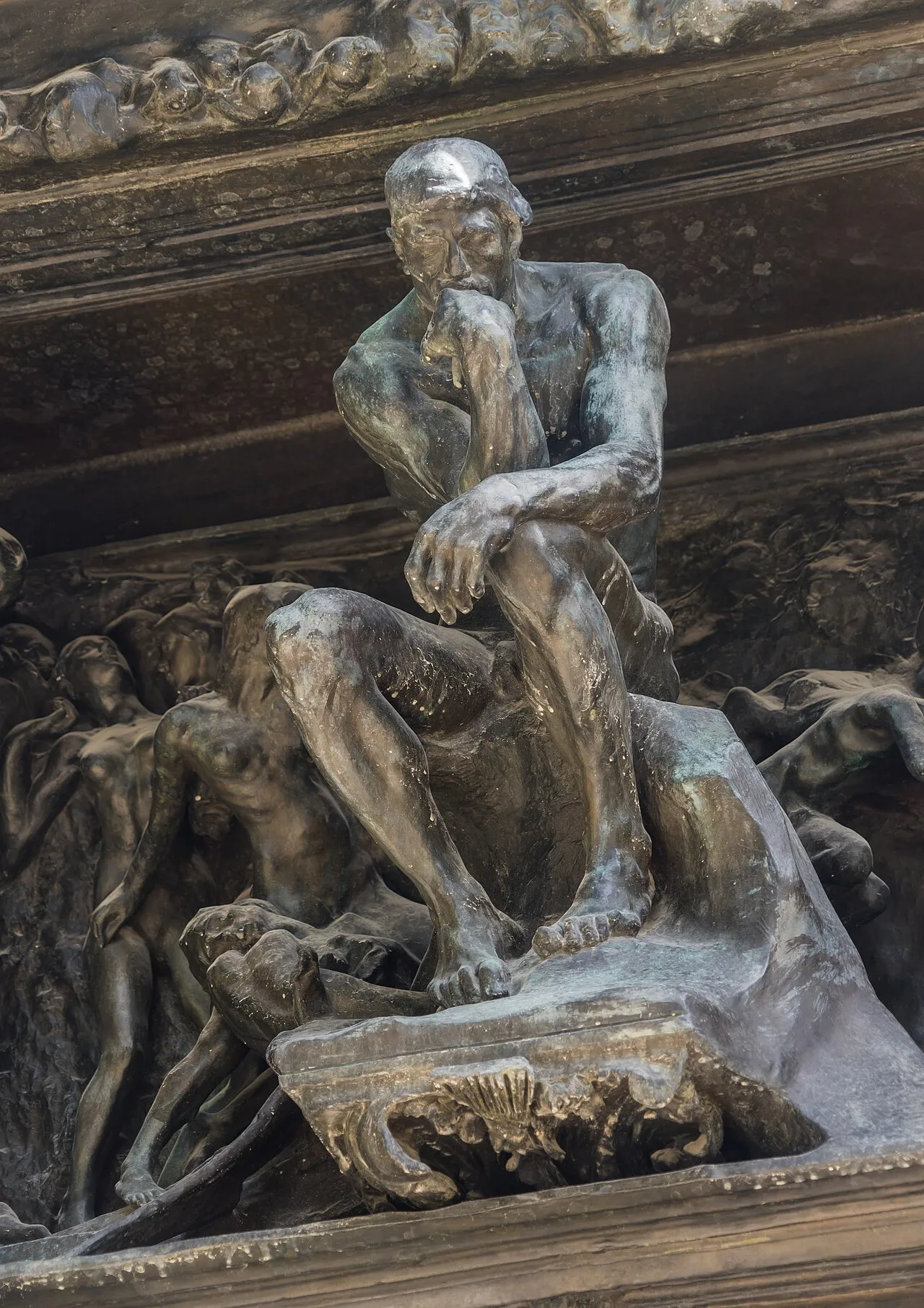
Auguste Rodin, "The Gates of Hell" (1880-1917), bronze, 635 x 400 x 85 cm. Musée Rodin, Paris. Several posthumous casts exist worldwide, including at Stanford University and the Philadelphia Museum of Art. Image: Public domain, via Wikimedia Commons
The planned museum was never built. Rodin worked on the Gates anyway, for thirty-seven years, until his death in 1917. The doors are approximately six meters high and covered with over 180 individual figures in states of torment, desire, and physical extremity. He used the project as a permanent workshop, continuously adding and removing figures, extracting individual forms to cast as independent sculptures. "The Thinker" (1880) was originally the central figure above the doors, a poet contemplating the suffering below him. "The Kiss" (1882) began as a figure inside the Gates and was removed because its tenderness seemed wrong in context. "The Three Shades" (1882), three identical figures with bowed heads, stands at the apex. The Gates were never finished to Rodin's satisfaction. The posthumous bronze casts, made from the plaster he left in his studio, preserve a work in permanent process.
The Thinker: How a Small Figure Became an Icon
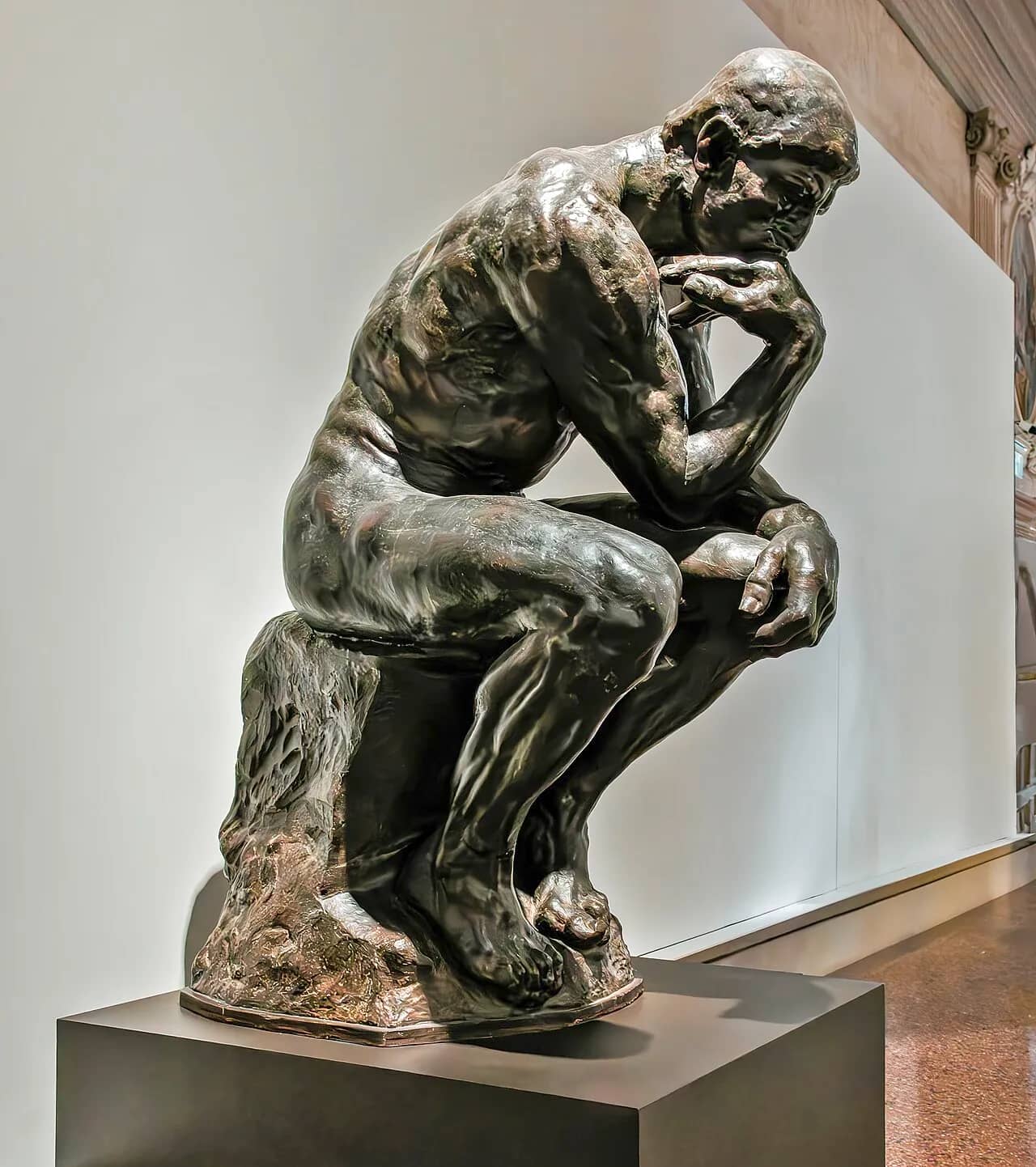
In its original form as part of the Gates, "The Thinker" is roughly 70 centimeters tall. The enlarged independent version, which is the one most people know, was cast in 1902 at approximately 180 centimeters. More than twenty authorized casts of this enlarged version exist in museums and public spaces worldwide, including outside the Musée Rodin in Paris and at the Cleveland Museum of Art.
The figure's pose is unusual for a contemplative subject. He does not sit upright or hold his chin delicately. He bends forward, elbows on knees, his chin resting on the back of one hand with the thumb pressing into his cheek. The muscles across his back are engaged. He looks like someone thinking hard enough to make it physical, a quality that made the sculpture immediately accessible to a broader public than most serious sculpture reaches. Rodin said of the figure: "What makes my Thinker think is that he thinks not only with his brain, with his knitted brow, his distended nostrils and compressed lips, but with every muscle of his arms, back, and legs, with his clenched fist and gripping toes."
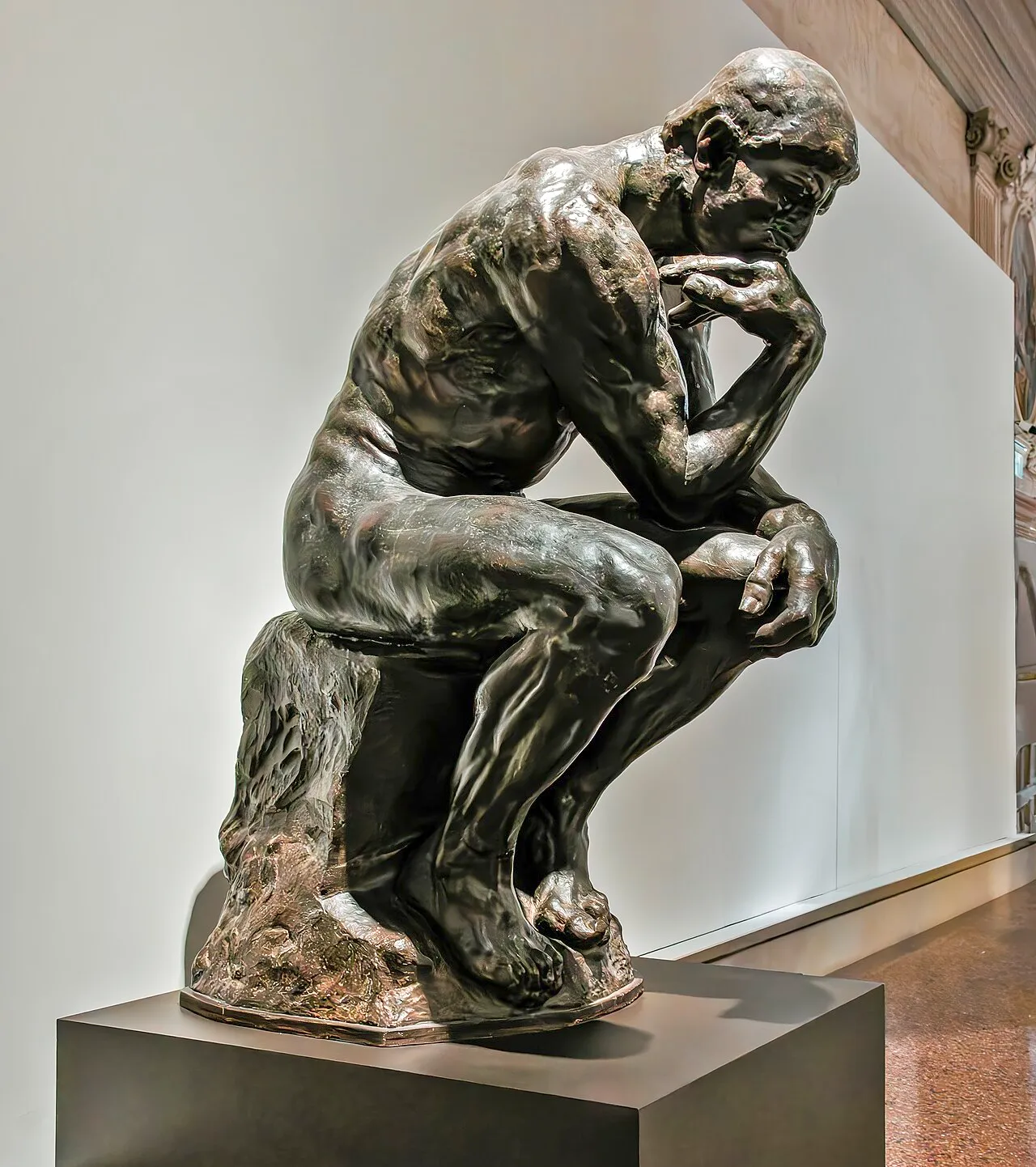
Auguste Rodin, "The Thinker" (1880, enlarged 1902), bronze. Musée Rodin, Paris (original cast). Over twenty authorized casts of the enlarged version exist in major museums worldwide. Image: Public domain, via Wikimedia Commons
Camille Claudel: The Collaboration That Ended Badly
Camille Claudel entered Rodin's studio as a student in 1882. She was eighteen; Rodin was forty-two and already living with Rose Beuret, who had been his companion since the late 1860s and would remain so until the end of his life. What followed was both an artistic collaboration and a romantic relationship of considerable intensity, and untangling them has occupied art historians for decades.
Claudel was a sculptor of exceptional ability. Her independent works, particularly "The Age of Maturity" (1899-1905) and "The Waltz" (1892-1905), demonstrate technical mastery and psychological complexity that stand fully on their own terms. The Musée Rodin's reattribution of certain works from Rodin's period, acknowledging Claudel's primary hand in pieces previously listed under Rodin's name, has been ongoing since the 1980s and is not complete. The relationship ended around 1898 when Rodin refused to leave Beuret. Claudel's mental health deteriorated over the following years. In 1913, her family had her committed to a psychiatric institution, where she remained until her death in 1943. Rodin died in 1917, four years earlier. He had not visited her in the institution.
The Burghers of Calais: A Different Kind of Monument
In 1884, the city of Calais commissioned a monument commemorating the six burghers who surrendered themselves to the English in 1347 to save the town from destruction during the Hundred Years' War. The expectation was a standard triumphal group: heroes elevated on a pedestal, rendered in postures of noble sacrifice, reassuring and distant.
Rodin proposed something different. He showed the six men as individuals, each at a different point in the psychological arc of their decision: one gathering courage, one in despair, one resigned, one looking back. He arranged them not in a composed pyramidal group but in a loose, straggling procession. And he proposed placing them at ground level in the public square, so that ordinary citizens would walk among them rather than looking up at them from below.
The Calais authorities hated the proposal. They had commissioned heroes and received men in the grip of fear. Rodin argued that showing the actual psychological cost of courage, rather than its idealized aftermath, was more genuinely honoring. The monument was installed in 1895 on a conventional high pedestal, over Rodin's protest. His original low-pedestal vision was not realized until a second casting was installed in London in 1915. The work is now recognized as one of the most consequential public sculptures ever made, and Rodin's argument about sculpture's relationship to its viewers, that proximity and human scale generate more meaning than monumental elevation, proved to be correct in a way the 20th century would demonstrate repeatedly.
Final Thoughts
Rodin died on November 17, 1917, in Meudon, France. He had left his studio, collections, and the rights to his work to the French state a year earlier, forming the basis of the Musée Rodin in Paris, which opened the following year.
His influence on sculpture after him is hard to overstate, though it operated in strange ways. Henry Moore learned from Rodin's exploration of the non-finito. Constantin Brancusi worked briefly in Rodin's studio before concluding, famously, that nothing could grow in the shadow of great trees, and departing to pursue an absolutely opposite direction toward abstraction and polish. Alberto Giacometti's elongated figures are not Rodinesque in style but they carry the same commitment to the body as a vehicle for psychological states rather than physical ideality. The entire tradition of figurative sculpture that treats the surface as a record of process rather than its erasure begins with the marks Rodin left in bronze.
For the materials and methods that Rodin worked with throughout his career, read the guide to Sculpture Materials: Clay, Bronze, Marble, and Found Objects. For the classical tradition he built on and broke from, see Renaissance Art: Perspective, Humanism, and the Birth of Modern Art. Have you encountered a Rodin sculpture in person? What surprised you most? Share your thoughts below.