
In 1888, Vincent van Gogh ordered three types of chrome yellow from his Paris art supplier Tasset et L'Hôte: Chrome 1 (lemon), Chrome 2 (yellow), and Chrome 3 (orange). He used them to paint "Sunflowers," the most famous yellow paintings in art history. The sunflowers are brilliant, almost radioactive, in their yellow intensity. But chrome yellow has a problem. It is lead chromate (PbCrO4), a toxic compound of lead and chromium. It darkens on exposure to light. The sunflowers that Van Gogh painted in 1888 are not the same color today. The chrome yellow has darkened. Some areas have turned brown or greenish. The painting is fading in real time, and the fading is irreversible. Van Gogh knew the risks. Renoir had warned that chrome yellow "plays nasty tricks." "I used chrome yellow which is a superb colour but which apparently plays nasty tricks," Renoir said. "I tried cadmium; I found great difficulties in using it, it made me paint heavy." Van Gogh chose the superb color over the stable one, and the result is a painting that is slowly destroying itself.
Yellow is the color of sunlight, of gold, of warmth, and of madness, poison, and betrayal. In the Renaissance, it was the color of Judas's robes. In many paintings, Judas wears yellow to signify treachery. In the 19th century, it was the color of chrome (toxic), Indian yellow (made from cow urine), and lead-tin yellow (a Renaissance pigment whose formula was lost for 300 years). In the 20th century, it was the color of Van Gogh's madness: the "yellow house" in Arles where he cut off his ear, the yellow stars in "The Starry Night," the yellow wheat fields of his final paintings. This guide covers the history of yellow in art: Indian yellow and its bovine origins, lead-tin yellow and the lost formula, chrome yellow (1797/1809) and its darkening, cadmium yellow (1840s) and its stability, Van Gogh's yellow obsession, Turner's yellow sunsets, and what yellow means in art in 2026. For the companion piece, read our guide to the history of blue.
Indian Yellow: The Pigment from Cow Urine
Indian yellow (magnesium euxanthate) was a yellow pigment used in Indian and European painting from the 15th to the 19th centuries. It was a brilliant, transparent yellow, ideal for glazes and watercolor washes. It was imported from India, where it was made in Monghyr (modern Bihar).
The source is the part that stops people. Indian yellow was made from the urine of cows fed exclusively on mango leaves. The cows' urine was collected, dried, and formed into balls called "piuri." The process was cruel. The mango-leaf diet caused malnutrition and kidney damage in the cows. An investigation in 1883 by the Indian economist K. T. Acharya exposed the practice, and the pigment was banned in India by 1908.
Indian yellow was used by Indian miniature painters (Mughal and Rajput schools) and by European painters who imported it through the East India Company. Turner used it for his golden sunsets. "The Fighting Temeraire" (1839) uses Indian yellow in the sky. The pigment's transparency made it ideal for glazing. A thin layer of Indian yellow over a white ground produced a luminous golden glow that you cannot get with an opaque yellow.
Indian yellow is a pigment whose beauty is inseparable from cruelty. The brilliant yellow that glows in Turner's sunsets was produced by starving cows. The pigment was banned because of animal cruelty, one of the few pigments to be banned for ethical rather than toxicological reasons. For more on how art encodes these kinds of social relations, see our guide to art and society.
Lead-Tin Yellow and the Lost Formula
Lead-tin yellow (lead stannate, Pb2SnO4) was the standard yellow pigment in European painting from the 14th to the 18th centuries. It was used by Vermeer, Rembrandt, and the Dutch Golden Age painters. Vermeer's "The Milkmaid" (c. 1657-1658) uses lead-tin yellow for the woman's yellow bodice.
Around 1750, lead-tin yellow disappeared from use. The formula was lost. Painters switched to Naples yellow (lead antimonate) and, later, chrome yellow. For 200 years, no one knew what the yellow in Vermeer's paintings was. The pigment was rediscovered in 1941 by the German chemist Richard Jacobi, who identified it in samples from old master paintings. The formula had been lost for nearly 200 years.
The loss of lead-tin yellow is a reminder that pigments are not permanent. They can be lost, forgotten, and rediscovered. The yellows in Vermeer's paintings were unidentifiable for two centuries. The material history of art is fragile. Pigments disappear, formulas are lost, and the colors we see in museums may not be the colors the painters intended. For more on Vermeer specifically, see our guide to Vermeer.
Chrome Yellow: The Color That Darkens (1797/1809)
Chromium was discovered in 1797 by the French chemist Louis Nicolas Vauquelin (1763-1829), who isolated the element from crocoite (lead chromate, PbCrO4), a mineral from the Ural Mountains of Siberia. Vauquelin named the element "chromium" from the Greek "chroma" (color) because its compounds are so intensely colored. Chrome yellow (lead chromate, PbCrO4) was first synthesized by Vauquelin in 1809 and published in "Annales de Chimie." It was commercially available by 1816-1818. The pigment is a bright, opaque yellow with high covering power. It ranges from primrose yellow (light, with lead sulfate) to orange-yellow (basic lead chromate). According to the WebExhibits overview of chrome yellow, it was "a superb colour" that quickly became popular.
The problem is that chrome yellow darkens on exposure to light. The chromate ion undergoes photo-reduction: Cr(VI) is reduced to Cr(III), which changes the color from bright yellow to dull brown or greenish. The darkening is irreversible. A 2018 study in "Angewandte Chemie" used macroscopic X-ray powder diffraction imaging of Van Gogh's "Sunflowers" and found two subtypes of chrome yellow in the same painting: the light-fast monoclinic PbCrO4 (LF-CY) and the light-sensitive monoclinic PbCr1-xSxO4 (x approximately 0.5; LS-CY). The light-sensitive variety was found in more than 50% of the chrome yellow regions, including the pale-yellow background and the bright-yellow petals. Some petals are still bright yellow. Others have darkened to brown. The painting is a time-lapse of chrome yellow's degradation.
Chrome yellow contains lead (Pb) and chromium (Cr), both toxic. Lead causes lead poisoning. Chromium (VI) is a known carcinogen. The pigment was largely replaced by cadmium yellow in the 20th century due to its toxicity and instability. Despite the problems, chrome yellow was widely used by 19th-century painters: Turner, Manet, Cézanne, Monet, Pissarro, Seurat, and Van Gogh. Cézanne used it to make "colored grays" by combining chrome yellow, ultramarine, and vermilion. Seurat's "A Sunday on La Grande Jatte" (1884-1886) uses chrome yellow that has darkened significantly. The painting is browner today than when it was made. For the basics of how color mixing works, see our guide to color theory, and for more on chrome yellow as a paint, see the Natural Pigments page on chrome yellow paint.
Van Gogh's Yellow Obsession
Van Gogh's letters to his brother Theo are full of yellow. He ordered chrome yellow in three hues (Chrome 1, 2, 3) from Tasset et L'Hôte in April 1888. He described "The Sower" as "one half is yellow, the upper part, the lower part is purple," a direct application of complementary color theory.
"Sunflowers" (1888), 92.1 x 73 cm, at the Van Gogh Museum, was painted in Arles to decorate the Yellow House for Gauguin's arrival. The painting uses chrome yellow in multiple formulations. The 2018 Angewandte Chemie study found both lightfast PbCrO4 and unstable sulfur-rich PbCr1-xSxO4 in the same painting. Some petals are still bright yellow. Others have darkened to brown. The painting is a patchwork of stable and unstable yellows. Some areas will survive. Others will not. The Van Gogh Museum's conservation team has concluded that "Sunflowers" is "stable, but fragile" and has decided the painting will no longer travel away from the museum.

Vincent van Gogh, "Sunflowers" (1888). Oil on canvas, 92.1 x 73 cm. Van Gogh Museum, Amsterdam. Image via Wikimedia Commons
"The Starry Night" (1889), 73.7 x 92.1 cm, at MoMA, is different. The stars and moon are painted with Indian yellow and zinc yellow (zinc chromate). Scientific analysis confirmed "indian yellow and zinc yellow for the stars and moon." The yellow of the stars is still visible. Indian yellow and zinc yellow are more lightfast than chrome yellow. "The Night Café" (1888), 70 x 89 cm, at the Yale University Art Gallery, Van Gogh described as "the most ugly" painting he had done, a room of "blood-red and dull yellow" walls. The yellow is chrome yellow, the red is vermilion. The painting is a study in the violence of color, yellow used not for sunlight but for sickness.
The Yellow House at 4 Place Lamartine, Arles, was where Van Gogh lived with Gauguin for nine weeks before the ear-cutting incident of December 1888. He rented it in May 1888 and painted it yellow in his painting "The Yellow House" (1888). The house was destroyed by Allied bombing in 1944. Van Gogh's yellow is not just a color choice. It is a psychological statement. He associated yellow with sunlight, warmth, and emotional energy. But the yellow he used (chrome yellow) was unstable and toxic, a "superb colour" that "plays nasty tricks." The contradiction is Van Gogh: brilliant and self-destructive, luminous and doomed. For more on his life and work, see our guide to Van Gogh.

Vincent van Gogh, "The Starry Night" (1889). Oil on canvas, 73.7 x 92.1 cm. Museum of Modern Art, New York. Image via Wikimedia Commons
Cadmium Yellow: The Stable Alternative (1840s)
Cadmium yellow (cadmium sulfide, CdS) became available in the 1840s. It is brilliant, opaque, stable, and lightfast. It does not darken like chrome yellow. It is also less toxic (cadmium is toxic but less so than lead chromate). The adoption was slow at first because it was expensive. By the 1860s, it was widely available. Monet, Pissarro, and Cézanne used it alongside chrome yellow. By the 20th century, cadmium yellow had largely replaced chrome yellow in artists' palettes.
Van Gogh used both chrome yellow and cadmium yellow. His letters show orders for both. "Sunflowers" uses chrome yellow (unstable) for the petals and cadmium yellow (stable) for the warmer orange tones. The painting is a patchwork of stable and unstable yellows. Some areas will survive, others will not.
Cadmium yellow is the modern yellow: stable, safe, affordable. But it is also a different color from chrome yellow. It is warmer, denser, less luminous. The yellow of old master paintings (lead-tin yellow) and the yellow of 19th-century paintings (chrome yellow) and the yellow of modern paintings (cadmium yellow) are three different colors. The history of yellow is not a history of one color but of many. For more on how these pigments work in practice, see our guide to oil painting techniques.
Turner and the Yellow Sunset
J.M.W. Turner (1775-1851) was the master of yellow in 19th-century British painting. "The Fighting Temeraire" (1839), 90.7 x 122.6 cm, at the National Gallery in London, uses Indian yellow and chrome yellow in the sunset sky. The painting shows a ghostly white ship being towed by a black steam tug, with a golden yellow sunset behind. The yellow is not decorative. It is the emotional center of the painting, the glow of a passing era.
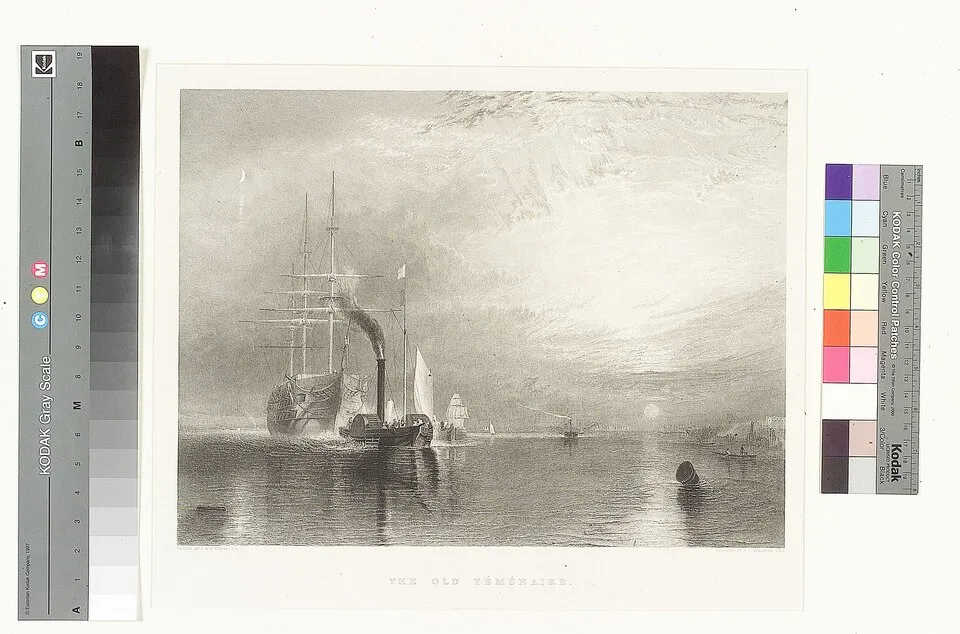
J.M.W. Turner, "The Fighting Temeraire" (1839). Oil on canvas, 90.7 x 122.6 cm. National Gallery, London. Image via Wikimedia Commons
Turner used Indian yellow extensively, and he also used chrome yellow. The problem is that many of Turner's reds and yellows have faded. He used cochineal lake for reds, which is "quite fugitive," and chrome yellow for yellows, which darkens. The Turner you see in the National Gallery today is not the Turner he painted. The colors have shifted. The yellow sunsets are paler. The reds have faded to pink. Turner knew the risks and refused to stop. He chose the superb color over the stable one, the same choice Van Gogh would make decades later.
Yellow in 2026
Museums are fighting a losing battle against chrome yellow degradation. The Van Gogh Museum, the National Gallery, and the Getty Conservation Institute have all conducted research on chrome yellow darkening. The process is irreversible. There is no way to restore the original color. The sunflowers that Van Gogh painted in 1888 will continue to darken. The Van Gogh Museum has decided that "Sunflowers" will no longer travel, to minimize vibrations and climate changes that could accelerate degradation. The painting is stable but fragile, and the museum is treating it accordingly.
The search for non-toxic yellow pigments continues. Mas Subramanian's lab at Oregon State University, which discovered YInMn blue in 2009, has produced durable, non-toxic yellows, oranges, and reddish pigments using a thortveitite-like crystal lattice with nickel, zinc, and vanadium. These pigments are stable under high temperatures and in acidic environments, and they can be made at relatively low temperatures (around 750 degrees Celsius), which makes large-scale production feasible. The work was published in "Chemistry of Materials" and funded by the National Science Foundation. Whether these pigments will replace cadmium yellow in artists' palettes remains to be seen.
Yellow still means what it has always meant: sunlight, warmth, gold, and madness. The yellow of a sunflower, the yellow of a taxi, the yellow of a warning sign. All carry the weight of pigment history. Yellow is the color of optimism and danger, the color that Van Gogh loved and that is slowly destroying his paintings. For more on where art is heading, see our guide to contemporary art trends in 2026.
Final Thoughts
Yellow is the color of sunlight and of self-destruction. Indian yellow was made from the urine of mango-fed cows, banned for animal cruelty in 1908. Lead-tin yellow was the standard yellow of the Renaissance, its formula lost for 200 years and rediscovered in 1941. Chrome yellow (1797/1809) gave Van Gogh his sunflowers, but it contains lead and chromium, and it darkens irreversibly on exposure to light. The sunflowers are fading. Cadmium yellow (1840s) is the stable alternative, but it is a different color: warmer, denser, less luminous. The history of yellow is the history of art's relationship to light, to toxicity, and to time.
Next time you see Van Gogh's "Sunflowers," in person or in reproduction, know that the yellow you see is not the yellow Van Gogh painted. The chrome yellow has darkened. The painting is fading in real time. The sunflowers are slowly dying, and there is nothing anyone can do about it. That is the tragedy of yellow: the most brilliant color is the most fragile.


