
In 1500, Albrecht Dürer painted a self-portrait that shocked the art world. He painted himself frontal, facing the viewer directly, symmetrically, with long golden-brown hair and a fur-trimmed robe. The pose was not new. It had been used for over a thousand years, but it had been used for Christ. Dürer painted himself in the pose of Christ. He was 28 years old. The inscription on the painting reads: "I, Albrecht Dürer of Nuremberg, painted myself in my own colors at the age of 28." The painting is not just a self-portrait. It is a declaration. Dürer is saying: I am the creator. My face is worth painting. My image is worth preserving. I am not a craftsman who takes commissions. I am an artist who makes himself the subject. The self-portrait as we know it, the artist as subject, the artist as author, the artist as authority, begins with Dürer in 1500.
Self-portraiture is one of the oldest genres in art, but it was not always a genre. The earliest self-portraits were incidental. Artists painted themselves into crowd scenes or group portraits, often as a signature. The self-portrait as an independent work, a painting made for its own sake depicting only the artist, emerged in the Renaissance, enabled by two technologies: the mirror, which became cheaper and clearer in the 15th century, and oil paint, which allowed the slow, layered work that self-portraiture requires. This guide covers the history of the self-portrait, from the earliest examples to Dürer and the artist as Christ, Rembrandt and the lifelong self-portrait, Artemisia Gentileschi and the female self-portrait, Van Gogh and the self-portrait as diagnosis, Cindy Sherman and the self-portrait as performance, the psychology of self-portraiture, and what the self-portrait means in the age of the selfie.
The Earliest Self-Portraits: From Marginalia to Mirror
The first known self-portrait is by the Egyptian sculptor Bak (c. 1345 BCE), who carved himself and his wife into a stela alongside Pharaoh Akhenaten. In the medieval period, self-portraits appear in manuscript illuminations: the monk Eadwine at work in the Eadwine Psalter (c. 1150), the sculptor Gislebertus on the tympanum at Autun (c. 1120-1135). These are not self-portraits in the modern sense. They are signatures, embedded in larger works. The artist is present but not the subject.
The self-portrait as an independent genre required the mirror. Before the 15th century, mirrors were made of polished metal: small, dim, and imprecise. In the 15th century, glass mirrors backed with tin-mercury amalgam were developed in Venice. The new mirrors were larger, clearer, and cheaper. For the first time, an artist could see their own face in detail and paint it. Catharina van Hemessen (1528-after 1565) painted "Self-Portrait" (1548), the first known self-portrait of an artist at work at an easel. The painting shows van Hemessen at her easel, brushes and palette in hand, looking at herself in a mirror. The painting is small (32 x 25 cm) and modest, but it is a declaration: I am a painter. This is what I look like. This is what I do. For more on how to read works like this, see our guide on how to look at art for beginners.
Dürer: The Artist as Christ (1500)
"Self-Portrait with Fur-Trimmed Robe" (1500, oil on lime panel, 67.1 x 48.9 cm, Alte Pinakothek, Munich) is the founding moment of the self-portrait as a genre. Dürer painted himself frontal, symmetrically, with long hair arranged like Christ's. The pose was traditionally reserved for images of Christ as Salvator Mundi (Savior of the World). By adopting it, Dürer equated the artist's creative power with divine creation.
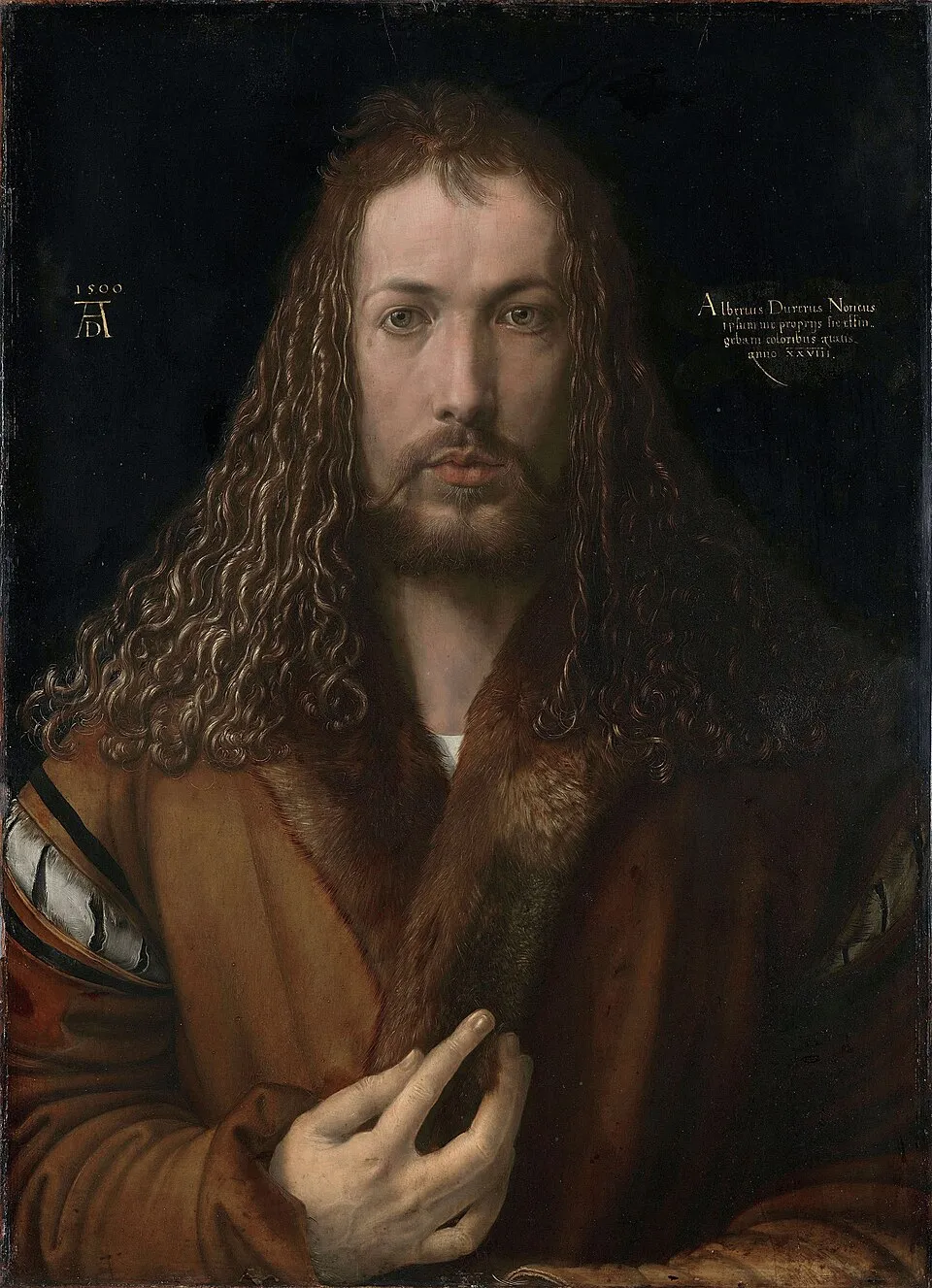
Albrecht Dürer, "Self-Portrait with Fur-Trimmed Robe" (1500). Oil on lime panel, 67.1 x 48.9 cm. Alte Pinakothek, Munich. Image via Wikimedia Commons
In 1500, artists were still classified as craftsmen, manual workers, not intellectuals. Dürer's self-portrait is a claim for the artist's status. The artist is not a manual worker but a creator, endowed with a divine gift. The inscription, "I painted myself in my own colors," emphasizes the artist's agency. The painting is not a commission. It is a self-creation. Dürer's first self-portrait was drawn at age 13 (1484, silverpoint, 27.5 x 19.6 cm, Albertina, Vienna), a precocious self-study. His "Self-Portrait with a Carnation" (1493, oil on vellum, 57 x 45 cm, Louvre) was painted at age 22 as a gift for his fiancée. The 1500 self-portrait is the culmination: the artist as creator, as Christ, as authority. After Dürer, the self-portrait becomes a genre that artists return to throughout their careers. For more on the works that defined this period, see our guide to famous paintings explained.
Rembrandt: The Lifelong Self-Portrait (1628-1669)
Rembrandt painted about 40 self-portrait paintings, 31 etchings, and 7 drawings, more than any artist before him. The self-portraits span his entire career, from age 22 (1628) to his death at 63 (1669). No artist has ever documented their own face so thoroughly. The young Rembrandt experimented with expression: surprise, laughter, anger. He used himself as a model for studies of emotion (tronies). "Self-Portrait in a Gorget" (c. 1629, 38 x 31 cm, Mauritshuis) shows him in costume, playing a role. "Self-Portrait Leaning on a Stone Sill" (1640, 102 x 80 cm, National Gallery, London) shows him in 16th-century costume, echoing Titian and Raphael, a claim to artistic lineage.
As Rembrandt's career peaked and then declined, the self-portraits became more sober. "Self-Portrait" (1658, 133.7 x 103.8 cm, Frick Collection) shows him at 52, seated like a king in a golden robe. "Self-Portrait with Beret and Turned-Up Collar" (1659, 84.5 x 66 cm, National Gallery of Art, Washington) shows him at 53, his face lined, his expression ambiguous. "Self-Portrait" (1660, 80.3 x 67.3 cm, Metropolitan Museum of Art) shows him at 54, weary and unflinching. "Self-Portrait" (1669, 86 x 70.5 cm, Mauritshuis), his last, painted in the year of his death, shows a 63-year-old man with thin white hair, deep wrinkles, and an unflinching gaze. There is no posing, no costume, no performance. Just a face, looking at itself.
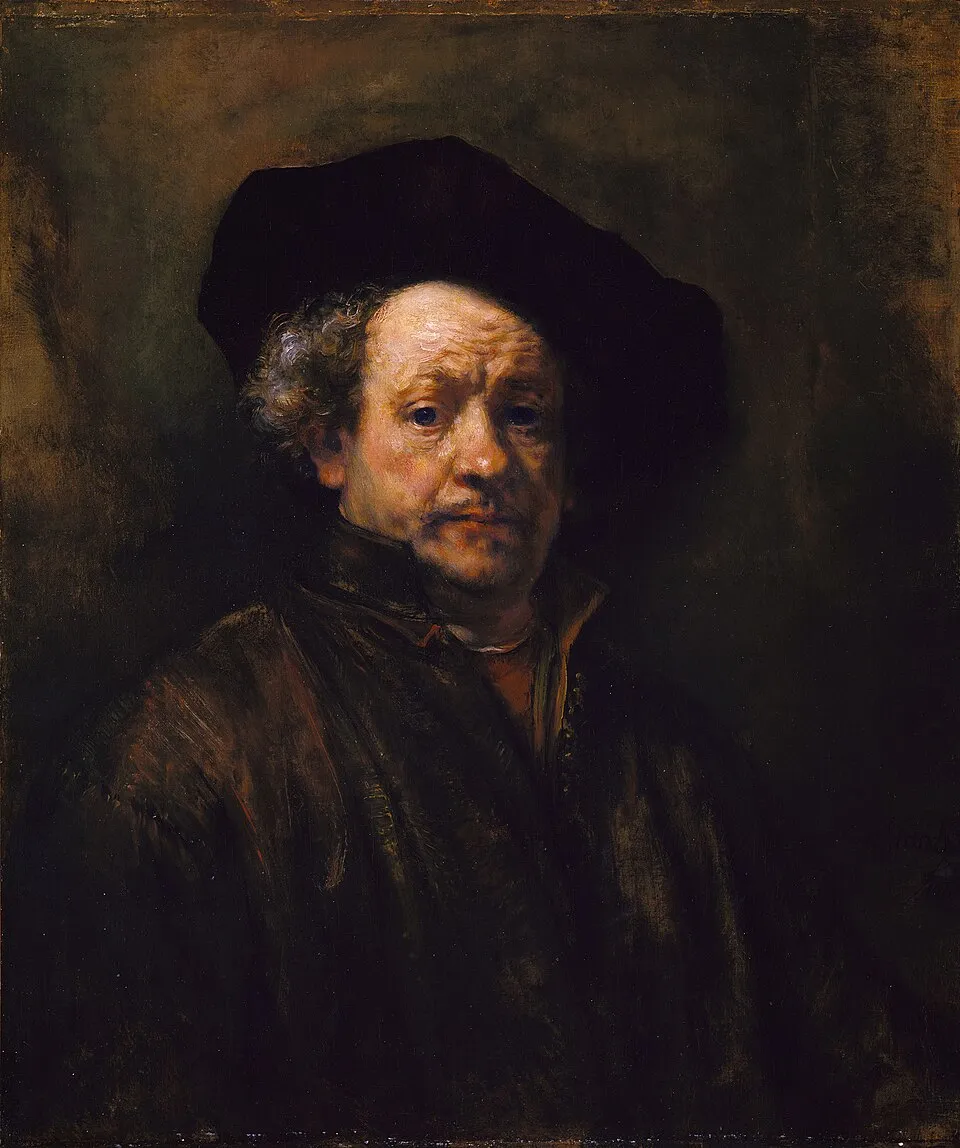
Rembrandt van Rijn, "Self-Portrait" (1660). Oil on canvas, 80.3 x 67.3 cm. Metropolitan Museum of Art, New York. Image via Wikimedia Commons
Rembrandt's self-portraits are a visual autobiography, a record of a face aging, a career rising and falling, and a self that keeps looking. No artist has ever been more honest with themselves. The late self-portraits are the most honest self-portraits in art history. They do not flatter, they do not idealize, they do not perform. They show an old man looking at himself, and the looking is the subject. For more on the painter behind these works, see our profile of Rembrandt.
Artemisia Gentileschi: The Female Self-Portrait (c. 1638-1639)
"Self-Portrait as the Allegory of Painting (La Pittura)" (c. 1638-1639, oil on canvas, 98.6 x 75.2 cm, Royal Collection, Buckingham Palace) is the first self-portrait by a woman that claims the authority of the genre. Gentileschi depicts herself as La Pittura, the personification of Painting, as described in Cesare Ripa's "Iconologia" (1593). Ripa specifies that Painting has disheveled hair, a mask around her neck (representing imitation), and a chain of gold at her throat. Gentileschi matches every detail, but she paints her own face, not an idealized figure.
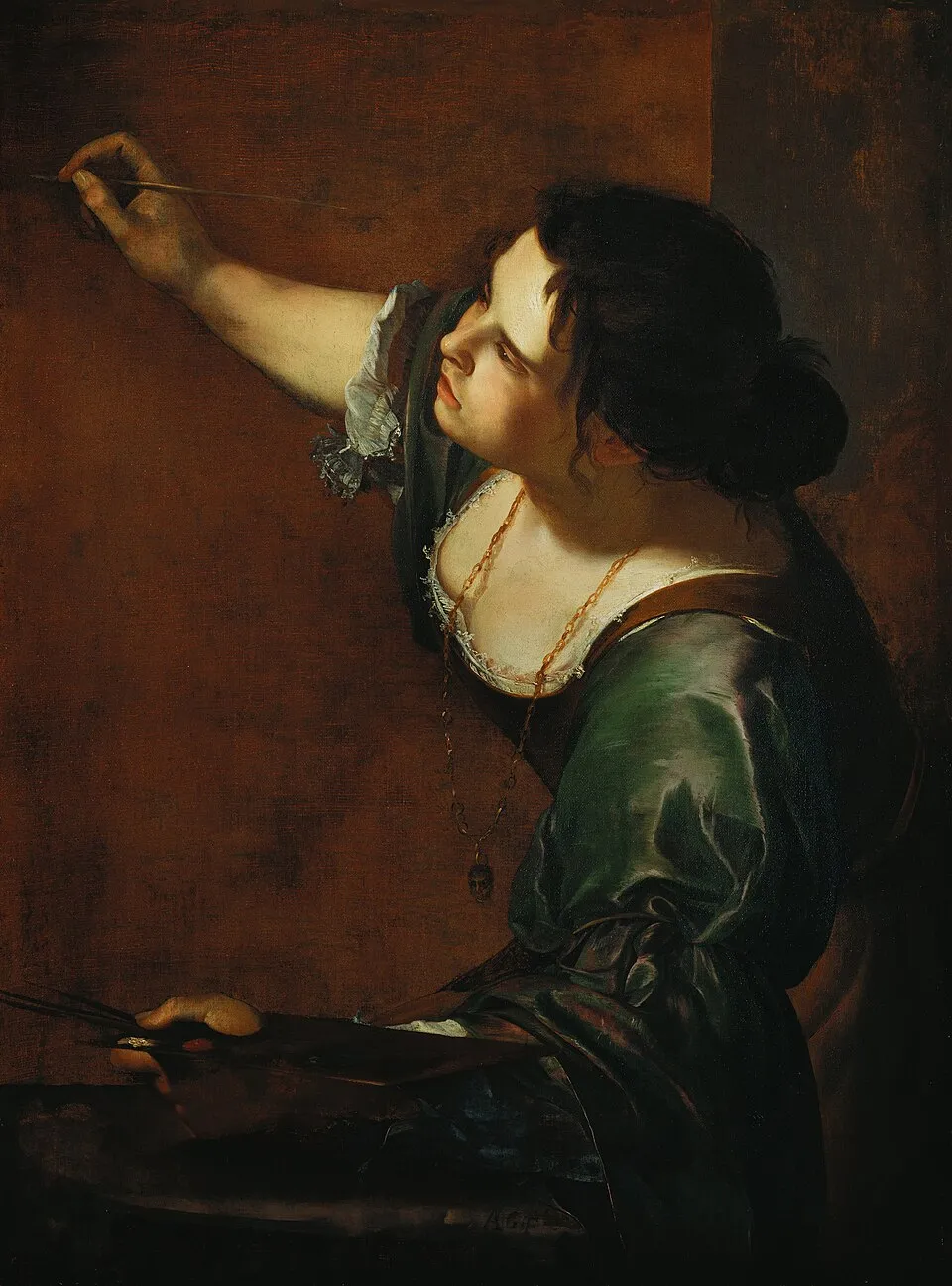
Artemisia Gentileschi, "Self-Portrait as the Allegory of Painting (La Pittura)" (c. 1638-1639). Oil on canvas, 98.6 x 75.2 cm. Royal Collection, Buckingham Palace, London. Image via Wikimedia Commons
Gentileschi (1593-1653) was the first woman accepted into the Florentine Academy of Design (Accademia delle Arti del Disegno). She was one of very few women in 17th-century Italy who had the means and connections to pursue painting as a career. Her self-portrait is not just a depiction of herself. It is a claim: I am Painting. Painting is me. The fusion of the artist and the allegory is a declaration of professional identity and a defiance of the male-dominated art world that had excluded women. Before Gentileschi, women's self-portraits were modest: Catharina van Hemessen at her easel, Sofonisba Anguissola at her spinet. Gentileschi's self-portrait is not modest. It is an assertion. She paints herself as the embodiment of Painting itself, with the tools of the trade in her hands and the disheveled hair of creative frenzy. The painting says: women are not subjects of art. They are makers of art. For more on the painter, see our profile of Artemisia Gentileschi.
Van Gogh: The Self-Portrait as Diagnosis (1886-1889)
Van Gogh painted over 35 self-portraits in a period of about 4 years (1886-1889). The self-portraits were painted partly out of necessity, because he could not afford models, and partly out of compulsion. He wrote to his brother Theo: "I am looking for a deeper likeness than that of the photographer." "Self-Portrait with Bandaged Ear" (1889, 60 x 49 cm, Courtauld Gallery, London) was painted after the infamous ear-cutting incident of December 1888. The bandage covers the right ear, the one he severed. "Self-Portrait" (1889, 65 x 54 cm, Musée d'Orsay) shows him with a gaunt face, swirling background, and intense blue-green eyes. "Self-Portrait with a Straw Hat" (1887, 34 x 26 cm, Metropolitan Museum of Art) shows him in the open air, with the confident brushwork of his Impressionist period.
Van Gogh's self-portraits are often described as "diagnostic," records of mental illness, of anxiety, of the artist's psychological state. This is partly true. The bandaged ear is a record of a breakdown, and the swirling backgrounds of the late self-portraits echo the turbulence of his mental state. But the self-portraits are not just records of illness. They are acts of self-creation. Van Gogh painted himself not to document his suffering but to assert his identity: I am a painter. This is what I look like. This is what I see. The self-portraits are a form of self-affirmation, the artist making himself visible in a world that did not see him. For more on the painter, see our profile of Vincent van Gogh.
Cindy Sherman: The Self-Portrait as Performance (1977-present)
Cindy Sherman (b. 1954) has spent her career photographing herself, but she is never "herself." In "Untitled Film Stills" (1977-1980, 69 photographs), Sherman posed as female characters from imaginary B-movies: the ingénue, the femme fatale, the career girl, the housewife. Each photograph is a self-portrait, Sherman is the model, but the "self" is a fiction. She is playing roles, not revealing herself. Sherman does not take photographs of herself in the traditional sense. She designs the costume, the makeup, the setting, the lighting, and the pose, then shoots the photograph, sometimes with a remote shutter, sometimes with an assistant. The result is a self-portrait that is also a performance: the artist as actress, the self as character.
Sherman's self-portraits challenge the assumption that a self-portrait reveals the artist. In the tradition from Dürer to Rembrandt to Van Gogh, the self-portrait is a form of self-revelation. The artist shows their true face, their true self. Sherman's self-portraits do the opposite. They show that the "self" is a construction, a performance, a fiction. The self-portrait is not a window into the artist's soul. It is a mirror reflecting the culture's images of femininity back at itself. For more on where this kind of work sits in the current moment, see our guide to contemporary art trends in 2026.
The Psychology of Self-Portraiture
The self-portrait requires the artist to look at themselves, really look, and paint what they see. This is not easy. The face in the mirror is not the face in the photograph. The mirror shows a reversed image, a three-dimensional face flattened to two dimensions, and a face that changes with light, mood, and time. The self-portrait is a negotiation between the artist and the mirror, between the self as seen and the self as painted.
What does the self-portrait reveal? Not the "true self." There is no true self to reveal. The self-portrait reveals what the artist chooses to show and what the artist cannot help showing. Dürer chose to show himself as Christ. Rembrandt chose to show himself aging. Van Gogh could not help showing his anxiety. Sherman chose to show that the self is a fiction. The self-portrait is not a window. It is a construction, an act of self-making.
Why do artists paint themselves? Frida Kahlo said: "I paint self-portraits because I am so often alone, because I am the person I know best." This is partly practical. The artist is always available, free of charge. But it is also psychological. The self-portrait is a form of self-examination, self-assertion, and self-preservation. The artist paints themselves to prove they exist, to make a record, to leave a trace, to say: I was here. I looked like this. I saw myself. For more on Kahlo, see our profile of Frida Kahlo. Artsy has a useful overview of 10 masters of the self-portrait, and NYU runs a course on six hundred years of self-portraiture that puts the genre in historical context.
The Self-Portrait in the Age of the Selfie
The selfie is the most common form of self-portraiture in history. Over 93 million selfies per day are taken worldwide. The selfie is a self-portrait, but it is not the same as the artist's self-portrait. The selfie is instant, casual, and disposable. The artist's self-portrait is slow, deliberate, and permanent. The selfie is for sharing. The self-portrait is for posterity.
The difference is in the duration of looking. The selfie is a performance: the subject poses, filters, and posts. The artist's self-portrait is also a performance, but it is a performance that takes hours, days, or months. The artist has time to look, to reconsider, to change their mind. The selfie does not allow for reconsideration. It is taken and posted in seconds. The artist's self-portrait is a record of sustained looking. The selfie is a record of a moment.
Despite the differences, the selfie and the self-portrait share the same impulse: the desire to see oneself, to record oneself, to make oneself visible. Dürer's 1500 self-portrait and the smartphone selfie are both acts of self-assertion: I exist, I look like this, I am worth recording. The technology has changed. The mirror has become the smartphone. But the impulse is the same. The Wikipedia entry on self-portraiture is a reasonable starting point for the longer history.
Final Thoughts
The self-portrait is one of the oldest and most persistent genres in art. Dürer's 1500 self-portrait, the artist in the pose of Christ, founded the genre as a declaration of creative authority. Rembrandt painted himself 40 times over 40 years, a visual autobiography of a face aging and a self looking. Artemisia Gentileschi painted herself as the Allegory of Painting, the first woman to claim the self-portrait as a professional identity. Van Gogh painted over 35 self-portraits in 4 years, acts of self-affirmation by an artist the world did not see. Cindy Sherman photographed herself as 69 fictional characters, proving that the self is a construction, not a revelation.
The self-portrait is not a window into the artist's soul. It is an act of self-making, a negotiation between the mirror and the paint, between the self as seen and the self as constructed. My position is that the search for the "real" artist in a self-portrait is a search for the wrong thing. The self-portrait is not a confession. It is a performance, and the performance is the art. In the age of the selfie, the self-portrait's impulse, the desire to see oneself and make oneself visible, has become universal. The technology has changed, but the human need has not. Next time you see a self-portrait by Dürer, Rembrandt, Gentileschi, Van Gogh, or Sherman, do not look for the real artist. Look for the construction: the pose, the costume, the expression, the choice. The construction is the art.


