
The next time you are in a museum in front of a Rembrandt, try this: get close enough that the security guard becomes uncomfortable. Look at the highlights on the forehead or the nose, the bright points where the paint catches the gallery light. You will see actual ridges of pigment standing up from the surface, sometimes a millimeter or more thick. Those ridges are not just paint. They are the dried residue of a decision Rembrandt made, probably with a palette knife, to drop a small pile of lead white or Naples yellow onto wet impasto. The paint records his hand with perfect fidelity. Nothing between you and a specific physical action taken in Amsterdam in the 1650s.
This is what oil paint does that no other medium quite matches. It dries slowly enough to be manipulated, but when it finally sets, it preserves the evidence of how it was handled with geological permanence. A thick impasto stroke of titanium white may feel dry to the touch within a week, but the center of the stroke can remain soft for six months or more, because linseed oil does not evaporate the way water does. It cures through oxidative polymerization, a slow chemical reaction with atmospheric oxygen that gradually turns a fluid oil into a tough, flexible polymer film. That is why oil paintings survive centuries in good condition, and it is why oil has been the dominant medium of Western painting since the 15th century.
In this guide, you will learn how oil paint actually works chemically, the major techniques artists have developed to exploit its properties, and how to read those techniques in the paintings you encounter in museums.
What Oil Paint Is and How It Dries
Oil paint is pigment, finely ground colored powder, mixed with a drying oil, most commonly linseed oil pressed from flax seeds. The pigment provides color; the oil is the binder that holds it together and adheres it to the painting surface. When you apply oil paint to a canvas, the linseed oil begins oxidizing, absorbing oxygen from the air and cross-linking into a polymer network. This process is not evaporation. The oil does not leave the paint film. It becomes part of it, which is why the paint film can be both thin enough to be transparent and thick enough to stand up in sculptural ridges.
The speed of this curing process depends on the oil and the pigment. Cobalt and lead-based pigments act as driers and speed curing significantly. Ivory black and zinc white slow it down. Thick passages cure more slowly than thin ones because oxygen has to penetrate further to reach the uncured oil. A thinly applied glaze over a dried layer may be ready for overpainting within a day. A heavy impasto passage might take months or years to cure all the way through.
Jan van Eyck (c. 1390-1441) is traditionally credited with developing systematic oil painting technique in early 15th-century Flanders, though the actual history is more gradual. What van Eyck perfected was not the oil binder itself but the disciplined use of transparent oil glazes layered over opaque underpaintings, a method that produced the luminous depth of the Arnolfini Portrait (1434) and the Ghent Altarpiece (1432). The National Gallery London's technical studies of the Arnolfini Portrait have documented the layered glazing structure in detail.
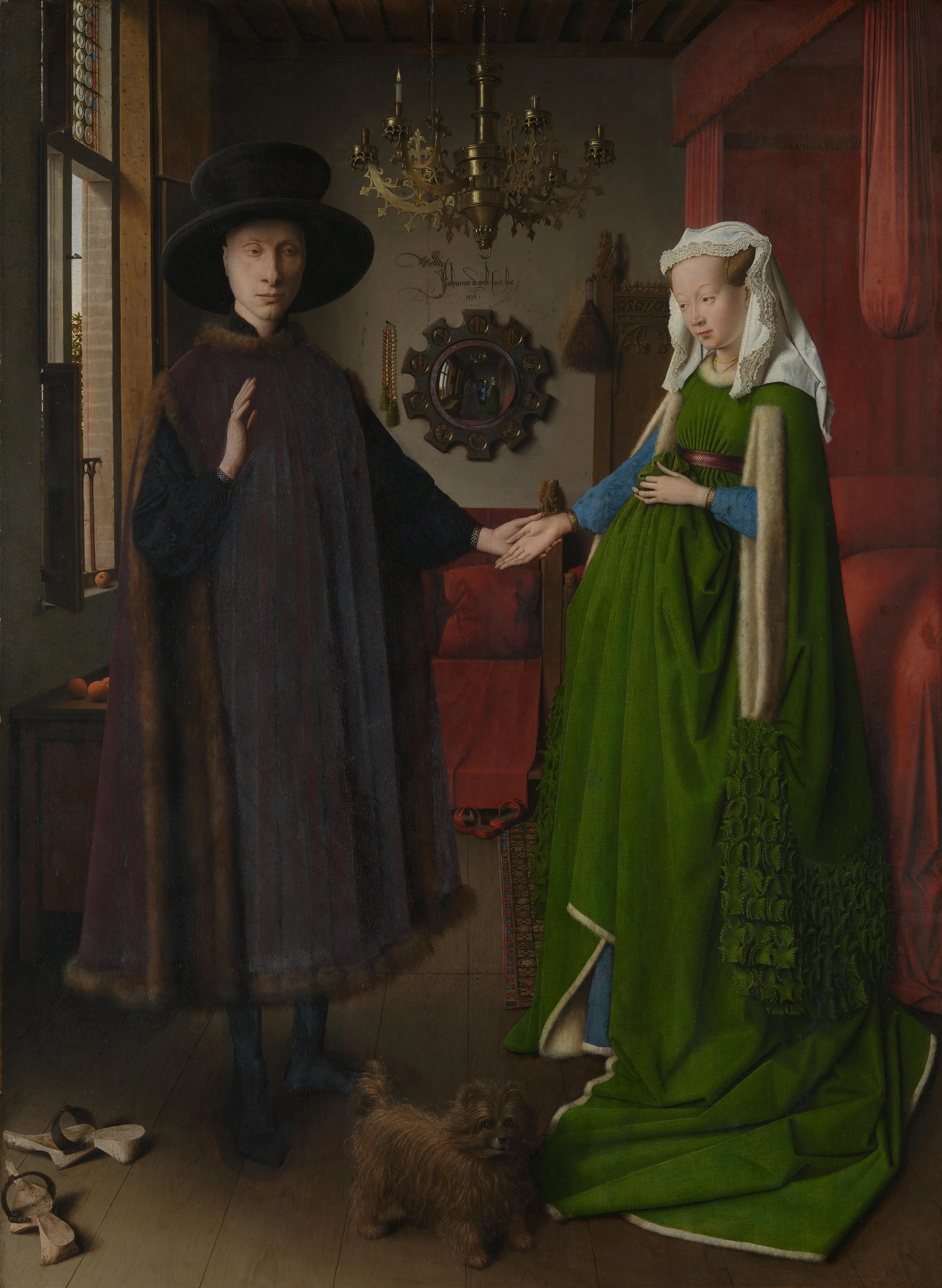
Jan van Eyck, "Arnolfini Portrait" (1434), oil on oak panel, 82.2 x 60 cm. National Gallery, London. The lustrous green of the wife's dress and the warm gold of the chandelier are both built up through multiple glazes over opaque underpaintings. Image: Public domain, via Wikimedia Commons
Why Oil Replaced Everything Else
Before oil paint became standard in northern Europe in the mid-15th century, the dominant painting media were egg tempera and fresco. Tempera, pigment bound with egg yolk, dries within seconds after application, which makes blending essentially impossible. You build tone through cross-hatching, thousands of fine overlapping strokes, which is exactly how Botticelli built the flesh in the "Birth of Venus" (1485). The technique is beautiful but inflexible. Fresco, pigment applied into wet lime plaster, requires painting in sections before the plaster dries, commits every mark immediately, and limits the color range to pigments that survive the alkaline plaster chemistry.
Oil paint addressed every limitation. It stays workable long enough to blend, adjust, and rework. It accepts virtually every pigment known to painters. It can be applied transparently in thin glazes or opaquely in thick impasto. It can be scraped off and repainted. It dries to a flexible, durable, slightly glossy film that resists cracking if properly constructed. By the 16th century, oil on canvas had become the standard medium across Europe, a position it maintained for four centuries and retains today.
The Major Techniques
Glazing
Glazing is the application of thin, transparent oil paint over a dried opaque layer. Because the glaze is transparent, light passes through it, bounces off the opaque underlayer, and returns through the glaze to the viewer's eye. The result is a color depth that looks genuinely three-dimensional rather than flat. No amount of mixing on a palette can replicate this optical effect, because mixed paint produces subtractive color mixing; glazing produces something closer to transmitted light.
Titian's deep reds, Vermeer's glowing interior walls, Velázquez's shimmering silks: all of these are glazed. When you look at the crimson in a Titian painting and it appears to pulse with light, you are seeing the cumulative effect of multiple transparent red glazes over a lighter ground. The depth of color is physically embedded in the painting's layer structure. Each glaze must dry completely before the next is applied, which is why the great glazers of the 16th and 17th centuries often had multiple canvases in progress simultaneously, rotating between them as layers cured.
Impasto
Impasto is paint applied so thickly that it stands up in three-dimensional relief. Where glazing works through transparency, impasto works through physical texture. The raised paint catches actual gallery light and casts actual shadows depending on the viewing angle, giving the surface a sculptural presence that changes as you move around it.
Rembrandt used impasto selectively and brilliantly: thin, transparent glazes in shadows, thick impasto in highlights. Get close to his "Jewish Bride" (c. 1665) at the Rijksmuseum and the golden sleeve is built up in thick ridges that catch the light almost like actual embroidery. Van Gogh used impasto throughout entire canvases, each stroke standing up from the surface in the characteristic curved, directional ridges visible in "The Starry Night" (1889) and the Wheatfield series. Frank Auerbach in the late 20th century pushed impasto further, building his portraits in such heavy accumulations that the dried paint surface resembles topographic terrain.
Alla Prima (Wet-on-Wet)
Alla prima, Italian for "at once," means completing a painting in one session, working wet paint into wet paint without waiting for layers to cure. The colors blend directly on the canvas rather than being built up in separate dried layers. The Impressionists used alla prima extensively when painting en plein air, where changing light made multi-session layered work impractical.
Alla prima demands confident, committed mark-making because you cannot adjust dried layers underneath. John Singer Sargent's portraits demonstrate alla prima at its most assured: faces and fabrics described in a handful of bold, correctly placed strokes that read as finished at viewing distance but appear almost abstract up close. The freshness of the surface is inseparable from the speed of the work.
Scumbling
Scumbling is the application of a thin, opaque or semi-opaque lighter paint over a darker dried layer, allowing the dark to show through irregularly. The broken coverage creates a hazy, atmospheric quality quite different from either glazing or solid overpainting. J.M.W. Turner used scumbling to generate his characteristic atmospheric veils: a pale warm grey scumbled over a blue-grey ground produces the kind of luminous fog Turner was after without either color being mixed. Scumbling works precisely because the application is uneven, the thin light layer covers some of the dark and leaves other areas uncovered, creating a live optical mixture on the surface.
Fat Over Lean
The most important structural rule in oil painting is fat over lean: each successive layer should contain more oil than the layer below it. This is not aesthetic preference but structural engineering. A lean underlayer (thinned with solvent, lower oil content) cures faster and becomes rigid. A fat upper layer (more oil) cures more slowly and remains slightly flexible longer. If you reverse this sequence, the upper layer locks rigid while the lower is still moving, and the result is cracking. The cracks visible in many old paintings in museums are often the result of violating fat over lean, either by the original artist or by a later restorer who repainted over old lean layers with fresh fat paint.
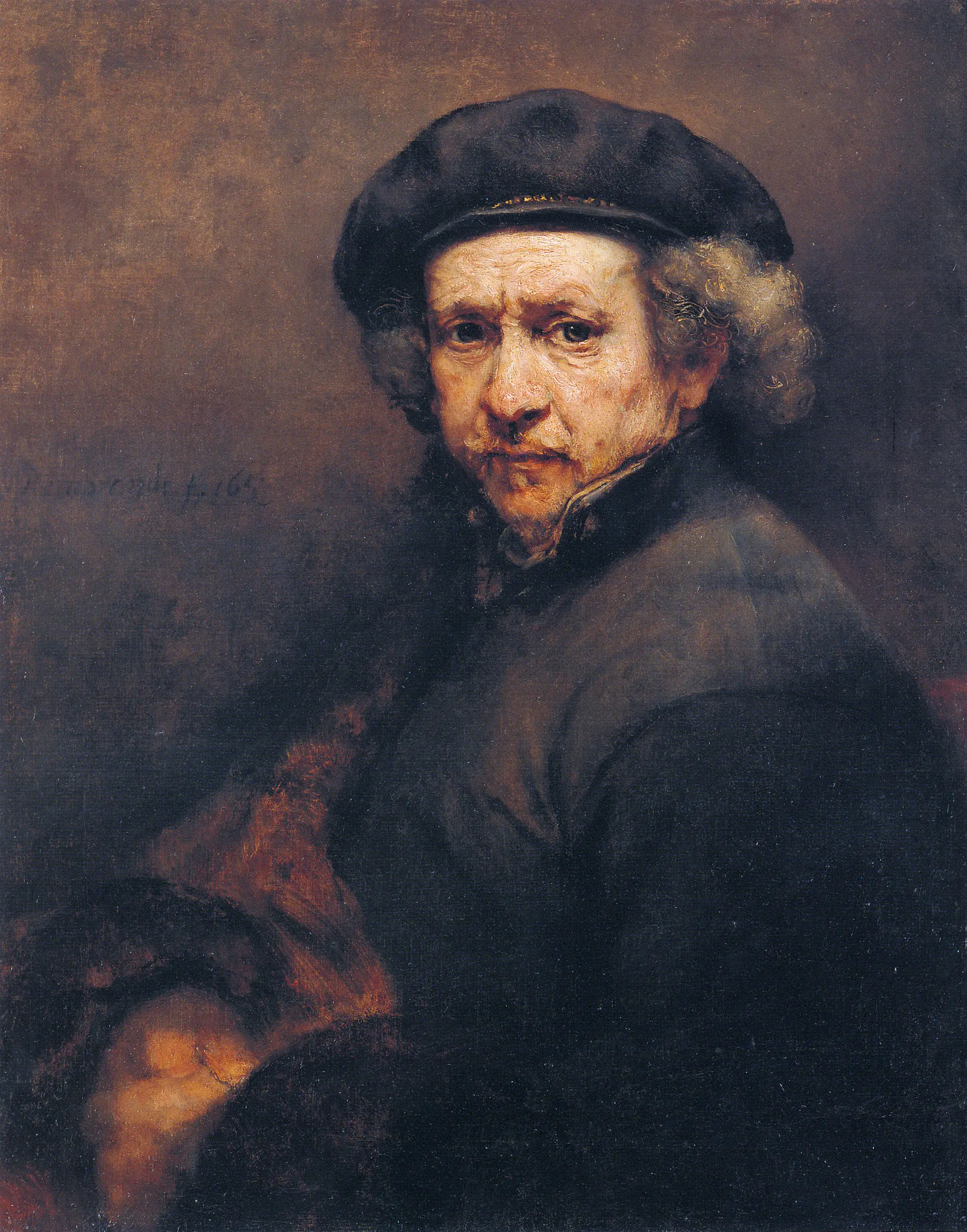
Rembrandt van Rijn, "Self-Portrait with Beret and Turned-Up Collar" (1659), oil on canvas. National Gallery of Art, Washington, D.C. The contrast between transparent shadow passages and thick impasto highlights is the technical foundation of Rembrandt's three-dimensional presence. Image: Public domain, via Wikimedia Commons
Materials: What Professionals Actually Use
Artist-grade oil paints from manufacturers like Winsor and Newton Artists', Gamblin, Old Holland, and Michael Harding contain significantly higher pigment loads than student-grade paints and fewer extenders and fillers. The difference in handling, color intensity, and longevity is substantial enough that most professional painters consider artist-grade the minimum for serious work.
A working palette of eight to twelve colors handles almost everything: titanium white, cadmium yellow (or a cadmium-free equivalent), yellow ochre, cadmium red or cadmium scarlet, alizarin crimson, ultramarine blue, cerulean blue or phthalo blue, viridian green, burnt sienna, and ivory black. Mediums modify the paint's behavior: linseed oil increases transparency and flow; odorless mineral spirits thin paint for lean underlayers; stand oil (a heat-polymerized linseed oil) produces a smooth, enamel-like surface with minimal yellowing; alkyd mediums like Liquin accelerate curing without the structural risks of adding more solvent.
How to Look at Oil Paintings in Museums
Once you know these techniques, standing in front of an old master painting becomes a different experience. Get close to the surface and look for the transitions between thick and thin paint. In Rembrandt portraits, the shift from thin transparent shadows to heavy impasto highlights is often visible from six inches away. Look for glazed areas by identifying the deepest, most saturated colors: dark reds, rich blues, and glowing shadows are almost always glazed. Notice brushwork: are the strokes smooth and blended into invisibility (Dutch academic technique), or are they separate, directional, and visible (Impressionist alla prima)? Watch the edges between forms: hard edges advance, soft edges recede, and the most technically sophisticated painters modulate edge hardness with the precision of a sculptor.
The paint surface of an original oil painting contains information that no reproduction can convey. That is why seeing these works in person still matters, even in an era when high-resolution images are freely available online.
Final Thoughts
Oil paint has dominated Western art for five centuries because of one specific property: it gives artists time. Time to blend, to build, to correct, to push the surface toward an idea that existed before the painting did. No other medium is as forgiving in the early stages and as permanent in the final one. From van Eyck's jewel-like glazes in 1434 to Gerhard Richter's photo-realistic blur effects today, the same chemistry has served every style and ambition artists have brought to it. Understanding it does not just help you paint. It helps you see. Want to learn more about painting techniques and materials? Explore watercolor basics, or see how the essential visual elements apply across all painting media.


