
In 1792, at age 46, Francisco Goya fell ill with a mysterious disease that left him permanently deaf. The illness, never definitively diagnosed, was possibly lead poisoning, possibly syphilis, possibly an autoimmune disorder. It transformed his art. Before 1792, Goya was a court painter: tapestry cartoons, portraits of the aristocracy, charming scenes of everyday life. After 1792, Goya painted the "Caprichos" (1799), 80 etchings of madness, witchcraft, and corruption. He painted the "Disasters of War" (1810-1820), 82 prints of atrocities, mutilation, and famine. And he painted the "Black Paintings" (1819-1823), 14 murals on the walls of his house, including "Saturn Devouring His Son," images of horror painted for no audience but himself. The deafness did not cause the darkness. Goya had always been aware of cruelty and violence. But the deafness isolated him, cut him off from the world of the court, and turned him inward. The art that resulted is the most powerful body of work in Spanish art, and it would not exist in the same form without the illness.
Illness has shaped the work of many of history's greatest artists. Goya's deafness, Monet's cataracts, Degas's retinal disease, Munch's anxiety, Van Gogh's mental illness, Kahlo's physical injuries, each of these conditions changed the artist's perception, their technique, or their subject matter. The history of illness in art is not a history of "overcoming." It is a history of transformation. Illness changes what the artist sees, how the artist works, and what the artist chooses to depict. This guide covers Goya's deafness and the Black Paintings, Monet's cataracts and the red water lilies, Degas's failing vision and the rough pastels, Munch's anxiety and "The Scream," Van Gogh's mental illness and the late paintings, the medical interpretation of art, and what illness brings to art that health does not.
Goya's Deafness and the Black Paintings (1792-1823)
In 1792, at age 46, Goya fell ill in Seville. Symptoms included dizziness, deafness, partial blindness, and abdominal pain. He was bedridden for months. The deafness was permanent. The other symptoms partially resolved. The diagnosis is unknown. Candidates include lead poisoning (from paint pigments), syphilis, Ménière's disease, autoimmune encephalitis, and viral infection.
The transformation is stark. Before 1792, Goya was a successful court painter, producing tapestry cartoons for the Royal Tapestry Factory, portraits of the aristocracy, charming scenes of Madrid life. After 1792, the work darkened. The "Caprichos" (1799) are satirical etchings of superstition, corruption, and folly. The "Disasters of War" (1810-1820) document the atrocities of the Peninsular War. The "Black Paintings" (1819-1823), painted directly on the walls of the Quinta del Sordo (Deaf Man's House), are images of horror: "Saturn Devouring His Son" (143.5 x 81.4 cm), "Witches' Sabbath," "The Dog." The deafness isolated Goya. He could not converse, could not participate in court life, could not hear music or conversation. He withdrew into his house and into his mind. The Black Paintings were painted for no audience. They were on the walls of his dining room and his sitting room, visible only to Goya and his companion, Leocadia Weiss. The deafness did not cause the darkness. Goya had witnessed war, corruption, and cruelty. But the deafness created the conditions for the darkness: isolation, inwardness, and the absence of an audience.
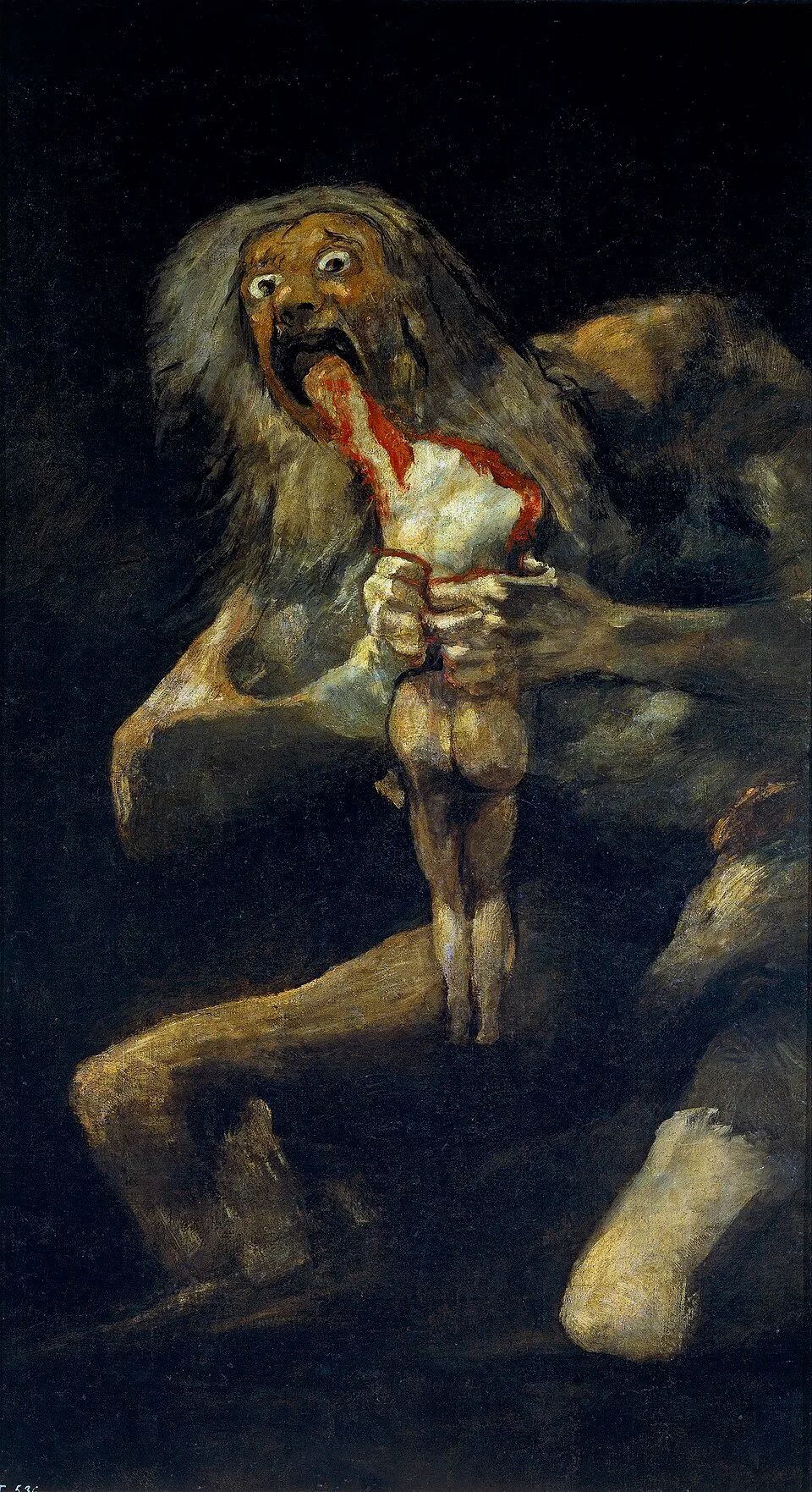
Francisco Goya, "Saturn Devouring His Son" (1819-1823). Mixed technique on mural, transferred to canvas, 143.5 x 81.4 cm. Museo del Prado, Madrid. Image via Wikimedia Commons
Research published in "Acta Ophthalmologica" (2020) suggests Goya may also have had cataracts in his later years, which would explain the "faded dark backgrounds" and "blurred silhouettes" in his late portraits. Goya himself wrote: "I see nothing but shapes which are illuminated and shapes which are not. My brush cannot see more than I can." For more on the stories behind specific works from this period, see our guide on famous paintings.
Monet's Cataracts and the Red Water Lilies (1912-1923)
Claude Monet began to experience vision problems around 1908. By 1912, he was diagnosed with cataracts in both eyes. The cataracts progressed steadily. By 1914, he wrote that "reds had begun to look muddy" and "my painting was getting more and more darkened." By 1922, he was nearly blind in his right eye.
Cataracts yellow the lens of the eye, filtering out short-wavelength light (blues and greens) and emphasizing long-wavelength light (reds, yellows, and browns). Monet's water lilies from this period, the ones painted at Giverny between 1914 and 1922, are dominated by reds, browns, and yellows. The blues and greens that characterized his earlier water lilies (1899-1909) are largely absent. Monet knew the colors were wrong. "I was forced to rely on the labels on the tubes of paint in place of my own vision." In 1923, Monet had cataract surgery on his right eye. After the surgery, he could see blues again, and he complained that the colors were "too blue" and "garish." The lens had been removed, and without it, the eye sees ultraviolet light (which the lens normally filters), giving everything a bluish tint. Monet repainted some of the water lilies after the surgery, adjusting the colors.
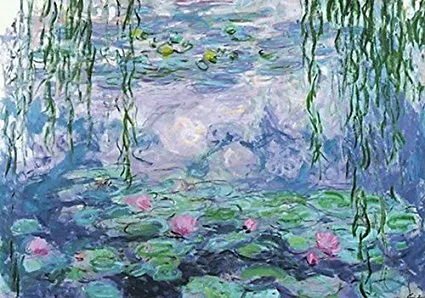
Claude Monet, "Water Lilies" (c. 1916). Oil on canvas. Musée de l'Orangerie, Paris. Image via Wikimedia Commons
Monet's cataracts did not destroy his art. They transformed it. The red water lilies are among his most abstract and powerful works. They push Impressionism toward abstraction. The surface of the pond dissolves into pure color, pure brushstroke. The cataracts created a Monet who could not see clearly, and the art that resulted is a record of impaired vision, not a record of the pond. Dr. Michael Marmor of Stanford University has simulated what Monet's paintings would have looked like through cataract-affected eyes. The simulations show "dark and muddied" versions of the water lilies, the vibrant colors muted, replaced by browns and yellows. The implication is that Monet's late water lilies are not what Monet intended. They are what Monet saw. The art is a record of the disease. ScienceDaily covered this research in a useful piece on how eye diseases gave great painters different vision. For more on Monet's movement, read our guide on Impressionism.
Degas's Retinal Disease and the Rough Pastels (1860-1910)
Edgar Degas began to experience vision problems in the 1860s, possibly retinal disease (retinopathy or macular degeneration). His vision deteriorated steadily over 50 years. By the 1890s, he could barely see. By 1900, his works were "mere shadows of his customary style."
Degas's early work (1870s) was precise, with careful shading and attention to the folding of ballet costumes and towels. As his vision deteriorated in the 1880s and 1890s, the work became rougher, looser, more abstract. He switched from oil painting to pastel, which required less precision. The late pastels, the bathers, the dancers, are broad, blurry, and gestural. The faces are empty ovals. The bodies are rough silhouettes. Degas's late work is often described as "coarse" or "garish" by contemporaries who did not know he was going blind. The implication is that the late work is a failure, a decline from the precision of the early work. But the late work is not a failure. It is a response to a different set of visual conditions. Degas could not see detail, so he painted what he could see: shape, color, gesture. The late pastels are more abstract, more expressive, and more modern than the early work. The retinal disease did not diminish Degas. It pushed him toward the 20th century. For more on the movement he helped found, read our guide on Impressionism.
Munch's Anxiety and "The Scream" (1893-1910)
Edvard Munch (1863-1944) suffered from chronic anxiety, depression, and possibly bipolar disorder. He was hospitalized at a psychiatric clinic in Copenhagen in 1908-1909 after a nervous breakdown. He wrote: "My fear of life is necessary to me, as is my illness. Without anxiety and illness, I am a ship without a rudder. My suffering is part of myself and my art."
"The Scream" (1893, tempera and pastel on cardboard, 91 x 73 cm, National Gallery of Norway) is the most famous image of anxiety in art history. Munch described the experience: "I was walking along the road with two friends. The sun was setting. Suddenly the sky turned blood red. I paused, feeling exhausted, and leaned on the fence. There was blood and tongues of fire above the blue-black fjord and the city. My friends walked on, and I stood there trembling with anxiety. And I sensed an infinite scream passing through nature."
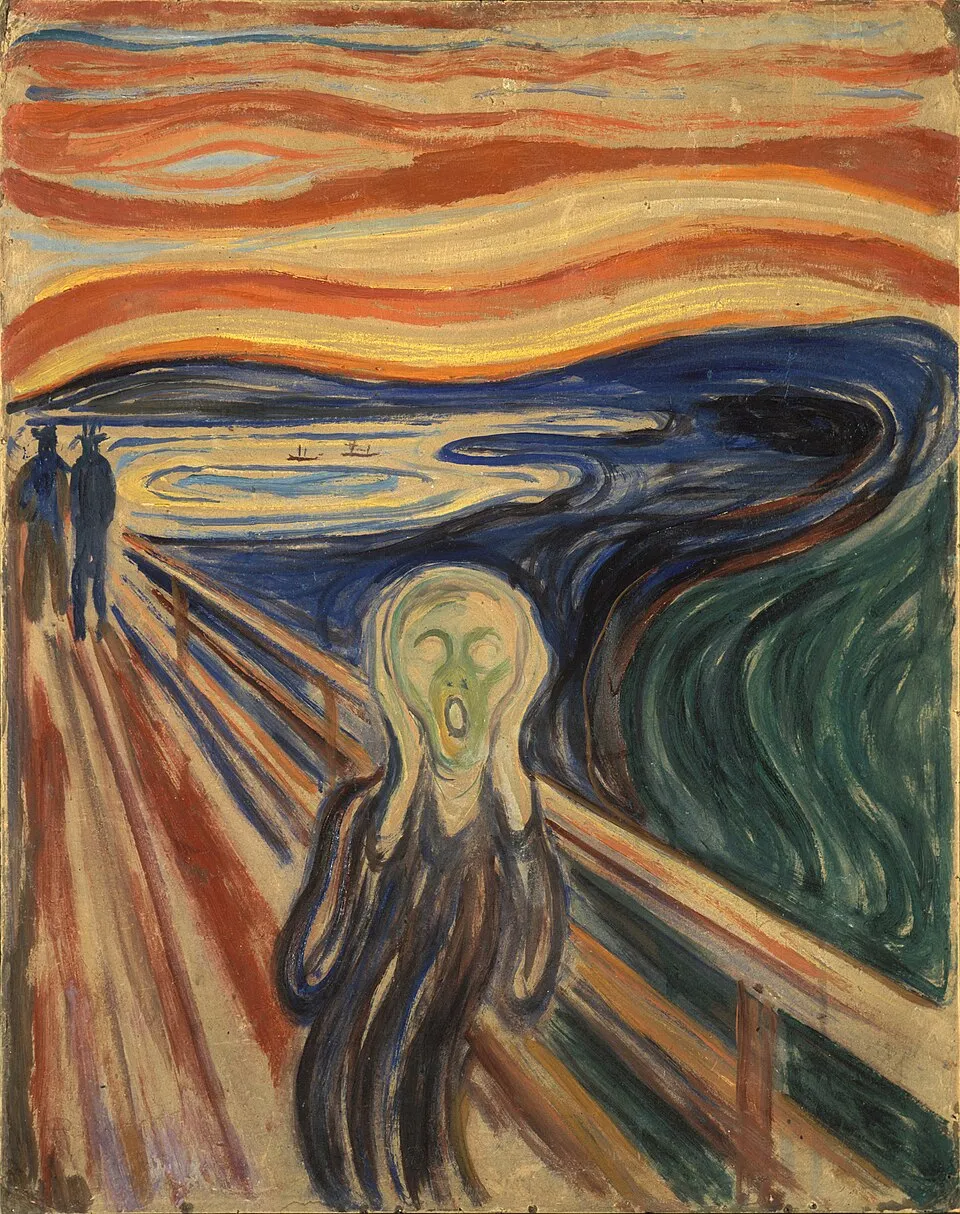
Edvard Munch, "The Scream" (1910). Tempera on cardboard. Munch Museum, Oslo. Image via Wikimedia Commons
Munch did not paint "The Scream" because he was ill. He painted it because he experienced anxiety as a perception, not just a feeling. The anxiety changed what he saw: the sky turned blood red, the fjord became blue-black, the landscape distorted. The painting is a record of anxious perception, not a representation of anxiety but a depiction of the world as seen through anxiety. Munch's statement, "without anxiety and illness, I am a ship without a rudder," is not a romanticization of illness but a recognition that illness is part of the self. The art is not "despite" the illness. It is the illness, made visible. For more on the movement Munch helped launch, read our guide on Expressionism. TheCollector has a useful overview of how mental illness shaped works by artists.
Van Gogh's Mental Illness and the Late Paintings (1888-1890)
Vincent van Gogh (1853-1890) suffered from recurrent mental illness, episodes of psychosis, hallucinations, and depression. The diagnosis is disputed. Candidates include bipolar disorder, temporal lobe epilepsy, alcohol withdrawal (delirium tremens), and porphyria. He was hospitalized at the Saint-Paul-de-Mausole asylum in Saint-Rémy from May 1889 to May 1890.
The late paintings, "The Starry Night" (1889, 73.7 x 92.1 cm, MoMA), "The Night Café" (1888, 70 x 89 cm, Yale), "Wheatfield with Crows" (1890, 50.5 x 103 cm, Van Gogh Museum), are among the most famous paintings in the world. They are also paintings made during episodes of illness. "The Starry Night" was painted from the asylum at Saint-Rémy, from memory and imagination, not from observation. Did the illness cause the art? No. Van Gogh was a trained painter with years of experience before the illness became severe. The late paintings are not the product of madness. They are the product of a skilled painter working under extreme conditions. The illness changed the conditions (hospitalization, isolation, episodes of hallucination) but did not cause the skill. Van Gogh himself wrote: "I am trying to recover, like someone who meant to commit suicide, and finding the water too cold tries to regain the bank."
Van Gogh's late work is often cited as evidence for the "tortured genius" myth, the idea that madness produces great art. But Van Gogh's case argues against the myth. He painted between episodes, not during them. He painted from skill and discipline, not from madness. The illness is a condition of the late work, not its cause. The art is great not because Van Gogh was ill but because Van Gogh was a great painter who was also ill. For more on this argument, read our guide on Van Gogh and the tortured artist myth.
The Medical Interpretation of Art
"Medical art history" or "pathography" is the study of how disease and disability have shaped the work of artists. The field emerged in the late 20th century, with studies of Monet's cataracts (Marmor, 2006), Degas's retinal disease (Marmor, 2006), Goya's deafness and possible cataracts (Ravin, 2000; Acta Ophthalmologica, 2020), Rembrandt's possible vision problems (Livingstone, 2000), and Titian's possible cataracts (SEN, 2019).
The Titian hypothesis is a good example. A 2019 study in the journal "Neurología" analyzed Titian's late works (1562-1576) and found a "reduced chromatic palette, with a tendency to use ochres and earthy and reddish tones. Blues, greens, and whites barely appear." The hypothesis: Titian had cataracts, which filtered out short-wavelength colors. The late Titian, the loose brushwork, the warm palette, the absence of blue, may be the result of impaired vision, not deliberate style. You can read the full study on the medical interpretation of colour in late Titian.
Medical art history is controversial. Art historians argue that it reduces art to pathology, that it treats the artist as a patient rather than a creator. The counter-argument is that medical art history does not reduce art to pathology. It enriches our understanding by revealing the material conditions under which the art was made. The late Titian is not less great because it may have been painted with cataracts. It is more remarkable because a painter with impaired vision produced work of such power. Medical art history is not a replacement for art history. It is a supplement. It adds a layer of understanding: the layer of the body, the eye, the hand. The art is not explained by the disease, but the disease is part of the story, and ignoring it is as reductive as reducing the art to the disease. For more on how art encodes social and material conditions, read our guide on art and society.
Final Thoughts
Illness has shaped the work of many of history's greatest artists. Goya's deafness (1792) isolated him and created the conditions for the Black Paintings. Monet's cataracts (1912-1923) turned his water lilies red and brown. The late paintings are a record of impaired vision. Degas's retinal disease (1860s-1910) made his work rougher, looser, and more abstract. Munch's anxiety produced "The Scream," a depiction of the world as seen through anxiety. Van Gogh's mental illness was a condition of the late paintings, not their cause. He painted between episodes, from skill and discipline. Medical art history, the study of how disease shapes art, enriches our understanding by revealing the material conditions of production. The art is not explained by the illness, but the illness is part of the story. Ignoring it is as reductive as reducing the art to the disease.
My view is that illness is not the cause of great art. It is a material condition that changes what the artist sees and how the artist works. The "tortured genius" myth is wrong. Van Gogh painted between episodes, not during them. The art is great not because the artist was ill but because the artist was great and also ill. For more on disability as a related but distinct condition, read our guide on disability and art, and for Kahlo's specific case, see our guide on Frida Kahlo.
Next time you see a late Monet, the red water lilies, the blurred Japanese bridge, know that you are seeing what Monet saw: not the pond at Giverny but the pond as filtered through cataracts. The art is a record of perception, and the perception was shaped by disease. This does not diminish the art. It makes it more remarkable: a painter who could not see clearly, painting what he saw, and producing some of the most powerful images in the history of art.


