
For most of European art history, blue was the most expensive color available. The reason was ultramarine, a pigment ground from lapis lazuli, a semi-precious stone mined almost exclusively in the Sar-e-Sang valley of Afghanistan. The stone was transported by camel caravan across the Silk Road to Venice, then ground, washed, and purified in a laborious process that could take weeks. The result was a blue of extraordinary brilliance and stability, but at a price that exceeded gold. In 17th-century Holland, an ounce of ultramarine cost the equivalent of a year's rent for a modest house. Vermeer used it so lavishly that he died in debt. Raphael used it only for final coats, painting underlayers in cheaper azurite. For 500 years, blue was a luxury, and its use in a painting was a statement of wealth, devotion, and ambition.
Blue has always been the most philosophically loaded color in Western art. In the Renaissance, it was the color of the Virgin Mary. Ultramarine was reserved for her robes because it was the most precious pigment, and she was the most precious figure. In the Romantic era, it was the color of distance, the blue of mountains, of sky, of longing (the German word "Sehnsucht" is etymologically linked to blue). In the 20th century, Yves Klein patented his own blue, International Klein Blue (IKB), and declared that blue was the color of infinity. This guide covers the history of blue in art from antiquity to the present: lapis lazuli and ultramarine, the Virgin Mary's robe, Vermeer's debt, the invention of synthetic ultramarine in 1828, Prussian blue in 1704, indigo and colonial trade, and Yves Klein's IKB in 1960.
Lapis Lazuli and the Origins of Ultramarine
Lapis lazuli was mined almost exclusively in the Sar-e-Sang valley of Badakhshan, Afghanistan, for over 6,000 years. The mines were described by Marco Polo in 1271: "There is a mountain in that region where the best lapis lazuli in the world is found." The stone was transported along the Silk Road to Venice, the main trading port between East and West. Extracting ultramarine from lapis lazuli was a laborious, multi-stage process. The stone was ground to a powder, then mixed with wax, oils, and resins. The mixture was kneaded in water. The blue pigment sank. The impurities floated. The process was repeated multiple times, each yielding a lower grade of blue. The finest grade was the most expensive. Even the lowest grade was still more expensive than most other pigments.
The cost was staggering. In 17th-century Holland, a pound of ultramarine cost the equivalent of 45 guilders, roughly a year's rent for a modest house. By comparison, a pound of azurite, a cheaper blue, cost 2 guilders. Smalt, a blue glass pigment, cost 1 guilder. Ultramarine was 20 to 40 times more expensive than the alternatives. The name "ultramarine" means "beyond the sea," a reference to the stone's origin across the Mediterranean and the Silk Road. The name itself encodes the pigment's exoticism and distance. The Paris Review has a good short piece on the history of ultramarine, and the National Gallery in London produced a useful podcast on the colour blue in art.
The Virgin Mary's Robe
In Renaissance painting, the Virgin Mary was almost always depicted wearing a blue mantle. The convention originated in Byzantine art and was codified in the Renaissance by painters like Giotto, Fra Angelico, and Titian. The reason was devotional and economic at once. Ultramarine was the most expensive pigment, and Mary was the most important figure in Christian art after Christ. Using ultramarine for her robes was an act of devotion: the painter or patron was offering the most valuable material to the most sacred figure. It was also an act of display. The patron who commissioned the painting could demonstrate their wealth and piety by specifying ultramarine.
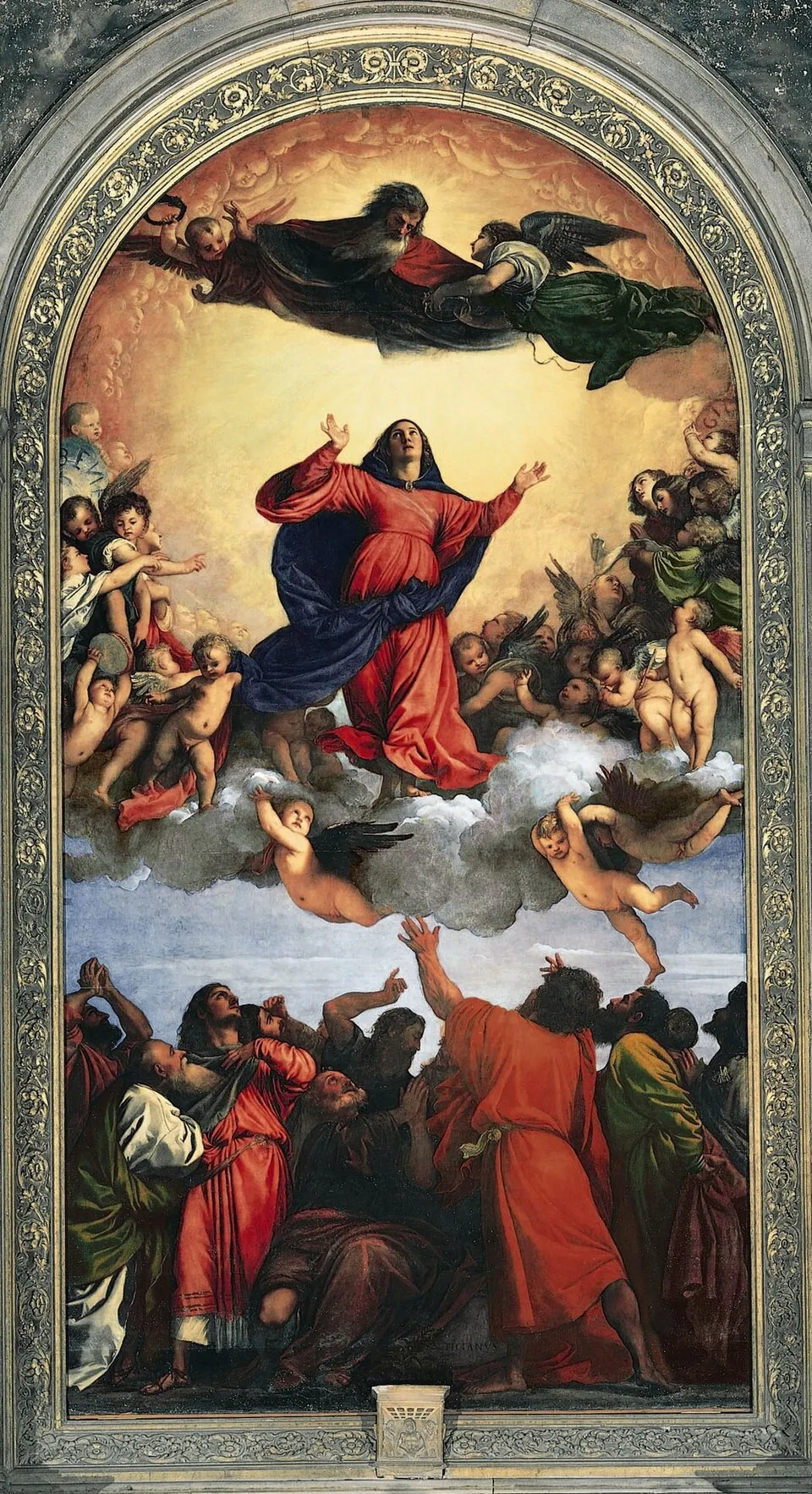
Titian, "Assumption of the Virgin" (1516-1518). Oil on panel, 690 x 360 cm. Santa Maria Gloriosa dei Frari, Venice. Image via Wikimedia Commons
Titian's "Assumption of the Virgin" (1516-1518), 690 x 360 cm, in Santa Maria Gloriosa dei Frari in Venice, is the clearest example. The painting is monumental, nearly 7 meters tall, and Mary's robe is rendered in brilliant ultramarine. The cost of the pigment alone would have been enormous. Titian used ultramarine not just for Mary's robe but for the sky behind her, creating a field of blue that dominates the painting. The association of blue with the Virgin Mary gave blue a sacred connotation that persisted for centuries. Blue was not just a color. It was a theological statement. When a Renaissance viewer saw ultramarine, they saw devotion, wealth, and the divine. For more on the stories behind works like this, see our guide to famous paintings explained.
Vermeer and the Debt of Blue
Johannes Vermeer (1632-1675) was the most extravagant user of ultramarine in the history of painting. As the Rijksmuseum has noted, "there is no other 17th-century artist who employed the exorbitantly expensive pigment ultramarine either so lavishly or so early in his career." In "The Milkmaid" (c. 1657-1658), 45.5 x 41 cm, now in the Rijksmuseum, the servant woman's blue apron is rendered in pure ultramarine, a pigment that most painters reserved for the Virgin Mary, used for a kitchen maid. The choice is extraordinary. Vermeer used the most expensive pigment available for a genre scene of domestic labor.

Johannes Vermeer, "The Milkmaid" (c. 1657-1658). Oil on canvas, 45.5 x 41 cm. Rijksmuseum, Amsterdam. Image via Wikimedia Commons
In "Girl with a Pearl Earring" (c. 1665), 44.5 x 39 cm, in the Mauritshuis, the turban is painted with ultramarine mixed with a small amount of madder lake. The pigment was, as the Mauritshuis describes it, "a notably costly pigment derived from crushed lapis lazuli imported from Afghanistan, a rare choice among Vermeer's contemporaries." In "View of Delft" (c. 1660-1661), 96.5 x 115.7 cm, also in the Mauritshuis, the sky is rendered in ultramarine, an extraordinary expense for a cityscape. Most painters used smalt or azurite for skies. Vermeer used ultramarine.
Vermeer's lavish use of ultramarine contributed to his financial ruin. He died in 1675 at 43, leaving his wife Catharina with 11 children and substantial debts. In a petition to her creditors, Catharina wrote that Vermeer's "art had been his sole asset, and his debts had been incurred in the exercise of that art." The ultramarine was part of those debts. The significance is that Vermeer used ultramarine not for sacred figures but for ordinary people: a milkmaid, a girl with a pearl earring, a view of a city. He democratized the most expensive pigment in art, using it for domestic scenes rather than religious icons. For more on the painter behind these choices, see our profile of Vermeer.
The Invention of Synthetic Ultramarine (1828)
By the early 19th century, natural ultramarine was so expensive that the French government offered a prize of 6,000 francs for the invention of a synthetic equivalent. The Société d'Encouragement pour l'Industrie Nationale set the prize in 1824. In 1828, the French chemist Jean-Baptiste Guimet synthesized ultramarine by heating kaolin clay, sodium carbonate, sulfur, and resin in a kiln. The process produced a blue pigment chemically identical to natural ultramarine at a fraction of the cost. Guimet won the 6,000-franc prize.
Synthetic ultramarine cost roughly 400 francs per pound, compared to 3,000 to 4,000 francs per pound for natural ultramarine. Within a decade, synthetic ultramarine had replaced natural ultramarine in most applications. The color that had been worth more than gold was now affordable. The invention democratized blue. Painters who could never have afforded natural ultramarine, Impressionists, Post-Impressionists, amateur painters, could now use the same brilliant blue that Vermeer had bankrupted himself for. The Impressionists' blue skies, Monet's water lilies, Van Gogh's "Starry Night," all were painted with synthetic ultramarine. Gwartzman's has a clear short history of blue pigments that covers the chemistry in more detail.
Prussian Blue (1704) and the First Modern Pigment
In 1704, the Berlin paint maker Diesbach was trying to make a red pigment (Florentine lake) and accidentally produced a deep blue. The color was named Prussian blue (Preußisch Blau). It was the first modern synthetic pigment. Prussian blue is iron hexacyanoferrate, the first coordination compound used as a pigment. It was cheap, stable, and non-toxic, unlike many earlier pigments. It was also the first pigment not derived from a mineral or organic source. It was entirely synthetic.
Prussian blue was adopted rapidly by painters. Watteau, Canaletto, and Hokusai all used it. Hokusai's "The Great Wave off Kanagawa" (c. 1831) uses Prussian blue. The pigment had reached Japan via Dutch traders and revolutionized Japanese printmaking. Prussian blue was the first color that existed only because of modern chemistry. It was not discovered in nature. It was invented. This made it the first "modern" pigment, and it paved the way for the synthetic pigment industry that would produce cadmium yellow, cobalt blue, and viridian in the 19th century. For the broader system that pigments fit into, see our guide to color theory made simple.
Indigo, Woad, and the Colonial Trade
Indigo is a blue dye derived from the plant Indigofera tinctoria, native to India. Indigo was used as a dye for 6,000 years. The earliest known indigo-dyed fabric was found in Huaca Prieta, Peru, dated to 6,000 BCE. Woad was the European equivalent, a blue dye derived from the plant Isatis tinctoria. Woad was the primary blue dye in Europe from the Roman era until the 16th century, when imported indigo began to replace it.
In the 17th and 18th centuries, European powers, especially Britain and France, established indigo plantations in their colonies: India, the Caribbean, and the American South. Indigo was a major colonial commodity, and its production relied on enslaved labor. In the American South, indigo was the second most important cash crop after rice in South Carolina before the Revolutionary War. The history of blue is not just a history of art but a history of colonialism and slavery. The blue dye that colored European textiles was produced by enslaved people in the Caribbean and the American South. The beauty of the color is inseparable from the violence of its production. For more on how art intersects with these structures, see our guide to art and society.
Yves Klein and International Klein Blue (1960)
Yves Klein (1928-1962) was a French artist. In 1960, Klein patented International Klein Blue (IKB), a specific shade of ultramarine blue mixed with a synthetic resin that preserved the pigment's raw intensity. Klein's IKB paintings are monochromatic: pure blue, nothing else. Klein believed that blue was the color of infinity, the color of the sky, the sea, and the void. "Blue has no dimensions," he said. "It is beyond dimensions." By painting monochromatic blue canvases, Klein attempted to create an experience of pure color, not a representation of something blue, but blue itself.
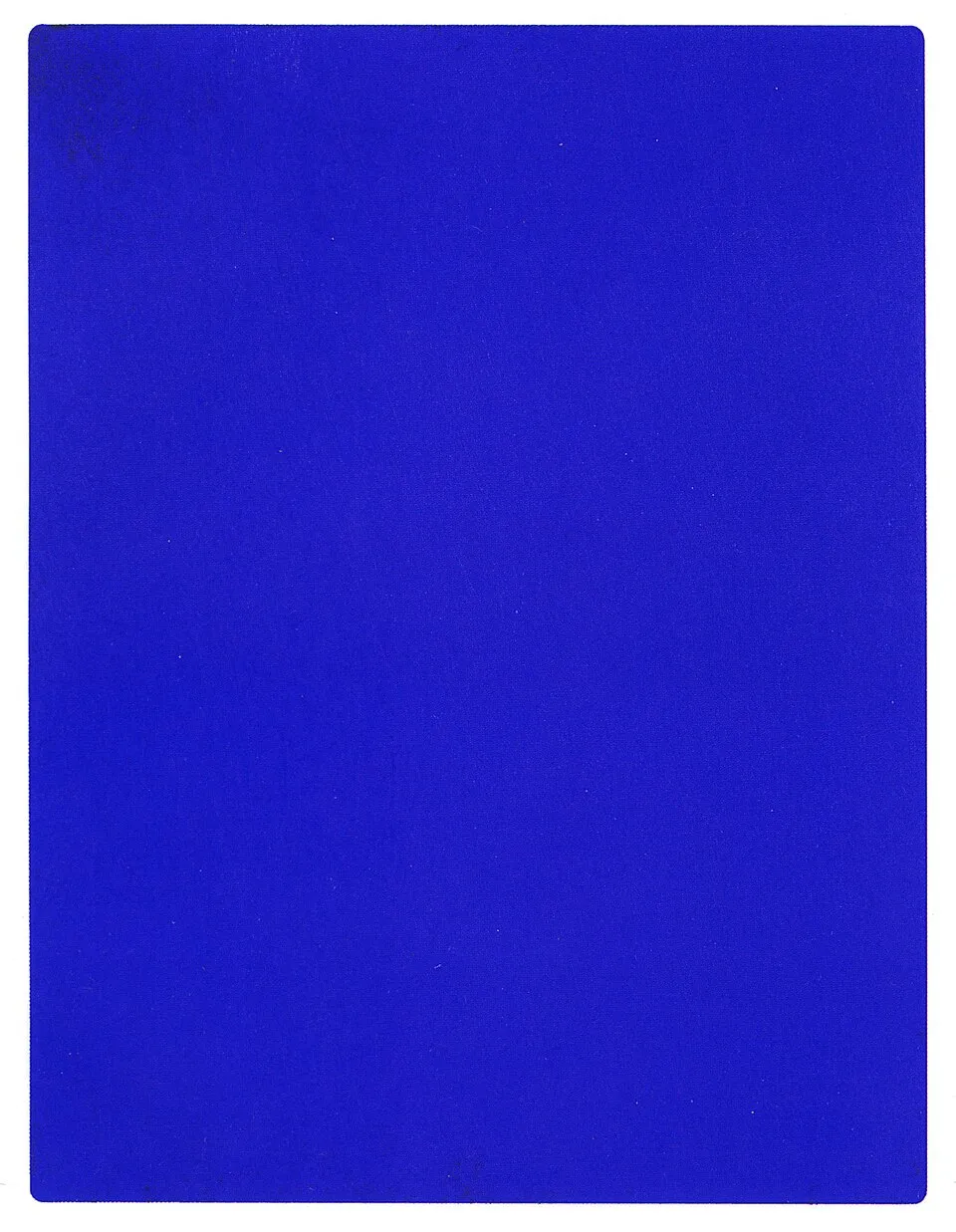
Yves Klein, "IKB 191" (1962). Pure pigment and synthetic resin on canvas, 199 x 153 cm. Tate Modern. Image via Wikimedia Commons
Klein's method was specific. He mixed dry ultramarine pigment with a clear synthetic resin (Rhodopas) rather than oil or acrylic. This preserved the pigment's granular texture and its raw, unmediated intensity. The result is a blue that appears to vibrate, a color that is not just seen but felt. Klein was the first artist to patent a color. The act was both a conceptual statement (color as intellectual property) and a practical one (protecting his specific formula). The patent was granted by the Institut National de la Propriété Industrielle in 1960. Klein's IKB paintings are now in major museums worldwide: Tate Modern, MoMA, the Centre Pompidou. For the movement Klein's work sits within, see our guide to Minimalism.
Blue in 2026
Blue is now the cheapest and most common color. Synthetic ultramarine costs a few dollars per pound. Blue is in every paint box, every printer cartridge, every screen. The color that was once worth more than gold is now free on every smartphone. Despite its democratization, blue still carries its historical associations: the sacred (Mary's robe), the distant (the blue of mountains), the infinite (Klein's IKB). These associations are not arbitrary. They are the accumulated weight of 500 years of art history, and they persist even when the pigment is cheap.
There is also a new blue. In 2009, Mas Subramanian, a materials scientist at Oregon State University, accidentally discovered YInMn blue, a new inorganic blue pigment made from yttrium, indium, and manganese. It is the first new blue pigment since Klein's IKB (1960) and is more stable, more durable, and more vivid than any previous blue. The color is now commercially available, a new blue for the 21st century, 500 years after ultramarine first arrived in Europe. For more on where pigment technology and contemporary practice meet, see our guide to contemporary art trends in 2026, and for the long view of how we got here, the art movements timeline.
Final Thoughts
Blue was once the most expensive color in art. It was ground from Afghan lapis lazuli, transported along the Silk Road, and worth more than gold. It was the color of the Virgin Mary, the color of Vermeer's debt, the color of colonial trade. The invention of synthetic ultramarine in 1828 democratized it. Prussian blue in 1704 modernized it. Yves Klein in 1960 patented it. YInMn blue in 2009 reinvented it. The history of blue is the history of art's relationship to material, money, and meaning: a color that was once sacred, then expensive, then cheap, and still, somehow, infinite.
Next time you see a Renaissance painting with a blue-robed Virgin Mary, know that the blue is not just a color. It is a statement of wealth, devotion, and global trade. The blue came from Afghanistan, was processed in Venice, and was applied by a painter who may have gone into debt to afford it. That is the history in the color. When you know the history, the blue looks different. It looks heavier, denser, more loaded. It is not just a hue. It is a record of how the world was connected, who paid for the connection, and what the connection was for.


